
What Is a VOCA Evaluation? Navigating Trauma Support in California

TL;DR:
VOCA is a federal program in California that funds victim support services like mental health counseling, crisis intervention, and legal advocacy. There is no standardized "VOCA evaluation"; it usually refers to a treatment plan submitted by providers for therapy authorization. The process involves filing claims, submitting a mental health treatment plan, and working within funding and documentation limits, which are affected by recent budget cuts and funding instability.
If you've been searching for help after a crime or traumatic experience in California, you may have stumbled across the term "VOCA evaluation" and found almost no clear explanation online. You're not alone. Thousands of Californians dealing with grief, PTSD, and crime-related trauma run into this exact wall: vague references, broken links, and conflicting information that leaves them more confused than when they started. This guide cuts through that noise. We'll explain what VOCA really means, how evaluations actually work within this system, and what concrete steps you can take to access mental health support in California today.
Table of Contents
Key Takeaways
| Point | Details |
|---|---|
| VOCA is not a single evaluation | There is no standardized “VOCA evaluation”—the process involves treatment plans and needs assessments. |
| Eligibility requires clear documentation | To qualify for VOCA-funded counseling in California, providers must submit evidence linking mental health needs to a crime. |
| Funding can affect access | Due to recent cuts and backfills, program eligibility, and service levels may shift each year. |
| Progress is regularly tracked | VOCA-funded services require regular reporting on client progress, service use, and outcomes. |
| Expert help is available | Therapists and support organizations like Alvarado Therapy can guide you through VOCA and trauma funding steps. |
Understanding VOCA: Purpose and programs in California
VOCA stands for the Victims of Crime Act, a federal victim support program that provides funding for victim assistance and compensation services. In California, these funds are administered primarily through two agencies: the California Office of Emergency Services (Cal OES) and the California Victim Compensation Board (CalVCB). Together, they channel federal dollars into local programs that directly serve people who have experienced crime or trauma.
What does VOCA actually fund? The range is broader than most people realize. Services covered include:
Mental health counseling for crime victims and their families
Crisis intervention and emergency support
Legal advocacy and help navigating the justice system
Medical support including forensic exams
Shelter and housing assistance for domestic violence survivors
Culturally specific services for underserved communities
Understanding VOCA empowerment in California is the first step toward knowing how to use it. These programs exist because trauma doesn't disappear after a crime ends. Survivors often carry invisible wounds that require sustained professional care, and VOCA funding makes that care accessible to people who otherwise couldn't afford it.
"VOCA-funded services represent a critical bridge between a traumatic event and long-term healing. Without stable funding, many survivors would have no access to professional support at any stage of their recovery."
This is why so many Californians encounter VOCA references when searching for therapy or victim support resources. It's not a single program with a single phone number. It's an ecosystem of services, each funded through a federal pipeline and administered locally.
Is there a VOCA evaluation? Clearing up the confusion
Here's where most confusion lives. When people search for a "VOCA evaluation," they often expect to find a specific form, a standardized test, or a formal checklist. That expectation makes sense because many government programs work that way. But VOCA doesn't.
The truth is that there is no single standardized process called a "VOCA evaluation." Instead, the term gets used loosely to describe several different things depending on context. What actually exists under the VOCA umbrella includes:
Performance measures and reporting used by agencies to track outcomes
Needs assessments conducted by states to determine funding priorities
Mental health treatment plans submitted by providers to authorize covered counseling sessions
Program audits used by grant administrators to ensure compliance
So when someone in California says they need a "VOCA evaluation," they usually mean one of two things: either they're asking whether they qualify for VOCA-funded services (an eligibility question), or their therapist has told them a treatment plan needs to be submitted before counseling sessions can be covered (a funding authorization question).
If you're accessing trauma therapy for victims through CalVCB, the "evaluation" is really a treatment plan document your provider completes on your behalf. If you're going through an immigration evaluation process, that's an entirely separate clinical procedure with its own requirements and documentation.
Pro Tip: Before assuming you need a specific form or evaluation, call CalVCB directly at 1-800-777-9229. Ask whether your situation qualifies as a covered victimization and what your provider needs to submit. This one phone call can save you weeks of confusion.
How VOCA evaluations work in California: The treatment plan
For most individuals in California seeking mental health support through CalVCB, the practical "evaluation" is the Mental Health Treatment Plan Form, also called the TP form. This document is what your licensed therapist or counselor submits to CalVCB to request authorization for covered counseling sessions.
The CalVCB Treatment Plan Form collects specific information including your diagnosis, the crime that caused your trauma, how your symptoms connect directly to that crime, what treatment goals have been set, and how many sessions are being requested. Session limits matter here. Direct victims are typically eligible for up to 60 hours of therapy and up to $10,000 in covered costs. Secondary victims (family members, for example) may have different limits.
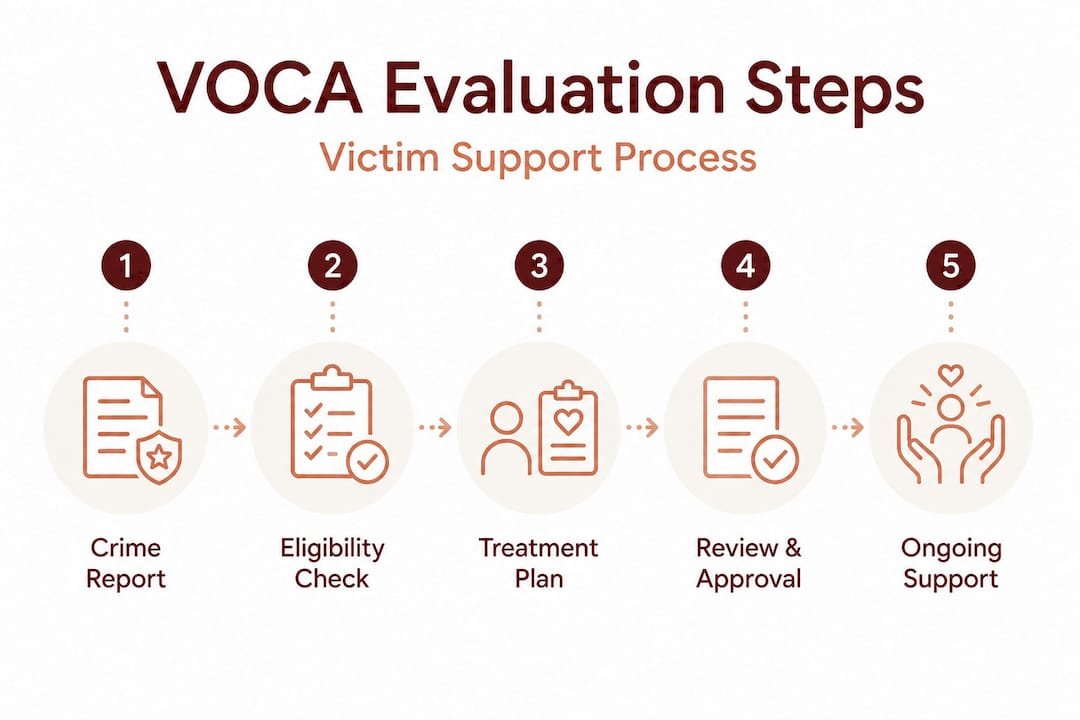
Here's how the process typically unfolds:
Report the crime to law enforcement or a recognized agency (required for most claims)
File a claim with CalVCB either directly or through a victim advocate
Connect with a licensed provider who accepts CalVCB as a payer
Provider submits the Treatment Plan Form documenting crime-related need and treatment goals
CalVCB reviews and approves the plan, with any requests for additional information
Therapy begins or continues under the authorized session limits
Provider submits updates if additional sessions are needed beyond the initial authorization
| Eligibility factor | Requirement |
|---|---|
| Type of crime | Must be a qualifying violent or personal crime |
| Reporting timeline | Generally must report within 5 years of the crime |
| Residency | Must be a California resident or crime occurred in California |
| Session limit (direct victim) | Up to 60 hours |
| Financial cap | Up to $10,000 for mental health services |
| Documentation needed | Police report, diagnosis, signed TP form |
For those dealing with ongoing PTSD symptoms, PTSD self-care strategies can help you manage between sessions while you wait for authorization. And understanding how VOCA empowers trauma recovery gives broader context for why this process exists.
Pro Tip: If your trauma is only partially connected to a crime (for example, you experienced childhood abuse and later a violent crime as an adult), your provider can document the crime-related portion specifically. You don't need a perfect, isolated trauma history. Honest, precise documentation of how the crime directly contributed to your current mental health needs is what matters most.
For Spanish-speaking clients, bilingual therapy resources explain how to navigate this process in your preferred language, which matters enormously when you're already under stress.
Needs assessments, funding cuts, and what it means for you
Understanding that the system exists is one thing. Knowing whether the system will actually be there when you need it is another. And here, the picture gets more complicated.

States conduct VOCA Needs Assessments to determine which victim populations are underserved and how funding should be directed. These assessments drive policy decisions at the state level and affect which programs receive grants. California faced VOCA funding cuts of approximately 78% between 2018 and 2024, a loss so severe that many victim service organizations were forced to reduce staff, shorten waitlists, or close entirely.
The numbers are significant. National cuts of 50 to 70 percent since 2018 created a funding crisis across the country, and California was not spared. The state responded by providing more than $100 million in backfill funding for 2024 and 2025, but advocates are clear that this is not a permanent solution.
| Service area | Before major cuts | After cuts (current) |
|---|---|---|
| Session availability | Higher caseload capacity | Reduced provider participation |
| Approval timelines | Faster processing | Possible delays |
| Eligibility flexibility | Broader interpretation | Stricter documentation review |
| Support organizations | More community partners | Some programs reduced or closed |
What does this mean for you practically? A few things worth knowing:
Waitlists are real. Some providers who accept CalVCB may have limited availability due to funding pressures.
Documentation matters more than ever. With tighter budgets, incomplete applications take longer to process.
State backfills exist but aren't guaranteed. Don't assume the same levels of support will be available year over year.
Advocacy organizations can help. Groups that track VOCA funding can sometimes connect you with current resources faster than general searches.
Explore mental health resources to find current support options in California. And check back on the impact of VOCA on recovery for updates on how funding shifts are affecting access.
Tracking outcomes: How VOCA evaluations and reporting ensure accountability
Beyond individual treatment plans, there's a broader layer of evaluation happening at the program level. VOCA Victim Assistance grants require all subgrantees (the local organizations that receive and use VOCA funds) to submit detailed performance reports. This is where "evaluation" takes on its institutional meaning.
Agencies and providers must report via SAR (Subgrantee Annual Report) and submit quarterly performance measures covering victims served, demographics, types of victimization, and services delivered. This data goes up the chain to the Office for Victims of Crime (OVC) at the federal level, which uses it to evaluate whether states and local programs are using funds appropriately.
The types of data tracked include:
Number of victims served broken down by age, gender, and victimization type
Services provided including crisis intervention, counseling, legal advocacy, and more
Outcomes reported such as increased safety, improved mental health, and restored functioning
Geographic reach to ensure underserved rural and urban communities receive attention
"Data integrity in victim services reporting is not just an administrative task. It reflects the real lives of survivors, and accurate reporting ensures that programs serving the most vulnerable populations continue to receive support."
Why does this matter to you as an individual? Because strong program accountability directly affects how well-funded and how available services will be when you need them. Programs with strong outcome data are more likely to receive renewed grants. And trauma assessment practices that align with evidence-based standards are more likely to be funded.
When you participate honestly in treatment and providers document accurately, you become part of a system that justifies its own continuation. That's a meaningful contribution, even when it doesn't feel that way in the middle of your healing process.
Our perspective: What people really miss about VOCA and support after trauma
After working with many trauma survivors navigating this system, one thing stands out clearly: people expect VOCA to work like a vending machine. Put in a claim, press a button, get approved therapy. The reality is a human process, full of variables, gray areas, and moments where the bureaucratic language doesn't match the emotional reality of surviving a crime.
The most common misconception we see is that clients think the "evaluation" is something done to them, like a test they might fail. In fact, the treatment plan is something your provider advocates for you. Your therapist is making the case that your healing is both necessary and crime-related. You are not on trial. You are being supported.
What trips people up most isn't the eligibility criteria. It's the follow-through. Claims stall because someone waited too long to follow up after submitting paperwork. Treatment plans expire because providers assumed renewal was automatic. Clients get discouraged and stop engaging with the process entirely, just when they were close to getting consistent coverage.
Empowering trauma recovery starts with understanding that you have to stay engaged with the process even when it's exhausting. Keep your own copies of everything submitted. Ask your provider when they expect a response. If you're waiting more than two weeks with no update, contact CalVCB directly. The system is not designed to fail you, but it also won't move on its own.
The unique thing about VOCA-funded trauma therapy is the balance it requires: rigid documentation forms on one side, and on the other, the deeply personal work of healing. A good trauma therapist holds both. They fill out the paperwork thoroughly and bring genuine empathy to every session. That combination is what makes the process worth navigating.
Find support: Trauma-informed therapy and consultations
Understanding VOCA is a meaningful step. But knowing the system and having a skilled, compassionate therapist walking alongside you are two different things.
At Alvarado Therapy, we provide trauma therapy for victims of crime across California, including VOCA-related evaluations, treatment planning, and bilingual trauma-informed care. Our licensed therapists understand both the clinical requirements of VOCA documentation and the emotional reality of what survivors carry. Whether you're just beginning to explore your options or you're already in the middle of a claim, we can help you find clarity. Schedule a consultation to talk through your situation, or learn more about what to expect from online trauma therapy before your first appointment. You deserve care that meets you where you are.
Frequently asked questions
What does a VOCA evaluation involve in California?
It's typically a mental health treatment plan submitted by your provider to CalVCB, detailing crime-related need, your diagnosis, treatment goals, and requested session limits before funding is approved.
How long does it take to get approval for VOCA-funded therapy?
Approval depends on prompt provider submission and CalVCB review, but California's funding instability since 2018 can cause delays, especially if additional documentation is requested or the system is under strain.
Do immigration evaluations count as VOCA evaluations?
Immigration evaluations are separate clinical documents, but VOCA does not standardize these as a recognized evaluation type. However, VOCA funding may cover trauma counseling connected to qualifying crimes, which can support immigration cases indirectly.
How much therapy does VOCA funding cover for trauma victims in California?
Direct victims are typically eligible for up to 60 hours of therapy and up to $10,000 in covered mental health costs, though limits may shift as funding levels change.
