
What identity affirming means in trauma-informed therapy

TL;DR:
Identity-affirming therapy recognizes the full scope of clients' identities, integrating cultural, racial, and gender experiences into treatment. It works in partnership with trauma-informed care to enhance trust, safety, and healing outcomes, especially for marginalized communities. Genuine affirmation requires consistent, flexible, and client-led practice that values exploration alongside support.
Imagine sitting with a therapist week after week, working through real pain, and yet somehow feeling like a part of you has been left outside the door. Your cultural background, your gender identity, your experience with discrimination — none of it comes up. It's treated as beside the point. For many Californians seeking trauma support, this experience is frustratingly common, and it can quietly undermine healing. Identity-affirming therapy validates a client's lived experience — including gender, race, culture, and sexual orientation — and adapts therapy techniques accordingly. This guide breaks down what that really means, how it connects to trauma-informed care, and why it matters for your healing.
Table of Contents
Defining identity affirming care: What it means and why it matters
How identity-affirming therapy intersects with trauma-informed care
Benefits: How identity affirmation improves therapy outcomes
A therapist's perspective: What most guides miss about affirming identity
Next steps: Find trauma-informed, identity-affirming support in California
Key Takeaways
| Point | Details |
|---|---|
| Identity-affirming defined | It means validating all aspects of a person’s identity and integrating lived experience into therapy. |
| Trauma-informed overlap | Identity-affirming care and trauma-informed principles both value safety, empowerment, and cultural understanding. |
| Practical session steps | Affirmation shows through language, treatment planning, and addressing discrimination or minority stress. |
| Balance is essential | Effective care affirms identity while allowing for individual exploration and avoids rigid applications. |
| Proven better outcomes | Research links identity affirmation with higher satisfaction and healing, especially for marginalized clients. |
Defining identity affirming care: What it means and why it matters
To move from confusion to clarity, let's break down the core meaning and impact of identity-affirming support in therapy.
The phrase "identity affirming" gets used a lot, but it's often left undefined in ways that leave people guessing. At its simplest, identity-affirming care means your therapist sees the whole you. Not just your symptoms or diagnoses, but the full context of who you are — your cultural background, racial identity, gender, sexual orientation, spiritual beliefs, immigration status, and any other layer that shapes how you move through the world.
This matters because identity is not separate from trauma. For many people, the very experiences that caused harm were tied directly to their identity. Racial discrimination, homophobia, xenophobia, religious persecution — these are identity-based injuries. A therapy approach that ignores identity cannot fully address wounds rooted in it.
Here's what identity-affirming care is not: it is not simply being polite or using the right words. It is not checking a box that says "culturally sensitive." It actively weaves your lived experience into the clinical work. That means your therapist uses what you share about your identity to inform treatment goals, the language used in sessions, and the lens through which your experiences are understood.
Core elements of identity-affirming care include:
Validating your identities without pathologizing them
Recognizing minority stress (the unique stress caused by discrimination and marginalization) as a clinical factor
Adapting therapy techniques to honor cultural values and ways of relating
Actively avoiding assumptions about what your identity means to you
Addressing discrimination and systemic harm as real contributors to your mental health
"Being seen in therapy — truly seen — is not a luxury. It's a clinical necessity. When a client's identity is sidelined, so is a critical piece of their story."
Pro Tip: When searching for a therapist, ask directly: "How do you incorporate my cultural or gender identity into treatment?" Their answer will tell you a lot about whether they practice genuine affirmation. You can also read more at this identity-affirming therapy overview to know what to expect.
How identity-affirming therapy intersects with trauma-informed care
With the groundwork set, let's explore how identity-affirming approaches complement trauma-informed care in practice.
Trauma-informed care and identity-affirming care are not the same thing, but they work best together. Trauma-informed care recognizes that many people entering therapy have experienced significant harm, and it structures the therapeutic relationship around safety, trustworthiness, and empowerment. A trauma-informed approach aligns with identity-affirming care by emphasizing safety, trustworthiness, empowerment, voice and choice, and cultural and historical awareness.
In other words, trauma-informed care creates the container. Identity-affirming care makes sure the container actually fits the person inside it.
Where they overlap most significantly:
Both prioritize client autonomy and informed consent
Both center the client's voice in shaping treatment
Both recognize systemic and environmental factors as contributors to mental health
Both work to avoid re-traumatization through careful, respectful engagement
Both build therapeutic trust as a precondition for healing
Where they differ is important. Trauma-informed care focuses on how clinicians respond to signs of trauma and prevent re-traumatization. Identity-affirming care goes further by actively acknowledging discrimination, minority stress, and identity-based injury as clinical realities that shape symptoms and healing.
| Feature | Trauma-informed care | Identity-affirming care |
|---|---|---|
| Core focus | Recognizing and responding to trauma | Validating and integrating all identity aspects |
| Client autonomy | Central | Central |
| Addresses discrimination | Indirectly | Directly and explicitly |
| Cultural responsiveness | Encouraged | Required |
| Treats identity as clinical factor | Partially | Fully |
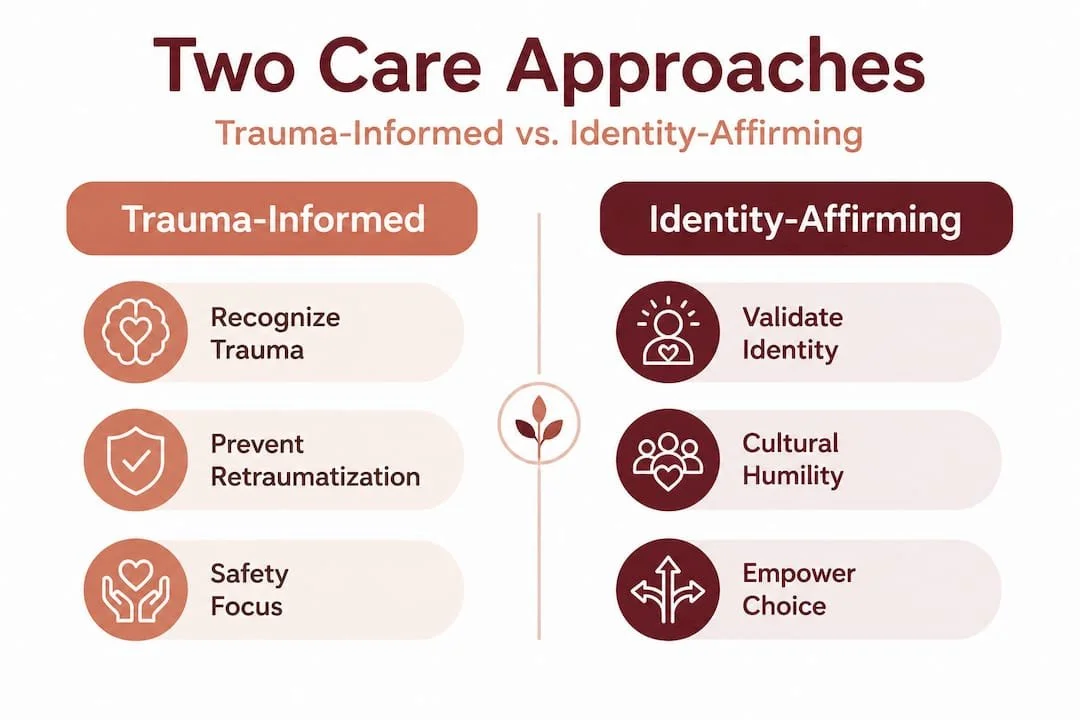
Together, these approaches can boost trauma healing in ways that neither approach achieves alone. Clients who feel both emotionally safe and truly seen tend to engage more deeply in the therapeutic process, which is ultimately what drives lasting change. Research on PTSD healing with trauma-informed care suggests significant improvements when these two frameworks are integrated.
What does affirmation look like in therapy sessions?
Now that you understand the values at stake, it's useful to know what affirmation actually looks like in the therapy room.

Theory only goes so far. What you probably want to know is what this looks like in real conversations and real sessions. Identity-affirming therapy tends to operationalize into specific, observable steps: using correct names and pronouns, collaboratively defining goals, explicitly addressing identity-based stigma, and adapting therapeutic modalities to fit the client's needs.
Here is what affirmation looks like, step by step:
First contact and intake: Your therapist asks about your preferred name and pronouns, your cultural background, and whether there are identity-related experiences you want to prioritize in treatment — without making these feel like a clinical interrogation.
Goal-setting: Goals are developed with you, not handed to you. If navigating racism at work is contributing to your anxiety, that becomes part of the treatment plan. Your therapist does not redirect you toward generic symptom management.
Active acknowledgment in sessions: When identity-related experiences come up — a microaggression, a family conflict rooted in cultural expectations, fear related to immigration status — the therapist names it and works with it, rather than redirecting.
Adapting therapeutic tools: Evidence-based techniques like EMDR or cognitive behavioral therapy are adapted so they align with your values and worldview. For example, some clients find that Western notions of individual processing conflict with collective cultural values, and a skilled therapist adjusts accordingly.
Ongoing check-ins: An affirming therapist regularly invites feedback about whether they are understanding your experience accurately. This humility is part of the model.
| Non-affirming approach | Identity-affirming approach |
|---|---|
| Ignores client’s pronouns after being told | Consistently uses correct pronouns, corrects errors immediately |
| Focuses only on symptom reduction | Addresses systemic and identity stressors alongside symptoms |
| Uses universal frameworks without adaptation | Adapts techniques to honor client’s cultural context |
| Treats identity as background information | Centers identity as a clinical variable |
| Avoids discussions of discrimination | Invites and addresses discrimination as part of treatment |
You can learn more about affirmation in California therapy and how cultural identity in therapy influences outcomes across different communities.
Debates and nuance: Affirmation versus exploration
Despite its benefits, affirmation isn't without controversy — let's take a clear-eyed look at these discussions.
Not everyone agrees on exactly what "affirmation" should mean in a clinical setting. There is ongoing debate about what affirmation should mean clinically — critics warn about applying affirmation rigidly, while supporters argue that affirmation is needed for safety and therapeutic alliance.
Critics of rigid affirmation models argue that if a therapist simply agrees with everything a client expresses about their identity, they may unintentionally close off space for genuine exploration, questioning, or ambivalence. The concern is not with affirmation itself, but with turning it into a script that the therapist follows regardless of the individual in front of them.
Supporters respond that the alternative — questioning or challenging identity disclosures — creates precisely the unsafe conditions that prevent marginalized clients from engaging honestly in therapy at all. When someone has spent years having their identity doubted by family, community, or systems, they need a therapeutic relationship where safety comes first.
The most thoughtful view sits in the middle. Genuine affirmation is not the same as passive agreement. It means creating enough safety and trust that a client can explore their identity, including its complexities and contradictions, without fear of judgment or pathologizing. That requires active listening, curiosity, and humility — not a formulaic script.
"Affirmation without exploration can become its own kind of limitation. The goal is a therapeutic relationship spacious enough to hold both."
Pro Tip: If you are evaluating a potential therapist, ask how they handle moments when a client is questioning or uncertain about their identity. A quality identity-affirming therapist should welcome that complexity rather than rushing to resolve it. For additional perspective, explore research on better PTSD relief with affirming approaches.
Benefits: How identity affirmation improves therapy outcomes
Understanding these nuances, the crucial question remains: does affirmation in therapy actually help? Here's what research and lived experience reveal.
The answer is clearly yes — and the evidence is growing. Transgender and non-binary affirming practice is associated with greater client satisfaction and therapy effectiveness, with therapeutic alliance serving as the key mediating factor. Put another way, when clients feel affirmed, they trust their therapist more. When they trust more, they engage more fully. And more complete engagement drives better outcomes.
Key benefits supported by research and clinical experience:
Higher satisfaction: Clients in affirming therapeutic relationships consistently report feeling more understood and more satisfied with their care.
Better retention: When people feel seen, they stay in therapy longer. Lower dropout rates mean more sustained healing.
Stronger therapeutic alliance: The quality of the relationship between client and therapist is one of the strongest predictors of positive outcomes across all therapy types, and affirmation builds that relationship faster.
Reduced minority stress symptoms: When therapy explicitly addresses discrimination and identity-based harm, clients report reductions in anxiety, depression, and shame tied to those experiences.
Greater willingness to disclose: Clients who feel affirmed are more likely to bring the experiences that matter most into the room, rather than keeping them hidden to protect themselves.
Statistic callout: Studies show that therapeutic alliance — the shared agreement on goals and trust between client and therapist — is a stronger predictor of positive outcomes than the specific therapy technique used. Affirmation accelerates alliance building for clients from marginalized communities.
For those considering this kind of support, seeking affirmation in California offers practical guidance on finding providers who genuinely deliver on these values.
A therapist's perspective: What most guides miss about affirming identity
Most articles on identity-affirming therapy stay at a conceptual level. They describe the principles clearly, but they often skip over what makes affirmation real versus performative in actual clinical work.
Here is what we have found through years of supporting trauma survivors in California: affirmation only works when it is consistent, flexible, and genuinely client-led. A therapist who learns someone's pronouns correctly but then makes assumptions about what their cultural background means to them is not practicing real affirmation. Affirmation requires constant recalibration because identity is not static. People evolve, circumstances shift, and what a client needs you to see and affirm at month one may look very different at month twelve.
Another piece that guides often miss is the role of interdisciplinary collaboration and community connection. Effective identity-affirming care rarely exists in isolation. It connects to community resources, recognizes the role of family systems and cultural communities, and sometimes involves collaboration with advocates, case managers, or other providers who understand the specific stressors a client is navigating. A therapist who works in a bubble — even a well-intentioned one — misses the broader ecosystem that shapes a client's healing.
The most effective clinicians we know approach this work with a clear combination of clinical skill, cultural humility, and ongoing learning. They do not treat identity affirmation as something they mastered in graduate school and can now apply on autopilot. They stay curious. They ask questions they do not already know the answers to. They make repairs when they miss something. And they hold complexity well enough that clients can bring their full selves, including the parts that are unresolved, contradictory, or still figuring themselves out.
If you are exploring what this kind of care looks like in practice, our guide to empowering healing safely offers a deeper look at trauma-sensitive therapy principles that work hand in hand with identity affirmation.
Next steps: Find trauma-informed, identity-affirming support in California
Ready to take empowered action? Here's how you can start or deepen your own healing journey with identity-affirming care in California.
At Alvarado Therapy, we believe that healing happens when you feel safe, respected, and fully seen. Our bilingual, culturally responsive team serves clients across Pasadena, Ventura, and online throughout California, offering trauma-informed therapy that centers your whole identity — not just your symptoms.
Whether you are new to therapy or looking for a better fit, we invite you to learn what to expect from trauma therapy before your first appointment. If you are navigating complex trauma or PTSD, our complex trauma resources provide a helpful starting point. When you are ready, book a consultation to connect with a therapist who will meet you where you are, honoring all of who you are from the very first session.
Frequently asked questions
How is identity-affirming therapy different from traditional therapy?
Identity-affirming therapy actively integrates clients' lived identity experiences into treatment rather than treating identity as a separate issue. Traditional therapy often focuses narrowly on symptoms, leaving cultural, racial, and gender experiences unaddressed.
Is affirmation in therapy just for transgender or LGBTQ+ clients?
No. Identity-affirming therapy supports all clients, including those whose distress is shaped by various identity-related experiences such as race, culture, religion, body image, or immigration background.
What should I look for in an identity-affirming, trauma-informed therapist in California?
Look for providers who demonstrate both trauma-informed principles and identity-affirming behaviors — specifically therapists who honor your autonomy, openly address discrimination, and invite your lived experience into the treatment plan.
Are there risks in affirmation-only therapy?
Some experts caution that affirmation applied too rigidly can limit space for individual exploration and questioning. Responsible affirmation should always remain flexible and client-led, not scripted.
Does identity-affirming therapy really work?
Yes. Research shows that affirming practice improves satisfaction and therapy outcomes for transgender and non-binary adults, with therapeutic alliance as the key mechanism that drives these results.
Recommended
Identity-affirming therapy for trauma recovery in California — Alvarado Therapy
Identity-affirming therapy: 60% better PTSD relief in 2026 — Alvarado Therapy
Why Seek Identity-Affirming Therapy in California — Alvarado Therapy
How cultural identity improves trauma therapy results in CA — Alvarado Therapy
