
How cultural competence transforms trauma therapy in CA

TL;DR:
Cultural competence in trauma-informed therapy involves ongoing awareness, humility, and adaptation to fit clients' unique backgrounds. Research shows that culturally adapted approaches lead to faster engagement, better outcomes, and lower dropout rates, especially for diverse communities. Finding therapists who demonstrate humility and personalized understanding is essential for effective, identity-affirming healing in California's multicultural context.
Therapy only works when you feel truly seen. For many Californians healing from trauma, anxiety, or relationship wounds, walking into a therapy room and meeting someone who doesn't understand your background, language, or lived experience can feel like another barrier rather than a bridge. Cultural competence in trauma-informed therapy isn't a nice-to-have add-on. It's a core clinical skill that directly shapes whether healing happens. This article walks you through what that means in practice, what the research actually shows, and how to find a therapist in California who will genuinely meet you where you are.
Table of Contents
Key Takeaways
| Point | Details |
|---|---|
| Core elements | Cultural competence combines bias awareness, diverse knowledge, cross-cultural skills, and social justice. |
| Healing impact | Culturally adapted therapy reduces symptoms and dropout rates more than standard approaches. |
| Limits exist | Some edge cases show mixed results; seek humility alongside competence. |
| Finding help | Look for therapists with MSJCC training and client-centered humility. |
| Next steps | Identity-affirming, trauma-informed therapy in California is accessible and effective for diverse needs. |
What is cultural competence in trauma-informed therapy?
Cultural competence sounds like a policy term, but in the therapy room it's deeply personal. At its core, it means a therapist actively develops awareness of their own biases, knowledge of diverse cultural experiences, skills for cross-cultural interventions, and a commitment to actions that support social justice. It's not a certificate you earn once. It's a practice that evolves over a career.
The most widely used framework guiding this work is the Multicultural and Social Justice Counseling Competencies, commonly called the MSJCC. Developed by the American Counseling Association, MSJCC asks therapists to look honestly at the power dynamics between themselves and their clients, including how race, gender, immigration status, religion, and socioeconomic background shape the therapeutic relationship. Paired with cultural humility, an approach that centers lifelong learning from the client rather than assuming expertise about a group, MSJCC creates the foundation for therapy that actually fits your life.
Here's what a genuinely culturally competent therapist is doing behind the scenes:
Regularly examining their own cultural assumptions and blind spots
Seeking ongoing education about cultural groups they serve
Adapting language, metaphors, and examples to match client context
Acknowledging systemic barriers like racism, immigration stress, and discrimination as real trauma sources
Advocating for clients within systems when relevant
Contrast that with a standard therapy approach:
| Approach | Standard therapy | Culturally competent therapy |
|---|---|---|
| Assessment | Universal screening tools | Culturally adapted instruments |
| Language | English-only, clinical tone | Bilingual, plain language |
| Trauma framing | Individual pathology | Systemic and community context |
| Coping strategies | Generic techniques | Culturally resonant methods |
| Family involvement | Individual-focused | Culturally appropriate family inclusion |
| Stigma | Addressed minimally | Directly explored and reduced |
The difference in that table isn't cosmetic. Research on therapy outcomes with cultural competence shows these adaptations translate directly into faster engagement, deeper trust, and measurable symptom reduction. For trauma survivors in particular, trust isn't a luxury. It's the prerequisite for any therapeutic work.
How cultural competence impacts trauma therapy outcomes
The evidence here is striking. Culturally adapted interventions reduce PTSD with a standardized mean difference (SMD) of -0.67 and anxiety with an SMD of -1.92 compared to standard treatment. Overall effect sizes range from d=0.45 to d=0.50, which in clinical terms means a meaningful, reliable improvement. For people who have spent years trying therapies that never quite landed, these numbers represent something real: a significantly better chance of actually getting better.
Why do adapted approaches work better? The short answer is that trauma healing requires emotional safety, and emotional safety requires being understood. When a therapist uses culturally resonant language, acknowledges your specific community's history, and doesn't pathologize your survival strategies, your nervous system can begin to relax into the work.
One of the most telling statistics involves treatment dropout. Culturally adapted therapy cuts dropout rates by 20 to 30 percent compared to standard care. For trauma therapy, dropout is a major problem. Many people start therapy, encounter a rupture in the relationship, and leave before healing begins. Reducing dropout means more people complete treatment, which compounds into significantly better long-term outcomes.
Here's how outcomes compare side by side:
| Outcome measure | Standard therapy | Culturally adapted therapy |
|---|---|---|
| PTSD symptom reduction (SMD) | Baseline | -0.67 improvement |
| Anxiety reduction (SMD) | Baseline | -1.92 improvement |
| Treatment dropout | Higher rates | 20–30% lower |
| Overall effect size (d) | ~0.20–0.30 | 0.45–0.50 |
| Client engagement | Moderate | Significantly higher |
These benchmarks around culturally adapted outcomes come from updated meta-analyses reviewing dozens of trials across diverse populations. The data also shows that effects are stronger for specific cultural groups, particularly Latinx, Black, and immigrant communities, where the mismatch between standard therapy and lived reality has historically been greatest.
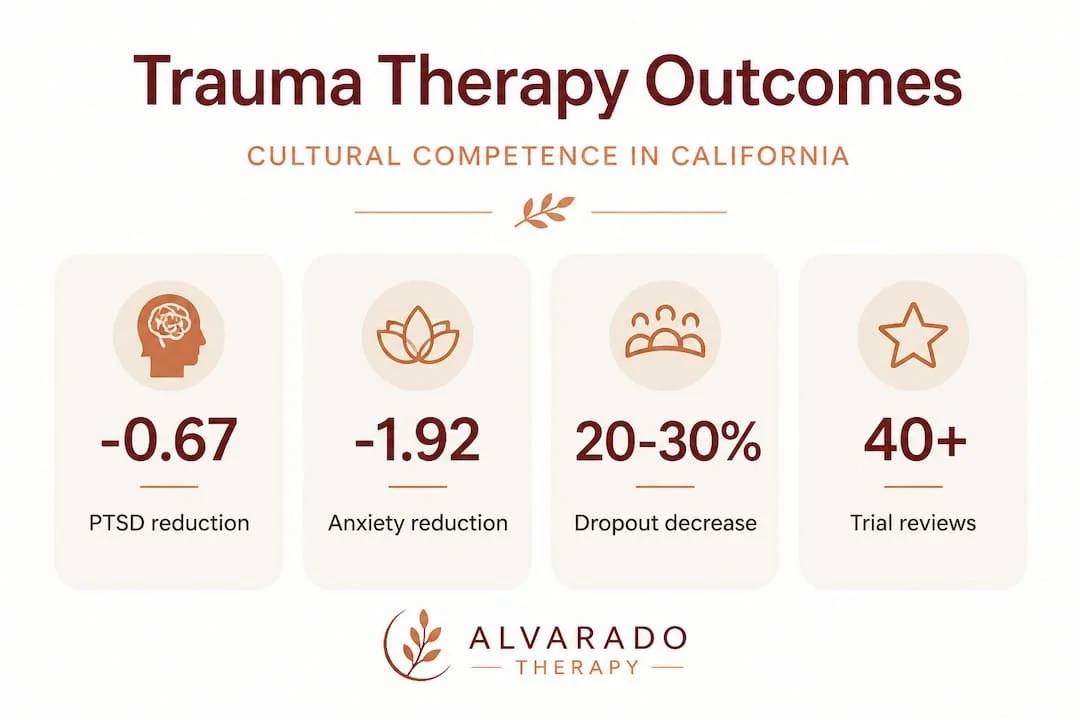
For California clients, this matters enormously. California is one of the most culturally and linguistically diverse states in the country, with a massive immigrant population, multigenerational trauma from historical displacement, and ongoing stressors like racism and economic inequality layered onto individual trauma histories. Cultural identity in therapy results in measurably faster progress when a therapist genuinely understands that context. And research confirms that 30% better recovery with cultural adaptation is achievable when the right adaptations are in place.

Nuance: Limits and potential pitfalls of cultural competence
Here's where honest conversation matters. Cultural competence is powerful, but it isn't magic, and the research has clear caveats worth understanding before you begin your search.
Edge cases show lower effects in several scenarios. Clients healing from childhood trauma, for example, sometimes show smaller gains from culturally adapted approaches compared to adults processing single-incident adult trauma. Very high levels of cultural knowledge in a therapist can occasionally cause cognitive overload, leading to over-analysis or miscommunication. Mixed results have appeared in some PTSD trials, particularly where the cultural adaptation was surface-level rather than deep. And long-term follow-up data, meaning outcomes beyond one year post-treatment, remains limited across most studies.
One of the most important distinctions in the research involves who is rating cultural competence:
"Client-rated competence correlates with outcomes (r=0.38), self-rated does not (r=0.06)."
That gap is huge. A therapist who believes they are culturally competent and a therapist whose clients experience them as culturally competent are often two very different people. Culturally adapted therapy training does increase therapist knowledge significantly (SMD 0.93), but that knowledge alone doesn't automatically improve client outcomes. The evidence certainty on training effects remains low, which means knowledge is a starting point, not an endpoint.
Three common misconceptions that get in the way of effective care:
"My therapist trained in cultural competence, so we're covered." Training is necessary but not sufficient. What matters is whether you, as the client, feel genuinely understood in session.
"Cultural competence means my therapist knows everything about my background." Real competence means curiosity, not assumption. A therapist who thinks they already know your story is more dangerous than one who asks.
"If therapy isn't working, it must be me." If the therapeutic relationship doesn't feel safe or identity-affirming, that's a real clinical problem worth naming. Trauma recovery and responsiveness depend on fit, not just technique.
Pro Tip: Look for therapists who openly describe their process of ongoing learning rather than presenting themselves as fully competent. Humility about the limits of their knowledge is actually a strong clinical indicator of responsive therapy benefits.
How to find culturally competent, identity-affirming trauma therapists in California
Knowing the research is one thing. Finding the right person is another. Here's a practical framework for your search.
Start with training credentials and ongoing education. Therapists with MSJCC training, documented continuing education in cultural responsiveness, and experience using evidence-based trauma methods such as EMDR or Trauma-Focused Cognitive Behavioral Therapy (TF-CBT) represent a meaningful foundation. TF-CBT, for example, has established protocols for cultural adaptation, including involving family systems in ways that fit specific cultural values around communal healing.
Cultural competence enhances trust and engagement for diverse California adults, particularly by reducing barriers like stigma, language difficulty, and historical mistrust of mental health systems. That means your first assessment of a potential therapist can happen in the initial consultation, before you commit to ongoing sessions.
Questions to ask during an intake or consultation:
How do you approach clients from backgrounds different from your own?
What ongoing training or consultation do you seek around cultural competence?
How do you incorporate a client's cultural identity into the treatment plan?
How do you handle moments when cultural misunderstanding happens in session?
Can you give me an example of adapting your approach for a client's specific cultural context?
Address intersectionality directly. Many California clients carry overlapping layers of identity: immigration history, racial identity, gender identity, language barriers, and socioeconomic stress. A therapist who understands intersectionality in trauma assessment will explore how these layers interact rather than treating your trauma as a single, isolated event. Immigration stress, for instance, often includes systemic trauma, family separation, acculturation conflict, and legal anxiety that standard PTSD frameworks were never designed to address.
The MSJCC and cultural humility framework explicitly asks therapists to consider privilege, oppression, and advocacy as part of their clinical work, not just their personal values. That integration matters when your trauma is connected to systemic injustice.
Pro Tip: When meeting a therapist for the first time, ask them specifically for an example of how they have adapted an intervention for a client's cultural context. Vague answers about being "open to all backgrounds" are less reassuring than specific examples showing they actually changed their clinical approach based on a client's lived experience.
If you are also using a starting trauma therapy checklist, add these cultural competence questions to your list. Being prepared going in helps you trust your gut when something doesn't feel right.
Why humility matters more than competence in trauma therapy
Here's our honest take after years working with California clients from extraordinarily diverse backgrounds: cultural competence can become its own problem.
When therapists focus too heavily on demonstrating competence, they can shift into a performance mode, showing off their knowledge of a culture rather than genuinely learning from the person sitting across from them. We've seen clients describe therapists who knew so much about Latinx culture that they stopped asking actual questions. That's not cultural competence. That's a more sophisticated version of assumption.
Trauma-sensitive counseling is built on the understanding that each client's nervous system, story, and healing path is unique. No framework, no matter how well-researched, predicts exactly what any individual needs. Cultural humility protects against the arrogance of assuming you already know.
What does humility actually look like? It looks like a therapist who says, "Tell me how your family understands what you've been through," rather than assuming they already know the answer. It looks like someone who doesn't rush to reframe your cultural practices through a Western clinical lens. It looks like a therapist who remains genuinely curious about your story long after they've read your intake paperwork.
"The most effective therapist isn't the one who knows the most about your culture. It's the one who keeps learning from you specifically."
This isn't a soft or philosophical point. The data supports it directly. Client-rated competence correlates meaningfully with outcomes. Self-rated competence does not. What happens in the room, as you experience it, is what actually moves the needle on healing.
Pro Tip: Look for therapists who listen more than they talk and adapt to your story. If you leave an initial session feeling like the therapist already has you figured out, that's a red flag worth heeding.
Connect with culturally competent trauma therapists in California
Healing from trauma is hard enough without also having to explain your cultural context to someone who isn't listening. At Alvarado Therapy, identity-affirming care isn't a slogan. It's woven into every aspect of how we show up with clients.
Our bilingual team serves adults across Pasadena, Ventura, and online throughout California, offering EMDR trauma therapy, PTSD and complex trauma support, couples therapy, and immigration psychological evaluations, all grounded in cultural responsiveness and trauma-informed principles. Whether you're navigating generational trauma, immigration stress, grief, or relationship difficulties, you deserve a therapist who brings both clinical skill and genuine curiosity to your story. If you're ready to take that step, book a consultation with our team today and see what identity-affirming therapy actually feels like.
Frequently asked questions
How does cultural competence improve therapy outcomes for trauma and anxiety?
Culturally adapted therapy reduces PTSD with an SMD of -0.67 and anxiety with an SMD of -1.92, producing meaningfully better results than standard approaches, with stronger effects for specific cultural groups.
What frameworks guide culturally competent trauma therapy?
The MSJCC and cultural humility frameworks are the most widely used in trauma-informed practice, guiding therapists to build awareness, knowledge, and cross-cultural skills while committing to ongoing social justice action.
Are culturally competent therapists more effective in all cases?
Not always. Childhood trauma and cognitive overload from excessive cultural knowledge can lower impact, and long-term data beyond one year remains limited in most studies.
How can I tell if a therapist is culturally competent?
Ask questions during your consultation and pay attention to how you feel understood. Client-rated competence predicts outcomes (r=0.38), while therapist self-ratings have almost no correlation with results (r=0.06), so your experience in the room matters most.
Can cultural competence help in couples or relationship therapy?
Yes. Identity-affirming approaches create safety for both partners to explore how their individual cultural backgrounds, family systems, and community values shape relationship patterns, reducing stigma and opening more honest communication channels.
Recommended
Why Cultural Competence in Therapy Leads to Better Outcomes — Alvarado Therapy
Find Culturally Sensitive Therapists in CA: 45% Dropout Cut — Alvarado Therapy
Culturally Responsive Therapy: 30% Better Trauma Recovery — Alvarado Therapy
California relationship transition support: Heal in 3-4 years — Alvarado Therapy
