
Save Weeks of Therapy: U.S. EMDR Intensives, 3–6 Hours a Day

Most EMDR intensives run 3 to 6 hours a day over 1 to 5 days, structured as a single goal directed treatment block rather than a string of standard 50-minute sessions. A single day format usually covers 4 to 6 hours, while multi-day retreats stretch across 2 to 4 or even 3 to 5 days with built in breaks and rest. Every hour is planned around assessment, processing, and integration, not just extended talk time, and most U.S. clinics bill these programs as flat, out-of-pocket packages.
TL;DR:
EMDR intensives typically range from 3 to 30 hours, scheduled over 1 to 5 days with scheduled breaks for rest and stabilization.
The success of an intensive depends on thorough screening, clear target setting, intentional sequencing, and integrated follow-up support, not just total hours.
Intensives show promising results, with some studies reporting over 73% of participants no longer meeting PTSD criteria after an 8-day program, and dropout rates are significantly lower than weekly sessions.
Proper planning includes screening for stability, building in preparation and integration, and ensuring the client has the capacity for emotional regulation during the intense schedule.
Cost typically is a flat, out-of-pocket package, with the importance of comprehensive safety planning and post-session follow-up surpassing the focus on overall duration.
Alvaradotherapy
Explore EMDR Intensive Therapy
Alvarado Therapy offers EMDR Intensives for trauma healing, with licensed therapists serving clients across California and online.
Table of Contents
What Are the Common EMDR Intensive Formats and Total Hours?
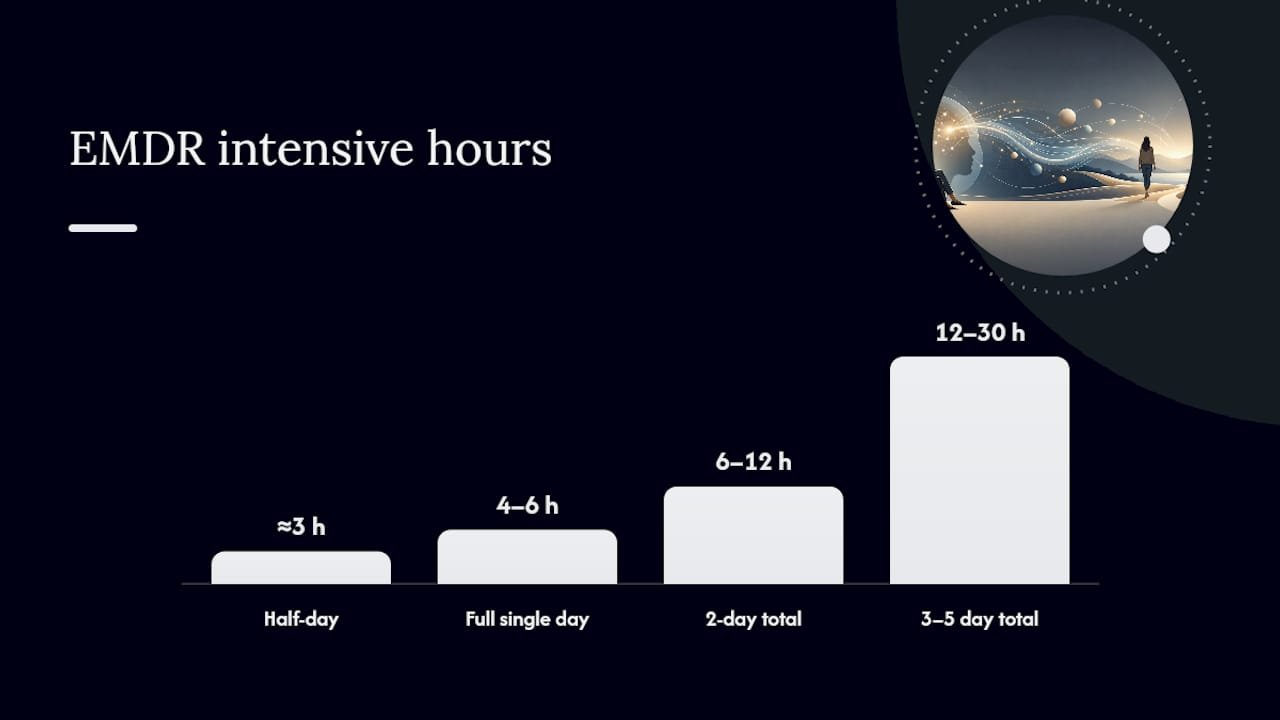
Clinics generally organize intensives around a handful of templates, and knowing them helps you match your calendar and budget to a realistic plan. A half-day format runs about 3 hours, a full single day runs 4 to 6 hours, and multi-day retreats span 2 to 5 days at 3 to 6 hours per day.
Here's how the math typically works out:
Half-day intensive: roughly 3 hours, often used for a narrowly defined target or as a follow-up to weekly therapy.
Full single-day intensive: 4 to 6 hours, the most common entry point for someone who wants concentrated progress without multiple days off work.
2-day intensive: 6 to 12 total hours, split across two sessions with a night to rest between them.
3 to 5-day intensive: 12 to 30 total hours, the format most associated with significant symptom shifts in a short window.
Compare that to weekly outpatient EMDR, where a client might log 50 minutes a week. Reaching 12 hours of processing time would take almost three months of once-weekly visits. An intensive compresses that same volume of work into a single week or even a single weekend, which is exactly why EMDR intensives are described as rapid healing for trauma survivors rather than simply "longer therapy."
Multi-day formats rarely run wall to wall. Clinicians build in breaks between processing sets, and many 3 to 5 day programs schedule at least one lighter day or a rest day midweek so the nervous system has room to settle before the next block. The exact rhythm depends on the client's target and stamina, but the underlying logic stays the same across 3 to 6 hour daily schedules: work, rest, reassess, continue.
How Is an EMDR Intensive Structured Differently From Weekly Sessions?
An intensive is not a marathon version of a regular appointment. It is a different clinical design, built around a finite window and a specific goal, and EMDRIA's own guidance stresses that intensives require distinct sequencing and safety planning rather than just more clock time.
The planning typically follows a sequence:
Pre-intensive screening. The clinician assesses risk, current stability, and the client's capacity for emotional regulation before ever scheduling the block.
Goal and target selection. Rather than open-ended processing, the therapist and client agree on one or two clear targets the intensive is meant to address.
Sequencing the work. Memories or triggers get ordered so early sets build stability for harder material later in the day or the program.
In-session flow. Each block usually opens with grounding and resourcing, moves into EMDR processing sets, and closes with containment exercises so the client leaves regulated, not raw.
Integration planning. The clinician schedules rest days, follow-up sessions, and aftercare supports so gains made in the intensive actually hold.
One underappreciated advantage of this structure: processing can run its full course instead of stopping because the clock hit 50 minutes. Clinicians who work this way often report that letting a set reach its natural end point improves continuity and cuts down on the frustration of feeling cut off mid-process.
Pro Tip: Ask your clinician what a typical hour inside the intensive actually looks like, minute by minute. A therapist who can describe the resourcing, processing, and closure rhythm in detail has done this before. One who gives a vague answer probably hasn't run many intensives.
Who Is a Good Candidate for an EMDR Intensive?
A good fit usually has three things: a clearly defined target, some existing capacity for self-regulation, and a stretch of protected time. If you can name the specific memory, event, or pattern you want to work on, and you already have basic grounding skills, you're the kind of candidate clinicians look for when they recommend an intensive over months of weekly visits.
Clinicians tend to defer intensives when someone is dealing with active, unmanaged substance use, severe unmanaged dissociation, or an unstable medical or psychiatric condition. In those cases, the compressed pace of an intensive can outstrip a person's ability to stay regulated between processing sets, and weekly therapy gives more room to build stability first.
Complex trauma doesn't automatically rule someone out. It usually means the clinician stretches preparation, adds more resourcing time between sets, or extends the total number of intensive days so the pacing matches the client's tolerance. Couples work and cases with significant comorbidities follow the same logic: the format flexes, but the screening step never gets skipped.
What Does the Research Say About Outcomes and Dropout?
The strongest data point in favor of intensive formats comes from an 8-day intensive outpatient program combining prolonged exposure and EMDR, which found that 73.3% of participants no longer met diagnostic criteria for PTSD at 3-month follow-up.
Dropout in that same program measured 4.3%, compared with 24.1% for weekly treatment as usual, according to the same trial.
That gap matters because dropout is one of the biggest practical problems in trauma treatment generally. A shorter, more contained commitment appears to keep more people engaged through to the end, even when the daily demand is heavier.
Other pilot work tells a similar but more cautious story. Feasibility studies combining EMDR with prolonged exposure and supportive activities report high attendance and meaningful symptom reductions, and EMDRIA's own summary of the 8-day trial echoes those findings. The caveat worth holding onto: many of these programs are multi-modal, blending EMDR with other approaches, which makes it harder to credit EMDR alone for every gain. Sample sizes in this research area also remain small, and the field needs larger randomized trials before anyone can call intensive formats a settled substitute for weekly care in every case.
What Should You Budget and Plan For Logistically?
Intensive EMDR in the U.S. is typically priced and paid for differently than a standard weekly session. Most clinics package the full program at a flat rate and bill it out-of-pocket, though a separate intake or screening appointment may sometimes be billable through insurance depending on your plan. Alvaradotherapy, for example, prices its 3-Day EMDR Intensive at $5,750, with shorter single-day options priced separately, all as one-time packages rather than per-session claims.
Beyond cost, plan for the days around the intensive, not just the hours inside it. Multi-day formats work best when you've cleared your schedule enough to actually rest between blocks, arranged limited work or childcare obligations, and lined up someone to check in with afterward. Clinics commonly ask for an emergency contact, medical or medication clearance when relevant, and a follow-up plan before they'll schedule you. None of that is bureaucratic friction. It's the same safety infrastructure that keeps dropout low in the research above.
What Questions Should You Ask Before Booking?
A short list of pointed questions separates a well-run intensive from one that's just a longer appointment slot with a bigger price tag.
How do you screen clients before an intensive, and what disqualifies someone?
What does preparation look like, and who will actually be in the room with me?
What happens if I become overwhelmed mid-session?
What are the exact daily hours, and how are breaks scheduled?
What's the cancellation policy, the total cost, and when is payment due?
What follow-up sessions are included or recommended after the program ends?
Treat vague answers as a warning sign. A clinician who can't describe their screening process, dodges questions about integration support, or won't name their EMDR training and credentials probably isn't set up to run this format safely.
How Alvaradotherapy Structures Its EMDR Intensives
Alvaradotherapy offers both 1-day and 3-day EMDR intensive formats, delivered by bilingual, trauma-informed clinicians across California with online booking available for scheduling. The 1-day option runs as either a 4 or 6-hour block, while the 3-day program spreads processing across multiple days for more complex or multi-target work.
Every intensive begins with intake and screening to confirm readiness and map out clear targets. Clients get downloadable preparation worksheets ahead of their scheduled day, and the practice builds post-intensive integration sessions into the plan so gains don't fade once the intensive ends. Anyone unsure whether an intensive or weekly format fits their situation should talk it through with a licensed clinician before booking.
Length Matters Less Than the Plan Behind It
The obsession with hour counts misses the real variable. Two intensives can both run 18 total hours and produce wildly different outcomes, because the difference isn't the clock, it's whether someone actually screened for readiness, sequenced the targets with intention, and built in real integration time afterward. That's the piece most casual guides to EMDR intensive length skip entirely.
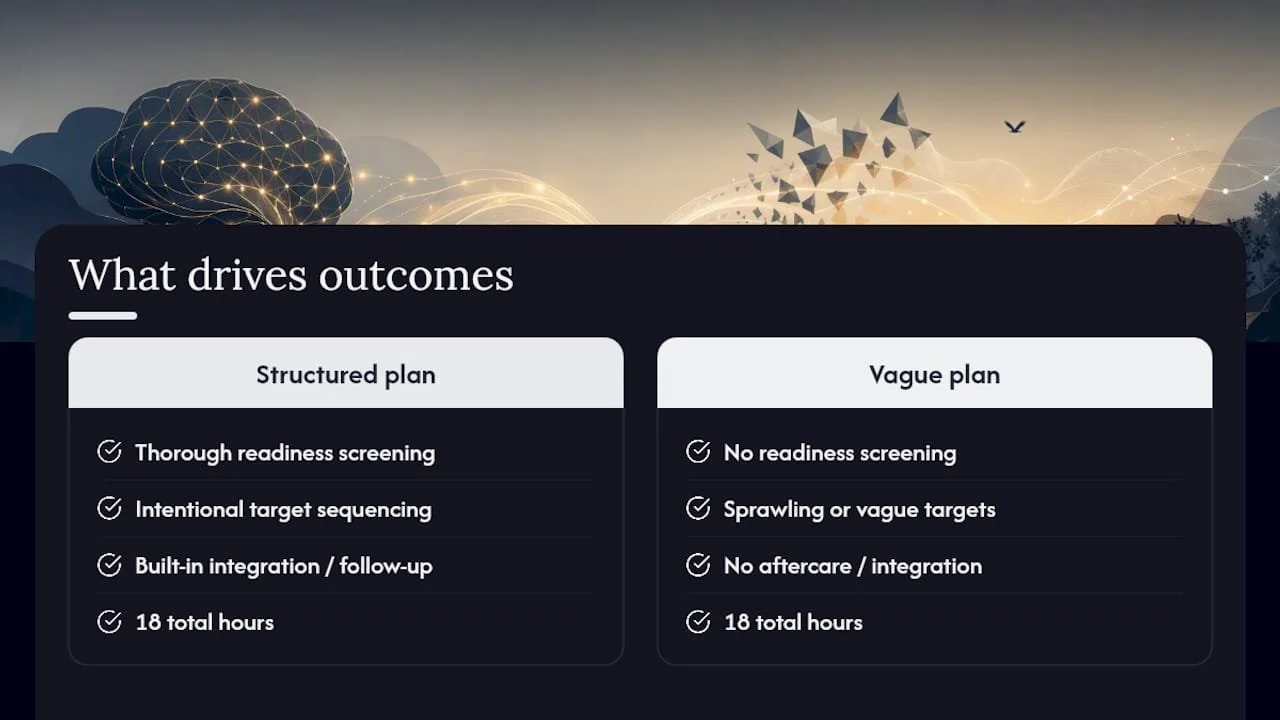
The conventional advice, "book the longest program you can afford," gets this backward. A tightly scoped 1-day intensive aimed at one clear target will often outperform a sprawling 5-day program with vague goals and no aftercare plan. The 8-day ITP data is compelling not because the program was long, but because it was disciplined: clear structure, defined goals, and built-in follow-up.
If you're weighing an intensive, prioritize the clinician's screening process and integration plan over the number of days on the calendar. Ask what happens after the last session ends. That answer tells you more about whether the format will actually work for you than any hour count ever will.
— Juiced
Ready to Book an EMDR Intensive?
If a concentrated, goal-focused format sounds like a better fit than months of weekly appointments, Alvaradotherapy's EMDR intensives give you a defined path instead of an open-ended commitment: a 1-day option at 4 or 6 hours, or a 3-day intensive for more complex work, each priced and scheduled as a single package rather than a string of separate bills.

Every intensive starts with an intake and screening call so a licensed clinician can confirm the format actually matches your goals and current stability, not just your calendar. Booking is handled online, and because these programs are typically paid out-of-pocket as flat packages, you'll know the full cost upfront before you commit any time off work. If weekly individual counseling and EMDR therapy sounds like a better starting point instead, that option is available too. Start with a consultation to talk through which format, timing, and target makes sense for where you are right now.
Further Reading and Primary Sources
For deeper reading on outcomes and clinical planning, see the 8-day intensive PTSD treatment trial, EMDRIA's guidance on understanding EMDR intensives, and Alvaradotherapy's research summary on EMDR effectiveness.
This article is general information, not a substitute for advice from a qualified doctor. Consult a qualified healthcare professional about your own circumstances before acting on anything here.
Sources
FAQ
Are EMDR intensives effective?
Research on intensive formats shows strong short-term results, with one 8-day program finding that 73.3% of participants no longer met PTSD criteria at 3-month follow-up. Dropout was also far lower than weekly treatment in that same trial, though sample sizes across this research area remain small and larger studies are still needed.
Is EMDR the hardest therapy?
EMDR can feel intense because it asks clients to briefly revisit distressing memories while using structured processing techniques, but it's not inherently harder than other trauma therapies like prolonged exposure. The intensity is manageable when a clinician properly screens for readiness and builds in grounding and containment throughout the session.
Who is a bad candidate for EMDR?
Clinicians typically defer EMDR, including intensive formats, for people with active unmanaged substance use, severe unmanaged dissociation, or unstable medical or psychiatric conditions. Complex trauma doesn't rule someone out entirely, but it usually calls for extended preparation and a slower pace rather than a compressed intensive schedule.
Why is there controversy with EMDR?
Some of the debate centers on the eye movement component itself, with critics questioning whether it adds anything beyond standard exposure-based techniques. Most current guidance, including EMDRIA's own materials, focuses less on that mechanism debate and more on ensuring clinicians follow proper sequencing, screening, and integration planning regardless of format.
