
Stop Translating Trauma: 3 Day Bilingual EMDR Intensive for Immigrants

Bilingual EMDR therapy works best when trauma memories are tangled up in a language your everyday English can't fully reach, and for many bicultural and immigrant adults, that's exactly the case. It's an evidence-based approach, and English-Spanish and Farsi services delivered through telehealth have made it far easier to find. The next step is concrete: look for a licensed, EMDR-trained clinician who is genuinely fluent in your language, not just translating on the fly, and ask directly about their cultural training before you book.
TL;DR:
Bilingual EMDR therapy offers faster, more emotionally accurate processing when trauma memories are encoded in the client's native language, especially for immigrants and bicultural individuals.
Clients with trauma in Spanish or Farsi often experience sessions that feel shorter, less draining, and yield quicker symptom relief compared to working solely in English.
Finding a qualified bilingual EMDR clinician involves verifying licenses, EMDR training, trauma experience, and asking specific questions about language fluency and cultural competence.
EMDR intensives in concentrated formats can deliver faster progress, particularly when conducted in the client's native language, with costs around $1,500 to $5,750 depending on format.
Short-term reactions like vivid memories or emotional heightening are common but manageable with a trained therapist; EMDR is not suitable for active psychosis or unmanaged suicidal risk.
Alvaradotherapy
Begin Trauma Therapy In Your Language
Alvarado Therapy offers bilingual, culturally responsive EMDR therapy and individual counseling online throughout California.
Table of Contents
Why Does Bilingual EMDR Improve Outcomes for Bicultural Clients?
Clinician Perspective: Why Language Shapes the Memory Itself
What Is EMDR and What Does the Research Say?
Eye Movement Desensitization and Reprocessing follows eight structured phases: history taking, preparation, assessment, desensitization, installation, body scan, closure, and reevaluation. During desensitization, the therapist guides the client through bilateral stimulation, usually side-to-side eye movements, tapping, or alternating audio tones, while the client briefly holds a distressing memory in mind. The theory is that this dual attention helps the brain reprocess stuck memories into something less charged.
The evidence behind this isn't thin. Systematic reviews and randomized controlled trials show EMDR produces clinically significant reductions in PTSD symptoms, with results comparable to trauma-focused cognitive behavioral therapy. The World Health Organization has also included EMDR among its recommended treatments for trauma, and it appears across national clinical guidelines. Researchers are still refining exactly how the mechanism works and which delivery models perform best across different populations, but the core evidence base is solid.
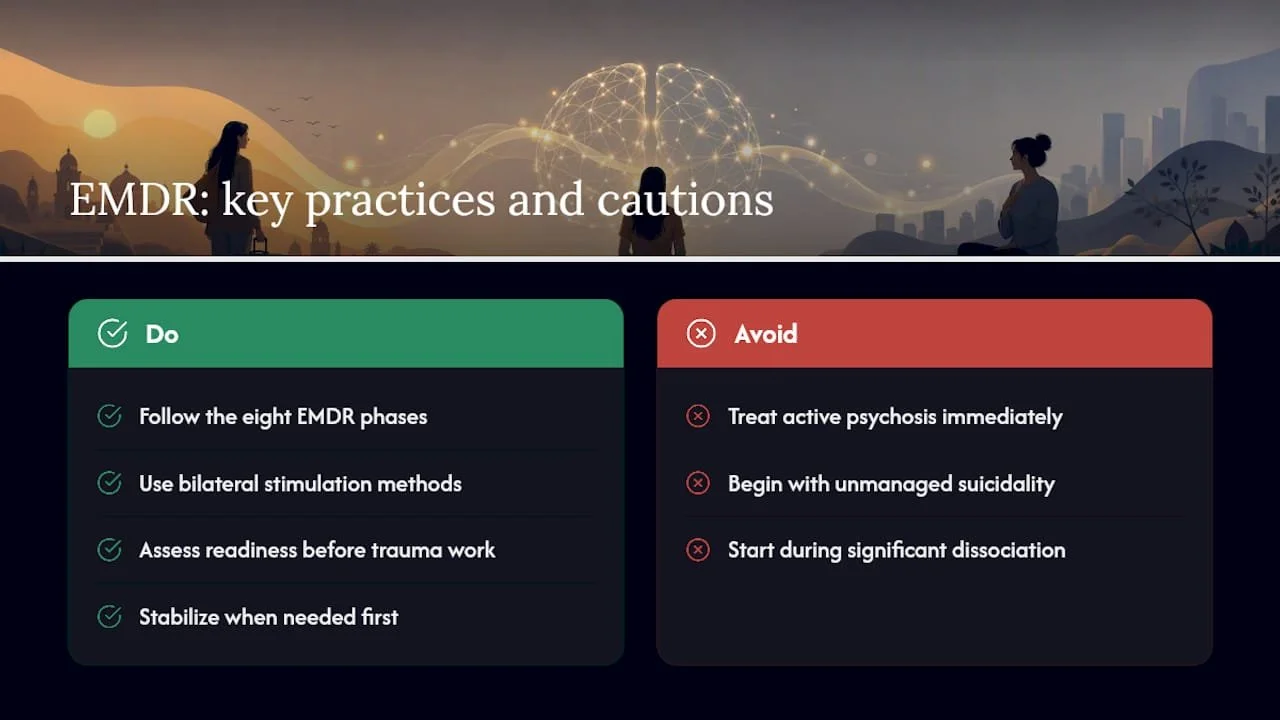
EMDR isn't automatically appropriate the moment someone walks in the door, though. Clients with active psychosis, unmanaged suicidality, or significant dissociation typically need stabilization first. A competent therapist assesses readiness before touching traumatic material at all.
Why Does Bilingual EMDR Improve Outcomes for Bicultural Clients?
Memory doesn't sit in a language-neutral vault. If a traumatic event happened in Spanish or Farsi, the sounds, phrases, and emotional texture of that memory are often encoded in that language. Asking someone to process it entirely in English can flatten the emotional charge, or worse, let the client intellectualize around it instead of actually feeling it. Peer-reviewed work on EMDR for bilingual clients notes that linguistic diversity, when integrated deliberately, supports better memory access and stronger therapeutic engagement.
There's a practical alliance benefit too. When a client doesn't have to translate their pain in real time, sessions move faster and feel less exhausting. Bilingual counseling resources consistently emphasize that language should never be the barrier standing between someone and honest emotional expression.
Cultural fluency matters just as much as vocabulary. A bilingual clinician is more likely to recognize idioms of distress, such as susto or nervios in Latin American culture, or culturally specific ways Farsi speakers describe grief and family obligation. They're also better equipped to understand transgenerational trauma tied to displacement, political upheaval, or immigration status, and how those threads show up in a session that looks, on the surface, like it's about something else entirely.
How Do You Find a Qualified Bilingual EMDR Therapist?
Start with specific search terms rather than generic ones. Searching "bilingual EMDR therapist Spanish" or "EMDR Farsi telehealth" tends to surface more relevant results than a broad "trauma therapist near me." Directories like Psychology Today let you filter by language, and many bilingual EMDR clinicians now advertise telehealth availability directly on their listings, which widens your options well beyond your zip code. Cross-check any name against your state's licensing board to confirm the license is active and unrestricted.
Credentials worth verifying before you book:
State license in good standing (LCSW, LMFT, LPCC, or psychologist)
Formal EMDR training through EMDRIA or an equivalent recognized body
Documented experience with complex trauma, not just general anxiety
Supervised clinical hours specifically in trauma treatment
Before your first session, ask direct questions: Do you personally speak my language fluently, or will you use an interpreter? What's your experience with immigrant or bicultural clients? How do you structure session frequency, and what are your fees or sliding-scale options?
Watch for red flags. A therapist who pushes for rapid trauma recall in an early session, can't articulate a safety plan, or seems unclear on trauma-specific training is not someone to move forward with.
Pro Tip: Ask a candidate therapist to describe, in their own words, how they'd handle a memory that surfaces partly in English and partly in your other language. Their answer tells you more about their actual bilingual competence than any credential on their website.
What Happens During a Bilingual EMDR Session or Intensive?
A typical EMDR session moves through a predictable arc, though the pacing shifts depending on how much stabilization work has already happened.
Assessment and stabilization. The therapist confirms the target memory and makes sure you have grounding tools available before touching it.
Desensitization and reprocessing. You hold the memory in mind while bilateral stimulation runs, and the emotional intensity is tracked throughout.
Installation. A more adaptive belief gets strengthened in place of the old, stuck one.
Closure. Every session ends with grounding, regardless of whether the processing feels finished.
In bilingual sessions, therapists often let clients switch languages mid processing, since a memory can start in English and shift into Spanish or Farsi as it gets closer to the emotional core. That fluidity is intentional, not a sign anything's going wrong.
EMDR intensives compress this work into multi-hour or multi-day formats instead of once-a-week sessions stretched over months. They tend to suit people with a single well-defined trauma target, stable daily functioning, and enough flexibility to clear their schedule for focused work, plus time afterward to rest and integrate.
What Are the Risks and Safety Considerations With EMDR?
Reprocessing trauma stirs things up, and that's expected, not a sign of failure. Common short-term reactions include:
Heightened emotions or unexpected tearfulness between sessions
Vivid or intrusive memories in the days following a session
Temporary changes in sleep or appetite
Brief dissociative experiences, such as feeling detached or foggy
A trained therapist manages this with grounding techniques, careful pacing, and agreed-upon stop signals so you're never pushed past what you can tolerate. EMDR is typically deferred or modified for clients in active psychosis, currently intoxicated, or facing unmanaged suicidal risk, and those cases usually call for coordination with a psychiatrist or medical provider alongside trauma-focused therapy.
Alvarado Therapy's Approach to Bilingual EMDR Care
A bilingual therapy practice provides EMDR services in English and Spanish, available in-person and online across multiple locations. That combination matters for readers weighing whether accelerated or weekly formats fit their life better.
The clinic's EMDR intensives run as 3-day, single-day 6-hour, or single-day 4-hour formats, priced at $5,750, $2,250, and $1,500 respectively, for clients who want concentrated progress on a specific memory rather than months of weekly sessions. For ongoing work, individual EMDR therapy sessions follows a standard weekly cadence. The practice also handles immigration psychological evaluations and support for victims of crime, both relevant to immigrant clients navigating legal processes alongside trauma recovery.
Alvarado Therapy's own writing on why bilingual therapy improves recovery outcomes reflects the same clinical reasoning covered above: language match shapes how deeply trauma work actually lands.
What Do Real Outcomes From Bilingual EMDR Look Like?
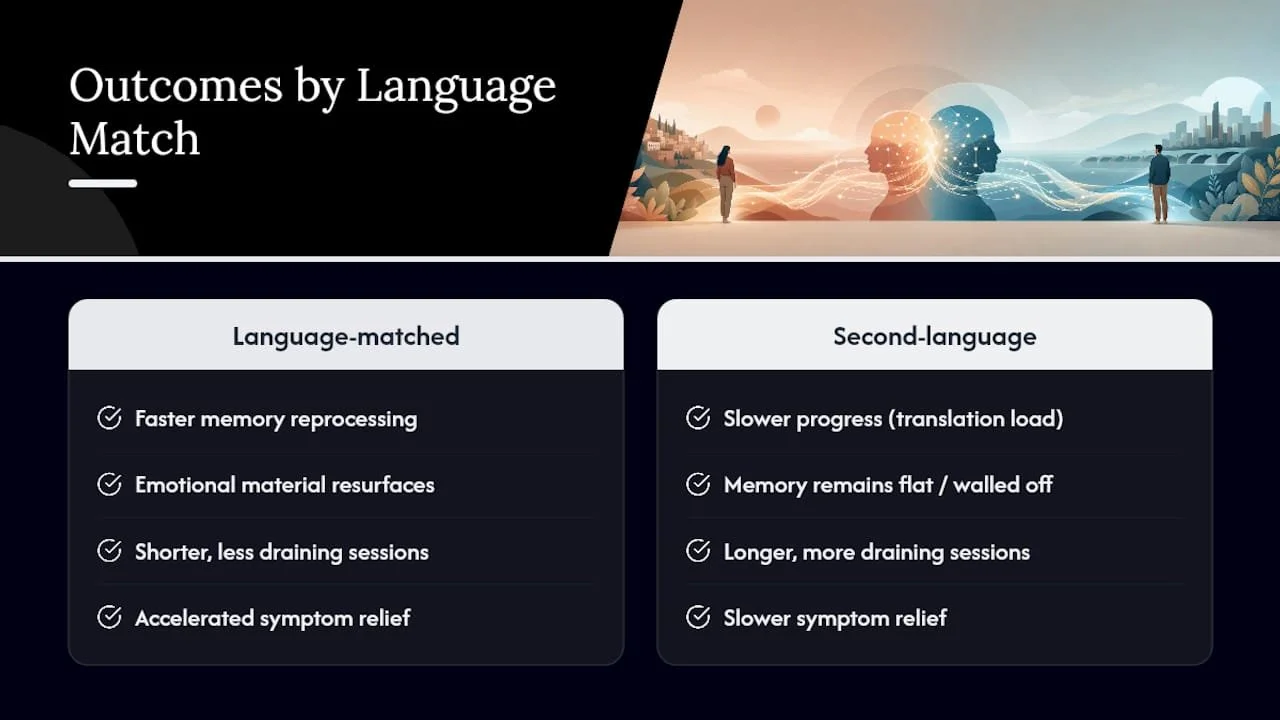
Case patterns reported by clinics offering EMDR intensives suggest that clients who process trauma in their native language often move through target memories faster than those working in a second language, because less energy goes toward translation and more goes toward the actual reprocessing. One clinic-reported pattern on intensive formats points to accelerated symptom relief when sessions are concentrated and language matched, though outcomes always depend on how ready a given client is and how complex the trauma history looks.
Consider a composite scenario that reflects what clinicians commonly see: a Spanish-speaking immigrant carrying decades-old memories of a dangerous border crossing has spent years in English-only talk therapy, describing the event calmly, almost like reciting facts from someone else's life. That flatness is common; it's often a sign the memory is still walled off rather than resolved, not evidence that the client has already healed. Once she moves into EMDR conducted in Spanish, the memory reportedly regains its emotional weight almost immediately, phrases from childhood surfacing that never once came up in English sessions.
Farsi-speaking clients report something similar around family obligation and generational grief, concepts that don't translate cleanly into English and tend to lose their emotional charge in the translation. When the target memory and the processing language finally match, clients often describe sessions that feel shorter and less draining, even when the material is objectively heavier.
None of this means monolingual EMDR fails. It means the language match removes a layer of friction that otherwise slows the work down.
How Do You Handle Language Barriers During Trauma Therapy?
The most common language barrier isn't a total language gap. It's the partial one, where a client speaks fluent conversational English but reverts to their first language the moment emotions run high. If your therapist doesn't speak that first language, that shift can leave the most important part of the session lost in translation, quite literally.
A few practical fixes:
Ask upfront whether your therapist can follow you if you switch languages mid-sentence, which happens often during EMDR processing.
If your therapist relies on an interpreter, ask how that interpreter is trained in trauma-sensitive language and confidentiality, since a poorly prepared interpreter can flatten emotional nuance or make a client self-censor.
Bring your own vocabulary for hard-to-translate feelings rather than searching for the "closest" English word; a good bilingual therapist will follow you into that language without breaking the session's flow.
If sessions feel like they're missing something even though the therapist is skilled, that mismatch is worth naming directly rather than pushing through.
Cognitive therapy delivered in multiple languages carries the same principle: the mechanism works the same way regardless of language, but the client has to feel like they can think in whichever language the memory actually lives in.
Can Therapists Get Trained and Certified in Bilingual EMDR?
EMDR training itself runs through EMDRIA-approved programs and follows a standard curriculum regardless of language, covering the eight-phase protocol, case conceptualization, and supervised practicum hours. What's less standardized is bilingual-specific training: there's no single national certification that verifies a therapist's ability to conduct EMDR fluently in Spanish or Farsi specifically.
In practice, this means bilingual competence usually comes from a therapist's own background rather than a formal add-on credential. Many bilingual EMDR clinicians are heritage speakers or immigrants themselves, and some pursue additional coursework in cultural humility or trauma-informed interpretation to sharpen that skill further. A handful of EMDRIA-approved trainers now offer instruction in Spanish, which is slowly expanding the pipeline of clinicians trained to deliver the protocol natively rather than translating it after the fact.
For clients, this gap is exactly why vetting matters more than assuming a "bilingual" label on a directory profile guarantees clinical fluency in trauma work specifically. Ask whether a therapist trained in EMDR in the language they'll actually be using with you, since some were trained in English and later added bilingual services without additional language-specific EMDR instruction. That distinction shapes how naturally the therapy actually flows once you're in the room.
Clinician Perspective: Why Language Shapes the Memory Itself
A phrase like "me lo tragué," swallowing it down, carries weight in Spanish that "I kept it inside" doesn't fully capture in English. That gap is exactly where reprocessing gets stuck if the therapist can't hear it. Choosing a clinician who listens for cultural meaning, not just words, changes what actually surfaces in a session. Seeking care in your first language isn't a compromise or a workaround. It's often the more direct route to the memory that needs the work.
— Juiced
How Alvarado Therapy Can Help You Start Bilingual EMDR
This practice offers trauma work conducted in the language where the memory actually lives, rather than translated after the fact. Clinicians conduct EMDR in English or Spanish, with online sessions available across California and New York.
If you're weighing a concentrated approach, the EMDR intensives run as 3-day, single-day 6-hour, or single-day 4-hour formats. If weekly sessions fit your life better, individual EMDR therapy sessions follows a standard ongoing schedule, and couples therapy is available for partners navigating trauma together. Before booking, review the what to expect page so you know exactly how intake and telehealth logistics work, and confirm clinician credentials directly. If you're a therapist looking to build a more visible bilingual practice yourself, resources on SEO for therapists can help clients actually find you. When you're ready, book a consultation to talk through which format fits your situation.
This article is general information, not a substitute for advice from a qualified doctor. Consult a qualified healthcare professional about your own circumstances before acting on anything here.
Sources
FAQ
What Could Go Wrong With EMDR?
The most common issues are temporary: heightened emotion, vivid memories resurfacing between sessions, or brief dissociative moments. A trained therapist screens for contraindications like active psychosis or unmanaged suicidality first and uses grounding techniques and pacing to keep the work safe throughout.
What Is the Success Rate of EMDR for Complex PTSD?
EMDR produces clinically significant symptom reduction in trials, performing comparably to trauma-focused CBT for PTSD. Complex PTSD often requires more stabilization work beforehand, and outcomes depend heavily on that groundwork being done well.
Does EMDR Work if You Don't Remember the Trauma?
Yes, EMDR can still work with partial or fragmented memories, or even with body sensations tied to an event rather than a clear narrative. Therapists often target the emotional or physical residue of an experience rather than requiring a complete memory to begin reprocessing.
Is It Possible to Experience Dissociation During EMDR Therapy?
Brief dissociative experiences, like feeling foggy or detached, can happen during reprocessing and are something therapists actively watch for. A qualified clinician uses grounding techniques and adjusts pacing immediately if this occurs, and agreed-upon stop signals let the client pause the process at any point.
How Much Does Bilingual EMDR Therapy Cost?
Pricing depends on the format and provider. Alvarado Therapy's EMDR intensives are priced at $5,750 for the 3-day format, $2,250 for a single 6-hour day, and $1,500 for a single 4-hour day, while pricing for ongoing individual sessions is available directly through the practice.
