
Fast, Large Gains: EMDR Intensive Outcomes (d=1.57, 5.5% Dropout)

Research on intensive EMDR-inclusive programs shows large PTSD symptom reductions, with many trials reporting loss of diagnosis or a clinically meaningful response for roughly half to three-quarters of participants, alongside consistently low dropout. Protocol fidelity holds: intensives compress the schedule, not EMDR's eight phases.
TL;DR:
Intensive EMDR programs achieve large symptom reductions with a large effect size, often exceeding d = 1.5 across diverse populations.
Treatment formats range from single-day sessions to eight-day outpatient programs, all maintaining the same protocol divided over shorter intervals.
Most participants experience rapid improvements, with significant symptom reductions occurring within weeks and a high percentage losing PTSD diagnoses.
Candidates with severe or complex PTSD benefit most, while those with unmanaged substance use or medical instability should seek stabilization beforehand.
Low dropout rates under 6% reflect strong tolerability, but processing multiple memories can be emotionally demanding, requiring careful preparation and safety planning.
Alvaradotherapy
Explore Intensive EMDR Support
Alvarado Therapy offers EMDR Intensives for Californians healing from trauma, PTSD, anxiety, grief, and related challenges.
Table of Contents
What the peer-reviewed studies and reviews report about outcomes
The strongest evidence for intensive EMDR comes from cohort studies and a systematic review that pooled results across multiple intensive formats. An 8-day program combining EMDR with prolonged exposure treated 347 adults with severe PTSD and produced a large effect size, with a Cohen's d of about 1.64 on the CAPS.
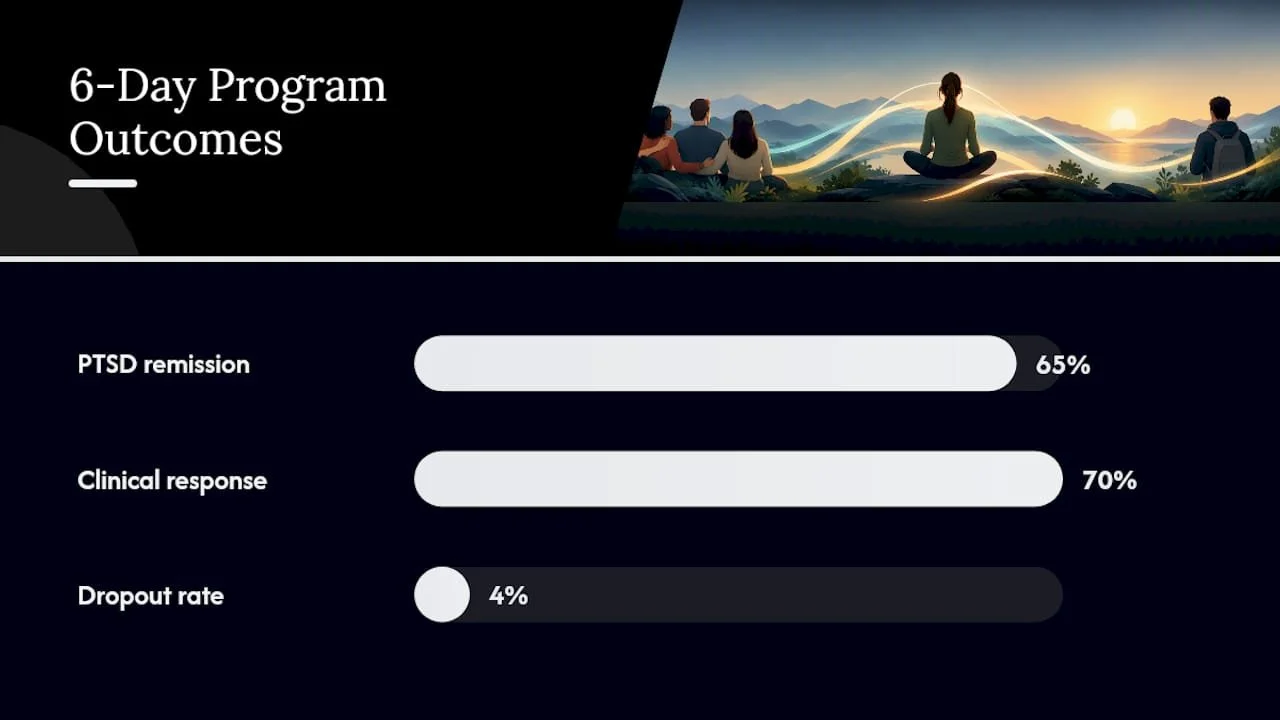
A shorter, 6-day intensive outpatient program built for adolescents and young adults found that 65% no longer met diagnostic criteria for PTSD at one month, with a 70% clinically meaningful response rate and a dropout rate of only 4%. That program also used a rotation-of-therapists model, which did not appear to compromise outcomes and helped programs schedule more flexibly while keeping shared case plans intact.
A comparative study of veterans found that twice-daily intensive EMDR produced symptom reductions similar to standard weekly EMDR. Scores on the Impact of Event Scale-Revised dropped from a mean of about 53 before treatment to roughly 17 after treatment, with gains holding at a mean of 15.6 a year later, meaning the intensive format matched weekly care rather than losing ground over time.
Zooming out, a systematic review of intensive, empirically supported PTSD treatments pooled results across studies and found:
A large weighted mean effect size of d = 1.57, with individual study effects ranging from 1.15 to 2.93.
A pooled dropout rate of about 5.5%, with individual programs ranging from 0% to 13.6%.
Consistently lower attrition than typically reported for weekly outpatient PTSD treatment, where dropout has run considerably higher in some reviews.
Across five major studies of intensive EMDR and EMDR-plus-exposure programs, pooled effect sizes exceeded d = 1.5, a magnitude generally considered large in psychotherapy research. That consistency across different populations, from adolescents to veterans to adults with severe PTSD, is what makes the intensive model worth taking seriously rather than treating as a shortcut.
How intensive EMDR programs are structured
Intensive EMDR does not mean rushed EMDR. It means the same eight-phase protocol delivered on a compressed calendar instead of once a week for months.
One-day intensives run several hours in a single sitting, often used for a single, well-defined trauma memory.
Three-day programs allow processing across multiple sessions with time to integrate between them.
Six-day and eight-day programs are the format behind the largest outcome studies, often scheduling twice-daily sessions.
Two-week intensive outpatient models spread sessions further, useful for more complex trauma histories.
Every format still moves through history-taking, stabilization, memory processing, and closure. Clinicians front-load stabilization skills before touching traumatic memories, which is part of why dropout stays low even under a compressed timeline. Larger trials, including the 8-day program referenced above, have paired EMDR with prolonged exposure, physical activity, and psychoeducation to support tolerance and integration between sessions. Some outpatient programs also rotate therapists across a shared case plan without harming outcomes. Telehealth delivery has become common for less complex presentations, though clinicians generally reserve in-person formats for higher-risk cases or when a client needs closer monitoring between sessions.
Who benefits most, and who should wait
Intensive EMDR was studied and validated primarily in people with severe or complex PTSD, not mild or subclinical symptoms. The 8-day program that produced a 54.9% loss-of-diagnosis rate specifically enrolled patients with severe post-traumatic stress disorder, suggesting the format holds up even for harder cases.
People often choose an intensive for faster relief, tighter scheduling around work or travel, or because weekly sessions have stalled. Reasons for caution include:
Active substance intoxication or unmanaged dependency during the treatment window.
Uncontrolled suicidality or self-harm risk that needs stabilization first.
Significant medical instability that could complicate a demanding emotional process.
Insufficient grounding or emotion-regulation skills going in.
Pro Tip: If you're not sure whether you're stabilized enough for an intensive, ask a clinician for a short pre-intensive assessment rather than guessing. For some people, a blended approach, weekly sessions building stabilization skills before an intensive, is the safer sequence.
What to expect and when results typically show up
Most people notice change quickly. In the studies above, clinically meaningful response and loss of diagnosis were measured at the end of treatment or within weeks, not months. The 8-day program reported an 82.9% clinically meaningful response rate at post-treatment, and the 6-day adolescent and young adult program found 65% no longer met PTSD criteria at the one-month mark.
Clinicians typically track progress with standardized tools:
CAPS-5 (Clinician-Administered PTSD Scale), the gold-standard structured interview used in several of the studies above.
PCL-5, a self-report checklist for tracking symptom change over time.
IES-R (Impact of Event Scale-Revised), used in the veteran comparison study to track symptom trajectories.
A weighted mean effect size of d = 1.57 across intensive PTSD treatments is considered large by conventional standards in psychotherapy research, meaning the average participant improved substantially more than someone receiving no treatment or a weaker comparison intervention.
Not every gain holds perfectly. Some participants show partial relapse in the months after an intensive, which is part of why many programs build in booster sessions or a follow-up plan rather than treating the intensive as a one-time fix. Based on the studies above, durable change is often visible within one month and, in the veteran comparison study, held at a year out. Anyone considering an intensive should plan for at least one follow-up check-in, not assume the work ends when the intensive does.
Safety, tolerability, and what to watch for
That is notably lower than dropout figures reported in some reviews of standard weekly PTSD treatment.
That does not mean intensives feel easy. Processing several trauma memories in close succession is emotionally demanding, and short-term distress between sessions is common and expected.
Clinicians build in breaks, grounding exercises, and check-ins between processing sessions.
Reputable programs complete a safety plan and, where relevant, medical or psychiatric clearance before starting.
Clients are coached on what a normal post-session reaction looks like versus a warning sign.
Anyone experiencing worsening suicidal thoughts, dissociation that does not resolve, or an inability to function after a session should contact their clinician immediately rather than waiting for the next appointment.
Preparing for an intensive: what to do beforehand
Preparation is where a lot of the safety and effectiveness data above actually comes from. Programs that report low dropout and strong outcomes tend to stabilize clients before processing begins, not after.
Build grounding and emotion-regulation skills ahead of time so you have tools between sessions.
Stabilize sleep and hydration in the days leading up to a multi-day program.
Ask the clinic direct questions: session schedule, clinician credentials and EMDR training, emergency procedures, and what follow-up looks like.
Plan logistics early, including time off work and travel or lodging for multi-day, in-person formats.
Confirm your technology ahead of any telehealth sessions so a connection issue does not interrupt processing.
Set up integration and follow-up care before you finish, including who you will check in with afterward.
Pro Tip: Ask specifically how the clinic handles a session that surfaces more than expected. A program with a real plan for that will have a clear, specific answer, not a vague reassurance.
Alvarado Therapy's approach to intensive EMDR
Some practices offer EMDR intensives designed around the same structure the research above describes: stabilization first, then concentrated processing on a compressed timeline. Formats may include various multi-day and single-day options.
A 3-Day EMDR Intensive for clients who want processing spread across several sessions with time to integrate between them.
A 1-Day EMDR Intensive (6 hours in one day) for a focused, single-day format.
A 1-Day EMDR Intensive (4 hours in one day) for a shorter single-day option.
Some practices describe their care as bilingual, offered in English and Spanish, and trauma-informed and culturally responsive, with a focus on Latinx, BIPOC, and LGBTQ+ clients. Services may include clients statewide, with online sessions available throughout. Readers who want a deeper walk-through of formats and what to expect can review the practice's own guide to what intensive EMDR therapy involves or its summary of EMDR outcome research.
When an intensive makes sense: a clinical perspective
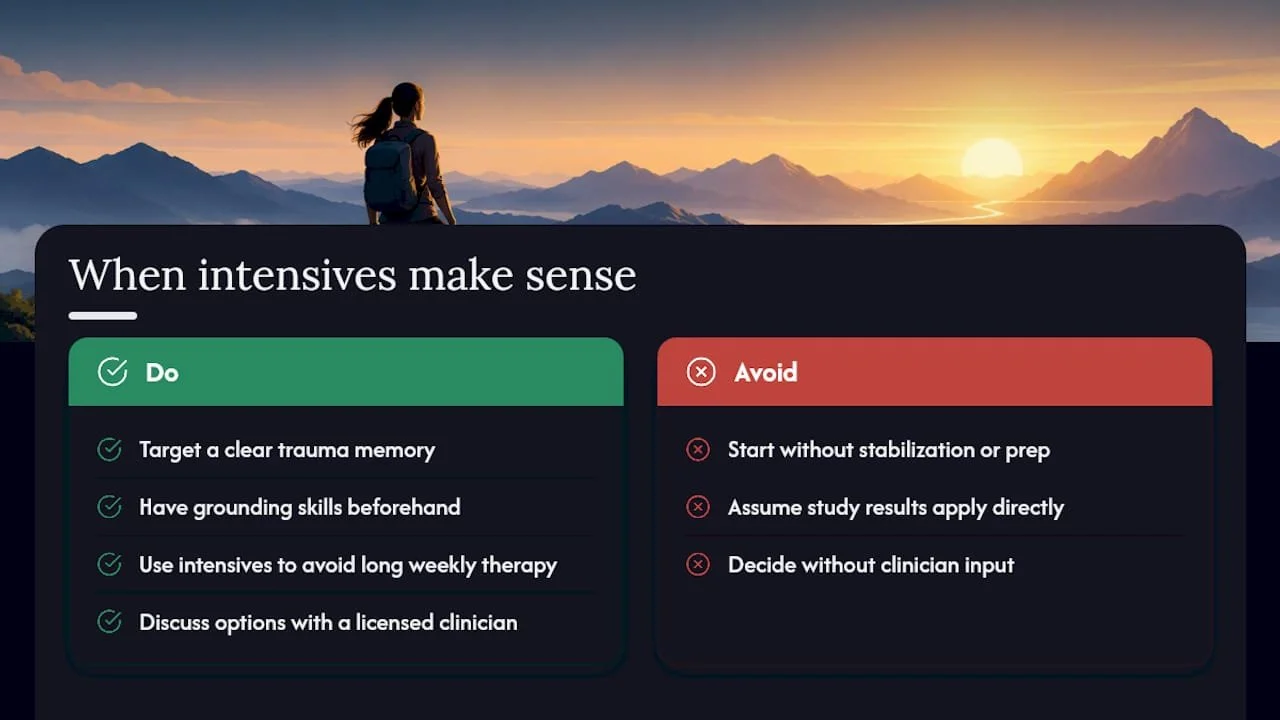
Intensives tend to work best for people who have a clear trauma memory or set of memories to target, have some grounding skills already in place, and want to avoid the stop-start rhythm of weekly sessions dragging out over many months. That pattern shows up across the studies above, from combat veterans to adolescents with recent, well-defined trauma.
Results still vary by individual. Someone with a longer trauma history or less stabilization going in may need more preparation or a blended approach rather than jumping straight into a multi-day format. Whatever your situation, talk it through with a licensed clinician before deciding, since the right format depends on your specific history and current stability, not just what worked in a study.
— Juiced
Start your EMDR intensive with Alvarado Therapy

If the research above has you weighing an intensive over months of weekly sessions, some practices offer a path including a pre-intensive intake to assess fit and stabilization, then a scheduled intensive built around client history rather than a generic template. Sessions may be available in English and Spanish, delivered by trauma-informed clinicians, with in-person options in California and online sessions throughout the state.
Choose from a 3-Day EMDR Intensive, a 1-Day EMDR Intensive (6 hours in one day), or a 1-Day EMDR Intensive (4 hours in one day) depending on your schedule and goals.
Start with an intake and preparation session to confirm the format fits your current stability.
Continue with individual EMDR therapy afterward if ongoing, weekly support fits your integration plan better.
Visit the EMDR intensives page to review formats and take the next step toward booking.
Primary studies and clinical resources cited
Intensive EMDR plus prolonged exposure for severe PTSD (PMC)
Six-day intensive outpatient program for adolescents and young adults (PMC)
Intensive daily versus weekly EMDR in veterans (Frontiers in Psychology)
Systematic review of intensive PTSD treatments
This article is general information, not a substitute for advice from a qualified doctor. Consult a qualified healthcare professional about your own circumstances before acting on anything here.
Sources
FAQ
Are EMDR intensives effective?
Published studies report large symptom reductions from intensive EMDR programs, with effect sizes as high as d = 1.64 in one 8-day program and a pooled effect of d = 1.57 across a systematic review of intensive PTSD treatments. Dropout in these programs has also stayed low, generally under 6% on average.
Can EMDR be too intense?
Processing multiple trauma memories in close succession can feel emotionally demanding, and short-term distress between sessions is common. Reputable programs manage this with stabilization skills, breaks, and safety planning before and during treatment, which is part of why serious adverse events are rarely reported in the studies above.
Has EMDR been debunked?
No. Trusted clinical resources, including Harvard Health, describe EMDR as an established, evidence-based treatment for PTSD that can work faster than some other approaches. Ongoing research continues to study exactly how and for whom it works best, which is normal for any active area of clinical research.
What is the success rate of EMDR?
Success rates vary by study and format, but intensive programs have reported clinically meaningful response in roughly 70% to 83% of participants and loss of diagnosis in about 55% to 65% depending on the population studied. Individual results depend on trauma severity, stabilization going in, and consistency with follow-up care.
