
When Trauma Blocks Grief: EMDR vs CGT for Intrusive Memories

EMDR is an evidence-supported therapy that helps many people whose grief is blocked by traumatic memories or intrusive images. Complicated Grief Treatment (CGT) has the strongest trial support overall, but EMDR is often the better fit when a death itself was sudden, violent, or witnessed and the memory keeps intruding. Deciding between them starts with an assessment of trauma symptoms, safety, and readiness, which the sections below walk through in order.
TL;DR:
EMDR shows promise in reducing intrusive trauma memories and trauma symptoms faster than exposure-based grief therapy, but evidence is based on small and varied studies.
It is most suitable when grief is complicated by violent or sudden death, witnessed trauma, intrusive images, nightmares, or blocked mourning related to trauma.
Treatment involves targeting past distressing memories, present triggers, and catastrophic future images, often requiring stabilization beforehand for those with dissociation or mood issues.
EMDR's long-term effectiveness remains uncertain due to limited follow-up data, so progress tracking and adjustments are essential during therapy.
It can be combined with structured grief treatments like CGT, especially when trauma symptoms are a primary obstacle to mourning.
Alvaradotherapy
Find Support for Trauma-Related Grief
Alvarado Therapy offers EMDR therapy and grief counseling for Californians coping with trauma, anxiety, loss, or intrusive memories.
Table of Contents
What clinical research says about EMDR for grief
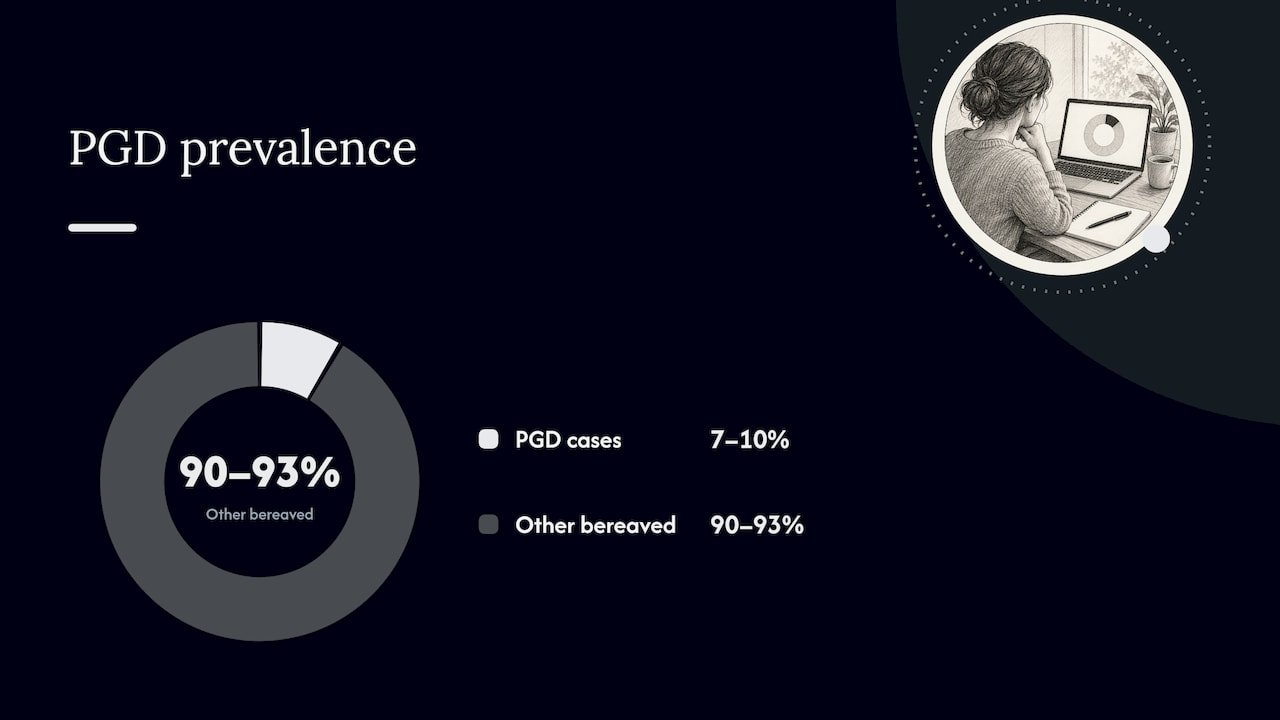
Prolonged Grief Disorder (PGD) affects roughly 7% to 10% of bereaved people and can disrupt work, relationships, and physical health for years if untreated, according to validation research on the PG-13-R screening scale. The disorder was added to the DSM-5-TR with a diagnostic threshold requiring symptoms to persist at least 12 months after the loss, and the PG-13-R scale gives clinicians a validated way to identify who meets that threshold rather than relying on general impressions of "grief that will not lift."
Within that population, a subset carries clear trauma features: flashbacks to the moment of death, intrusive images of a hospital room or accident scene, or a persistent sense that the loss itself was unbearable to witness. This is the group EMDR research has focused on. A review of EMDR theory, research, and practice for prolonged grief describes EMDR as a fitting option because it addresses past traumatic memories, present-day triggers, and future-oriented fears about living without the person, rather than treating grief as a single undifferentiated symptom.
Smaller controlled studies point in a similar direction. Work summarized in comparative research on EMDR and grief found that EMDR reduced intrusive grief imagery and trauma symptoms, in some cases faster than exposure-based grief interventions. These findings are worth taking seriously, but they come from small samples and varied designs, which limits how far they generalize.
EMDR shows meaningful symptom reduction in trauma-focused grief studies, according to the Frontiers in Psychiatry review. Though the evidence base is still smaller than that supporting first-line grief treatments.
Set against this, Complicated Grief Treatment has the largest randomized controlled trial base for complicated grief specifically, with higher response rates reported in multicenter trials. That does not make EMDR a second-choice option. It means the two therapies have been tested differently, for different symptom profiles, and the research gap should factor into how a clinician and client choose between them. Key limitations to weigh:
Most EMDR-for-grief trials involve small sample sizes, often under 50 participants.
Few studies directly compare EMDR against CGT head-to-head in the same population.
Outcome measures vary across studies, making it hard to pool results into firm effect sizes.
Follow-up periods in several trials are short, so durability of gains beyond a few months is not well established.
How EMDR addresses the trauma trapped inside grief
EMDR is built on the Adaptive Information Processing (AIP) model, which holds that distressing experiences can get stored in the brain without being fully linked to related, more adaptive memories and information. When that happens with a death, the mind can get stuck replaying the worst moment: the phone call, the hospital corridor, the moment of identification, rather than integrating that memory alongside the fuller relationship it came from.
In grief work, common targets include the moment of death or notification, hospital or funeral scenes, feelings of guilt or responsibility, and recurring intrusive images that surface without warning. Processing these targets does not erase the memory. It aims to let the memory settle into the past instead of feeling like it is happening now.
Clinicians typically organize this work around three prongs, a structure detailed in the review on EMDR for prolonged grief:
Past: reprocessing the most disturbing memories tied to the death itself.
Present: addressing current triggers, such as anniversaries, objects, or places that provoke acute distress.
Future: using flash-forward and future template techniques to work through catastrophic images about life ahead, such as the fear of being permanently alone.
The Frontiers review notes that flash-forward work is particularly useful for grief because it targets images like "I'll be alone forever" that keep a person locked in dread rather than mourning. Successfully processing these images sometimes reopens access to positive memories of the person that had become hard to reach.
The broader aim, as EMDR International Association guidance puts it, is to shift someone from "loving in presence" to "loving in absence": keeping the relationship meaningful while no longer being held hostage by the trauma of how it ended.
Pro Tip: Ask a prospective therapist how they distinguish between "grief work" and "trauma work" in their EMDR practice, since the two require different pacing and targets.
Who is a candidate, and what a proper assessment covers
Not everyone grieving needs EMDR, and not everyone with prolonged grief has a trauma component to treat. EMDR tends to be most relevant when a loss involved sudden or violent death, when a person witnessed the death or its immediate aftermath, when intrusive images or nightmares are present, or when the mourning process itself seems blocked by something more specific than sadness.
A thorough assessment before starting reprocessing work generally covers:
Diagnostic screening using PG-13-R or DSM-5-TR criteria for Prolonged Grief Disorder, confirming symptoms have persisted beyond the 12-month threshold.
Trauma screening for co-occurring PTSD, since traumatic loss frequently produces overlapping symptom clusters.
Mood and risk assessment, including screening for depression and any suicidal ideation, which requires immediate clinical attention regardless of grief status.
Substance use review, since numbing behaviors can complicate both diagnosis and treatment planning.
Dissociation screening, because significant dissociative symptoms usually call for additional stabilization before trauma reprocessing begins.
Before any reprocessing work starts, EMDRIA guidance stresses building affect tolerance and making sure a client can stay within a manageable emotional range, since starting too soon can temporarily worsen functioning rather than help it. This stabilization phase includes grounding techniques, resourcing exercises, and coping skills the client can use between sessions.
When multiple issues are present, such as PTSD, depression, and grief together, clinicians typically prioritize whatever is blocking progress most directly. The Complicated Grief Treatment manual recommends addressing the primary trauma-related obstacle first when it is preventing any movement in mourning at all, then returning to broader grief work once that block has eased.
What a course of EMDR for grief actually looks like
EMDR follows eight phases: history taking, preparation, assessment, desensitization, installation, body scan, closure, and reevaluation. For grief work, the history-taking and assessment phases are where a clinician identifies specific targets, the death scene, a guilt-laden memory, a recurring nightmare, rather than treating "the loss" as one undifferentiated target.
The three-prong model gets implemented across sessions rather than in a single pass:
Early sessions often target the past: the most disturbing memory connected to the death, processed until it no longer triggers intense distress.
Middle sessions address present triggers: reminders, anniversaries, or specific places that still provoke acute reactions.
Later sessions use flash-forward and future template work to address fears about the future, helping the person picture moving forward without the catastrophic images that had been blocking that.
Adaptations depend on the nature of the loss. Sudden or accidental deaths often require heavy focus on the notification moment itself. Traumatic deaths, such as those involving violence, may need more stabilization before any reprocessing begins. Complicated attachment histories, where the relationship with the deceased was itself difficult, can require additional targets tied to earlier relational memories, not just the death. Bereavement following abuse may involve processing memories that predate the loss entirely.
On pacing, some of the smaller comparative studies of EMDR and grief found symptom reduction happening faster than with exposure-based grief interventions, though sample sizes were small enough that this should be read as a promising signal rather than a settled finding. Our related guide on EMDR therapy for grief walks through what early sessions tend to involve in more detail.
Where EMDR fits alongside CGT, CBT, and medication
Complicated Grief Treatment remains the treatment with the deepest evidence base for complicated grief, combining behavioral tasks like imaginal revisiting of the death with structured work on personal goals and restoring a sense of connection to life. It was designed specifically for complicated grief, which is part of why its trial results have been so consistent.
EMDR is not a competing claim to that evidence so much as a different tool suited to a specific pattern when trauma symptoms, not general grief symptoms, are what's keeping someone stuck. Clinicians sometimes integrate elements of both, using CGT's structured grief work alongside EMDR's trauma targets when a case calls for it. A few points guide that decision:
If intrusive trauma memories dominate the clinical picture, EMDR may be prioritized early.
If the main struggle is difficulty accepting the loss and rebuilding a life around it, CGT's structured approach may be the better starting point.
Antidepressant medication can help with co-occurring depressive symptoms, but it has not reliably been shown to improve CGT outcomes on its own.
Either path should involve an open conversation with a clinician about which symptoms feel most disruptive day to day, since that often points toward the more fitting approach.
What to realistically expect, and where the evidence runs thin
Studies of EMDR for grief report reductions in intrusive memories, lower trauma symptom scores, and, in some cases, renewed access to comforting memories of the person that had been overshadowed by traumatic ones. Some small trials found these gains emerging faster than in exposure-based grief treatments, though that finding needs replication in larger samples before it can be treated as reliable.
The evidence base for EMDR in grief is real but still developing, per the Frontiers in Psychiatry review, with few large trials directly comparing it to CGT and limited long-term follow-up data. That gap is a reason to ask a therapist about how they will track progress and adjust course, not a reason to rule EMDR out.
Safety, side effects, and choosing a therapist
Temporary increases in distress, vivid dreams, or fatigue after sessions are common and usually settle within a day or two. Therapists reduce risk through grounding techniques, pacing the intensity of processing, and building coping resources before deep trauma work begins.
Active suicidality, unstable substance use, or severe dissociation generally call for stabilization first, sometimes with a different treatment sequence entirely.
Bring a support plan for the hours after a session, since some emotional processing continues after you leave the room.
Ask a prospective therapist about their specific training in grief-focused EMDR, not just general EMDR certification.
Pro Tip: Keep a short list of grounding activities, a walk, a call to a friend, a favorite playlist, ready for the evening after a reprocessing session.
How Alvarado Therapy approaches EMDR for grief
The practice offers trauma-informed, bilingual EMDR intensives and standard weekly EMDR sessions, available in person and online. Assessment includes screening for trauma symptoms and readiness before any reprocessing begins, with target planning built around the specific nature of the loss.
Sessions are available in English and Spanish with culturally responsive care.
Both EMDR intensives and standard weekly sessions are offered.
Online sessions are available for clients who cannot attend in person.
| Service format | What it involves |
|---|---|
| EMDR intensives | Concentrated multi-hour sessions over one or several days |
| Individual EMDR therapy | Standard weekly sessions, in person or online |
| Bilingual care | Sessions offered in English and Spanish |
A clinician's perspective on grief and trauma work
Grief does not need fixing, but trauma trapped inside it does. The work is to tell the difference, then move at the pace the nervous system can tolerate, never faster, so that mourning can continue rather than stall.
— Juiced
Getting support through Alvarado Therapy
If intrusive memories or a traumatic death are keeping grief from moving forward, Alvarado Therapy offers EMDR intensives for concentrated, focused work and individual EMDR therapy for a weekly pace.

The 3-Day EMDR Intensive costs $5,750 and suits clients wanting concentrated trauma processing over several days.
The 1-Day EMDR Intensive (6 hours) costs $2,250, and the 4-hour version costs $1,500.
Ongoing individual counseling and EMDR therapy is available for clients who prefer a weekly pace.
Clients needing a higher level of care, such as inpatient support, should ask their therapist for a referral. Book an intake through the individual counseling page to start with an assessment.
Sources
EMDR Therapy for Grief and Mourning - EMDR International Association
Validation and discussion of PG-13-R mapping to DSM-5-TR criteria
This article is general information, not a substitute for advice from a qualified doctor. Consult a qualified healthcare professional about your own circumstances before acting on anything here.
FAQ
What are some examples of complicated grief?
Complicated grief can look like intense yearning that does not ease over time, intrusive images of the death, avoidance of reminders of the person, and difficulty accepting the loss even years later. It often includes a sense that life has lost meaning or that moving forward would betray the relationship.
Can you recover from complicated grief?
Yes, many people see substantial improvement with targeted treatment such as Complicated Grief Treatment or EMDR, especially when trauma symptoms are addressed directly. Recovery does not mean forgetting the person, but regaining the ability to engage with life while holding onto meaningful memories.
What are the interventions available for complicated grief?
Complicated Grief Treatment has the strongest trial evidence and combines behavioral tasks with structured grief work, while EMDR is often used when trauma symptoms dominate the clinical picture. Antidepressant medication can help with co-occurring depression but has not been shown to reliably improve grief-specific outcomes on its own.
What is the relationship between PTSD and complex grief?
PTSD and prolonged grief frequently overlap, since a traumatic death can produce both intrusive trauma memories and blocked mourning at the same time. Screening for both conditions matters because treatment planning often depends on which set of symptoms is most disruptive, and addressing trauma symptoms first can sometimes free up progress in grieving.
