
Get EMDR Paid by CalVCB: Exact Intake Steps for California

Yes, CalVCB covers EMDR therapy when it's treatment for a qualifying crime and properly documented. The California Victim Compensation Board reimburses mental health treatment tied to the crime you survived, and EMDR qualifies as long as three conditions line up: a documented treatment plan connecting your symptoms to the crime, a California-licensed provider (or one covered under new out-of-state rules), and correct insurance and billing paperwork.
TL;DR:
EMDR therapy is reimbursable by CalVCB if it is properly documented as addressing crime-related trauma symptoms and billed with correct paperwork.
A comprehensive Treatment Plan at intake must state the crime, link symptoms to it, and specify the percentage of treatment attributable to the crime; progress notes must follow this connection.
Only licensed California providers or out-of-state clinicians licensed in the victim's state can bill CalVCB, with recent changes allowing out-of-state billing if licensed in the victim’s current home state.
Most claims are delayed or denied due to missing insurance EOBs, unsigned forms, or unclear documentation connecting sessions to the crime, all of which are fixable with correct paperwork.
Choosing an EMDR therapist experienced in CalVCB billing procedures and familiar with the documentation process increases the likelihood of timely reimbursement.
Alvaradotherapy
Begin Trauma-Informed EMDR Care
Alvarado Therapy provides EMDR therapy and support for crime-related trauma across California, including online care and services for victims of crime.
Table of Contents
Documenting Crime-Relatedness: Treatment Plans and Percent-of-Treatment Rules
Session Limits, Billing Forms, and the Payor-of-Last-Resort Rule
Start EMDR Therapy With CalVCB Documentation Handled From Day One
How EMDR Fits Into CalVCB-Covered Mental Health Treatment
CalVCB doesn't publish a menu of approved therapy brand names. Its reimbursement policy is built around necessity: if a licensed clinician determines that counseling is required because of the crime, that counseling gets reimbursed, regardless of which clinical model the therapist uses.
EMDR, short for Eye Movement Desensitization and Reprocessing, falls squarely inside that framework. It's a widely researched trauma treatment, and CalVCB's own funding guidance confirms clinicians can use evidence-based practices beyond whatever is explicitly named in program materials, with EMDR specifically called out as acceptable. In practice, that means:
CalVCB reimburses the underlying need (trauma treatment), not a specific brand-name protocol.
EMDR sessions bill the same way any other covered counseling session bills.
The therapist's clinical judgment, backed by documentation, determines the modality.
Your provider can reference research on EMDR's effectiveness when writing treatment goals.
The catch isn't whether EMDR qualifies. It's whether the paperwork proves the treatment addresses crime-related symptoms and not something unrelated that happens to surface during sessions.
Documenting Crime-Relatedness: Treatment Plans and Percent-of-Treatment Rules
CalVCB requires a Treatment Plan at the start of care, and that document does more work than most claimants realize. It's what turns "we did EMDR sessions" into "we did EMDR sessions that CalVCB has to pay for."
Complete the Treatment Plan at intake, before or during the first billed session, not retroactively after CalVCB asks questions.
State the qualifying crime and the specific symptoms it caused (nightmares, intrusive memories, hypervigilance, avoidance).
Assign a percentage of treatment attributed to the crime versus any unrelated issues that come up in sessions.
Write progress notes that tie each EMDR phase, history-taking, desensitization, reprocessing, closure, back to those documented symptoms.
Update the plan if new crime-related symptoms emerge or if the percentage shifts over time.
CalVCB has the right to verify that billed sessions are actually crime-related, and it can recover or offset payments made for treatment that drifts outside that scope. That's not a rare technicality. It's the single most common reason a claim that should have been simple turns into a repayment headache months later.
Pro Tip: Ask your therapist to build a one-page summary at intake: your application ID, the qualifying crime, the symptoms it caused, and the percentage of treatment tied to it. It takes ten minutes and it's the difference between a smooth reimbursement and a denial letter three months later.
Who Can Bill CalVCB for EMDR, and What SB 877 Changed
Not every therapist with an EMDR certificate can bill CalVCB. Eligibility comes down to licensure, supervision, and, since 2023, where you and your provider are located.
The clinician must hold an active California license (LCSW, LMFT, LPCC, psychologist, or similar).
Associate-level clinicians working under supervision need their supervisor's signature on the CMS 1500 billing form.
Senate Bill 877, effective January 1, 2023, lets CalVCB reimburse out-of-state clinicians as long as they're licensed in the state where the victim actually lives, for services that started on or after that date.
If you've moved out of California or you're using telehealth from an out-of-state provider, SB 877 is the rule that decides whether that provider can get paid.
If you're unsure whether your situation fits, verify your provider's license status directly and confirm telehealth eligibility with CalVCB before starting sessions. It's a five-minute phone call that saves weeks of back-and-forth later.
Session Limits, Billing Forms, and the Payor-of-Last-Resort Rule
Most victims are eligible for up to 40 counseling sessions under CalVCB, though that cap isn't a hard stop. If you and your therapist need more, the provider files an Additional Treatment Plan explaining why continued care, including continued EMDR reprocessing, is medically necessary.
CalVCB is the payor of last resort. That means:
Insurance gets billed first, and the provider submits the Explanation of Benefits (EOB) before CalVCB pays, except in specific listed exemptions.
Bills must be submitted on a CMS 1500 form, itemized per date of service, not bundled.
A Mental Health Billing Intake Form gets completed alongside the first bill.
Maximum reimbursement rates and session limitations are published in CalVCB's mental health guidelines, which your provider's billing staff should check before submitting anything.
Skipping the EOB step is one of the fastest ways to get a claim bounced back for correction, adding weeks to a reimbursement that should have been straightforward.
How to Apply and Get EMDR Reimbursed, Step by Step
Apply for CalVCB compensation and give your application ID to your therapist at intake.
Have the provider complete the Treatment Plan and Mental Health Billing Intake Form during the first session.
Submit any insurance EOBs to your provider so they can bill CMS 1500 correctly.
If you need more than the initial session allotment, ask your therapist to file an Additional Treatment Plan before sessions run out, not after.
Watch for the three most common delay triggers: a missing EOB, a missing supervisor signature, or documentation that doesn't clearly tie treatment to the qualifying crime.
None of these steps are complicated on their own. They just have to happen in order, and at the right time, which is exactly where claims tend to stall.
What to Ask Before Choosing an EMDR Therapist
Not every EMDR-trained clinician handles CalVCB paperwork well, and that gap causes more denied claims than bad clinical care does. Before booking, ask a potential therapist a few direct questions.
How much EMDR-specific training and supervised practice do they have, beyond a weekend certification?
Have they worked with crime survivors and CalVCB claims before, and do they know the Treatment Plan process cold?
Can they complete the Mental Health Billing Intake Form and CMS 1500 forms without you having to explain the process to them?
Do they offer bilingual, culturally responsive care if English isn't your first language or your family's?
Pro Tip: A therapist who hesitates when you mention CalVCB by name is a red flag. The paperwork should be routine for anyone who regularly works with crime survivors.
Bilingual care matters more than people expect here. A large share of California crime survivors process trauma more fully in their first language, and a therapist fluent in both English and Spanish can catch symptom details that get lost in translation, literally and clinically.
Finding an EMDR Provider CalVCB Will Reimburse
CalVCB doesn't maintain a public list of preferred or exclusively approved EMDR providers. There's no directory to search. Instead, eligibility runs through provider licensure and enrollment as a CalVCB mental health service provider, not through a pre-vetted roster of specific clinicians or practices.
That means the real filter isn't "is this person on a list." It's whether the provider is licensed in California (or eligible under SB 877's out-of-state rules), enrolled to bill CalVCB, and experienced enough with the intake paperwork to avoid the common stumbling points. Look for a clinician who can point to specific EMDR training, not just a general trauma-therapy background, since EMDR involves a structured, phase-based protocol that takes real practice to run well.
Ask directly whether the practice has billed CalVCB before. A provider who has done it will have the Treatment Plan template ready, know the CMS 1500 formatting requirements, and won't need you to explain what an Additional Treatment Plan is. That experience, more than any credential on a wall, predicts whether your reimbursement goes smoothly.
For telehealth clients or those who've relocated within California, confirm the provider can see you online and still meet CalVCB's documentation standards. Distance shouldn't be a barrier to getting EMDR covered, but it does add one more thing to verify up front.
Documentation You Need for an EMDR Reimbursement Claim
EMDR claims need a bit more documentation than a standard talk-therapy session, mainly because EMDR has distinct treatment phases that a claims reviewer may not automatically understand.
Your file should include a Treatment Plan naming the qualifying crime and the specific symptoms driving treatment, plus a percentage estimate of how much of your care is crime-related versus unrelated. Progress notes matter just as much: each note should connect what happened in session, history-taking, preparation, desensitization, reprocessing, or closure, to a documented symptom like nightmares, intrusive thoughts, or hypervigilance. A reviewer reading the file should be able to trace a clear line from "crime happened" to "these symptoms appeared" to "this is why EMDR addresses them."
Beyond the clinical notes, you need the administrative layer: insurance EOBs showing what your health plan already covered, CMS 1500 forms itemized by date of service, and a completed Mental Health Billing Intake Form on file with your provider. If a supervised associate provided care, their supervisor's signature needs to appear where required.
Missing any single piece doesn't necessarily kill a claim, but it almost always delays it. Reviewers can't approve what they can't verify, and incomplete files get kicked back for clarification before payment moves forward.
Why EMDR Claims Get Denied and How to Fix It
Three issues account for most EMDR reimbursement denials, and all three are fixable before they ever become a problem.
Missing insurance EOBs top the list. CalVCB's payor-of-last-resort rule means the board expects to see what your insurance already paid, or a documented reason why insurance wasn't billed. Providers who skip this step, even accidentally, trigger an automatic hold.
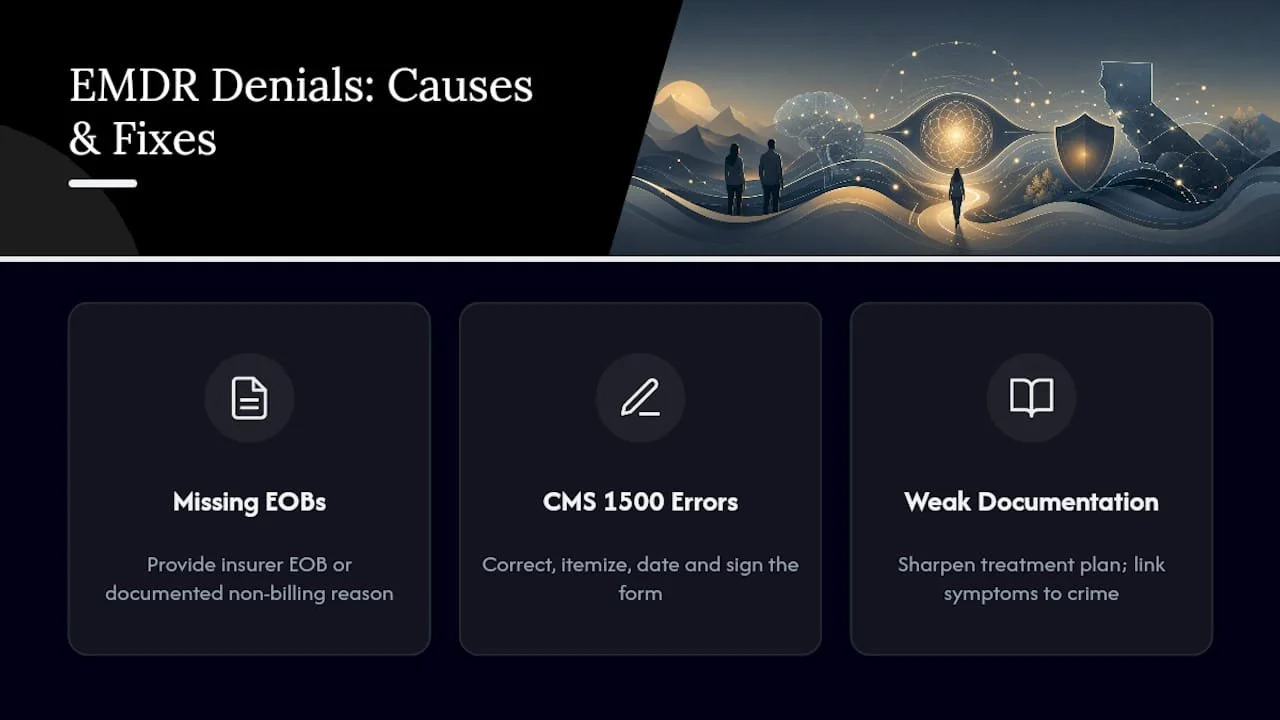
Incomplete or unsigned CMS 1500 forms come next. A missing supervisor signature on an associate's billing, a date-of-service mismatch, or a form that bundles multiple sessions instead of itemizing them will all bounce back for correction.
The third, and arguably the most avoidable, is documentation that doesn't clearly tie the EMDR sessions to the qualifying crime. If a treatment plan is vague, or progress notes drift toward symptoms that aren't obviously crime-related, reviewers can't approve the claim as written. The fix is almost always the same: go back to the Treatment Plan, sharpen the language connecting symptoms to the crime, and resubmit with clearer notes. Most denials aren't permanent. They're a request for better paperwork, and a therapist who knows the CalVCB process can usually resolve them within one billing cycle.
The Real Bottleneck Isn't Coverage, It's Paperwork Literacy
The question "does CalVCB cover EMDR" has a simple answer, but it hides the actual problem most claimants run into. CalVCB was never going to reject a legitimate, well-documented trauma treatment. What derails claims is that most therapists, even excellent clinicians, aren't trained in victim-compensation billing the way they're trained in EMDR protocol.
That's a systemic gap, not a personal failing. Graduate programs teach reprocessing phases and clinical technique. They don't teach CMS 1500 formatting or how to write a percent-of-treatment attribution that survives an audit. So the burden quietly shifts to claimants, who are already managing trauma symptoms, to educate their own providers or hunt down a therapist who already knows the system.
The fix isn't more coverage. It's choosing a provider who treats the administrative side of CalVCB claims with the same seriousness as the clinical side. If you're evaluating a therapist, ask about their CalVCB experience before you ask about their EMDR certification. Both matter, but only one of them determines whether you actually get reimbursed on time.
— Juiced
Start EMDR Therapy With CalVCB Documentation Handled From Day One
Some practices work directly with California crime survivors navigating CalVCB, so the paperwork that trips up most claims can get handled correctly the first time. The practice offers individual EMDR therapy for ongoing weekly care, concentrated EMDR intensives starting at $1,500 for a single 4-hour day, and dedicated support for victims of crime that includes completing your Treatment Plan and Mental Health Billing Intake Form at intake.

Some clinicians trained in EMDR are also familiar with CalVCB's documentation requirements, including EOB submission and CMS 1500 billing, so clients may find it helpful not to have to explain the reimbursement process to their own therapist. Bilingual, culturally responsive care is sometimes available for clients in various locations within California. If you're ready to start EMDR and want a provider who already knows how to work with CalVCB, book an individual counseling session or reach out about victims of crime support to get started.
Official CalVCB Resources Worth Bookmarking
Reimbursement guidance: EOB rules, billing basics, and overpayment recovery.
Mental Health Support: session limits and Treatment Plan details for victims.
CalVCB mental health guidelines PDF: CMS 1500 instructions and reimbursement rates.
What Is Covered: full list of reimbursable expenses and exclusions.
Mentalhealth: immediate crisis resources if you need help right now.
This article is general information, not a substitute for advice from a qualified doctor. Consult a qualified healthcare professional about your own circumstances before acting on anything here.
Sources
FAQ
What Does CalVCB Pay For?
CalVCB reimburses expenses directly tied to a qualifying crime, including mental health counseling, medical care, and lost wages in many cases. It's the payor of last resort, meaning insurance or other coverage gets billed first whenever it applies.
What Is Typically Not Covered by CalVCB?
CalVCB does not compensate for pain and suffering, and it won't cover treatment that isn't documented as related to the qualifying crime. Property damage and expenses already reimbursed by another source are also excluded.
How Long Does It Take to Get Paid From CalVCB?
Timelines vary depending on how complete the paperwork is when submitted. Claims with a finished Treatment Plan, proper EOBs, and correctly filed CMS 1500 forms move faster than those missing any of those pieces, which is the biggest factor claimants can actually control.
Does CalVCB Cover EMDR Specifically?
Yes. EMDR qualifies as an evidence-based trauma treatment that CalVCB reimburses like any other covered counseling, as long as it's documented as crime-related and billed correctly. Alvarado Therapy's clinicians handle that documentation directly as part of intake.
Can an Out-of-State Therapist Bill CalVCB for EMDR?
Sometimes. Under Senate Bill 877, effective January 1, 2023, CalVCB can reimburse a clinician licensed in the state where the victim currently lives, even if that's not California, for services starting on or after that date.
