
Healthcare Workers: 4 Trauma Therapies That Fit Shift Schedules

If you're a healthcare worker experiencing intrusive memories, nightmares, or persistent dread after a hard shift, trauma-focused therapy works, and it does not have to mean months of weekly sessions you cannot schedule. Trauma-focused CBT, EMDR, and brief digital interventions all have research support, and several formats are built for people who cannot commit to a standing weekly appointment. The first move is simple: get a confidential screening through an employee assistance program, a peer support pathway, or a trauma-focused clinician, and let that conversation determine which format fits your caseload and your calendar.
TL;DR:
Short, digital trauma interventions can significantly reduce intrusive memories within five weeks, especially when delivered soon after the traumatic event.
For busy healthcare workers, flexible options like EMDR intensives or condensed protocols are available, fitting better into unpredictable shift schedules.
Digital tools such as teletherapy, mobile apps, and asynchronous platforms improve access and reduce stigma, but they should complement professional care for severe symptoms.
Peer support programs are effective for early identification and normalization, but they require organizational integration and clear escalation pathways to licensed clinicians.
Confidential, low-cost trauma care options exist through apps, state resources, and specialized providers, with important questions to ask about privacy, coverage, and treatment format.
Alvaradotherapy
Find Trauma-Informed Support That Fits
Alvarado Therapy offers EMDR, individual counseling, and online care for California adults healing from trauma, anxiety, grief, or PTSD.
Table of Contents
How Trauma Shows Up in Healthcare Workers, and When It's Time for Healthcare Worker Trauma Therapy
Do Digital Tools and Teletherapy Actually Help Shift Workers?
Why We Treat Access and Culture as Part of Trauma Care, Not an Add-On
How Alvarado Therapy Supports Healthcare Workers Ready for Trauma Therapy
How Trauma Shows Up in Healthcare Workers, and When It's Time for Healthcare Worker Trauma Therapy
Trauma in clinical settings rarely announces itself the way textbooks describe it. It shows up as a nurse who cannot stop replaying a code, a paramedic who flinches at a specific siren tone, or a resident who has gone numb to patient deaths that used to hit hard. These are not signs of weakness. They are predictable responses to repeated exposure to death, violence, and high-stakes failure, and they are exactly what healthcare worker trauma therapy is designed to treat.
Watch for these patterns, especially when they cluster together:
Intrusive memories or flashbacks tied to specific patients, codes, or shifts
Nightmares or disrupted sleep connected to clinical events
Avoidance of certain units, procedures, or patient types you used to handle fine
Hypervigilance, a racing heart, or a clenched jaw that does not ease off shift
Emotional numbing or a sense of detachment from patients and coworkers
Moral injury, the specific guilt of having acted against your own values under impossible constraints
Compassion fatigue that overlaps with but is not identical to burnout
Not every rough week needs a formal diagnosis. But certain signals mean it is time to move past coping on your own. If intrusive memories persist beyond a month, if the symptoms are interfering with your ability to function at work or at home, or if you are having thoughts of suicide or self-harm, that is the threshold for specialty care, not self-management. Many hospital systems now run brief screening tools, sometimes modeled on Handle with Care or Helping Healthcare Workers style programs, that take five minutes and flag when a referral makes sense. A quick PTSD self-assessment can also clarify whether what you are experiencing fits a trauma response pattern worth discussing with a clinician.
Which Trauma Therapies Actually Work for Busy Clinicians?
Four modalities dominate the evidence base for trauma and PTSD, and each one has a different rhythm, so the right fit depends partly on your schedule and partly on what your trauma actually looks like.
Trauma-focused CBT targets the thoughts and behaviors that keep trauma responses alive: catastrophic thinking about a bad outcome, avoidance of triggering situations, and the belief that you should have done something differently. It typically runs 12 to 16 weekly sessions and works well for people who like structure and homework between appointments.
EMDR (Eye Movement Desensitization and Reprocessing) uses bilateral stimulation, usually guided eye movements, while you process a specific traumatic memory. It does not require you to narrate the event in detail the way exposure therapy does, which many healthcare workers find easier to tolerate. Standard EMDR runs weekly over several months, but condensed EMDR intensive protocols compress that timeline into a handful of concentrated days, an approach clinical literature on short-term intensive trauma interventions supports for people who cannot sustain a long-term weekly commitment.
Prolonged exposure has you gradually and repeatedly confront trauma memories and triggers, in session and through homework, until the emotional charge fades. It is well-studied and effective, but it demands direct engagement with difficult memories, so it is not the first choice for everyone.
Cognitive processing therapy (CPT) focuses on the meaning you have made of the trauma, particularly the guilt and self-blame common in moral injury. It runs about 12 sessions and pairs well with the kind of "I should have saved them" thinking common among code team members and ICU staff.
Trauma-focused CBT: structured, weekly, strong for anxiety and avoidance patterns
EMDR: memory-focused, available as weekly or intensive format, minimal verbal processing required
Prolonged exposure: direct confrontation of triggers, strong evidence base, demands more from the client
CPT: targets guilt and moral injury, structured weekly format
Pro Tip: If weekly appointments keep getting bumped by call shifts, ask specifically about EMDR intensives or condensed protocols during your first consultation. Many clinicians who treat trauma will restructure the format around your schedule rather than the other way around.
None of these are appropriate to self-administer around active medical instability, uncontrolled substance use, or acute psychosis. Reviews of short-term intensive trauma interventions are consistent on this point: intensives and single-symptom protocols work best when supervised by an experienced trauma clinician who can pace the work to your stability, not compress it regardless of readiness.
Do Digital Tools and Teletherapy Actually Help Shift Workers?
Yes, and the evidence for at least one specific technique is stronger than most people expect. A randomized controlled trial tested a brief, digitally delivered imagery-competing task, essentially a structured mental exercise you do soon after a distressing event, against an active control group of frontline healthcare workers exposed to trauma.
The intervention group had a median of 1.0 intrusive memories at five weeks, compared to 5.0 in the control group — a statistically significant relative reduction (incidence rate ratio of 0.30), according to the randomized controlled trial published in PMC. That is a striking result for something that takes minutes, not months, and it suggests brief behavioral tools deployed close to the traumatic event can blunt the intrusive-memory cycle before it calcifies into full PTSD.
Beyond single techniques, broader digital infrastructure is closing access gaps that have kept clinicians away from care for years. A comprehensive review of digital mental health tools for nurses found that teletherapy, mobile apps, and AI-supported tools reduce the anonymity and scheduling barriers unique to shift-based work, with documented improvements in burnout, anxiety, and PTSD symptoms when the tools are tailored to nursing schedules rather than generic wellness apps.
Teletherapy: matches trauma-focused CBT, EMDR, and CPT to any shift, including night rotations
App-based supports like PTSD Coach: free, anonymous, useful for symptom tracking between sessions
Asynchronous platforms: message-based check-ins for clinicians who cannot guarantee a live appointment slot
None of this replaces a clinician when symptoms are severe. Digital tools work best layered on top of professional care, or as a bridge while you wait for an intake appointment. If self-guided tools are not moving the needle within a few weeks, or symptoms are getting worse rather than better, that is the signal to escalate to a licensed trauma specialist rather than keep troubleshooting on an app.
What Peer Support and Employer Programs Can (and Can't) Do
Peer support programs, sometimes called trauma support pathways or TSPs, work by pairing affected staff with trained colleagues who have been through similar experiences. Research on these programs finds they genuinely normalize stress reactions and speed up early referral, because a peer conversation carries less stigma than walking into occupational health.
An implementation study on trauma support programs for healthcare workers found that peer practitioners and psychologists both saw real value in these pathways for early identification, but flagged a consistent limitation: the benefit only holds if the program is built into organizational policy, with clear escalation routes to licensed clinicians. A peer conversation that goes nowhere after the initial check-in is a missed opportunity, not a support system.
The stronger organizational model combines screening with a structured intervention. A randomized controlled trial of 501 nurses tested psychologically safe screening alone versus screening paired with MINDBODYSTRONG, a digitized cognitive-behavioral skill-building (CBSB) program. The combined approach produced sustained improvements in burnout, anxiety, and depression symptoms over several months, beyond what screening alone achieved. Broader workforce research echoes this: the Future of Nursing 2020-2030 report concludes that personal resilience skills only move the needle when paired with organizational changes like psychological safety and workload adjustment.
If your workplace has these programs, here is how to use them without losing ground on privacy:
Ask occupational health or HR whether a peer support or trauma support pathway exists, and whether it is voluntary and confidential by policy, not just by informal practice.
Request the specific escalation path: who you would be referred to, and whether that referral requires disclosure to your supervisor or licensing board.
If no formal program exists, ask whether your EAP covers trauma-focused therapy sessions, and how many, before you commit to an external provider.
An employer or a partner focused on workplace mental health strategy can help organizations build these screening and referral structures correctly, but as an individual clinician, your leverage is simply asking the right questions before you disclose anything.
How to Find Confidential, Affordable Trauma Care
Start with what is free before you spend anything. The PTSD Coach app from the U.S. Department of Veterans Affairs is not just for veterans. It offers symptom tracking, grounding exercises, and psychoeducation anonymously, and it pairs well with the VA's provider toolkit for coping with burnout and secondary traumatic stress, which many hospital systems adapt for their own staff. State health departments also maintain resource pages; Massachusetts, for example, lists free and low-cost services for healthcare workers including therapy-aid programs and crisis lines built specifically for clinical staff.
Before booking with any provider, ask these questions directly:
Is this confidential from my employer, and does anything trigger a licensing board report?
Do you offer telehealth, and what hours, given rotating shifts?
Do you offer intensive or condensed formats if weekly sessions aren't realistic?
Is there a sliding scale, and does insurance cover trauma-focused modalities like EMDR or CPT?
Pro Tip: Bring a rough timeline of the events bothering you to your first intake, not a polished narrative. Clinicians trained in trauma work will guide the conversation; you do not need to arrive with a clean story, and pushing yourself to over-explain before you're ready can backfire.
At intake, you do not need every detail resolved. A trauma recovery workflow can help you organize what to bring and what to expect, whether you are heading into weekly sessions or an intensive format.
What Does the Research Actually Show?
The strongest recent evidence for healthcare-worker-specific trauma interventions comes from three distinct study types, each answering a slightly different question.
| Study type | What it tested | Key finding |
|---|---|---|
| Randomized controlled trial | Brief digital imagery-competing task vs. active control | Intrusive memories dropped to a median of 1.0 vs. 5.0 at five weeks (IRR = 0.30) |
| Systematic review | Digital mental health tools (teletherapy, apps, AI) for nurses | Documented improvements in burnout, anxiety, and PTSD symptoms with shift-tailored tools |
| Randomized controlled trial (n=501) | Screening alone vs. screening plus digitized MINDBODYSTRONG CBSB program | Sustained burnout and symptom reductions over several months in the combined group |
Each study answers a different piece of the puzzle: what stops a single traumatic memory from spiraling, what infrastructure makes ongoing care accessible, and what organizational combination sustains improvement over months rather than weeks. Read together, they point toward a layered approach rather than any single fix.
Legal and Ethical Considerations Before You Disclose Trauma
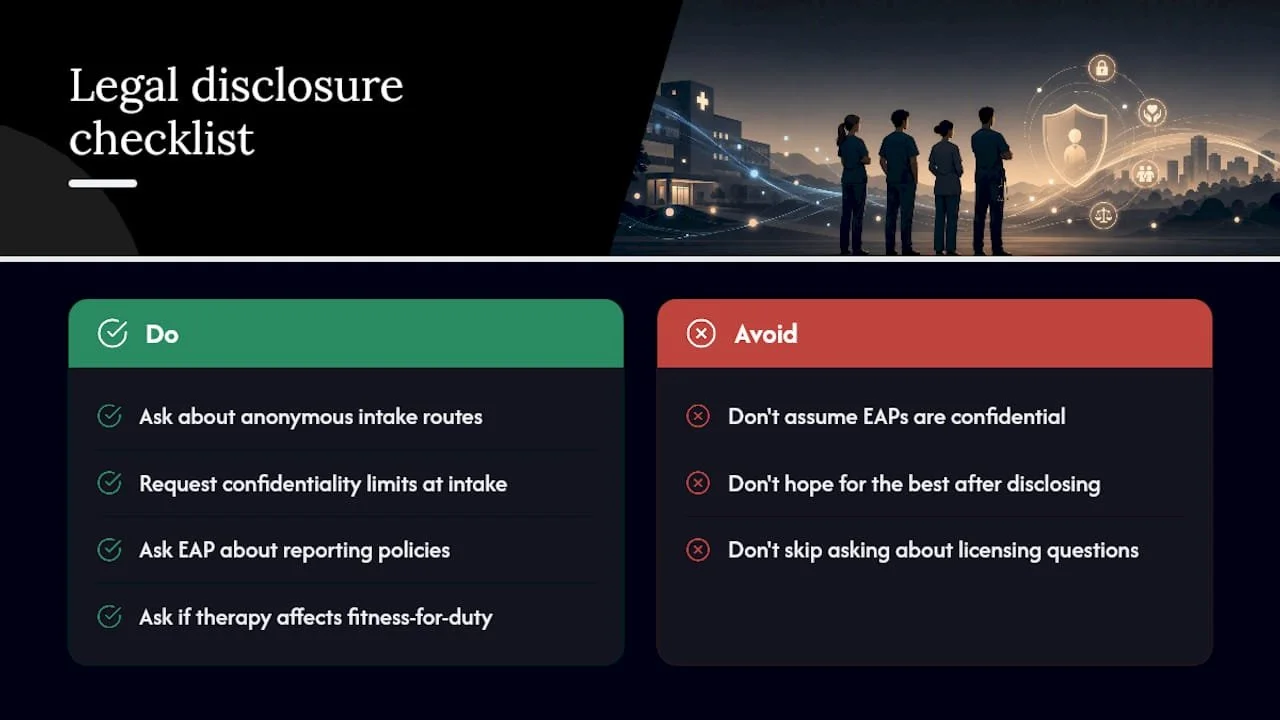
Confidentiality concerns keep more healthcare workers out of therapy than almost any other barrier, and the concern is not irrational. Licensing boards in many states ask about mental health treatment history during renewal, which creates real hesitation about seeking help. According to nursing board mental health resources in Washington State, specialized programs increasingly offer anonymous or confidential intake routes specifically designed to avoid triggering mandatory reporting or employer disclosure, and it is worth asking any prospective clinician whether they operate within one of these frameworks.
Standard therapist-patient confidentiality (protected under HIPAA in the United States) covers most of what you say in session, with narrow exceptions: imminent danger to yourself or others, suspected abuse of a child or dependent adult, or a court order. A trauma clinician should walk you through these limits explicitly at intake, not bury them in paperwork you skim and sign.
Employer-sponsored EAPs occupy a gray zone worth understanding before you use one. Many EAPs are confidential by contract and do not report back to HR beyond aggregate usage statistics, but policies vary by employer and by state, so ask directly rather than assuming. If your job requires periodic fitness-for-duty evaluations, ask your EAP counselor upfront whether standard trauma therapy sessions could ever factor into that process. Getting a clear answer before you disclose anything protects you far better than hoping for the best afterward.
Should Family Be Part of the Healing Process?
Trauma from clinical work rarely stays contained to the person who experienced it. A partner who cannot understand why you have gone quiet after a bad shift, or kids who notice you flinch at hospital dramas on TV, are living with secondary effects even when they were never in the room.
Bringing family into the process does not mean detailed disclosure of clinical events, which can itself be traumatizing to share and to hear. It means helping the people closest to you understand the shape of what you are dealing with: that certain triggers exist, that withdrawal is a symptom and not rejection, and that recovery is not linear. Many trauma clinicians offer occasional joint sessions, or can coach you on language to use at home, without turning family members into co-therapists for your trauma.
For clinicians whose trauma symptoms are affecting a relationship directly, whether through emotional withdrawal, irritability, or numbing, couples-focused work alongside individual trauma therapy can address dynamics that individual sessions alone will not touch. Support does not have to be clinical, either. Peer groups made up of other healthcare workers, or online communities specific to your specialty, can carry weight that family members, however well-meaning, often cannot, simply because the shared context is already understood.
Why We Treat Access and Culture as Part of Trauma Care, Not an Add-On
Trauma-informed care means more than knowing EMDR protocols. It means recognizing that a bilingual nurse processing a traumatic loss may need to do that work in Spanish, not translated English, and that a Latinx, BIPOC, or LGBTQ+ clinician carries layered stressors, discrimination on top of clinical trauma, that generic protocols miss entirely. Culturally responsive care improves engagement precisely because it removes the extra labor of explaining your identity before you can even start on the trauma itself.
That shapes how some trauma therapy services are built: bilingual English and Spanish sessions, identity-affirming practice, and EMDR intensives designed for people who cannot sustain months of weekly appointments around clinical schedules. If you recognize your own experience in what this article describes, that recognition itself is worth acting on.
— Juiced
How Alvarado Therapy Supports Healthcare Workers Ready for Trauma Therapy
Some providers offer healthcare workers trauma-focused care that does not require restructuring your entire schedule around weekly appointments. The 3-Day EMDR Intensive ($5,750) and shorter 1-Day EMDR Intensive options ($2,250 for six hours, $1,500 for four hours) compress months of processing into a block of days you can plan around call rotations, using time off strategically instead of stretching treatment across a semester.
For clinicians who prefer a standard weekly rhythm, Individual Counseling and EMDR Therapy sessions are available in both English and Spanish, with trauma-informed, identity-affirming care for Latinx, BIPOC, and LGBTQ+ clients. Intake often starts with understanding your symptoms and your schedule constraints, and discussions can help determine whether an intensive or a standard weekly format fits your situation better. If your trauma is tangled up in a relationship strain at home, Couples Therapy is also available alongside individual work. Reach out through the site to schedule a consultation and find out which format fits your caseload.
Where to Get Immediate Support and Information
PTSD Coach app (VA), free, anonymous symptom tracking and coping tools
VA provider toolkit, practical assessment and referral resources for clinicians
Massachusetts healthcare worker mental health resources, a model for state-level free and low-cost services
NAMI resources for healthcare professionals, peer and professional support directories
This article is general information, not a substitute for advice from a qualified doctor. Consult a qualified healthcare professional about your own circumstances before acting on anything here.
Sources
FAQ
Do Healthcare Workers Get Free Therapy?
Many do, through employer EAPs, state-run programs, or free tools like the PTSD Coach app, though coverage varies widely by employer and state; check your EAP benefits and your state health department's resource page first.
What Degree Do You Need to Become a Trauma Therapist?
Trauma therapists typically hold a master's degree in counseling, social work, or psychology, plus state licensure and specialized training in modalities like EMDR or trauma-focused CBT, which usually requires additional certification beyond the degree itself.
Who Should Not Do EMDR?
EMDR is generally not started during acute medical instability, active severe substance use, or uncontrolled psychosis; a trauma clinician should assess stability before beginning, and short-term intensive protocols specifically call for experienced clinical supervision.
What Is the Difference Between Trauma and PTSD?
Trauma refers to the distressing event and the body's stress response to it, while PTSD is a diagnosable condition marked by persistent intrusive memories, avoidance, hypervigilance, and mood changes lasting more than a month and causing real functional impairment.
Does Alvarado Therapy Offer Bilingual Trauma Therapy for Healthcare Workers?
Yes, Alvarado Therapy provides trauma-informed individual counseling and EMDR therapy in both English and Spanish, along with EMDR intensives for clinicians who need condensed treatment timelines.
