
Somatic Grounding Exercises: Safe Tools at Home for Anxiety Spikes

Somatic grounding exercises are short, body-based practices that pull your attention into the present and help settle acute anxiety, so you feel calmer, more present, and less overwhelmed. Guidance from the National Center for PTSD and systematic reviews of mind-body work back this approach. Try the quick list below.
TL;DR:
For acute spikes, use sensory naming, feet pressure, or a cold object; during dissociation, stand, keep your eyes open, and move.
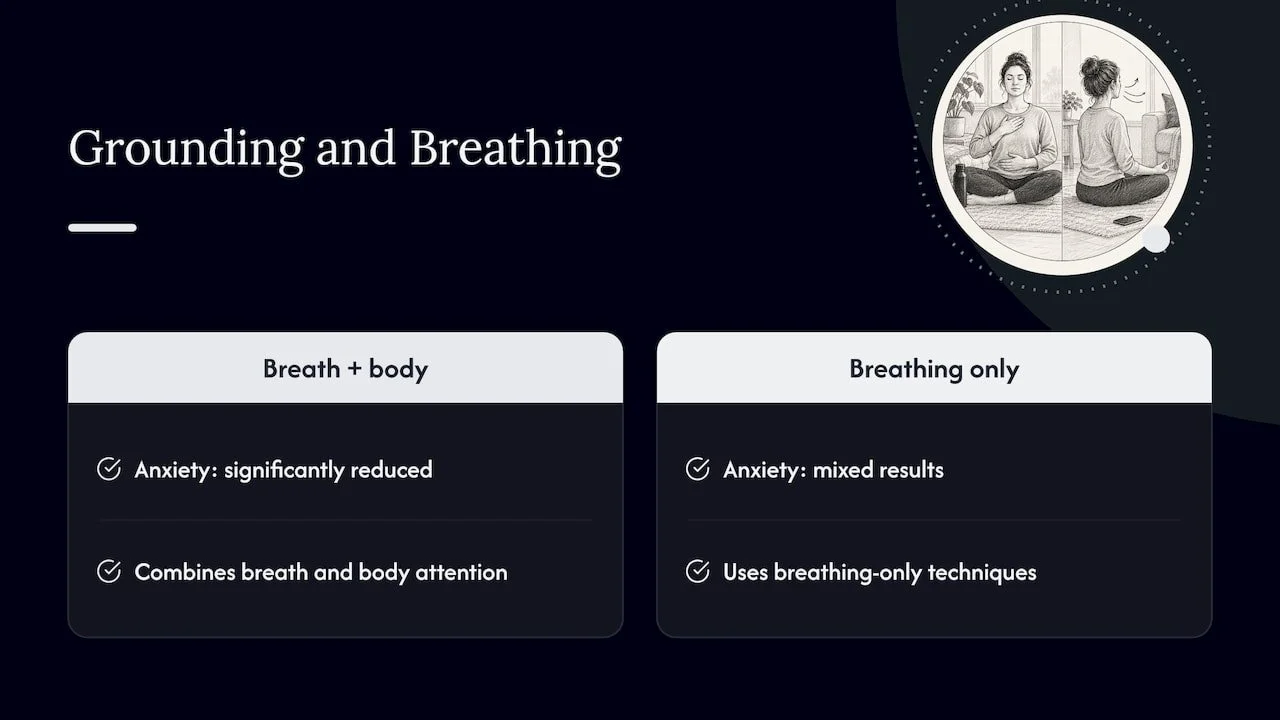
Pair a longer exhale with a sensory or body anchor: a review found combined approaches reduced state anxiety, while breathing only approaches showed mixed results.
Start with an exercise each day for 60 seconds, add an afternoon check after three days, then practice for five to ten minutes in week two.
Stop and switch to an external anchor if panic rises, dissociation worsens, or flashbacks emerge; seek professional support when symptoms persist or disrupt daily life.
Alvaradotherapy
Find Support for Anxiety and Trauma
Alvarado Therapy offers trauma-informed counseling and EMDR for anxiety and trauma, with licensed therapists serving clients across California online.
Table of Contents
Which somatic grounding exercises can you try right now?
Pick one that fits where you are. None of these needs equipment, and most are quick to try.
5-4-3-2-1 sensory grounding: name five things you see, four you feel, three you hear, two you smell, and one you taste. Use it when your thoughts are racing. Adapt it by turning your head slowly to find each item, or keep your eyes open and name objects aloud.
Diaphragmatic breathing: breathe low into your belly and make the exhale longer than the inhale. Use it for rising tension. Adapt it by resting your hands on your lap instead of your belly if focusing on your torso feels uncomfortable.
Progressive muscle relaxation: tense then release one muscle group at a time. Use it when stress sits in your body. Adapt it by tensing only your hands and feet and keeping your eyes open.
Feet-on-floor weighting: press your feet into the floor and notice the support beneath you. Use it when you feel floaty or spacey. Adapt it by standing and looking at a fixed object across the room.
Cold-water or temperature anchor: hold a cold glass or splash cool water on your face. Use it for sudden spikes. Adapt it by holding the glass while describing its color and shape out loud.
Hand or ear massage: press and rub the fleshy part of your palm or gently pull the outer edge of each ear. Use it when you need something discreet. Adapt it by using a textured object, such as a smooth stone, if touching yourself feels unsafe.
Gentle rhythmic movement: rock slowly side to side or walk at an even pace. Use it when sitting still makes things worse. Adapt it by walking while noticing three sounds outside.
Container imagery: picture placing a worry inside a sturdy box and closing the lid. Use it when intrusive thoughts crowd in. Adapt it by describing a real box in the room rather than imagining one.
Pro Tip: Start with a short round and add time only if you feel steady. End before distress rises, and let your body get used to grounding gradually.
How do you do the top five exercises step by step?
Each sequence below is built to be repeatable. Acute tools run 30 to 120 seconds, while longer practices run 5 to 15 minutes.
5-4-3-2-1 with head and eye movement
Sit or stand and let your eyes move slowly around the room, turning your head with them.
Name five things you see, saying each one aloud or silently.
Name four things you can touch, and actually touch two of them.
Name three sounds, near or far.
Name two scents, or recall two you like.
Name one taste, such as sipping water or noticing your mouth.
The Cleveland Clinic notes that sight is usually the easiest sense to start with and taste the hardest, and that regular practice makes the technique work better.
Diaphragmatic breathing with pacing
Sit with your back supported and place one hand on your belly.
Inhale through your nose for a count of four, letting your belly rise.
Exhale through pursed lips for a count of six to eight.
Repeat for six to ten breaths, then breathe normally and notice what changed.
If counting feels stressful, drop the numbers and simply make each exhale a little slower than the inhale.
Brief progressive muscle relaxation
Start with your feet: curl your toes briefly, then release.
Move up through your calves, thighs, belly, hands, shoulders, and face.
Keep the tension moderate, never painful.
Finish with a few slow breaths and notice any warmth or heaviness.
The full sequence takes several minutes. When you are short on time, use only hands, shoulders, and face.
Weighted grounding and feet contact checklist
Place both feet flat on the floor, shoes on or off.
Notice the pressure under your heels, the balls of your feet, and your toes.
Press down gently for five seconds, then ease off.
Feel the chair or floor holding your weight.
Name the surface under you: carpet, wood, tile.
A heavy blanket or a backpack resting on your lap adds weight if you want more input.
Hand or ear massage
Rest one hand palm up and press your opposite thumb into the center of the palm.
Use firm but comfortable pressure and make slow circles briefly.
Squeeze the base of each finger, then switch hands.
For ears, pinch the outer rim between thumb and finger and gently pull outward, working from top to lobe.
Pressure should feel like a satisfying squeeze, never a sharp ache.
Pro Tip: Practice when you are already fairly calm. A skill you have rehearsed is far easier to reach for when your stress is high.
Troubleshooting common reactions
Dizziness: shorten your breaths, breathe normally, and press your feet into the floor.
Racing heart: stop breath counting and switch to the 5-4-3-2-1 sensory exercise or a slow walk.
Feeling more anxious inside your body: open your eyes, look at something in the room, and name it.
Feeling stuck or frozen: stand up, shift your weight, and move your arms.
For more fast options, see our post on grounding techniques for trauma.
Why does grounding calm your nervous system?
When anxiety spikes, the mind loops through worries and the body braces for threat. Grounding interrupts that loop by giving your senses something concrete to process. This pulls you back into an orienting response, the natural act of looking around and confirming your surroundings are safe. As your attention settles on the room, rumination loses fuel.
Slow breathing works on a second track. A longer exhale is associated with a shift toward the parasympathetic branch of your nervous system, the part that supports rest and recovery, which is why many exercises cue a slow release of breath.
Therapists describe it in similar terms. Many people try to think their way out of anxiety, while grounding uses touch, temperature, and movement to send signals of safety to the autonomic nervous system and bypass distressing thought loops.
Research points the same direction. A systematic review of brief interventions found that strategies combining attention to breath and body reduced state anxiety significantly, while breathing-only approaches gave mixed results. In practice, that means pairing breath with a body or sensory anchor is often your strongest move during an anxious moment.
When should you use a quick exercise versus a longer practice?
A simple rule: match the tool to the intensity.
Spikes: use 5-4-3-2-1, feet-on-floor, or a cold anchor.
Rebuilding and resilience: use progressive muscle relaxation, paced breathing, or a slow walk.
Dissociation: stand up, hold something with texture or temperature, and keep your eyes open and moving.
Limited privacy: choose discreet options such as hand pressure, feet contact, or silent sensory naming.
A flexible two-week starter plan
Days 1 to 3: one 60-second exercise each morning. Just notice how your body feels before and after.
Days 4 to 7: add a second micro-check mid-afternoon, rotating tools to find your favorite.
Days 8 to 10: keep the daily micro-checks and add one 5 to 10 minute session of muscle relaxation or paced breathing.
Days 11 to 14: hold two longer sessions across the week and use a quick tool the next time stress rises.
Track calm minutes and whether your chosen tool helped. Small, steady practice tends to beat occasional long sessions, and the research on duration is still unsettled, so let your own results guide you. Our clinician-safe polyvagal exercises can round out your toolkit.
How can you practice grounding safely?
Turning attention inward can briefly raise distress for some people, especially after trauma. The National Center for PTSD suggests that if one technique causes discomfort, you adjust it, for example by opening your eyes, walking, or pairing it with a pleasant outside activity such as music, rather than giving up. Short sessions help too.
Stop and switch techniques if you notice:
Growing dissociation, such as feeling unreal or far away
Rising panic that is climbing instead of leveling off
A flashback or vivid intrusive memory
When that happens, move to an external anchor: look around the room, name objects, hold something cold, or walk.
Seek professional support if symptoms persist, worsen, or interfere with sleep, work, or relationships. Grounding is a helpful adjunct, but it does not replace trauma-focused therapy when you need it. If you are considering counseling, our guide on preparing for a counseling session as a trauma survivor can ease the first step. Gentle movement can also help when anxiety shows up as muscle tension, and this overview of stress and back pain explains the connection.
What do clinicians and research say about these practices?
Therapists use sensory input to cut through cognitive loops and calm the autonomic nervous system, which is the clinical rationale behind nearly every exercise above.
The research supports that logic. The systematic review of brief interventions found that combined attention-to-breath-and-body approaches significantly reduced state anxiety, and that brief embodiment strategies helped consistently. A meta-analysis of mind-body exercises in people with PTSD found significant improvements in PTSD symptoms, depression, and anxiety, and suggested these practices can serve as adjuncts to conventional treatment.
Some caveats matter. Breathing-only techniques showed mixed results, and the best frequency and duration for mind-body practice remain unclear. That is why we encourage you to tailor your practice, test what works for your body, and bring in a clinician when self-help stalls.
What would a clinician tell you about starting small?
Treat grounding as an experiment, not a test you can fail. Some tools will fall flat and others will surprise you, and both results are useful information. Begin with the smallest version, such as one slow breath and one object named aloud, and stop before you feel pushed. Progress usually looks quiet: a spike that fades a little faster, a night that feels a little easier.
Keep a short log with the date, the tool you used, the minutes spent, and what changed in your body or mood. With regular tracking, patterns may appear that you would never spot from memory. And if the log shows you are working hard with little relief, that is a good moment to bring in support rather than push alone.
— Juiced
When does clinician-guided support make sense?
Self-practice is a strong start, and some people want a guide. Our clinicians offer trauma-informed individual counseling and EMDR therapy, bilingual care in English and Spanish, and online appointments. You may prefer clinician-guided work if:
Dissociation keeps returning despite practice
Your symptoms are getting worse
You want treatment aimed at the roots of trauma rather than only managing spikes
We can teach grounding skills at your pace and build them into a plan that fits your life. Learn more about individual counseling and EMDR therapy and reach out when you are ready to book a first conversation.
This article is general information, not a substitute for advice from a qualified doctor. Consult a qualified healthcare professional about your own circumstances before acting on anything here.
FAQ
How do you do somatic experiencing at home?
Start by noticing one physical sensation, such as your feet on the floor, without trying to change it. If attention to your body feels uncomfortable, anchor on something outside you first. Deeper somatic work is best done with a trained clinician.
How do I calm down my nervous system quickly?
Slow your exhale so it runs longer than your inhale, and add a sensory anchor like holding something cold. Combined breath-and-body strategies reduced state anxiety in a systematic review. A brief practice may be enough to help you notice a shift.
What are effective grounding techniques for anxiety?
Good starting options include 5-4-3-2-1 sensory naming, feet-on-floor weighting, paced belly breathing, muscle relaxation, and temperature anchors. Choose the one that feels safest in your body. Rotate tools to see which helps most.
What is the somatic nervous system and what does it do?
It is the part of your nervous system that carries sensation from your body and controls voluntary movement. Somatic grounding uses that channel, through touch, posture, and movement, to help your body settle.
Sources
5 Grounding Techniques Therapists Use—and Why They Work | Psychology Today
Coping with Traumatic Stress Reactions - PTSD: National Center for PTSD
