
U.S. Therapy Superbill: 4 Steps to Seek Reimbursement

A therapy superbill is a detailed receipt your therapist gives you after a session, listing the codes and fees an insurance company needs to process an out-of-network claim. Submitting one does not guarantee payment, but it can lead to partial reimbursement depending on your plan's out-of-network benefits. The rest of this guide walks through exactly what insurers require and how to submit a claim correctly.
TL;DR:
Before submitting, verify your name, provider’s NPI, service dates, CPT and diagnosis codes, charges, payments, and signature; small errors can delay or derail claims.
Insurers may require their own claim form, proof of payment, and insurance card copies alongside the superbill; use the accepted submission channel and save confirmation.
Payment depends on your deductible, coinsurance, and insurer’s allowed amount, not the therapist’s fee; choosing a therapist outside your network generally leaves you responsible for the difference.
If a claim is downcoded, request the written denial and payment benchmark; therapist documentation can support a formal appeal filed before your plan’s deadline.
HSA or FSA funds may cover eligible therapy expenses, but keep superbills for substantiation and check administrator rules before combining account payments with insurance reimbursement.
Alvaradotherapy
Find Therapy Support Beyond Paperwork
Alvarado Therapy offers trauma-informed counseling, EMDR therapy, and online care across California for adults seeking support with healing.
Table of Contents
What a superbill contains: fields to check before you submit
What insurers typically reimburse for out-of-network therapy
Using superbills with out-of-network benefits, HSAs, and FSAs
What a superbill contains: fields to check before you submit
Before sending anything to your insurer, scan your superbill for accuracy. Insurers reject claims over small errors, so this check matters more than it looks.
Your full name and, when your plan requires it, your member ID number
Provider name, credentials, National Provider Identifier (NPI), practice address, and phone number
Dates of service, CPT procedure codes, number of units, ICD-10 diagnosis code, and place of service
Charges billed, any payments you already made, remaining balance, and the provider's signature or attestation
Each field feeds directly into how a claims processor matches your visit to your plan's coverage rules, so a missing NPI or an incorrect date can stall the whole claim.
How to request a superbill from your therapist
Most therapists are used to this request, so a short, specific message usually gets a quick response. Ask by email or during a session, and name exactly what you need.
"Could you send me a superbill for our sessions, including CPT and ICD-10 codes, your NPI, and the dates of service?"
"Can I get this as a PDF, or would a mailed copy work better for your office?"
Ask after each session if you plan to submit claims monthly, or request a single statement covering several visits at once. Larger practices often export superbills directly from their electronic health record system quickly; smaller or solo practices may need longer to prepare one by hand. Once you receive it, check the dates, codes, and your personal information before filing it away.
Pro Tip: Request your superbill right after your last session of the month, while the details are still fresh for your therapist to confirm.
How to submit a superbill to your insurer step by step
Submission generally follows the same pattern across insurers, even though the exact forms and contact methods vary by plan.
Log into your insurer's member portal or call the number on your insurance card to locate the out-of-network claim form and confirm your member ID.
Gather your documents: the superbill, proof of payment or a receipt, the completed claim form if your plan requires one, and a copy of the front and back of your insurance card.
Submit through whichever channel your insurer accepts, portal upload, fax, or mail, using the address or fax number listed on their website, and keep a copy or confirmation of what you sent.
Track the claim using the confirmation or claim number you receive, and follow up if you have not heard back within the timeframe your plan publishes.
A few habits make this process smoother:
Keep a folder, physical or digital, with copies of every superbill and claim form you submit.
Note the date you mailed or uploaded each claim in case you need to reference it later.
What insurers typically reimburse for out-of-network therapy
Reimbursement amounts depend on your plan's deductible, coinsurance percentage, and out-of-network benefit level, along with the insurer's own allowed amount for that service. Insurers often calculate payment using internal benchmarks, sometimes referencing a qualifying payment amount or a usual-and-customary rate rather than your therapist's actual fee.
The federal No Surprises Act generally does not apply when you knowingly choose an out-of-network therapist for elective outpatient care, according to UnitedHealthcare's guidance on out-of-network benefits. That means you are typically responsible for the gap between your therapist's fee and whatever amount your insurer allows, and federal protections usually will not limit what you owe. Partial reimbursement is common; full coverage of your session fee is not.
Common CPT and diagnosis codes on a therapy superbill
Superbills rely on a small set of recurring codes, and recognizing them helps you confirm your superbill is accurate.
Individual psychotherapy sessions are typically billed with timing-based codes that reflect the length of the session.
Couples or family sessions, and specialized approaches like EMDR, use their own distinct codes separate from standard individual therapy codes.
The ICD-10 diagnosis code reflects your clinical diagnosis, and an inaccurate or vague code can affect whether a claim is processed smoothly.
If a code on your superbill looks unfamiliar or inconsistent with your actual sessions, ask your therapist to confirm it before you submit the claim.
How long reimbursement takes and what paperwork to keep
Insurers' acknowledgment and resolution times vary depending on your plan's internal processing speed.
Keep every Explanation of Benefits (EOB) you receive, since it shows exactly how your insurer calculated the allowed amount, your responsibility, and any reimbursement issued.
Hold onto proof-of-payment receipts in case your insurer requests additional documentation before finalizing a claim.
Understand whether you are filing the claim yourself or whether your provider has an assignment-of-benefits arrangement, since that changes who receives the reimbursement check directly.
If your claim is denied: appeals steps and documentation
Claims get denied for a range of reasons, including missing fields on the superbill, a service that was downcoded to a lower-paying code, or a dispute over medical necessity. The Federal Register's final rules on surprise billing require plans to disclose when a claim was downcoded and what the payment would have been without that change, information that can strengthen an appeal.
Request the denial reason in writing directly from your insurer rather than relying on a verbal explanation.
Ask your insurer for the specific policy language or benchmark they used to calculate the allowed amount.
Get supporting documentation from your therapist, such as session notes or a letter confirming medical necessity.
Submit a formal written appeal before your plan's stated deadline, referencing the specific denial reason.
If the internal appeal fails, escalate to an external review, your state insurance department, or a patient advocate, as outlined in federal guidance on surprise billing protections.
Our blog post on California CalVCB therapy rules covers denial patterns specific to California claims and EOB handling in more depth.
Superbills versus insurance claim forms like CMS-1500
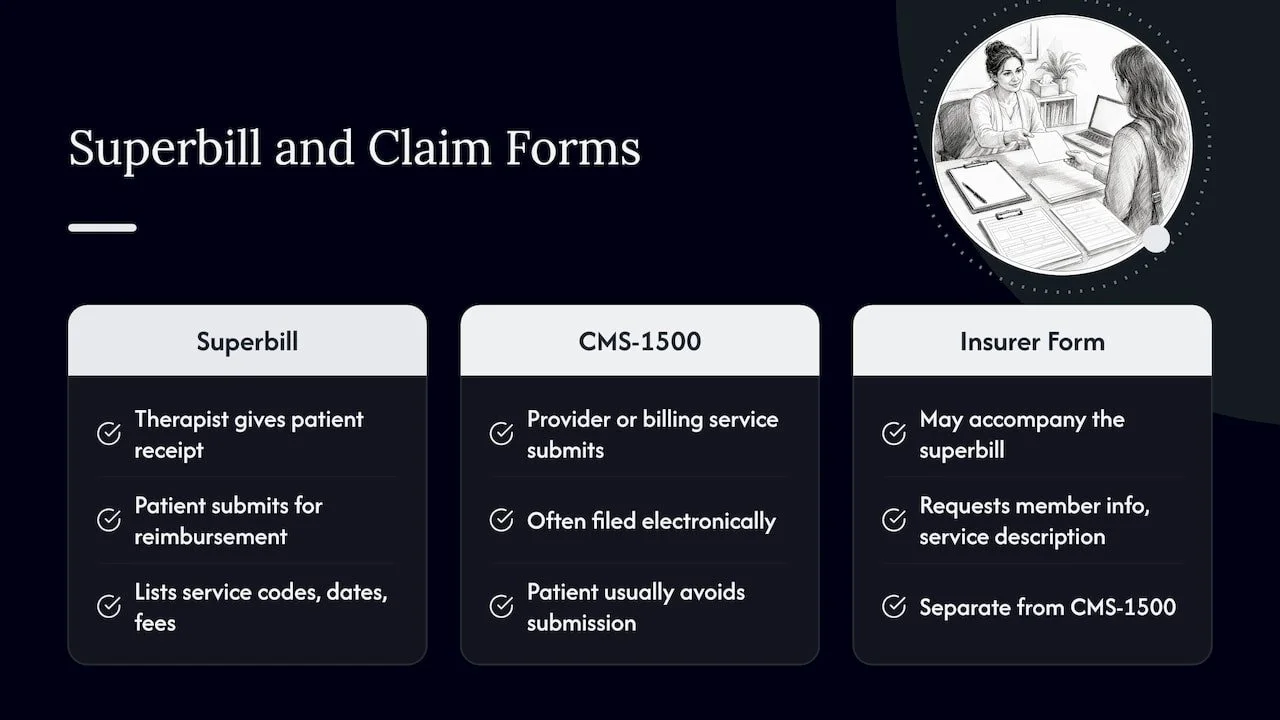
A superbill and an insurance claim form solve related but different problems. A superbill is a receipt your therapist hands directly to you, listing the codes, dates, and fees for services you already paid for out of pocket. You then take that document and submit it yourself to your insurer for possible reimbursement.
A CMS-1500 form, by contrast, is a claim form that providers or billing services may submit directly to an insurer, often electronically, without involving the patient in the submission process. When you see your in-network provider, the office typically files a CMS-1500 claim on your behalf and you only deal with your copay or coinsurance. When you see an out-of-network therapist, there is usually no direct claim filing relationship between the provider and the insurer, so the superbill exists to give you the same underlying billing information in a format you can submit yourself.
Some insurers ask you to attach a completed claim form of their own alongside the superbill, which is a separate document from a CMS-1500 and usually shorter, asking for your member information and a brief description of the service. Always check your specific insurer's out-of-network submission page to confirm whether they want just the superbill, the superbill plus their own form, or both alongside a copy of your insurance card.
Using superbills with out-of-network benefits, HSAs, and FSAs
A superbill plays two separate roles depending on which type of account or benefit you are using it for, and it helps to keep them distinct.
When you submit a superbill to your insurance company for out-of-network reimbursement, you are asking the plan to pay you back a portion of what you already spent, based on your deductible, coinsurance, and the insurer's allowed amount for that service. This is the reimbursement path described throughout this guide.
A Health Savings Account (HSA) or Flexible Spending Account (FSA) works differently. These accounts may let you pay for eligible medical expenses, including therapy. Check with your HSA or FSA administrator about whether a superbill can serve as documentation. If you paid for a session using an HSA or FSA debit card, you typically do not need to submit the superbill anywhere, but keeping it on file protects you if the administrator later asks for substantiation.
It is possible to use both paths for the same expense in different ways, though you generally cannot get reimbursed twice for the same dollar amount. If your insurer reimburses part of your session fee and you paid the original bill with HSA or FSA funds, check your plan administrator's rules on how that overlap should be handled, since double-dipping on the same expense can create a tax issue.
Organizing and tracking superbills across multiple sessions
If you are seeing a therapist weekly or biweekly, superbills can pile up fast, and a simple system saves you from scrambling at tax time or when an insurer requests documentation months later.
Start a dedicated folder, either a physical envelope or a cloud folder, and name each file consistently, for example by date and provider. A basic spreadsheet with columns for session date, amount paid, date submitted to insurance, claim number, and reimbursement received gives you a clear record without much effort. Update it right after each submission rather than trying to reconstruct the timeline later.
If your therapist sends monthly statements instead of per-session superbills, file those under the month they cover and cross-reference them against your payment records. Keeping a running log also makes it far easier to catch a stalled claim, since you can see at a glance which submissions never received an acknowledgment or EOB.
Protecting your privacy when handling superbills
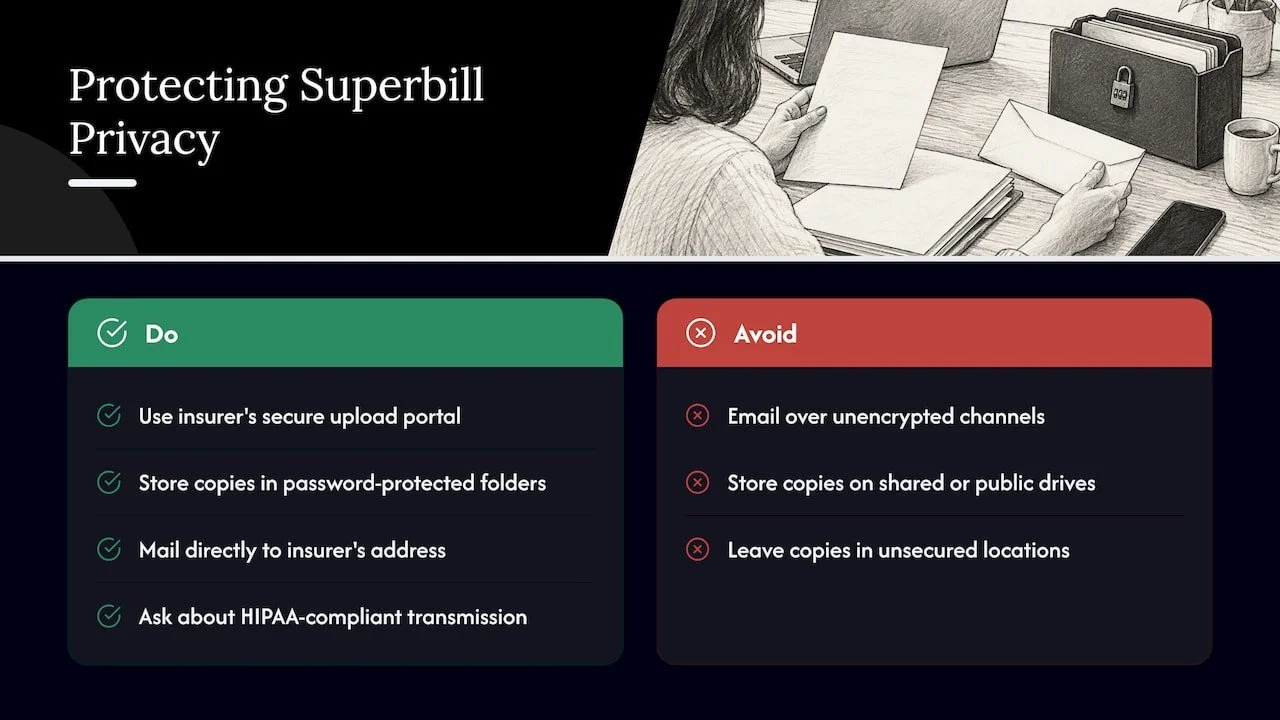
A superbill contains sensitive information, including your diagnosis code, the type of therapy you received, and your provider's details, so it deserves the same care you would give any medical record.
Avoid emailing superbills over unencrypted channels when possible, and use your insurer's secure portal for uploads rather than a general email account. If you store digital copies, keep them in a password-protected folder rather than a shared or public drive. When mailing physical copies, send them directly to the address your insurer provides rather than leaving them in an unsecured location.
Because a superbill reveals your mental health diagnosis, it is worth asking your therapist how their office transmits these documents and whether they use a HIPAA-compliant method for sending them to you. Our guide to the therapy intake process covers how paperwork, including documentation like superbills, is handled securely from your very first appointment.
Why therapists provide superbills in the first place
We support clients who are paying out of pocket, because access to care should not stop at the insurance gap. A correct NPI, an accurate CPT code, and a diagnosis that matches your sessions can be the difference between a processed claim and a denied one, so we encourage clients to double-check these details before submitting. If you want a clearer sense of what paperwork to expect from your first session onward, our what to expect page walks through the process.
— Juiced
Get support beyond the paperwork
Chasing reimbursement forms is only one part of affording trauma-focused care, and we built our practice around reducing the other barriers that get in the way. We offer EMDR Intensives, including a 3-Day EMDR Intensive and shorter one-day formats, for clients who want concentrated symptom relief. Beyond EMDR, we provide individual counseling, couples therapy, immigration psychological evaluations, and support for victims of crime, all delivered in a bilingual, trauma-informed setting across Pasadena, Ventura, and online throughout California. If you are weighing your out-of-network options or want help understanding how a superbill fits your treatment plan, schedule a consultation and we will walk through it with you directly.
FAQ
Are therapists required to provide superbills?
Whether a therapist issues a superbill may depend on their practice policies. Ask the provider what documentation they can provide to support a reimbursement claim. If a provider cannot or will not produce one, ask whether they can at least confirm their NPI, license details, and session dates in writing.
Do insurance companies accept superbills for reimbursement?
Many insurance plans with out-of-network benefits accept superbills as the basis for a reimbursement claim, often alongside their own claim form. Acceptance and reimbursement amount depend entirely on your specific plan's out-of-network coverage terms, so checking your policy details before submitting saves time.
What determines how much an insurer reimburses for a therapy session?
Reimbursement depends on your deductible, coinsurance percentage, and your plan's allowed amount for that service, not simply your therapist's billed fee. The federal No Surprises Act generally does not apply when you choose an out-of-network provider by choice, so you typically absorb the difference between the bill and the allowed amount.
Does my insurance plan accept superbills from any licensed therapist?
Most plans with out-of-network mental health benefits will accept a superbill from any licensed provider with a valid NPI, though some plans exclude certain license types or service categories. Checking your plan's mental health coverage details or calling member services before your first session avoids surprises later.
Sources
Legal - Payment of out-of-network benefits | UnitedHealthcare
[Federal Register :: Requirements Related to Surprise Billing](https://www.federalregister.gov/documents/2022/08/26/2022-18202/requirements-related-to-surprise-billing)
