
EMDR and Phase Based Care: How Adults Heal from Childhood Trauma

Yes, adults heal from childhood trauma. Evidence-based, trauma-focused therapies such as EMDR, CPT, and Prolonged Exposure produce measurable improvement in symptoms, and for trauma rooted in childhood, that work often starts with phase-based stabilization before any memory processing begins. Healing typically looks like fewer intrusive symptoms, steadier emotions, and relationships that don't collapse under old patterns. The right next step is an honest assessment with a licensed clinician who treats childhood trauma specifically, not just anxiety or depression in general.
TL;DR:
Trauma-focused therapies like EMDR, CPT, and Prolonged Exposure are effective for adults healing from childhood trauma, with stabilization often preceding memory processing.
Complex trauma from chronic childhood abuse includes emotion regulation issues, identity confusion, and relationship patterns, requiring phase-based treatment and stabilization first.
EMDR sessions typically last 60 to 90 minutes, with most trauma processing completing in 6 to 12 sessions, though complex cases often need longer durations.
Choosing a trauma specialist involves verifying their specific training, approach to stabilization, and experience with dissociation and cultural considerations.
Therapy progress may include setbacks or flare-ups, which are normal, and often require revisiting stabilization and coping skills before proceeding further.
Alvaradotherapy
Find Trauma-Informed Support in California
Alvarado Therapy offers EMDR and individual counseling for adults healing from childhood trauma, PTSD, anxiety, grief, and complex trauma.
Table of Contents
Evidence-Based Trauma-Focused Therapies: EMDR, CPT, and Prolonged Exposure
How to Choose a Trauma Therapist Who Treats Childhood Trauma
Complex Trauma vs. Single-Incident Trauma: Why the Distinction Matters
Combining Trauma Therapy With Medication and Other Treatment
How Childhood Trauma Shows Up in Adult Life
Childhood trauma rarely announces itself as "trauma" in adulthood. It shows up as a racing heart during a routine performance review, a body that aches for no clear reason, or a relationship pattern that keeps repeating regardless of the partner.
Common signs adults report include:
Persistent anxiety, hypervigilance, or a startle response that feels disproportionate to the situation
Depression, numbness, or a sense of disconnection from one's own life
Sleep disruption, chronic pain, gastrointestinal issues, or autoimmune flare-ups tied to stress
Difficulty trusting others, fear of abandonment, or swinging between clinginess and withdrawal
A harsh inner critic and a persistent sense of being fundamentally flawed
When the trauma was chronic or came from a caregiver, clinicians often see a broader picture called complex trauma: trouble regulating emotion, a shaky sense of identity, and relationship patterns that swing between over-attachment and total avoidance. The Cleveland Clinic notes that adverse childhood experiences carry long-term physical health risks alongside the psychological ones, which is part of why early intervention matters. The encouraging counterpoint: the brain retains the capacity to change at any age, which is the entire premise behind trauma-focused therapy working for adults decades removed from the original events.
Evidence-Based Trauma-Focused Therapies: EMDR, CPT, and Prolonged Exposure
Three therapies dominate the research on adult trauma treatment, and they approach the same problem from different angles. Eye Movement Desensitization and Reprocessing, or EMDR, uses an eight-phase structure that pairs memory recall with bilateral stimulation, usually guided eye movements, to help the brain reprocess stuck memories. Cognitive Processing Therapy (CPT) targets the beliefs trauma leaves behind, the "it was my fault" or "no one can be trusted" thinking that keeps someone stuck. Prolonged Exposure (PE) has clients gradually and repeatedly approach trauma memories and reminders until the fear response fades.
EMDR: eight phases, typically 60 to 90-minute sessions, no requirement to verbally narrate the trauma in detail
CPT: structured worksheets and Socratic dialogue over roughly 12 sessions, strong evidence base for shifting distorted beliefs
PE: imaginal and real-world exposure exercises, usually 8 to 15 sessions, effective but demanding for people not yet ready for direct exposure
Major clinical guidelines are blunt about the hierarchy here: trauma-focused psychotherapies come first, and medication plays a supporting role rather than a leading one.
The VA/DoD PTSD clinical practice guideline recommends CPT, EMDR, and PE as first-line treatments for PTSD, prioritizing psychotherapy over pharmacotherapy whenever a patient can access and tolerate it. The National Center for PTSD echoes this, framing the choice among these three as a collaborative decision rather than a one-size answer.
Fit matters more than any theoretical ranking. Someone who dissociates easily or feels flooded by direct exposure often does better starting with EMDR or a skills-based approach before any exposure work. Someone who processes experience verbally and wants to work through distorted beliefs may respond faster to CPT. None of the three is objectively "stronger" across the board. The right one is the one a person can actually stay in long enough to finish.
Why Phase-Based Care Often Comes First for Childhood Trauma
Adults with a single traumatic incident, a car accident, an assault, often move fairly directly into memory processing. Adults carrying childhood-onset trauma usually can't, because years of relational injury leave gaps in emotion regulation and interpersonal skills that trauma processing alone doesn't fix.
That's the logic behind Skills Training in Affective and Interpersonal Regulation, known as STAIR: a stabilization phase focused on naming emotions, tolerating distress, and rebuilding functional relationships before touching the traumatic memories directly. It's not stalling. It's building the capacity to process trauma without getting overwhelmed by it.
STAIR targets emotion regulation and interpersonal skills first
Processing (EMDR or narrative therapy) follows once those skills are in place
The sequence is designed for people with emotion dysregulation, dissociation, or attachment-based relational trauma
A randomized controlled trial on adult survivors of childhood abuse found that STAIR followed by either EMDR or narrative therapy produced substantial, lasting improvement in PTSD symptoms, with gains holding at follow-up.
Pro Tip: If a therapist wants to jump straight into detailed trauma memories in session one, ask why. A thoughtful clinician usually wants to assess your coping skills and safety first.
How to Choose a Trauma Therapist Who Treats Childhood Trauma
Not every licensed therapist has training in trauma-focused modalities, and that gap matters more here than in almost any other area of mental health.
Check licensure and specialized training. Look for EMDRIA-trained EMDR clinicians, CPT or PE certification, or documented experience with STAIR, DBT, or Internal Family Systems for complex trauma.
Ask about their approach to stabilization. A therapist should be able to explain, in plain language, how they decide when someone is ready for trauma processing.
Ask how they handle dissociation and crisis planning. This reveals whether they've actually worked with complex presentations, not just textbook PTSD.
Weigh telehealth against in-person. Telehealth works well for many adults doing EMDR and talk therapy; in-person may matter more for somatic work or severe dissociation.
Prioritize cultural and linguistic fit. Therapy lands differently when a clinician understands your language, background, and identity without you having to translate your own experience first.
Red flags include a therapist who can't describe their trauma-specific training, dismisses questions about pacing, or pushes exposure work before establishing any safety plan. Sliding-scale clinics, university training clinics, and therapist directories filtered by trauma specialty are practical starting points if cost or access is a barrier.
What to Expect: Sessions, EMDR Structure, and Timelines
Expect variation, not a fixed formula. Standard PTSD often responds within 6 to 12 EMDR sessions, but childhood-onset or complex trauma frequently needs longer sequences, sometimes 16 sessions or more, once stabilization work is factored in.
EMDR itself moves through eight phases: history taking, preparation, target identification, desensitization, installation of a positive belief, body scan, closure, and reevaluation. A single memory can sometimes finish processing in one to three sessions, but complex childhood material usually involves multiple targets processed over time, not one dramatic breakthrough session.
Weekly sessions suit people who want gradual pacing alongside daily life
EMDR intensives compress that same work into consecutive days for people who are stabilized and ready for concentrated processing
Progress looks like fewer triggers, calmer reactions, and relationships that stop repeating old wounds, not a memory disappearing entirely
Practical Supports Between Sessions
Therapy does the heavy lifting, but daily habits either support that work or quietly undermine it.
Grounding techniques: naming five things you can see, slow exhale-focused breathing, or holding something cold to interrupt a flashback
Boundaries and peer support: survivor support groups and honest friendships reduce the isolation that trauma often creates
Sleep, movement, and nutrition: all three influence the brain's capacity for the neuroplastic change therapy depends on
When to escalate: suicidal thoughts, severe dissociation, or feeling unsafe call for immediate professional contact, not a wait-and-see approach
Pro Tip: Keep a simple log of triggers and what helped in the moment. Bring it to sessions. It gives your therapist real data instead of vague memory of a hard week.
Alvaradotherapy's Approach to Childhood Trauma and EMDR
A bilingual, trauma-informed practice in California and New York may use a model combining phase-based stabilization with EMDR for adults carrying childhood-onset trauma. Clients who are stabilized and ready for concentrated work can move into EMDR intensives, while those who prefer gradual weekly pacing can start with individual EMDR therapy. Care is delivered in English and Spanish with attention to cultural and identity fit.
Complex Trauma vs. Single-Incident Trauma: Why the Distinction Matters
A car accident survivor and an adult raised by an unpredictable parent can both meet criteria for PTSD, but their symptom pictures often look nothing alike, and that difference shapes treatment from day one.
Single-incident trauma tends to produce a fairly clean symptom cluster: intrusive memories of the event, avoidance of reminders, hyperarousal, and negative shifts in mood tied specifically to that incident. The person usually had a stable sense of self before the trauma occurred, which gives therapy a baseline to work back toward.
Complex trauma, the pattern that follows chronic childhood abuse, neglect, or an unstable attachment figure, adds layers a single-incident model doesn't cover. There's often no clean "before" to return to, because the trauma happened during the very years identity was forming. Adults with complex trauma frequently describe chronic emotional numbness punctuated by intense emotional flooding, a persistent sense of shame or worthlessness that feels like fact rather than feeling, and relationship patterns marked by either desperate attachment or reflexive distancing. Dissociation, mentally checking out under stress, shows up far more often in complex presentations than in single-incident PTSD.
This is why a therapist trained only in standard PTSD protocols can miss the mark with childhood-trauma survivors. Treatment that ignores the identity and relational damage to complex trauma, and jumps straight to processing a specific memory, often stalls or triggers overwhelming distress. Recognizing which pattern you're dealing with, one incident versus a childhood's worth of accumulated injury, is often the first real diagnostic step toward choosing the right treatment sequence.
How Childhood Trauma Reshapes the Developing Brain
Childhood trauma doesn't just leave emotional scars. It measurably shapes how the brain's stress-response systems develop, and understanding that helps explain why adult symptoms can feel so involuntary.
The amygdala, the brain's threat detector, tends to become more reactive in children exposed to chronic stress or abuse, staying primed to sense danger long after the danger has passed. Meanwhile, the prefrontal cortex, responsible for reasoning through emotional reactions and calming the body down, develops with less capacity to regulate that amygdala response. The result in adulthood is a nervous system that reacts to a raised voice or a slammed door the same way it would react to actual physical threat, because early conditioning wired it that way.
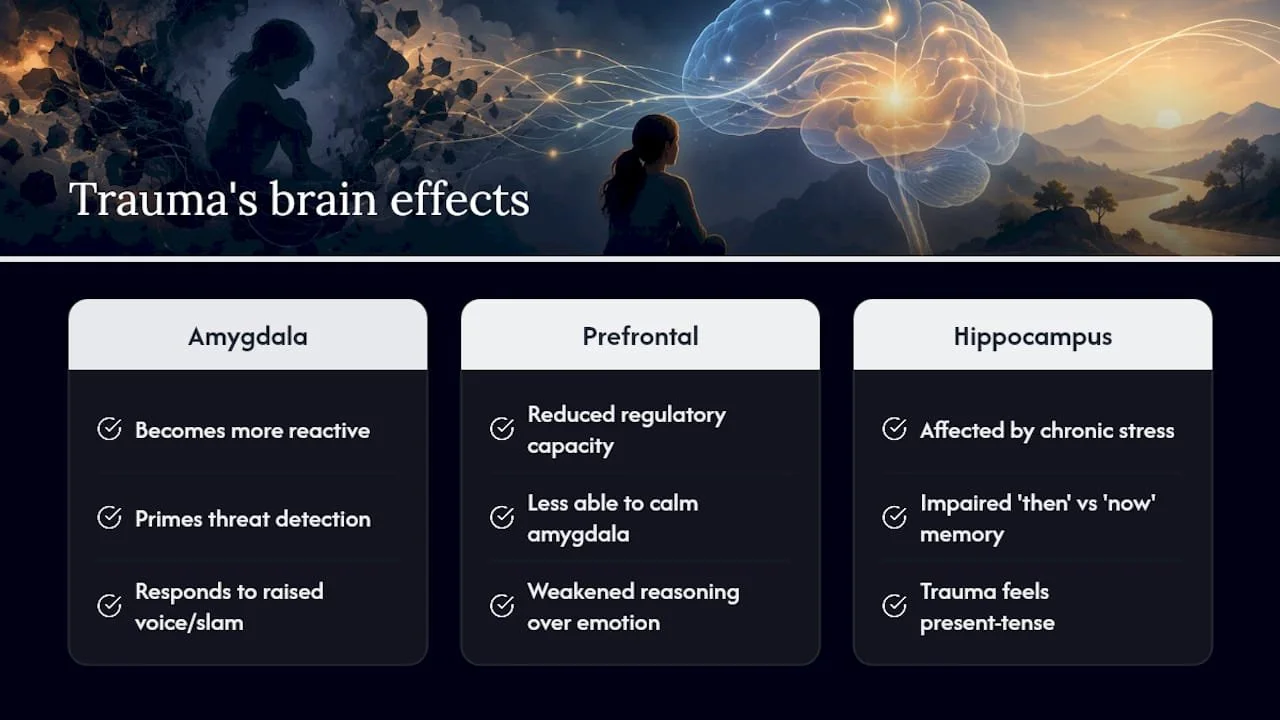
The hippocampus, which handles memory formation and helps the brain distinguish "then" from "now," can also be affected by chronic childhood stress, which partly explains why trauma memories often feel present-tense and physically real rather than filed away as the past.
None of this is permanent. The brain's neuroplasticity persists across the lifespan, which is the actual mechanism behind trauma therapy working for adults decades after the original harm. EMDR's bilateral stimulation, exposure-based reprocessing in PE, and the cognitive restructuring in CPT all appear to work in part by giving the brain new, corrective experiences that weaken those old threat pathways. Therapy isn't erasing what happened. It's retraining a nervous system that adapted to a dangerous childhood and is still running that old program in a life that's actually safer now.
How Attachment Style Shapes the Way Therapy Unfolds
The relationship a child forms with early caregivers builds a template for every close relationship afterward, therapy included, and that template shows up in session whether a client names it or not.
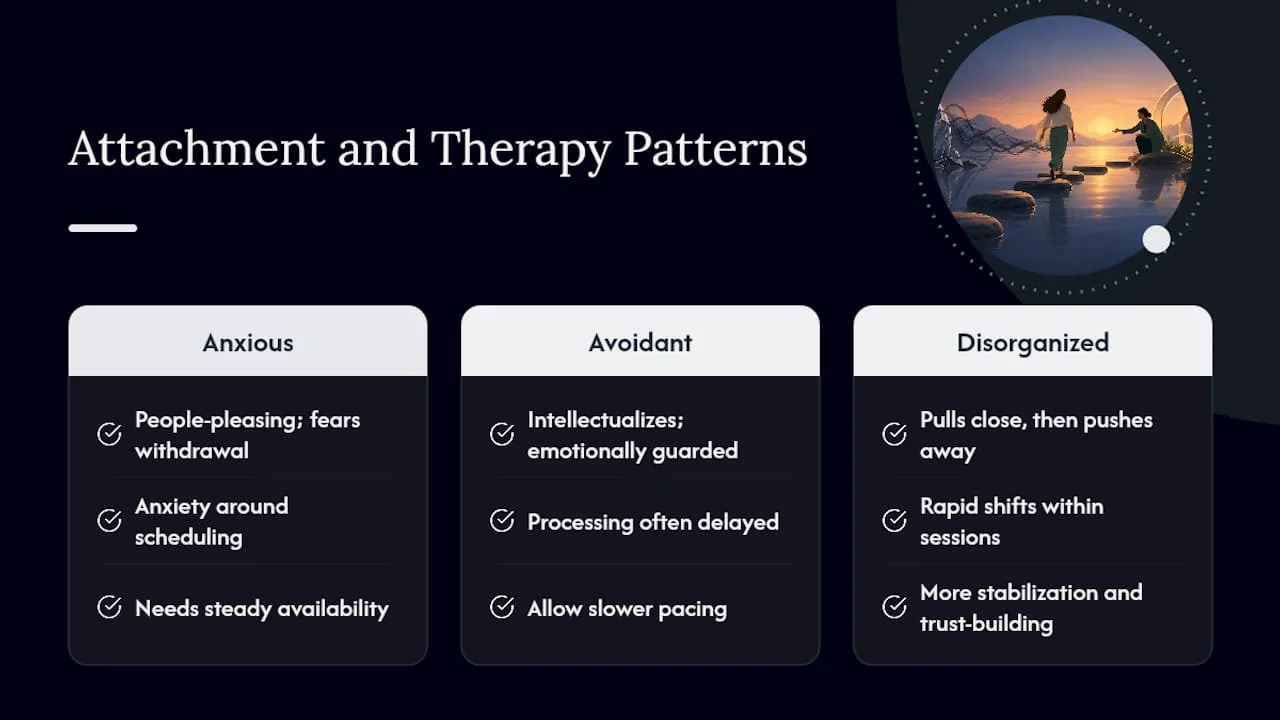
Adults with an anxious attachment style often crave connection with their therapist but fear it will be withdrawn, which can show up as people-pleasing in session or panic around scheduling changes. Adults with an avoidant style may intellectualize their trauma fluently while staying emotionally guarded, sometimes for months, before real processing becomes possible. Disorganized attachment, common among survivors of chaotic or frightening childhoods, tends to produce both patterns at once: pulling the therapist close, then pushing away, sometimes within the same session.
None of this is a character flaw. It's information. Therapists trained in attachment-aware trauma work read these patterns as clinical data rather than resistance, and they adjust pacing accordingly. Someone with disorganized attachment, for instance, usually needs more time in the stabilization phase before trauma processing begins, precisely because trust itself is the therapeutic territory that needs building first.
The therapeutic relationship consistently predicts outcomes across nearly every modality studied, EMDR, CPT, PE, and beyond. That's not a soft or secondary finding. It suggests that how safe a client feels with their specific therapist may matter as much as which manualized protocol that therapist uses. This is part of why cultural fit, communication style, and simple trust weigh so heavily in choosing a clinician for childhood trauma work, arguably more than they do for more circumscribed, single-incident presentations.
Setbacks During Trauma Therapy and How to Work Through Them
Trauma therapy rarely moves in a straight line, and expecting steady, linear improvement sets people up to feel like they're failing when a rough week hits.
Symptom flare-ups after a productive session are common and don't mean the therapy isn't working. Processing a difficult memory can temporarily increase distress before it decreases, a pattern sometimes called an "abreaction." A skilled clinician prepares clients for this ahead of time and builds in grounding tools to manage it between sessions.
Some adults hit a plateau where progress seems to stall entirely. This often signals that stabilization work was skipped or rushed, and revisiting emotion-regulation skills, rather than pushing harder into memory processing, is usually the fix. Others experience what feels like backsliding when a new life stressor, a breakup, a job loss, reactivates old patterns that therapy had quieted. That's not a treatment failure. Trauma recovery under new stress often surfaces old material temporarily before settling again.
Dropout is a real risk, particularly with exposure-based approaches that ask clients to sit with distress they'd rather avoid entirely. The trials behind phase-based and intensified treatment protocols exist partly because researchers recognize standard protocols don't retain everyone, and tailoring pace and structure to the individual can reduce that dropout. If a particular approach isn't working after a genuine trial period, that's information worth bringing directly to the therapist, not a reason to give up on treatment altogether. Switching modalities, adjusting pacing, or returning briefly to stabilization are all normal course corrections, not signs of failure.
Combining Trauma Therapy With Medication and Other Treatment
Trauma-focused psychotherapy doesn't have to stand alone, and for many adults with childhood trauma, it works best as part of a coordinated plan rather than the only intervention.
Medication, typically SSRIs or SNRIs, can reduce the intensity of depression, anxiety, or sleep disruption enough to make therapy more tolerable, particularly for someone too dysregulated to engage with exposure or memory work yet. Clinical guidance consistently frames medication as supportive rather than primary. The VA/DoD guideline recommends trauma-focused psychotherapy first when a patient can access and tolerate it, with pharmacotherapy filling gaps rather than replacing that work.
Co-occurring conditions complicate the picture further. Substance use, eating disorders, and personality-disorder traits often develop as coping mechanisms for childhood trauma, and treating trauma symptoms without addressing the co-occurring condition, or vice versa, tends to produce incomplete results. Integrated care, where a therapist coordinates with a psychiatrist or addiction specialist, generally outperforms treating each issue in isolation.
Adults juggling multiple diagnoses should ask prospective therapists directly how they coordinate with prescribers and other specialists. A clinician who works in silos, refusing to communicate with a psychiatrist or ignoring a substance use pattern because "that's not my area," is a sign to keep looking.
Clinician Perspective: Pacing, Alliance, and Realistic Hope
Trauma therapy isn't about erasing a memory. It's about restoring choice and calm to a nervous system still reacting to a childhood that's over. Go at a pace that respects your actual readiness, and choose a clinician who will assess that readiness honestly rather than rushing you.
— Juiced
If You Want Help Now: EMDR Options at Alvaradotherapy
Alvaradotherapy is a direct path forward if you're ready to stop researching and start working with someone. Bilingual, trauma-informed clinicians offer individual EMDR therapy for adults who want gradual, weekly pacing, and EMDR intensives, including the 3-Day EMDR Intensive for $5,750, a 1-Day, 6-hour intensive for $2,250, and a 1-Day, 4-hour intensive for $1,500, for those who are stabilized and ready for concentrated processing rather than months of weekly sessions.

Finding the right therapist matters more than finding the fastest one. An initial intake call is the place to ask about experience with childhood trauma, pacing philosophy, and cultural fit before committing to a course of treatment. If couples work or an immigration psychological evaluation is what actually brought you here, Alvaradotherapy also offers couples therapy and immigration evaluations. Reach out through the site to book a consultation and describe what you're carrying. The right next step is a conversation, not another article.
This article is general information, not a substitute for advice from a qualified doctor. Consult a qualified healthcare professional about your own circumstances before acting on anything here.
Sources
VA/DoD PTSD clinical practice guideline (2023/2024 synopsis)
Simply Psychology — Healing from childhood trauma in adulthood
FAQ
What type of therapist is best for childhood trauma in adults?
Look for a licensed therapist with specific training in trauma-focused modalities, EMDRIA-certified EMDR, CPT, or PE, rather than general talk therapy experience. For complex or childhood-onset trauma, prioritize someone familiar with phase-based approaches like STAIR who can assess stabilization needs before starting memory processing.
How do I deal with childhood abuse as an adult?
Working with a trauma-specialized therapist using evidence-based approaches like EMDR, CPT, or PE gives you the strongest, most researched path forward. Pairing that with grounding techniques, social support, and consistent sleep and movement supports the nervous-system changes therapy is working toward.
What are the seven stages of trauma healing?
There's no single, universally agreed-on "seven stages" framework in the clinical literature, so definitions vary depending on the source. What is well established is a general arc from safety and stabilization, through processing the traumatic material, to integration and rebuilding a life not organized around the trauma.
Can racing thoughts be a symptom of PTSD?
Yes. Racing thoughts, along with hypervigilance and difficulty concentrating, are common hyperarousal symptoms of PTSD and often intensify during stress or when a trauma reminder appears. If they're persistent or disrupting daily life, that's a clear signal to seek an evaluation from a trauma-focused clinician.
