

EMDR can help when depersonalization is rooted in trauma, because it targets the memories and stress responses that often keep the feeling of unreality going. It works best when it is paced carefully: with depersonalization, the early stabilization work matters as much as the memory processing that follows. Research on EMDR for depersonalization itself is still thin, so the most reliable guidance comes from trauma and dissociation research. This guide explains what that evidence says, how therapy is usually adapted, and how to prepare.
Alvaradotherapy
Explore Trauma-Informed EMDR Support
Alvarado Therapy offers EMDR and trauma-informed counseling for Californians experiencing trauma-related distress, with care available in English and Spanish.
TL;DR
Depersonalization (feeling detached from your body, thoughts or self) often follows trauma or prolonged stress, and EMDR is a trauma-focused therapy that works on the memories behind it.
Direct research on EMDR for depersonalization is limited. A case report showed significant symptom reductions, and the wider PTSD evidence base for EMDR is strong.
With dissociative symptoms, therapy usually begins with a longer stabilization phase and slower pacing before any memory processing.
A thorough assessment before starting is part of safe treatment, and it is worth telling your therapist about every detached or "unreal" experience you have.
In California, you can explore weekly EMDR sessions or an EMDR intensive with our licensed, bilingual team, in person in Pasadena and Ventura or online.
Table of Contents
What depersonalization is and why trauma is so often behind it
How EMDR works, in plain language
What the research says about EMDR and depersonalization specifically
Why stabilization comes first
Pacing: what adapted EMDR looks like
Why assessment matters before you begin
What to expect during and between sessions
How long does it take?
Our perspective
Getting started with EMDR in California
Frequently asked questions
Sources
What depersonalization is and why trauma is so often behind it
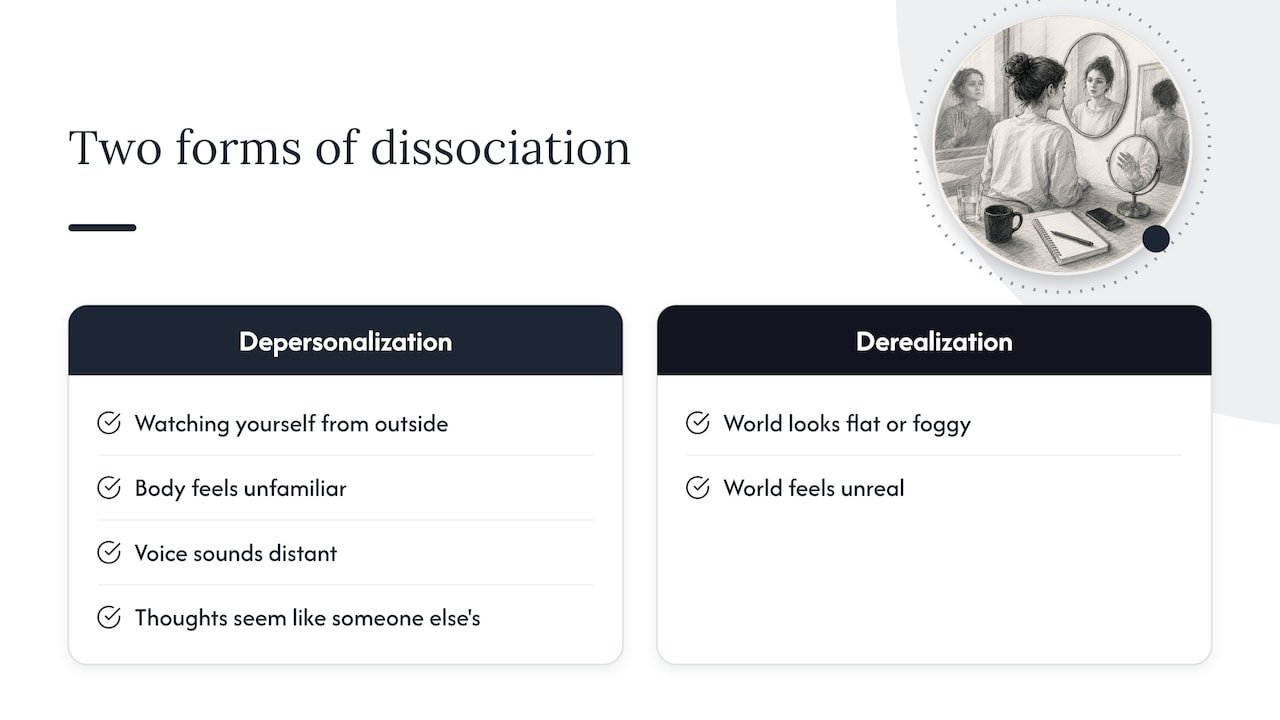
Depersonalization is the sense of watching yourself from outside: your body feels unfamiliar, your voice sounds distant, your thoughts seem like they belong to someone else. Its close relative, derealization, makes the world look flat, foggy or unreal. Clinicians group both under dissociation, a protective mental response in which the mind disconnects from experience that feels too much to bear.
The MSD Manual's consumer entry on depersonalization/derealization disorder notes that the condition may fade without treatment and that complete recovery is possible for many people, especially when symptoms come from stresses that can be addressed in therapy. That last point is the reason trauma-focused therapy is worth considering: when the detachment began during or after overwhelming experiences, the work is often about those experiences and the nervous system's habit of switching off.
Depersonalization also shows up as part of post-traumatic stress. The U.S. National Center for PTSD describes a dissociative subtype of PTSD, in which people with PTSD also have depersonalization and derealization symptoms. It reports that these individuals tended to respond better to treatment that added cognitive restructuring and skills training in emotional and interpersonal regulation to exposure-based therapies. In plain terms: skills for staying present are not an extra, they are part of what helps.
If you grew up with chronic stress, neglect or abuse, or live with complex trauma, detachment may have been a lifelong way of coping rather than a recent symptom. That history is useful information for a therapist and shapes how treatment is planned
How EMDR works, in plain language
EMDR (eye movement desensitization and reprocessing) is a structured therapy. According to the American Psychological Association, you briefly focus on a trauma memory while experiencing bilateral stimulation, typically guided eye movements, and this is associated with a reduction in the vividness and emotion of the memory. It does not require extended exposure, a detailed retelling of what happened, or homework between sessions.
That last feature matters for people who feel detached. Many trauma therapies ask you to stay with painful material for long stretches, which can be hard when your mind's escape route is to go numb or spacey. EMDR uses short, guided sets of attention, and your therapist can check in with you between them.
The National Center for PTSD describes EMDR as an effective trauma-focused psychotherapy for PTSD, typically delivered in weekly individual sessions of up to 90 minutes over approximately three months. It cites 38 randomized controlled trials in its PTSD repository and recent meta-analyses pointing to moderate to strong effects on PTSD symptoms, on depression, and on loss of PTSD diagnosis. If you want a deeper look at how to interpret those numbers, our guide to reading EMDR success rates walks through them.
What the research says about EMDR and depersonalization specifically
Here is the honest picture of the evidence, so you can set realistic expectations.
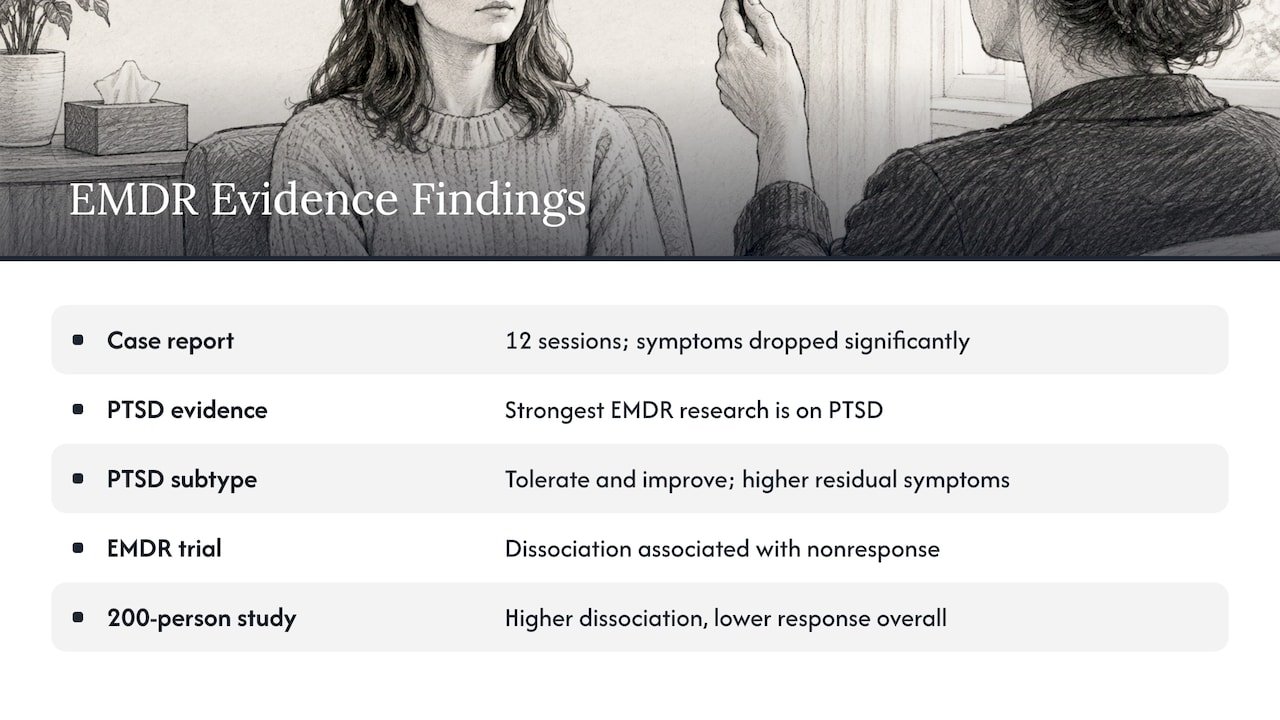
Direct evidence is limited but encouraging. A published case report applied the standard 12-session EMDR protocol to a young adult whose depersonalization and derealization began after watching a movie. Preparation, psychoeducation, a technique called backflow and core-memory processing were used. Symptoms did not disappear completely but dropped significantly. A single case cannot predict your result, but it shows the approach is being applied and studied.
The larger trauma evidence base applies when trauma is involved. Because the strongest EMDR research is on PTSD, the best fit is depersonalization that is tied to traumatic experiences or ongoing traumatic stress.
Dissociation can shape how treatment unfolds. The VA's update on the dissociative subtype of PTSD reports that people with this subtype tolerate trauma-focused treatment and improve, though they typically finish with higher residual symptoms than others, and that in one EMDR trial, dissociative symptoms were associated with not responding. A separate study of 200 people with chronic PTSD found that a group with higher dissociative symptoms was less likely to respond overall, but that was not the case specifically for exposure-based treatment. The practical takeaway is that dissociation is a factor to plan around, not a reason to avoid treatment. The National Center for PTSD says more research is needed to fully understand how depersonalization and derealization affect treatment response.
Medication is not the only route. The MSD Manual says no medication has proven effective for depersonalization/derealization disorder, though antianxiety medications, antidepressants and naltrexone are sometimes helpful. Its professional edition lists psychotherapies that have worked for some patients, including cognitive and behavioral approaches, grounding with the five senses, and psychodynamic therapy. Any medication question belongs with a prescribing physician or psychiatrist.
Why stabilization comes first
If you take one idea from this article, take this one. With depersonalization, a good EMDR course does not start by diving into the worst memory. It starts by building the ability to stay present.
EMDR has eight phases, and the early ones are history-taking and preparation. The EMDR training manual from the International Society for the Study of Trauma and Dissociation states that for PTSD with dissociative features, an extended stabilization and preparation phase is frequently necessary before accessing trauma material, and that advanced training and consultation are vital for work with complex PTSD presentations.
The MSD Manual's consumer entry on the dissociative subtype of PTSD describes the same gradual logic: identifying, stabilizing, clarifying and discussing depersonalization and derealization symptoms, exploring the stressors that trigger episodes, and reducing the risk of being harmed again, before deeper reprocessing.
In practice, preparation for someone with depersonalization often includes:
Naming the experience. Learning that detachment is a protective response, not a sign you are "going crazy," often lowers the fear that feeds it.
Learning to notice early signs. Many people can feel the fog arriving: a flattening of sound, tunnel vision, a floaty feeling. Catching it early gives you more choices.
Practicing grounding. Orienting to the room, feeling your feet on the floor, using temperature or texture. For a clear comparison of two common tools, see this explainer on grounding versus mindfulness.
Building a calm or safe place and rehearsing returning to it.
Agreeing on signals. A hand gesture or word that means "pause" gives you control during sessions.
Our step-by-step EMDR guide describes all eight phases, and our guide to preparing for EMDR covers what to do before your first session.
Pacing: what adapted EMDR looks like
A 2023 study in Counselling and Psychotherapy Research found that when therapists adapt EMDR, they emphasize the stabilization phase and slow the pace of trauma processing so clients stay within their window of tolerance. That window is the zone where you feel activated enough to process but not so overwhelmed that you shut down or dissociate. The adaptations are about emphasis and tempo, not a different core protocol.
For depersonalization, that can mean:
Shorter sets of processing with frequent check-ins on how present you feel.
Choosing targets carefully. Starting with less intense memories, or with the moments just before the detachment began, rather than the most distressing event.
Time to integrate between sessions, so you are not carrying unprocessed material through your week.
Pausing when needed. If you drift into numbness, the work shifts back to grounding before continuing.
A worked example: imagine a 29-year-old who has felt "behind glass" since a car accident two years ago. Early sessions focus on history and on teaching her to notice and reverse the fog. Only when she can come back to the room within a minute or two does the therapist begin with a mildly distressing memory, such as the drive to the accident site, before moving toward the collision itself. Progress is judged by how present she feels during processing, not just by how upsetting the memory is. This is an illustration of the general approach, not a promise of a particular result.
Why assessment matters before you begin
Depersonalization can sit alongside a range of conditions, from anxiety and depression to PTSD and dissociative disorders. A careful assessment sorts out which is which, and that determines the safest route.
The Journal of EMDR Practice and Research reports that standard EMDR procedures call for thorough clinical assessment and formal screening for dissociative disorders, and that a single questionnaire score is not enough on its own to decide whether someone is ready to reprocess traumatic memories. The same article notes the International Society for the Study of Trauma and Dissociation's concern that standard EMDR with an unrecognized dissociative disorder can cause significant harm. A related 2022 paper cited in the ISSTD training manual describes problems such as flooding and rapid destabilization when dissociation was missed. The lesson is not to fear EMDR. It is to start with a clinician who asks detailed questions and adjusts the plan to your answers.
To get the most from an assessment:
Describe your detached experiences in your own words: when they began, how long they last, what triggers them.
Mention memory gaps, losing time, or feeling like different parts of you act differently, even if they seem minor.
Share any medications and past therapy experiences.
Tell your therapist about current safety concerns, substance use or suicidal thoughts so the plan can address them first.
Our article on screening questions before EMDR for dissociation lists questions that help you understand what a thorough screening covers, and EMDR contraindications and how clinicians prepare explains the situations where preparation takes priority.
If you are in immediate danger or thinking about harming yourself, call or text 988, the Suicide and Crisis Lifeline, or call 911.
What to expect during and between sessions
The Cleveland Clinic describes EMDR as having very low risks, with the most common negative effect being upsetting thoughts or feelings between sessions. It advises contacting your provider if symptoms from upsetting memories change or affect your life in a new or disruptive way.
With depersonalization in particular, here is what that can look like and how to handle it:
| What you notice | What it can mean | What to do |
|---|---|---|
| Emotions feel stronger for a day or two after a session | Memory processing continuing between sessions | Use your grounding skills, keep routines steady, tell your therapist at the next visit |
| Detachment increases right after a session | The nervous system protecting you from intensity | Use grounding, rest, and let your therapist know so pacing can be adjusted |
| Vivid dreams or sudden memories | Normal part of processing for many people | Note them in a journal and bring them to session |
| Feeling overwhelmed, unsafe, or unable to function | Pacing may need to change | Contact your therapist promptly; use 988 or 911 in a crisis |
A journal helps here. Our PTSD Recovery Journal offers reflective prompts you can use between sessions to track what you notice.
How long does it take?
The National Center for PTSD describes standard EMDR as weekly sessions over about three months for PTSD. With depersonalization, the length depends on how long you have had symptoms, how much stabilization you need, and how much trauma is involved. A single-trauma history with recent onset often moves differently from complex childhood trauma. Because the preparation phase can take longer when dissociation is present, it is reasonable to plan for a course that is paced to you rather than fixed in advance. The case report above used 12 sessions and saw significant but not complete reductions, which is a useful reminder that improvement often comes in degrees.
Some people prefer concentrated work. EMDR intensives compress therapy into longer blocks. Our overview of EMDR intensive outcomes and safety covers what the research shows, and intensive strategies for trauma recovery in California explains how they are structured.
Our perspective
We meet many people who arrive saying, "I don't feel like myself," and who have been told, or have told themselves, that it is just stress. Often the detachment began as protection. A child who could not leave a frightening home learned to leave inside. An adult who survived a crisis learned to switch feelings off to keep functioning.
That is why we approach depersonalization as a trauma-informed question first: what did your mind have to do to cope, and what does it need now to feel safe in the present? EMDR is a strong fit for this work because it helps the brain reprocess distressing experiences without requiring you to narrate every detail.
We also believe that care works best when it fits who you are. Our practice offers therapy in English and Spanish, and we work in an identity-affirming way with Latinx, BIPOC and LGBTQ+ clients. Feeling understood, culturally and linguistically, is part of feeling safe enough to heal.
For people who want concentrated progress, we offer EMDR intensives alongside weekly individual EMDR therapy. Either way, you set the pace with us, and we start with where you are today.
Juiced
Getting started with EMDR in California
We offer individual counseling and EMDR therapy with licensed therapists in Pasadena, Ventura and online throughout California, in English and Spanish. You can learn more and book on our individual counseling and EMDR therapy page.

If you would rather work in a concentrated format, our EMDR intensives are published at these prices: $1,500 for a 1-day intensive of 4 hours, $2,250 for a 1-day intensive of 6 hours, and $5,750 for a 3-day intensive. The same page has details and booking.
Frequently asked questions
Does EMDR work for depersonalization?
It can help, particularly when depersonalization is connected to trauma. A published case report found significant reductions in depersonalization and derealization after a 12-session EMDR course, and EMDR has a strong evidence base for PTSD. Research on depersonalization alone is still limited, so outcomes vary from person to person.
Will EMDR make my depersonalization worse?
The Cleveland Clinic reports very low risks, with upsetting thoughts or feelings between sessions the most common. Because dissociation can make processing feel overwhelming, therapy usually builds grounding skills first and moves at a slower pace. Tell your therapist if detachment increases so they can adjust.
Do I need a diagnosis before starting EMDR?
Not necessarily, but you do need a thorough assessment. A clinician will ask about your history, trauma exposure and dissociative experiences to decide on the right pacing and preparation. Describing your symptoms in detail is the most useful thing you can bring.
What therapy is best for depersonalization?
There is no single answer. The MSD Manual lists cognitive, behavioral, grounding and psychodynamic approaches as helpful for some people. When trauma is part of the picture, trauma-focused therapy such as EMDR, with careful stabilization, is a reasonable option to explore with a licensed therapist.
Can I do an EMDR intensive if I experience depersonalization?
It depends on your assessment and how stable you feel. Preparation matters more, not less, when dissociation is present. You can ask us about weekly sessions or an intensive on our EMDR intensives page, and we will help you find the right format.
Sources
Eye Movement Desensitization and Reprocessing for PTSD, National Center for PTSD
The Dissociative Subtype of PTSD: An Update of the Literature, PTSD Research Quarterly
Depersonalization/Derealization Disorder, MSD Manual Consumer Version
Depersonalization/Derealization Disorder, MSD Manual Professional Version
Dissociative Subtype of Posttraumatic Stress Disorder, MSD Manual
Eye Movement Desensitization and Reprocessing Therapy, American Psychological Association
Investigation of the effectiveness of EMDR therapy, case report
Beyond the DES-II: Screening for Dissociative Disorders, Journal of EMDR Practice and Research
EMDR Therapy: What It Is, Procedure and Effectiveness, Cleveland Clinic
Grounding vs. Mindfulness: How They Differ and When to Use Each
