

Intergenerational trauma therapy helps you understand which fears, reactions and relationship habits came down to you from a family's unhealed past, and gives you tools to stop passing them on. You do not need your relatives to take part, and you do not need to blame them. The work happens in your own nervous system, your own memories and your own relationships. For many adults, trauma-focused approaches such as EMDR are the most direct way in, especially when the pattern is tied to specific childhood experiences.
Alvaradotherapy
Work Through Inherited Trauma Patterns
Explore trauma-informed therapy, including EMDR and individual counseling, with bilingual care available in English and Spanish across California.
TL;DR
Intergenerational trauma is the passing of trauma's effects from one generation to the next, through biology, family relationships, and what a family does and does not talk about.
Therapy for it is individual work: you can change your own reactions and what you hand to the next generation without any relative joining you.
Evidence-based trauma treatments, including EMDR and trauma-focused CBT, are used to address the symptoms and memories at the root of these patterns.
Culture, language and collective history belong in the room, so a bilingual, culturally responsive therapist matters.
Our therapists offer EMDR, individual counseling and EMDR Intensives in English and Spanish, in Pasadena, Ventura and online across California.
Table of Contents
What intergenerational trauma actually is
How it shows up in your life
Do you need your family involved to heal?
Approaches used for intergenerational trauma
What to expect when you start
Culture, language and collective history belong in therapy
Getting started with us
Our perspective
FAQ
Sources
What intergenerational trauma actually is
The American Psychological Association's dictionary defines intergenerational trauma as the transmission of trauma, or its legacy, from the generation that lived through it to later generations. It lists reactions such as shame, anxiety, guilt, helplessness, depression, dissociation (feeling detached from yourself or the moment), hypervigilance (being constantly on guard), intrusive thoughts, difficulty with attachment and extreme stress reactivity. The same entry notes that the mechanism is believed to be epigenetic, meaning life experience changes a gene's chemical marker rather than the gene itself.
Transmission is not only biological. A 2025 systematic review of the research on second-generation survivors found that changes in stress regulation and brain structure suggest trauma can be biologically embedded. It also found that socially, the effects shaped relationships and identity, often fostering mistrust and emotional restraint. Psychologically, descendants showed higher distress and trauma symptoms, with a parent's PTSD a key predictor.
One example from that review: researchers found that maternal PTSD and the age at which a mother was exposed to Holocaust trauma predicted lower cortisol (a stress hormone) in her descendants, and low cortisol is associated with a higher predisposition to PTSD. You do not need a family history that dramatic for the idea to apply. War, migration, abuse, poverty, discrimination, addiction and sudden loss all leave marks that families carry quietly.
How it shows up in your life
Intergenerational trauma rarely announces itself. It tends to look like a personality trait or a family quirk. The American Counseling Association describes people affected by it as often showing strong emotions, irrational fears, and distrust of places, communities or systems they have never personally experienced. Silence in a family about what happened can itself be a sign.
In practice, adults often describe patterns like these:
A sense of danger that does not match the present situation, such as scanning every room or bracing for bad news.
Difficulty asking for help, because help was never safe for the people who raised you.
Over-responsibility for parents' feelings, or a strong need to control outcomes.
Emotional distance in close relationships, or intense fear of abandonment.
Anxiety, burnout, grief or low mood that therapy for "just the symptoms" has not fully shifted.
The APA's report on trauma across generations gives the research behind some of these. Trauma researcher Yael Danieli observed patterns among children of Holocaust survivors, including an overly protective stance toward parents, a high need for control and a defensive stance toward life. Psychologist Elena Cherepanov describes how fear-based survival messages, such as the idea that asking for help is dangerous, raise later generations' vulnerability in relationships. Many families have their own version of that message.
Two cautions help here. First, a pattern in your family does not mean you are damaged or that your parents failed you. Second, recognizing the pattern is a starting point, not a diagnosis. A licensed clinician can help sort what is inherited, what is your own history, and what is current stress.
Do you need your family involved to heal?
No. This is the most common worry we hear described by people considering this work, and the research supports a reassuring answer. A 2023 paper by Mooren and colleagues explains that a parent's ability to tolerate and regulate their own emotions helps them contain a child's. Anger and irritability after trauma can show up as hostility, while numbness can make a parent emotionally unavailable. The practical point: parents can learn to recognize their triggers and regulate intense emotions even before trauma treatment is finished. The change starts with the person in therapy.
That is why individual therapy is a legitimate route for intergenerational trauma. You work on:
Understanding where your reactions come from, without assigning blame.
Processing the memories and experiences that feed those reactions.
Building regulation skills so you respond rather than react, with partners, children and colleagues.
Deciding what you want to keep from your family's story and what you want to put down.
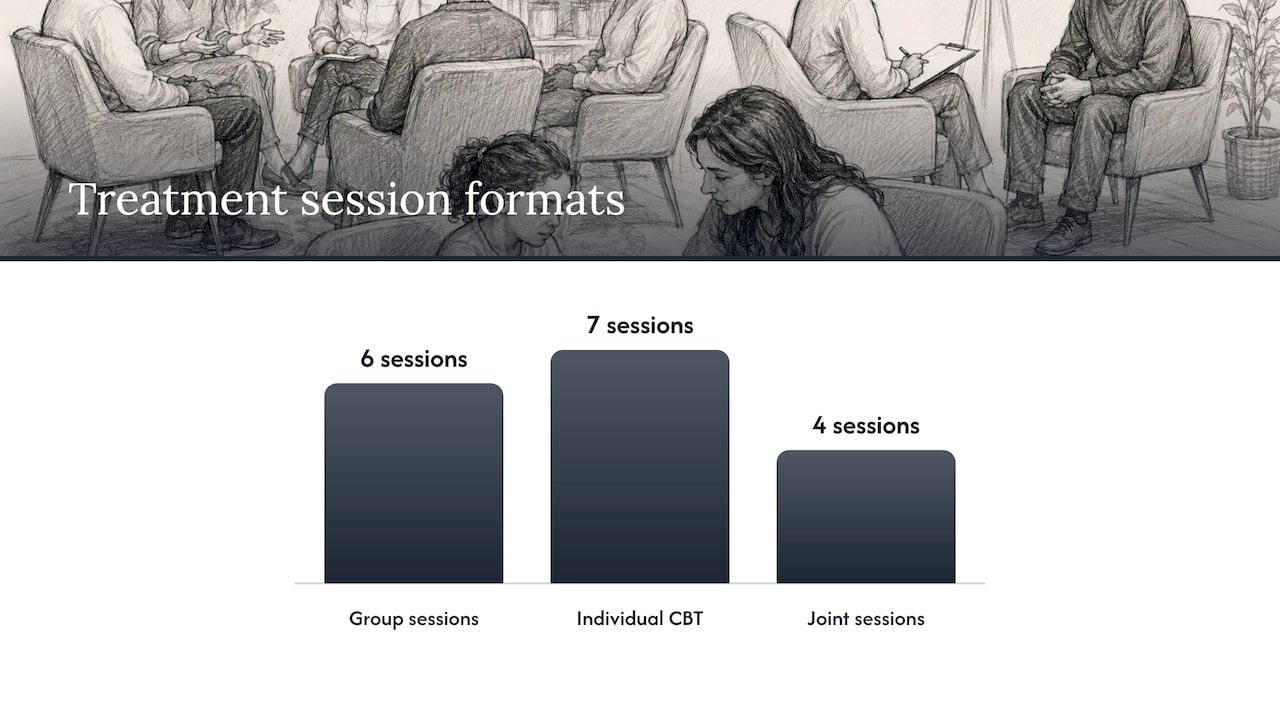
If you are a parent, this work also matters for your children. In the evidence base, programs for families treat the caregiver's own unresolved trauma first. The California Evidence-Based Clearinghouse for Child Welfare describes the Intergenerational Trauma Treatment Model, which works with caregivers' unresolved childhood trauma before the child (ages 3 to 18) joins, so two generations are treated together. It uses six 90-minute group sessions, seven individual CBT sessions for caregivers and four joint sessions with the child. Not everyone needs that format, but it shows the logic: the adult's healing comes first.
Approaches used for intergenerational trauma
There is no single "intergenerational trauma therapy". Clinicians draw on trauma treatments with strong research behind them and add tools that bring the family story into view.
Tools for seeing the pattern
The American Counseling Association describes an approach that combines cognitive behavior therapy, narrative therapy, genograms and guided imagery. A genogram is a family tree that records not just names but relationships, losses, migrations, illnesses and conflicts. The ACA notes it can screen for intergenerational trauma, and that writing or visually expressing family history can reveal patterns of trauma, resilience and persistence. Work often begins with education about trauma and questions about where you feel it physically in your body.
Trauma-focused CBT
Trauma-focused cognitive behavioral therapy (TF-CBT) helps you examine beliefs tied to painful events and build coping skills. A 2022 review of child maltreatment trauma notes it has more than 20 randomized controlled trials, is generally delivered over 16 to 24 weeks, and may take longer for complex trauma.
EMDR therapy
EMDR (Eye Movement Desensitization and Reprocessing) helps the brain reprocess distressing memories so they stop feeling as if they are happening now. A 2016 evidence update describes EMDR as combining coping skills, cognitive restructuring, imaginal exposure and bilateral sensory input, typically over 8 to 12 individual sessions in the child and adolescent studies it reviewed, with trials showing it outperformed waitlist and treatment as usual and performed similarly to CBT. A 2021 integrative model names TF-CBT and EMDR as the major evidence-based trauma treatments.
Why EMDR fits inherited patterns: many of them have an anchor in your own experience. The childhood moment when you learned not to cry, the household where you had to stay alert, the day a parent's fear became yours. EMDR targets those memories directly. If you want the details of how we sequence care, read our guide to EMDR and phase-based care for adults healing from childhood trauma, or what the research shows on EMDR treatment effectiveness.
Family-level approaches
Mooren and colleagues describe trauma-focused multifamily therapy, in which EMDR, Narrative Exposure Therapy and other methods can be integrated, aiming to reduce the limits PTSD places on parenting and to build sensitive parenting and secure attachment through mentalization (understanding your own and others' inner states), emotion regulation and empowerment. For couples, the work often runs alongside individual healing, since inherited patterns show up in how partners handle conflict and closeness. Our page on PTSD effects on relationships explains how this plays out.
What to expect when you start
Starting trauma therapy follows a predictable path. The VA's PTSD clinical team in South Texas, describing its own program, outlines a useful general model: an initial evaluation averaging about 90 minutes covering medical and mental health history, childhood background, living situation, family dynamics and symptoms, then a collaborative treatment-planning conversation, then matching with a therapist trained in the chosen approach. Formats and schedules differ between providers, but the shape is common.
For intergenerational trauma, expect early sessions to cover:
Your history and goals. What brings you in, what you notice in yourself and what you want to be different.
Your family story. What you know, what was never discussed, and what you suspect. You decide how much to share and when.
Stabilization. Skills for calming your body and handling strong feelings, so processing does not overwhelm you.
Processing. Working through memories and beliefs with a method such as EMDR.
Integration. Applying changes to relationships, parenting and daily life.
That sequence is the reason pacing matters. Going straight into the hardest memories is not the goal. Preparation comes first, and you can slow down at any point.
If you are having thoughts of harming yourself or are in immediate danger, call 911 or go to the nearest emergency room. If sleep trouble is part of your picture, talk with your physician or a psychiatrist: the same 2022 review notes that medications such as prazosin, clonidine or melatonin may be considered for PTSD-related sleep difficulties, after trauma therapy is established as the first step.
Culture, language and collective history belong in therapy
Family trauma is rarely only a family matter. Immigration, displacement, racism, war and colonization shape what a family carries. The government's SAMHSA defines historical trauma as the cumulative, multigenerational, collective experience of emotional and psychological injury in communities and their descendants. The same guidance stresses that words for emotional health differ across communities, so providers should learn the local terms and ask about community strengths and recovery.
Indian Health Service guidance goes further, directing clinicians to assess how trauma is processed in the family, along with migration, trauma in the community of origin, and language. It is written for American Indian and Alaska Native care, but the principle travels: a therapist should ask about your whole context, not only your symptoms.
What to raise in a first conversation:
The languages you think and feel in. Many bilingual adults find that emotions surface differently in Spanish than in English.
Family migration, separation or loss, and what was or was not said about it.
How your community talks about mental health, and what you were taught to do with pain.
Experiences of racism, discrimination or exclusion, and how they intersect with your family's story.
We offer therapy in both English and Spanish, and our practice is built around culturally responsive, identity-affirming care for Latinx, BIPOC and LGBTQ+ clients. If this is a priority for you, these pages go deeper: why culturally responsive therapy matters for healing, how cultural identity can improve trauma therapy results and what racial trauma therapy is.
Getting started with us
Our licensed therapists provide EMDR therapy and individual counseling for childhood trauma, PTSD, complex trauma, grief, anxiety and relationship difficulties, in Pasadena, Ventura and online throughout California. Details on individual counseling and EMDR therapy are on its page, and you can learn about PTSD and complex trauma care or what to expect from online EMDR therapy.
If weekly sessions do not fit your life, or you want concentrated time for deeper processing, our EMDR Intensives are an option. The published fees are $1,500 for a 1-day intensive of 4 hours, $2,250 for a 1-day intensive of 6 hours, and $5,750 for a 3-day intensive.
If you are not sure which format suits you, you can start with a consultation. We also offer couples therapy for partners working through patterns that began long before the relationship.
Our perspective
We meet many adults who arrive describing themselves as "too sensitive", "too anxious" or "just like my mother". Very often, what they describe is not a flaw of character. It is a survival strategy that made sense for someone in their family, once, and that got handed down along with the recipes and the language.
We believe the most useful thing therapy can do is separate what is yours from what you inherited, and then give you the choice. That takes a trauma-informed approach, which means pacing, safety and your consent come before any processing. It also takes cultural responsiveness: a therapist who can hear your family's story in the language it was lived in, and who understands migration, racism and community history as part of the picture.
We use EMDR because it works on the memories and beliefs underneath the pattern, not only on the symptoms above it. For people who want to go deeper in concentrated time, EMDR Intensives let that work happen in one day or across three. Healing does not require your family to change first. It requires one person willing to start, and that person can be you.
Juiced
FAQ
Is intergenerational trauma the same as generational trauma?
In everyday use, yes. People use "generational", "intergenerational" and "transgenerational" trauma for the same idea: the effects of trauma passing from one generation to the next. The APA dictionary uses the term intergenerational trauma. Therapy focuses less on the label than on the specific patterns you notice in yourself.
Can intergenerational trauma be treated?
Yes. Trauma-focused treatments such as EMDR and TF-CBT are established approaches for trauma symptoms, and clinicians add family-history tools like genograms and narrative work to bring inherited patterns into view. Results and timelines differ from person to person, and a licensed therapist can tell you what to expect for your situation.
How do I know if my anxiety or relationship struggles are inherited?
You cannot always tell on your own, and you do not have to. Signs include strong fears that do not match your own experience, distrust of people or institutions you have never dealt with, and a family history of silence around painful events. A therapist can help you map your family history and sort inherited patterns from your own experiences.
Can I do this work online and in Spanish?
Yes. We provide therapy in English and Spanish, in person in Pasadena and Ventura and online throughout California. You can choose the language in which you feel most able to speak about what matters.
Sources
Impact of intergenerational trauma on second-generation survivors, systematic review (PMC, 2025)
American Counseling Association: Generational trauma, uncovering and interrupting the cycle
Mooren et al. (2023): Combatting intergenerational effects of psychotrauma
California Evidence-Based Clearinghouse: Intergenerational Trauma Treatment Model
Evidence Base Update for Psychosocial Treatments for Trauma (2016)
Assessing and Responding to the Trauma of Child Maltreatment (PMC)
VA South Texas: Post-Traumatic Stress Disorder Clinical Team
SAMHSA: Cultural Awareness tips for disaster responders in Indian Country
IHS: Integrating Trauma Informed and Historical Trauma Informed Care
