

Racial trauma therapy is treatment for the lasting emotional and physical impact of racism, whether it came from one frightening event or from years of smaller experiences that built up. It works best with a therapist who believes your experience, does not question whether it happened, and helps you steady your body, loosen painful beliefs, and rebuild a sense of power. This guide explains what racial trauma is, how it shows up, what treatment involves, and how to find the right fit.
Alvaradotherapy
Find Culturally Responsive Support
Alvarado Therapy offers trauma-informed, identity-affirming counseling in English and Spanish, online throughout California.
TL;DR
Racial trauma, also called race-based traumatic stress, can follow a single event, repeated everyday discrimination, or witnessing racism in person, online, or in the media.
It often looks like PTSD: hypervigilance, nightmares, avoidance, anger, hopelessness, and physical tension.
Good treatment starts with validation. Your therapist should treat the racism you describe as real, then help with the stress responses that grew out of it.
Look for warmth, cultural humility, and a space that affirms your identity. Ask about experience with race-related stress before you commit.
If symptoms are affecting your relationships, work, sleep, or ability to function, it is time to talk to a mental health professional.
Table of Contents
What racial trauma is
The National Center for PTSD describes racial trauma as the emotional impact of racism, discrimination, and race-related stressors such as stereotypes, hurtful comments, or barriers to advancement. It can refer to a specific incident or to the harm that accumulates over time.
That range matters, because many people wait for a "big enough" event before they take their symptoms seriously. Mental Health America notes that race-based traumatic stress can come from one event, from many small acts of discrimination that add up, or from witnessing racism, and that it can happen in person, online, or through the media. The American Psychological Association likewise points to major experiences such as workplace discrimination or hate crimes, as well as an accumulation of everyday discrimination and microaggressions.
The International Society for Traumatic Stress Studies adds that the direct experience of, or witnessing or learning about, hatred, injury, or threatened harm based on race can all produce a painful reaction, and that it can be cumulative and persistent.
Examples that can qualify include being bullied at school for being "different," racial profiling by police, and racial harassment at work. The APA notes that these can all be events that meet the PTSD trauma criterion, yet clinicians sometimes miss them because they do not ask about racism or do not recognize it as traumatic. If a past provider brushed off what you described, that was a gap in their training, not in your experience.
Is racial trauma a diagnosis?
Not formally. The Association for Behavioral and Cognitive Therapies explains that race-based traumatic stress is not a separate diagnosis in the DSM-5, but research shows it produces symptoms similar to PTSD and other trauma disorders: intrusion, avoidance, and arousal and reactivity. The APA adds that all the symptoms can be present even when no single identifiable event can be named. Not having a label does not make the distress less real or less treatable.
Common signs of racial trauma
Racial trauma shows up differently from person to person. Mental Health America lists sadness or hopelessness, anger and irritability, reliving the event, nightmares or trouble sleeping, difficulty concentrating, feeling on edge, avoiding certain places or people, and physical symptoms like headaches, appetite changes, and muscle tension.
The APA describes additional signs, including distrusting others after repeated letdowns, feeling triggered by reminders of a racist experience, difficulty controlling emotional responses, and being hypervigilant about danger because of your race.
The New York State Office of Mental Health also links racism to feelings of sadness or depression, anxiety and vigilance, internalized racism and lower self-worth, hopelessness about change, anger, low energy for planning and coping, and increased use of alcohol and substances.
In daily life this can look like:
Rehearsing conversations before meetings or doctor visits in case you are treated unfairly.
Scanning a room for safety before you can relax.
Feeling numb or exhausted after news coverage or a viral video.
Pulling back from friends, classes, or workplaces where you feel unsafe.
Doubting your own perception after a comment that felt off but was explained away.
Effects on the body and relationships
The National Center for PTSD says racial trauma can raise the risk of physical and mental health problems, affect daily functioning at school, work, or home, and strain relationships. The New York State Office of Mental Health explains that when a stressor like structural racism never goes away, the body can stay in a heightened state, and over time this can contribute to inflammation, higher cortisol, higher blood pressure, increased heart rate, and decreased immune function. If you want to understand the cardiovascular side of chronic stress more broadly, this overview of how stress affects your heart is a good place to start. Any physical symptom you are worried about deserves a visit with your primary care provider.
Relationships feel it too. Hypervigilance, irritability, and withdrawal can make partners and family members feel shut out, even when they are supportive. Couples work can help both people understand what is driving the distance.
How therapy helps with racial trauma
The first job of therapy is not technique. It is safety and validation. Monnica T. Williams, a recognized expert on trauma and racial health disparities, emphasizes that the most important first step is making sure clients feel seen and heard, and accepting that the experiences of racism they share are real, not imagined or exaggerated. The ABCT reports that when therapists miss chances to validate, clients can experience worsening mood, a breakdown of the therapeutic relationship, or early termination of treatment.
From there, treatment typically combines several elements.
Settling the body
Cognitive behavioral approaches can teach strategies to settle your body, reduce unhelpful thinking patterns that limit coping, and address systems that affect your mental health. Early sessions often focus on sleep, grounding, and ways to calm a body that has been on alert for years.
Working with beliefs, not with your reality
The ABCT advises that therapists should validate the experience of racism while challenging unhelpful self-appraisals or behaviors that developed in response to the trauma, rather than the client's view of the situation itself. In practice, that means you are never asked to prove that something was racist. Williams and colleagues warn that Socratic questioning about whether experiences of racism really happened only compounds confusion and shame.
The JED Foundation describes identity affirmation as working with a therapist to recognize false beliefs you have absorbed about yourself, separate who you are from those thoughts, and push back against negative messages society sends about your identity.
A three-phase example
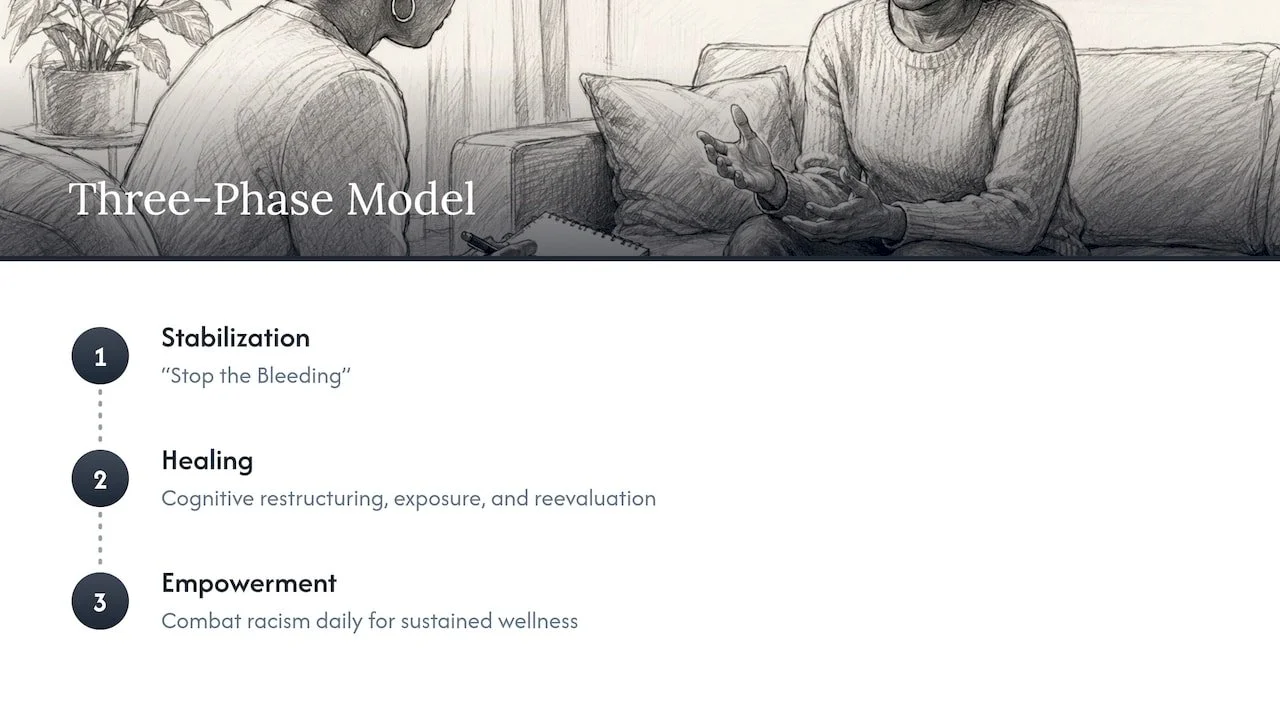
One published model, the Healing Racial Trauma protocol, shows how this can be organized. It has three phases: stabilization ("Stop the Bleeding"), healing through cognitive restructuring, exposure, and reevaluation, and empowerment, which focuses on combating racism in daily life for sustained wellness. The shape is useful even outside that specific protocol: stabilize first, process second, then rebuild agency.
What to look for in a culturally responsive therapist
The fit between you and your therapist is part of the treatment. The ABCT says clients should expect a relationship marked by warmth, empathy, and affirmation of their lived experience with racism. It also names common reasons people hesitate to seek help: cultural stigma around mental health care, mistrust of the health system, and the belief that you should handle problems alone. If any of those sound familiar, they are common and understandable.
A practical checklist:
They ask about racism and identity. They do not wait for you to bring it up, and they do not treat it as a side topic.
They show cultural humility. The TF-CBT-RS manual describes this as an ongoing process of self-exploration and self-critique combined with a willingness to learn from others. That includes not assuming they know your values, beliefs, or family life based on your race.
The space feels affirming. The same manual recommends therapy spaces with artwork, images, and quotes from diverse people.
They speak your language. For many Spanish-speaking clients, describing painful experiences in the language they were lived in changes what is possible in the room.
They can treat the trauma itself. Ask what methods they use for trauma symptoms such as flashbacks, nightmares, and hypervigilance.
In California, the professional association CAMFT has published social policy statements and educational resources on anti-racism and culturally responsive training for clinicians, a sign of how central this skill set is becoming in the field. For more on why this fit matters, see our articles on why culturally responsive therapy matters for healing and how cultural identity shapes trauma therapy in California.
Our perspective
We see racial trauma as part of a person's whole story, not a separate topic to be handled in one session. Many of the people who come to us carry experiences of racism, immigration stress, family expectations, and cultural stigma around asking for help, all at once. Therapy that ignores any of those layers asks you to leave part of yourself outside the door.
That is why we offer trauma-informed, identity-affirming care that is culturally responsive and available in both English and Spanish. We work with Latinx, BIPOC, and LGBTQ+ clients, and we begin from belief: what you tell us about your experience is real.
For clients who want focused, concentrated work, we offer EMDR therapy, including EMDR intensives, and individual counseling for trauma, anxiety, grief, and relationship difficulties. We designed our intensives to give people a way to make meaningful progress in a compact block of time. Our clinicians are licensed, and sessions are available in Pasadena, Ventura, and online throughout California.
Healing from racism-related stress does not mean getting used to it. It means getting your body, your sense of self, and your relationships back.
Juiced
What you can do between sessions
Therapy is one part of care. Mental Health America suggests you lean into your community, talk with trusted people, set boundaries, find ways to feel grounded, and practice self-care. A few specifics, drawn from professional guidance:
Limit media intake. The APA recommends limiting media exposure, connecting with others, eating well, sleeping enough, and moving your body. A wellness plan from Richmond's RTC resource suggests 7 to 9 hours of sleep and boundaries around media consumption.
Separate what you can control from what you cannot. That same resource encourages this distinction as a way to conserve energy.
Say the hard feelings out loud. The APA notes that holding in anger or painful feelings affects emotional well-being, and sharing with friends, family, clergy, or professionals can help.
Try mindfulness and journaling. The JED Foundation says these can help you process heavy thoughts and feelings and consider new strategies. A review in Annual Reviews also lists self-compassion, social support, expressive writing, and identity-affirming practices among evidence-based coping techniques.
Draw on your roots. The RTC resource suggests learning about the history of resilience in your family and community.
These habits support therapy and do not replace it. As the Annual Reviews authors put it, coping strategies can provide much-needed support for people affected by racism while the larger work of addressing its root causes continues.
When to reach out for professional help
Mental Health America advises talking to a mental health professional if you are struggling to feel better and your experiences affect your relationships or your ability to take care of responsibilities. The RTC resource adds that support is worth seeking when you have prolonged flashbacks or nightmares, avoidance, negative thoughts and mood, ongoing excessive worry, loss of interest in things you used to enjoy, or thoughts of suicide.
If you are having thoughts of suicide, call or text 988, the Suicide & Crisis Lifeline, or go to your nearest emergency room. You do not need to wait for a scheduled appointment.
Starting racial trauma therapy with us
If you live in California and want a therapist who understands the intersection of race, culture, and trauma, we can help. Our individual counseling and EMDR therapy is available in English and Spanish, in person in Pasadena and Ventura, and online across the state. Couples can work with us through couples therapy, and people who have been harmed by a crime can learn about our victims of crime support.
If you prefer concentrated work, our EMDR intensives are published at $1,500 for a 4-hour single day, $2,250 for a 6-hour single day, and $5,750 for three days. Individual counseling rates are not published, so contact us for details. You can also start from our home page to book online or browse our journals and workbooks.
FAQ
Is racial trauma the same as PTSD?
Not exactly. Race-based traumatic stress is not a separate DSM-5 diagnosis, but the ABCT notes it causes symptoms similar to PTSD, including intrusion, avoidance, and heightened reactivity. Some people meet full PTSD criteria, and others have significant symptoms without a single identifiable event. A licensed clinician can assess which applies to you.
Do I need one major incident for therapy to be worthwhile?
No. The APA explains that racial trauma can come from a major experience or an accumulation of everyday discrimination and microaggressions. If the stress is affecting your sleep, relationships, work, or health, that is reason enough to seek support.
Does my therapist need to share my racial background?
Shared background can help some people feel safer, but it is not the only thing that matters. The qualities research emphasizes are warmth, empathy, cultural humility, and affirmation of your experience. Ask any prospective therapist how they approach race and identity in treatment, and choose someone whose answer feels respectful and informed.
Can I get racial trauma therapy online in California?
Yes. We offer online sessions throughout California, in English and Spanish, along with in-person care in Pasadena and Ventura. Online therapy can be especially helpful if you live far from a culturally responsive clinician or need a flexible schedule.
What if a therapist questions whether what happened was racism?
That is a sign the fit may be wrong. Williams and colleagues state that validating a client's experience is essential and that questioning the veracity of racism experiences compounds shame. You deserve a clinician who believes you and helps with what the experience left behind.
Sources
Uncovering the Trauma of Racism, American Psychological Association
Managing your distress in the aftermath of racial trauma, APA
The Mental Health Effects of Racism, NYS Office of Mental Health
An Evidence-Based Approach for Treating Stress and Trauma Due to Racism
How You Can Cope With Racism and Racial Trauma, JED Foundation
Racial Stress, Racial Trauma, and Evidence-Based Strategies, Annual Reviews
