

EMDR for body image works by finding the memories, beliefs and physical sensations that keep a negative view of your body alive, then reprocessing them until they lose their charge. It does not try to talk you into liking your body. It targets the moments that taught you to dislike it. If a comment, a photo, a medical visit or years of criticism still makes your chest tighten when you look in the mirror, EMDR gives that reaction a direct route to change. At Alvarado Therapy, we offer individual EMDR therapy in California and New York, in person and online, in English and Spanish.
Alvaradotherapy
Explore EMDR Support for Body Image
Alvarado Therapy offers individual EMDR therapy in California, with care in English and Spanish for people working through trauma and related challenges.
TL;DR
EMDR for body image identifies a target memory or image, the negative belief tied to it (for example, "I am disgusting") and the sensations it triggers, then reprocesses them with bilateral stimulation.
It is used for general body dissatisfaction, body dysmorphic disorder (BDD) and body-image distress linked to eating disorders, and each calls for a different plan.
Research is encouraging: a randomized study, small BDD trials and case reports show less body shame and less distress about body-related memories.
Safe EMDR starts with a thorough history, screening for dissociation and, when an eating disorder is involved, medical and nutritional support alongside therapy.
Therapist training matters: a minimum of 50 hours is the standard for calling yourself EMDR trained.
Table of Contents
Body dissatisfaction, BDD and eating disorders are not the same thing
How EMDR works with body-related memories
The eight phases, applied to body image
The rejected self protocol for BDD
What the research shows
Safety and readiness: what a careful start looks like
Choosing a qualified EMDR therapist
Our perspective
Start EMDR with Alvarado Therapy
FAQ
Sources
Body dissatisfaction, BDD and eating disorders are not the same thing
Before choosing a treatment, it helps to know what you are dealing with. Three terms get blurred together online.
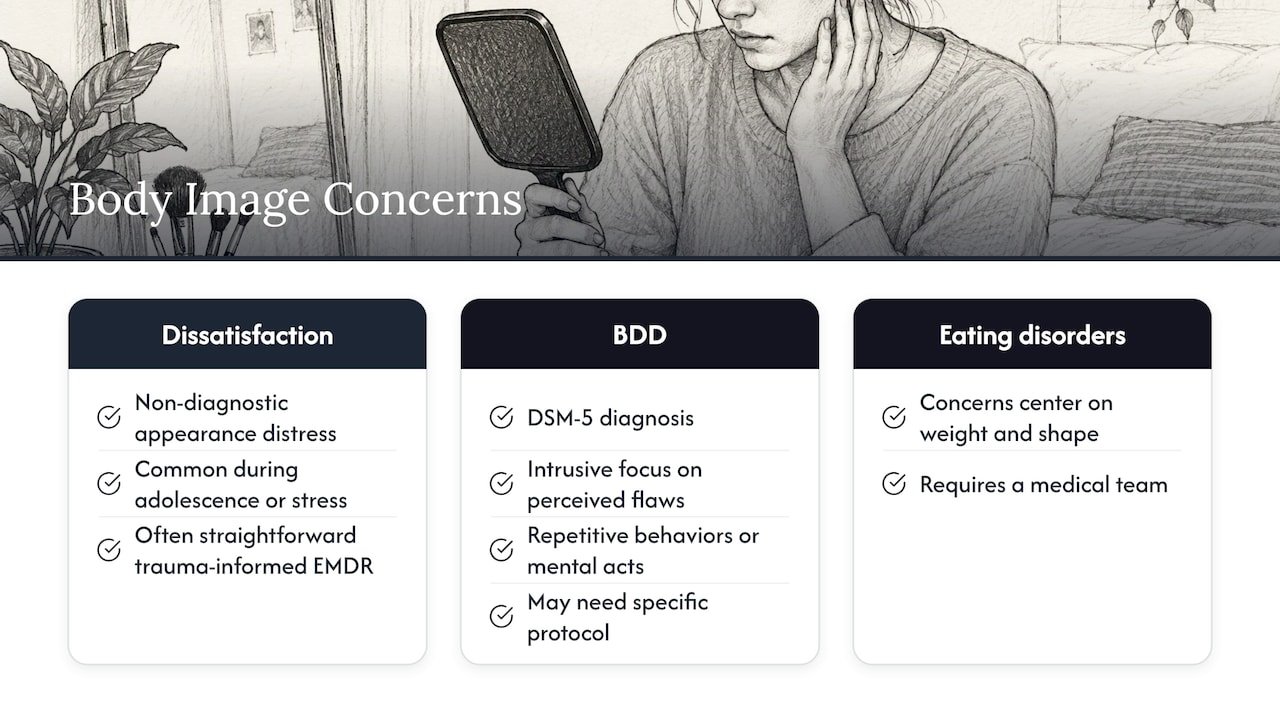
Body dissatisfaction or "body dysmorphia" in everyday speech. The National Eating Disorders Association (NEDA) explains that "body dysmorphia" is a non-diagnostic term for dissatisfaction or distress about appearance. Most people feel it at some point, especially during adolescence, stress, or heavy social media exposure.
Body dysmorphic disorder (BDD). The same NEDA page describes BDD as a DSM-5 diagnosis with persistent, intrusive preoccupation with perceived flaws, repetitive behaviors or mental acts, and significant distress or impairment. NEDA also reports that BDD affects roughly 1.7 to 2.9 percent of adults, with similar rates across genders. The perceived flaw is usually not observable to others or is a slight difference. In an American Family Physician review, BDD is described as a preoccupation with a specific body part that impairs social, academic or work functioning.
Eating disorders. In eating disorders, body-image problems typically center on weight and shape, while BDD involves specific features such as skin, hair or facial features. A BDD diagnosis requires that the preoccupation is not better explained by eating-disorder concerns about weight.
Why does this matter for EMDR? The target of the work is similar in all three cases: the memories and beliefs that feed the distress. But the surrounding plan is not. BDD may call for a specific protocol. An eating disorder calls for a medical team. General dissatisfaction often responds to a straightforward trauma-informed course of EMDR.
How EMDR works with body-related memories
EMDR is built on the adaptive information processing model. Francine Shapiro's 2014 paper in PMC explains that the model treats unprocessed memories of earlier life experiences as the foundation of many mental health problems. When those memories are sufficiently processed, the negative emotions, physical sensations and beliefs attached to them change as the memory links up with more adaptive information.
Apply that to body image. A body-related memory might be:
A relative's comment about your weight at a family dinner.
Being teased in a locker room or on a playground.
A medical appointment where you felt shamed.
A moment in a relationship where your body was criticized or used.
A photo, a mirror or a piece of clothing that still sets off a wave of disgust.
A 2018 systematic review in PMC describes a traumatic memory as a set of multi-sensory images, negative cognitions, negative emotions and unpleasant physical sensations. That description fits body-image pain well. The image of yourself, the thought "I'm too much," the shame and the knot in your stomach are all parts of one memory network.
The VA's National Center for PTSD describes how this works in session. The assessment identifies a target image, a negative self-belief, and the person's distress level and physical sensations. During desensitization, sets of bilateral stimulation are used while you focus on aspects of the memory. This continues as new insights, associations, emotions and sensations emerge, until distress is greatly reduced and a more adaptive self-appraisal takes hold.
The eight phases, applied to body image
EMDRIA, the professional association for EMDR clinicians, lists eight phases of EMDR therapy. Here is how each one tends to look when the issue is body image.
History and treatment planning. Your therapist gathers your history, with attention to pacing and to how much you can comfortably disclose, and plans treatment with you. EMDRIA's glossary describes this phase as including a readiness assessment and collaborative treatment planning. For body image, this is where you map the memories: first comments, first diets, first times you felt watched.
Preparation. The therapist explains EMDR, discusses what to expect and teaches techniques to manage emotional disturbance. These skills build the ability to settle between sessions, and some people need more preparation than others before reprocessing.
Assessment. You choose a target, such as the mirror moment or the remark at the dinner table. You name the negative belief ("I am unacceptable") and a positive belief you would like to hold ("I am worthy as I am"). Two scales help here. A 2025 IntechOpen chapter explains that the SUD scale measures distress from 0 to 10, and the VOC scale rates how true the positive belief feels from 1 to 7.
Desensitization. You hold the target in mind while the therapist leads sets of eye movements, sounds or taps. You notice what comes up, and the therapist follows the associations until the distress drops. The 2018 PMC review notes that tactile taps or audio tones can replace eye movements for clients who have difficulty with visual tracking.
Installation. The positive belief is strengthened. The IntechOpen chapter on eating disorders and body schema notes that in this phase, new positive beliefs about the body and the relationship with food are reinforced.
Body scan. This phase matters more for body image than for almost any other concern. You bring the original target to mind and check for residual tension in your body, and any sensations found are targeted for reprocessing.
Closure. Each session ends with you feeling stable, using the skills from preparation.
Reevaluation. Each new session opens with a check on what has changed and what disturbance remains, and the plan is adjusted.
If you want a deeper walk-through of each stage, our guides to the step-by-step EMDR process and how to prepare for EMDR therapy cover what each session asks of you.
The rejected self protocol for BDD
For body dysmorphic disorder, a specific adaptation exists. A 2024 study in the Journal of EMDR Practice and Research states that for BDD, the protocol introduced by the experts is the rejected self protocol (Seijo, 2018). It follows the main components and the eight phases of the standard protocol, with some differences.
The idea behind it is simple and humane. The same paper explains that dissatisfaction with appearance in BDD stems from a gap between the perceived self and the ideal self, and that concern over body image begins when a rejected self is created: a reflection of a past self the person has rejected and strives never to be again. That could be the child who was teased, the teenager who was told to lose weight, or the person who felt exposed. Treatment goes after those memories rather than arguing with the mirror.
What the research shows
EMDR has a large evidence base in general: the 2024 BDD paper notes it has been supported by more than 30 randomized controlled trials, particularly in the area of posttraumatic stress disorder. For body image specifically, the studies are smaller but point in a consistent direction.
| Study | Who | What it found |
|---|---|---|
| Bloomgarden and Calogero, 2008 | 86 women in residential eating disorder treatment | Women who received EMDR on top of standard treatment reported less distress about negative body-image memories and lower body dissatisfaction after treatment and at 3 and 12 months |
| PouladiHanieh et al., 2024 | Four women with BDD, 10 sessions of 90 minutes | Significant reductions in BDD symptoms, appearance-based rejection sensitivity and body shame, and an increase in self-compassion |
| Dziegielewski and Wolfe, 2008 | Single-subject case study over 43 days | Clinical improvement in self-esteem and body-image avoidance |
| Seven-case series, 1997 | Seven consecutive BDD cases | Six of seven improved, and five had complete resolution of symptoms |
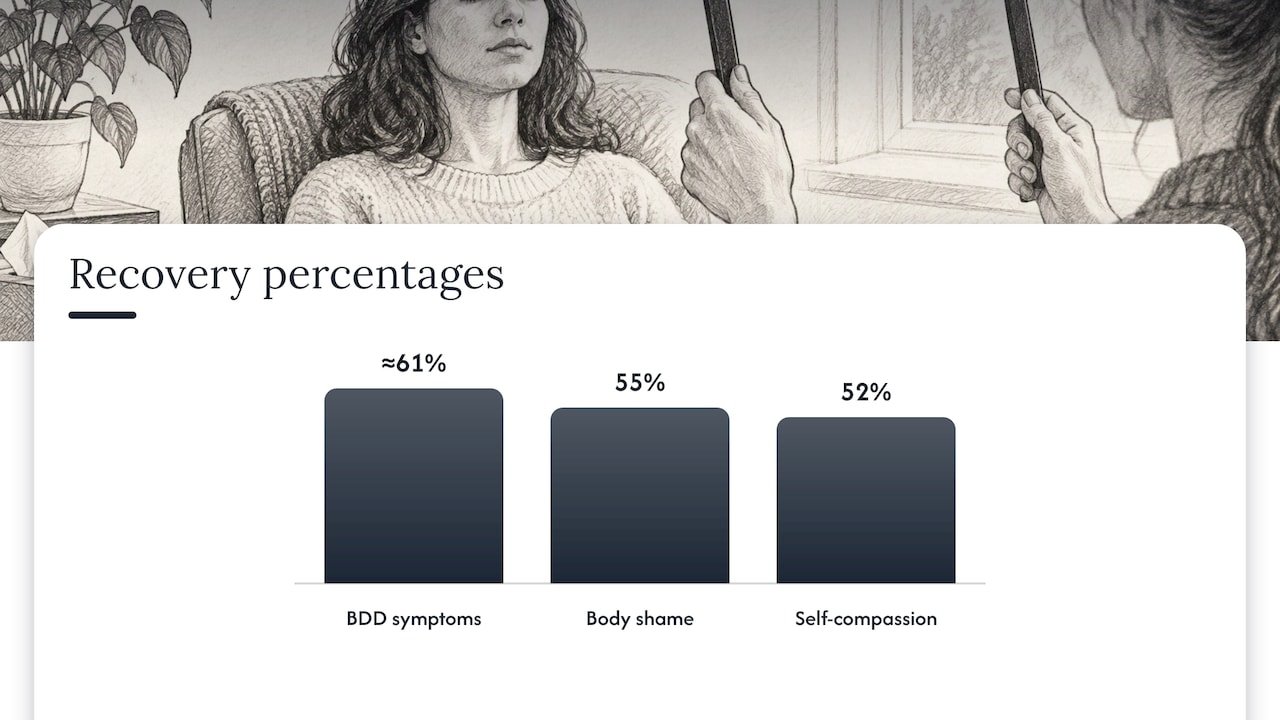
The 2024 trial reported recovery percentages of about 61 for BDD symptoms, 55 for body shame and 52 for self-compassion. These come from four participants, so they show a promising direction rather than a guarantee for any one person. A 2025 IntechOpen chapter describes EMDR as an emerging complementary therapy for eating disorders and body image disorders, with studies suggesting it may reduce symptom severity, improve body acceptance and address trauma-related cognitive distortions.
To read results like these sensibly, it helps to know how success rates are defined and measured. Our articles on what the research shows about EMDR effectiveness and how to read EMDR success rates explain this in plain language.
Safety and readiness: what a careful start looks like
Good EMDR does not begin with reprocessing. It begins with assessment, and two points deserve your attention.
Screening for dissociation
EMDRIA's guidance says clinicians should conduct a thorough Phase 1 assessment, including assessment for dissociation, before starting. The same post quotes Shapiro's textbook on giving the DES-II (a dissociation questionnaire) and conducting a clinical assessment with every client, so the therapist does not underestimate the work needed before reprocessing. A paper in the Journal of EMDR Practice and Research adds that DES-II scores alone are not enough to judge readiness, and that items endorsed at 20 or higher should be followed up. Clinicians should also check that you can tolerate calm and move from disturbance back to calm before reprocessing begins. If you want to know what a therapist might ask, read our screening questions for EMDR and dissociation.
When an eating disorder is involved
If your body-image distress comes with restricting, bingeing, purging or compensatory behaviors, EMDR is best used as one part of a larger plan. EMDRIA's February 2026 article on eating disorders explains that EMDR targets what bodies and brains have learned from past experiences, not physical or medical problems. It recommends a multidisciplinary team with medical care, nutrition support and trauma-informed therapy, and says medical monitoring and nutritional support are essential. It also notes that for some people, reprocessing comes later in treatment, once basic safety and stabilization are established.
This is how to use EMDR well: with your physician and a dietitian involved, and with your therapist pacing the trauma work to your stability. If you have a diagnosed or suspected eating disorder, tell your therapist at the first contact so that the team can be set up from the start. If you have urgent medical symptoms, see a physician or go to an emergency department first.
Other signs you are ready
Readiness is practical. It usually means you can use coping skills between sessions, stay present during distressing material, and come back to the room if your mind drifts. Preparation builds these abilities, and a therapist who spends several sessions on them is doing the work correctly.
Choosing a qualified EMDR therapist
The EMDRIA article on finding a therapist states that a clinician needs a minimum of 50 hours of training to ethically market themselves as EMDR trained: 20 hours of instruction, 20 hours of supervised practicum and 10 hours of consultation. EMDRIA certification goes further, with at least 20 hours of consultation, at least 50 hours of delivering EMDR to at least 25 clients, and 12 hours of continuing EMDR education every two years.
Beyond credentials, look for:
A therapist who takes a full history before reprocessing.
A clear explanation of the phases and how many preparation sessions to expect.
Comfort discussing bodies, identity, culture and shame without judgment.
Language fit. If Spanish is your first language, therapy in Spanish can make it easier to name how you feel about your body.
Our perspective
Body image is rarely about the mirror. When someone sits down with us, the story is almost always about a moment: a remark, a look, a time they felt exposed. The belief that grew from it, "something is wrong with me," then follows them into every room.
We believe EMDR is a strong fit for this because it works with the whole memory: the image, the belief, the emotion and the sensation in the body. Our practice is trauma-informed, culturally responsive and bilingual in English and Spanish, and we care about how identity shapes the way people experience their bodies. Latinx, BIPOC and LGBTQ+ clients often carry messages about bodies from family, community and culture, and our care is identity-affirming so those messages can be examined safely.
We also offer EMDR in more than one format. Weekly individual sessions suit people who want to build slowly. EMDR intensives suit people who want concentrated time and rapid symptom relief. Either way, preparation comes first, and pacing is set with you.
Juiced
Start EMDR with Alvarado Therapy
We provide EMDR therapy through individual sessions and through intensives, with licensed therapists in California and New York, online and in person, in English and Spanish. Our intensive options, as published on our site, are a 1-day intensive of 4 hours at $1,500, a 1-day intensive of 6 hours at $2,250, and a 3-day intensive at $5,750. Individual EMDR sessions have no published price, so reach out through our consultation page to learn about fit and fees, or see the details of our EMDR intensives.

If your distress includes trauma from childhood, our page on PTSD and complex trauma explains how we approach it, and our article on phase-based care for adults healing from childhood trauma shows why preparation and pacing come first.
FAQ
Can EMDR help with body image issues?
Yes. EMDR targets the memories, beliefs and sensations behind negative body image, and studies in eating disorder treatment and BDD have reported less body-related distress and body shame after EMDR. Results vary from person to person, and a therapist can tell you what to expect after assessing your history.
How many sessions does EMDR for body image take?
It depends on how many memories feed the distress and how much preparation you need. The 2024 BDD trial used 10 sessions of 90 minutes, with follow-ups at 1 and 3 months. Some people prefer a concentrated format, which is why we offer 1-day and 3-day intensives alongside individual sessions.
Is EMDR for body dysmorphic disorder different from standard EMDR?
Slightly. The rejected self protocol follows the same eight phases as standard EMDR, with some differences in focus. It works on the rejected self, the version of you that you have been trying hard not to be. Your therapist will explain which approach fits your history.
Do I need to talk about every painful memory in detail?
No. The history phase is paced to what you can comfortably share, and EMDR does not require long, detailed retellings. You identify a target, name the belief and sensations, and the processing happens with bilateral stimulation while you notice what comes up.
Can I do EMDR online?
Yes. We offer online EMDR to clients across California and New York, and online sessions use the same phases as in-person work. Bilateral stimulation can be adapted for the screen, and you and your therapist plan your setup during preparation.
Sources
Efficacy of EMDR in Body Dysmorphic Disorder and associated symptoms (2024)
Eye Movement Desensitization and Reprocessing for PTSD, VA National Center for PTSD
How Does Eye Movement Desensitization and Reprocessing Work? (2018, PMC)
EMDR for Eating Disorders and Body Schema Disorders (2025, IntechOpen)
Body Dysmorphia and Eating Disorders, National Eating Disorders Association
A Randomized Experimental Test of the Efficacy of EMDR (2008, PubMed)
EMDR as a treatment for body image disturbance and self-esteem (2008)
Body dysmorphic disorder: Seven cases treated with EMDR (1997)
How to Set a Firm Foundation for EMDR Therapy Reprocessing, EMDRIA
Beyond the DES-II: Screening for Dissociative Disorders in EMDR
