

The Flash Technique is a brief method used inside EMDR therapy to make a very distressing memory less intense before the memory is processed. You hold the memory at a distance, focus on something pleasant, and blink quickly a few times when your therapist cues you. It is a preparation-phase tool, not a separate replacement for EMDR, and the research behind it was built around guided sessions with a trained clinician. If you are weighing it, the practical question is less "can I do Flash?" and more "who will guide me through EMDR as a whole?"
Alvaradotherapy
Explore EMDR Therapy Support
Alvarado Therapy offers EMDR therapy and intensives, with licensed therapists serving clients in person and online across California.
TL;DR
The Flash Technique (FT) is used during the preparation phase of EMDR to lower the intensity of extremely disturbing memories so they can be processed with standard EMDR.
You do not have to describe or fully recall the memory. You keep a safe distance from it while focusing on a positive engaging focus and blinking in short bursts.
Published studies, including a 2024 report covering 654 people, found large drops in distress after short guided sessions, with the research delivered by trained presenters or supervised clinicians.
Flash works best as one piece of a full EMDR plan with a licensed therapist, who can screen for safety, pace the work and move into processing when you are ready.
In California and New York, we offer EMDR therapy and EMDR intensives, in person and online.
Table of Contents
What the Flash Technique is, and how it relates to EMDR
What happens in a Flash session
Why it may work
What the research shows
What the national PTSD guideline says
Where Flash fits in a full EMDR plan
Can you do the Flash Technique on your own?
Safety: who should take extra care
Getting ready for your first sessions
Our perspective
EMDR with Alvarado Therapy
FAQ
Sources
What the Flash Technique is, and how it relates to EMDR
EMDR (eye movement desensitization and reprocessing) is a structured therapy for trauma with eight phases. Phase 2 is preparation: the therapist builds enough stability and trust that you can approach painful material without being flooded.
The Flash Technique was developed for exactly that moment. According to a 2017 article in the Journal of EMDR Practice and Research, it is meant to reduce the intensity of extremely disturbing memories quickly and without pain, so the memory can then be handled with the remaining EMDR phases. The same article recommends it for clients who are very apprehensive about touching traumatic material, who dissociate (mentally detach or go numb), who become overwhelmed, or who resist going to the memory at all. It describes the intervention as taking roughly 10 to 45 minutes.
So the short answer to a common question is no, Flash and EMDR are not the same thing. Flash is a technique that sits within the EMDR framework. Standard EMDR has the client briefly hold the memory while following bilateral stimulation (side-to-side eye movements, taps or tones) and then reprocess it. Flash asks for much less contact with the memory.
The EMDR International Association (EMDRIA) describes the technique as an advance in EMDR treatment, usable as a quick, painless process in preparation so that clients do not need to dissociate or defend against the memory.
What happens in a Flash session
Protocol details vary a little between clinicians, but the research describes a consistent shape. A 2024 article in the Journal of EMDR Practice and Research outlines five steps:
Choose a memory and rate it. You pick a distressing memory and give it a SUD score (subjective units of distress, a 0 to 10 scale where 10 is the worst). You do not need to tell the story. Many people just say "the worst moment" or give it a nickname.
Keep your distance. Your therapist helps you hold the memory far enough away that it stays in the background.
Pick a positive engaging focus (PEF). This is something that absorbs your attention in a pleasant way. Examples in the research include a positive memory, a funny music video, a fun conversation, singing or dancing, or slow breathing.
Blink on cue. While you concentrate on the PEF, your therapist prompts you with a word such as "flash" or "blink," and you blink rapidly three to five times. Bilateral stimulation, such as slow eye movements or alternating taps, may accompany this. About six prompts make up a round.
Re-rate the memory. You give the memory a new SUD score. Many people notice it has become fuzzier, farther away or simply less charged, often without having tried to change it.
According to the same research, the therapist typically checks in after every five sets of triple blinks. That pacing matters. The therapist watches how you respond and decides whether to repeat, stop or move on to another step.
A worked example
Imagine a client, Maria, whose most painful memory is a car accident at 19. When she even starts to describe it, her chest tightens and she goes blank. She rates it 9 out of 10 on the SUD scale.
In a Flash round, she does not tell the story. She names the memory "the crash" and puts it at the back of her mind. She chooses a PEF: a recent trip to the beach with her sister. As she talks about the water and the music playing in the car, her therapist says "flash," and she blinks quickly a few times. After several rounds, she re-rates the crash and gives it a 4. She can now name some details of the memory without the blankness, which gives the therapist a way into standard EMDR processing.
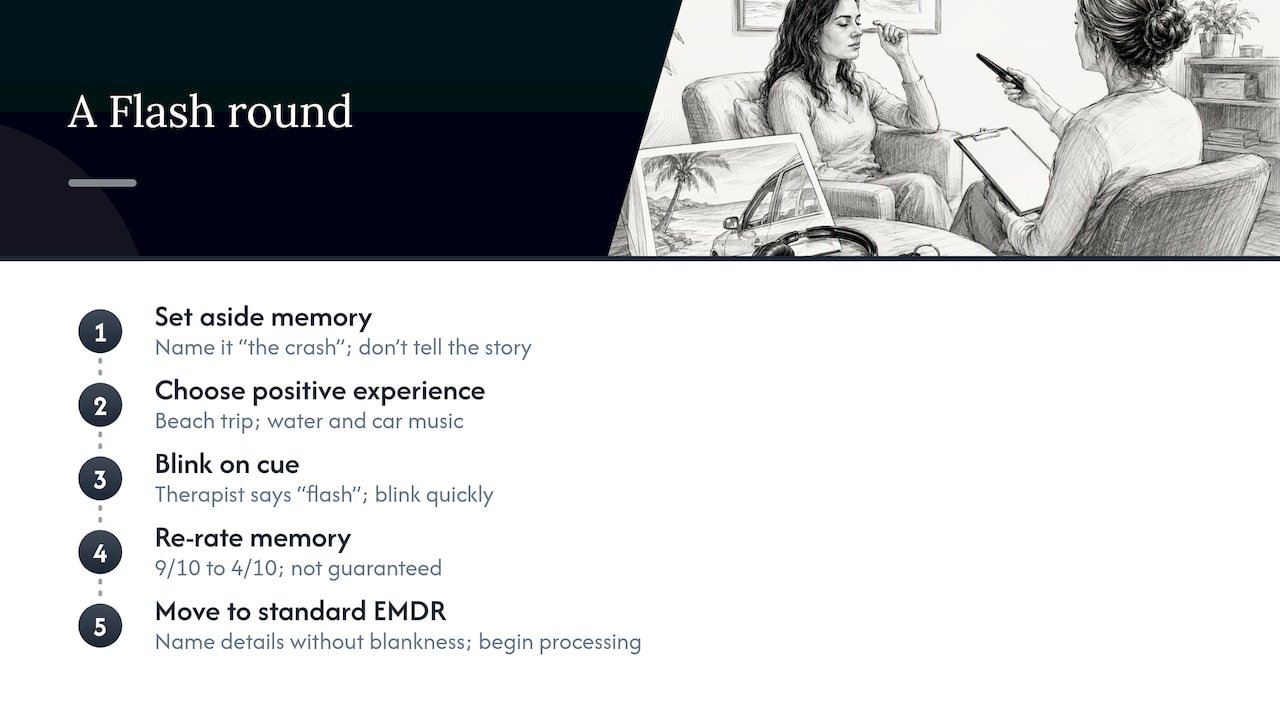
This is an illustration of how a round looks, not a promised outcome. Responses vary from person to person.
Why it may work
Researchers are still working out the mechanism. One proposal, in the 2024 Journal of EMDR Practice and Research article, draws on the broaden-and-build theory of positive emotion: pleasant, engaging experiences widen attention and build resources, which may help explain why focusing on a positive memory or activity changes how the disturbing memory feels.
Another idea, known as Wong's theory, concerns blinking. It suggests that during a brief blink a deep brain region may access the disturbing image while the blink is too short for the prefrontal cortex to respond, so there may be no fear response. A 2026 research note using published timing data found that for the great majority of healthy subjects, a delay of more than 100 milliseconds separates access to a disturbing image from the prefrontal response, which is consistent with one of the theory's assumptions.
You do not need to understand the mechanism to benefit from the technique. It is useful to know, though, that this is an active research area and that authors continue to study how and why it works.
What the research shows
The evidence for Flash comes mostly from short sessions and non-clinical or mixed groups, and the results are encouraging.
A four-study report (2024). In Frontiers in Psychiatry, Manfield and colleagues combined four studies, two in the US, one in Australia and one in Uganda. A total of 654 people completed 813 fifteen-minute guided sessions. Mean distress reduction exceeded two-thirds in every study. Only two sessions showed slight increases, and both people improved in a second session. Benefits held at 4 weeks and at 18 months in a subgroup that began with high distress. The authors say further study is warranted.
Safety at follow-up. At 18 months, 23 of 75 people who started with SUD 9 to 10 responded, reporting 791 Flash sessions, none of which were harmful.
A randomized comparison (2021). In Frontiers in Psychology, Brouwers, de Jongh and Matthijssen randomized 60 non-clinical participants. Flash reduced the emotionality and vividness of an unpleasant memory as much as an abbreviated EMDR protocol, and participants rated it as more pleasant.
Newly arrived migrants (2025). A university study of 55 people at a U.S. point of entry found average distress fell from 7.222 to 2.944 after a single Flash session, and all 11 providers observed clients shift from nervous and anxious toward relaxed.
Two points of context help you read these numbers. First, the studies measured distress about a specific memory in short sessions. They are not a measure of recovering from PTSD or complex trauma, which unfold across a full treatment plan. Second, the Brouwers study used participants who were not seeking treatment and had only 8-minute sessions, and the authors call for further work with clinical groups. That is a reason to think of Flash as a promising tool within therapy, not as a standalone cure.
What the national PTSD guideline says
The 2023 VA/DoD clinical practice guideline for PTSD recommends cognitive processing therapy, EMDR and prolonged exposure. It also says there is insufficient evidence to recommend individual components of manualized protocols over, or in addition to, the full therapy protocol. For you, that means the most dependable path is a complete, well-structured EMDR course delivered by a licensed clinician, with preparation techniques like Flash used where they fit.
Where Flash fits in a full EMDR plan
In a 2023 EMDR Therapy Quarterly article, therapist Justin Havens describes Flash as usable at different stages of the standard protocol, not as a replacement for EMDR. In early preparation, he writes, the goal is not to bring distress to zero but to gradually lower the "trauma load" without leaving the client upset. When distress is lower, the therapist can switch into full EMDR processing, which can leave clients less drained and lower the risk of abreaction (a sudden, intense emotional release) or dissociation.
This is a useful way to think about your own treatment:
Early on, a gentle technique can take the edge off the memories that feel too big to approach.
In the middle, the reduced charge makes it possible to enter the standard EMDR phases of assessment, desensitization and reprocessing.
Later, installing positive beliefs, a body scan and closure consolidate the change.
If you want a plain walk-through of those phases, our step-by-step EMDR therapy guide covers each one, and our post on examples of EMDR techniques for trauma healing shows how they differ.
Can you do the Flash Technique on your own?
You will find videos and music tracks online that walk through a Flash round, and the community threads that rank for this topic are full of people trying them. The published evidence, though, is built on guided delivery. The 2024 studies used structured, scripted Flash led by trained presenters in group settings. In the 2023 study of student clinicians, the work was delivered under licensed supervision. A 2020 review of self-administered EMDR noted that the only published trial involved a guided internet program with weekly contact with a clinical psychologist, so no conclusions can be drawn about fully unsupervised use.
A therapist does more than read the cues. They help you choose a memory at a manageable level, notice when your body is signaling that you are too close, adapt the pace, and decide what comes next. If a memory is linked to abuse, assault, grief or immigration-related harm, that guidance is where the safety is. Working with a licensed EMDR therapist is the most reliable way to get it.
Safety: who should take extra care
Flash is described as gentle, but it is still part of trauma treatment, and some situations call for assessment before you start. A 2022 BJPsych Advances review lists conditions where EMDR should be used with caution or may be contraindicated:
not enough trust in the therapeutic relationship
dangerous behavior or behavior that interferes with therapy
past suicide attempts or self-harm that need assessment
severe, life-threatening substance misuse
inadequate social support
severe general debility
eye defects
epilepsy, pseudoseizures or neurological impairment
benzodiazepine use, which can affect processing speed
If any of these apply, tell your therapist at the first appointment, and speak with your physician about epilepsy, eye conditions or any medication you take. A clinician can then decide how to adapt, sequence or delay the work. We explain how this screening goes in 4 EMDR contraindications and how clinicians prepare, and in our guide to screening questions to ask before EMDR for dissociation.
If you are in crisis or thinking about harming yourself, call or text 988, the Suicide and Crisis Lifeline, or call 911 in an emergency.
Getting ready for your first sessions
A few steps make EMDR, including any preparation technique, go more smoothly:
Write down what you want to work on, in a few words rather than a full story.
Think about your positive anchors. A favorite memory, a song, a person or a place gives your therapist material for the preparation phase.
Note your health basics. Medications, sleep, eye or neurological conditions and substance use all matter for planning.
Plan some space afterward. Many people feel tired after trauma work, so leave a quiet hour if you can.
Choose a setting that feels safe. For online sessions, that means a private room and a stable connection.
Our guides on how to prepare for EMDR therapy and how to prepare for EMDR therapy in California go into each point.
Our perspective
We see Flash as a good example of what makes EMDR work: the pace is set around the person, not the protocol. Many people arrive wanting relief from a memory but dreading the moment of telling it. Preparation is where that fear gets met.
Our approach is trauma-informed, which means safety, choice and trust come before any technique. Our clinicians offer EMDR in English and Spanish, and we work with Latinx, BIPOC and LGBTQ+ clients who often carry layered experiences of harm, migration or discrimination. A well-paced EMDR plan gives those histories room.
We also know that not everyone can spread treatment across months of weekly appointments. That is why we offer EMDR intensives, which concentrate processing into longer blocks. Whatever the format, our goal is the same: that you leave a session more grounded than you arrived.
Juiced
EMDR with Alvarado Therapy
If the idea of reducing the weight of a painful memory without retelling it appeals to you, a full EMDR plan with a licensed therapist is the place to start. We provide individual counseling and EMDR therapy in Pasadena, Ventura and online across California, with online services in New York as well, in English and Spanish.
For people who want focused, concentrated work, our EMDR intensives come in three formats:
| Format | Length | Price |
|---|---|---|
| 1-Day EMDR Intensive | 4 hours in one day | $1,500 |
| 1-Day EMDR Intensive | 6 hours in one day | $2,250 |
| 3-Day EMDR Intensive | 3 days | $5,750 |
To see how online sessions work, read about online EMDR trauma therapy in California and New York. If you have PTSD or complex trauma, our PTSD and complex trauma page explains how we approach it, and you can book a consultation to talk through what fits you.
FAQ
Is EMDR the same as flash therapy?
No. EMDR is a full eight-phase trauma therapy. The Flash Technique is a short method used during its preparation phase to reduce the intensity of a disturbing memory, so the memory can then be processed with standard EMDR. The two share bilateral stimulation and a focus on memory, but Flash asks for far less contact with the painful material.
Do I have to talk about my trauma during a Flash session?
No. You only need to identify the memory privately, often with a nickname, and rate how disturbing it feels. Most of the attention goes to a positive engaging focus, such as a pleasant memory or a favorite song, while you blink on cue.
Why does EMDR make you tired?
Trauma processing asks a lot of your attention and emotions, and many people feel drained afterward. Havens notes that moving into full processing once distress has been lowered can leave clients less drained. Plan a quiet hour after a session, drink water and eat something, and tell your therapist how you felt so they can adjust the pace.
Who is a bad candidate for EMDR?
There are few absolute exclusions, but caution is advised with insufficient trust, severe substance misuse, unaddressed self-harm risk, epilepsy, eye or neurological conditions, and some medications. A therapist assesses these before starting and may adapt or sequence the work. Share your history and medications openly, and talk with your physician about medical conditions.
Sources
Testing Wong's theory on the Flash Technique with published timing data (EMDRIA, 2026)
Preliminary evidence for the acceptability, safety, and efficacy of the Flash Technique (PMC, 2024)
The Effects of the Flash Technique Compared to Abbreviated EMDR (Frontiers in Psychology, 2021)
The Flash Technique as an Effective Low-Intensity Intervention (UTRGV, 2025)
Self-administered EMDR therapy: potential solution for trauma (PMC, 2020)
Eye movement desensitisation and reprocessing: part 1 (BJPsych Advances, 2022)
