

Trauma and chronic illness are closely linked. People with a history of trauma, especially childhood adversity or PTSD, are more likely to develop long-term physical conditions such as chronic pain, diabetes and heart disease. Living with a serious illness can also bring on trauma symptoms of its own. The research shows association, not proven cause. The practical conclusion is still clear: if trauma is part of your story, treating it alongside your medical care is a sound step. At Alvarado Therapy, we provide trauma-informed EMDR therapy for adults across California and online.
Alvaradotherapy
Support for Trauma and Chronic Illness
Explore trauma-informed EMDR therapy and individual counseling for adults across California, including online care.
TL;DR
Large studies link childhood adversity, trauma exposure and PTSD to a higher risk of chronic physical conditions. Researchers describe this as an association, not a proven cause.
PTSD and chronic pain often occur together and can feed each other through hypervigilance, catastrophizing and avoidance.
A serious diagnosis, or distressing hospital care, can itself trigger trauma responses.
Trauma-focused therapy works alongside your medical treatment. It does not replace it.
Persistent distress that disrupts your daily life or relationships is a reason to ask for an evaluation.
Table of Contents
What the evidence says: association, not proven cause
Childhood trauma and adult health
PTSD and chronic pain
Why the two can feed each other
When the illness itself is the trauma
Signs that trauma may be affecting your illness
What support looks like alongside medical care
When to ask for professional help
How we can help
Our perspective
Frequently asked questions
Sources
What the evidence says: association, not proven cause
The strongest finding is consistent across many studies: people who have lived through trauma are more likely to have chronic illness. What researchers are careful about is the word "cause."
A ten-country study found that three or more childhood adversities were independently associated with the onset of all six chronic physical conditions it examined. The hazard ratios ranged from 1.44 to 2.19. A hazard ratio above 1 means a higher rate of the condition appearing over time. The authors also state that the retrospective design, in which adults look back and report their childhoods, rules out strong causal conclusions.
The pattern holds in adults exposed to trauma later in life. A 2025 study of U.S. veterans in Annals of Behavioral Medicine followed participants over time. Greater lifetime trauma exposure (HR 1.15), PTSD symptoms (HR 1.22) and a PTSD diagnosis (HR 1.39) each predicted developing more chronic disease. The associations were consistent for cardiovascular disease, diabetes and pulmonary disease, and they persisted after accounting for other psychiatric diagnoses.
What does this mean for you? Trauma is one risk factor among many, alongside genetics, environment, access to care and more. It does not mean your illness is "all in your head." It also does not mean that everyone who has experienced trauma will become ill. The research describes patterns across large groups, and your own health history deserves an individual look.
Childhood trauma and adult health
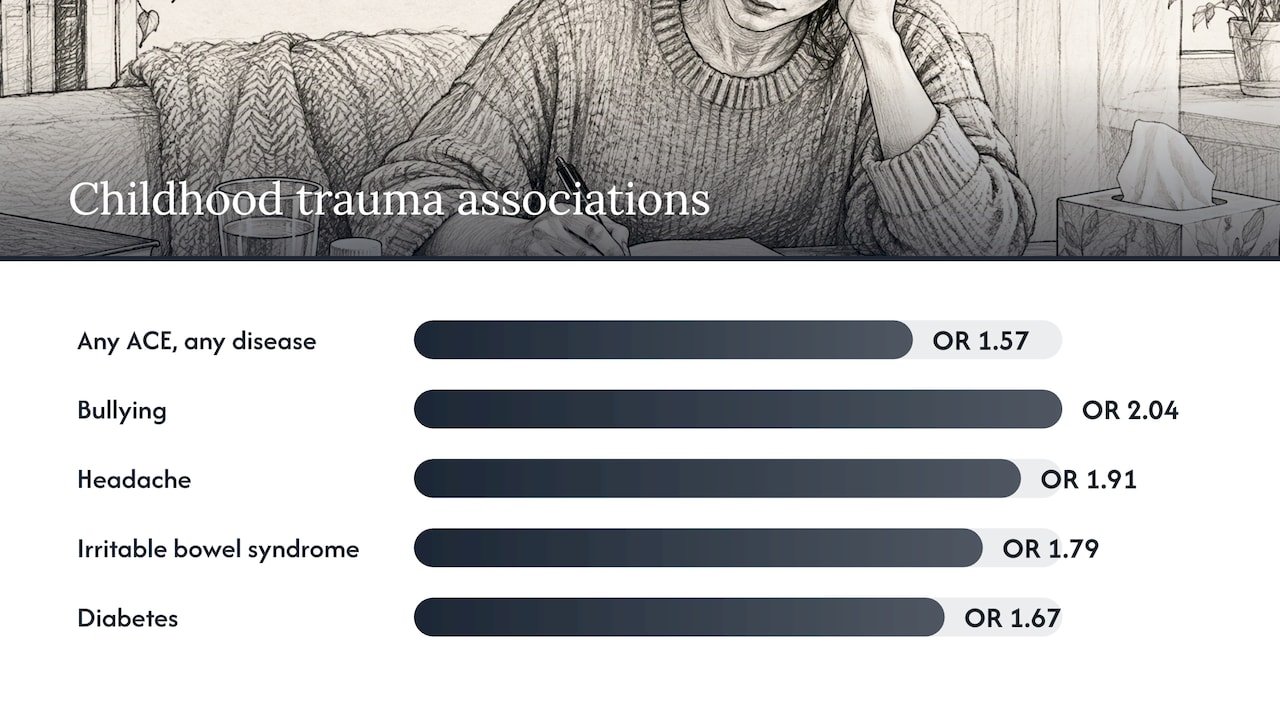
If your trauma began in childhood, the evidence base is the largest. A 2025 umbrella review in eClinicalMedicine pooled 36 reviews covering 250 studies and more than six million participants. It found highly suggestive evidence linking any adverse childhood experience (ACE) to any non-mental medical disease (OR 1.57). Some associations were stronger: bullying (OR 2.04), headache (OR 1.91), irritable bowel syndrome (OR 1.79) and diabetes (OR 1.67). The authors note that much of the data relies on self-reported trauma and varied study designs. They also note that prospective data, which follows people forward in time, showed lower bias.
An ACE is a stressful or harmful experience in childhood, such as abuse, neglect or growing up in a household affected by violence or addiction. If you want to see how these experiences can show up in adulthood, our guide to the impacts of childhood trauma on adult life covers the emotional and relational side.
How might early trauma reach the body?
Researchers propose several pathways. A 2016 editorial in PMC summarizes them in two groups:
Neurobiological: inflammatory, cardiometabolic, epigenetic, gene-expression and cellular-aging pathways.
Psychosocial: anxiety and depression, and central sensitization, in which the nervous system becomes more responsive to pain signals.
The same editorial points out that some proposed mechanisms, such as certain cardiovascular ones, were not supported in well-designed studies. A 2022 systematic review of longitudinal studies agrees that a clear picture of the mechanisms is not yet available. This is an active field of research. Anyone who tells you exactly how trauma produces a particular illness in your body is going beyond what the science currently shows.
PTSD and chronic pain
The overlap between PTSD and chronic pain is the best-documented link between trauma and a specific chronic symptom.
A 2013 meta-analysis of 71 studies found that people who reported trauma exposure were 2.7 times more likely to have a functional somatic syndrome. This group includes fibromyalgia, chronic widespread pain, chronic fatigue syndrome, temporomandibular disorder and irritable bowel syndrome. The association was significantly larger for PTSD than for sexual or physical abuse alone.
In the other direction, a review of the PTSD and chronic pain literature reports that 7.3% of people with chronic back pain in the U.S. National Comorbidity Replication Survey met criteria for PTSD. It describes a typical community rate of comorbid PTSD and chronic pain of around 7 to 8%, with higher rates in treatment settings.
The U.S. National Center for PTSD explains that factors such as anxiety sensitivity and childhood adversity can predispose a person to both conditions. It also explains that the hypervigilance and arousal of PTSD can produce a dysregulated stress response that leads to central sensitization. A 2024 PLOS One systematic review of 13 studies found that cumulative childhood maltreatment has long-term effects on both PTSD or complex PTSD and chronic pain in adulthood. It recommends routine screening for childhood trauma and PTSD, with trauma-focused therapies including EMDR.
Complex PTSD is a form of PTSD that develops after repeated or prolonged trauma, often in childhood. You can read more in our overview of PTSD and complex trauma.
Why the two can feed each other
When trauma symptoms and a physical condition coexist, they tend to form a loop. The National Center for PTSD describes it this way: you become more alert to anxiety or pain signals, you catastrophize ("this pain means something is really wrong"), and you start avoiding anything that reminds you of either. Over time that avoidance leads to isolation, physical deconditioning and low mood. These in turn make it harder to take part in treatment.
A 2024 review by Yamin, Meints and Edwards adds that patients with both pain and trauma report greater functional impairment and emotional distress, and a worse response to treatment, than those with only one. This is not a verdict on your prospects. It explains why a plan that addresses only the physical side can stall, and why addressing both sides makes sense.
There is also a practical difficulty. Clinicians note that patients with both conditions often cannot tell which symptoms come from pain, which from PTSD and which from the interaction between the two, especially when both trace back to the same event. Sorting this out is a key task in treatment, according to the PTSD and chronic pain literature. It is also why a thorough trauma assessment is a useful first step.
When the illness itself is the trauma
Trauma and chronic illness do not only connect through the past. For many people, the diagnosis, a hospitalization or an invasive procedure is the frightening event.
A 2023 review of trauma-informed palliative care describes how posttraumatic stress in serious illness can show up as increased pain, death anxiety and difficulty taking part in treatment planning. The review describes a stepwise model with three stages: easing immediate discomfort, teaching coping skills, and then treating specific trauma issues. That includes identifying and changing hospital-care triggers that set off the fight-or-flight response.
If you flinch at the smell of a clinic, dread every scan, or replay a painful procedure in your mind, those reactions deserve attention in their own right. They are not a sign that you are coping badly.
Signs that trauma may be affecting your illness
The National Center for PTSD lists signs that PTSD may be amplifying chronic pain. Many of them apply to other long-term conditions too:
Heightened attention to pain or to anxiety signals in your body
Catastrophizing: expecting the worst from every flare or symptom
Avoiding physical activity, or cycling between overdoing it and crashing
Pulling away from other people
Poor sleep
Difficulty coping with setbacks
One or two of these on a bad week is common. A cluster that persists is worth raising with your doctor and a trauma-informed therapist. For a broader view of how PTSD shows up in the body and mind, see how PTSD affects adults.
What support looks like alongside medical care
Trauma therapy adds to your medical care. It does not take its place. Your physicians keep managing the condition, and therapy addresses the trauma response around it.
The 2024 review by Yamin and colleagues recommends routine trauma screening with validated tools. It also recommends trauma-informed care built on safety, trustworthiness, choice, collaboration and empowerment, and trauma-focused adaptations of CBT, acceptance and commitment therapy, and exposure-based methods delivered alongside pain treatment. A 2022 review by Lumley and colleagues emphasizes that psychological treatments can target trauma and chronic pain together, including Emotional Awareness and Expression Therapy. If you want to understand how coverage and care coordination work for ongoing conditions, this guide to chronic disease management programs outlines plan options.
The National Center for PTSD advises that when medical treatment does not fully resolve chronic pain, the goal should be better functioning and quality of life rather than the elimination of pain. That is a useful frame for therapy too. The aim is not to prove that your symptoms are psychological. It is to lower the alarm in your nervous system so that you have more room to live.
For a practical look at therapy choices, our guide to PTSD management strategies explains what tends to help.
When to ask for professional help
The American Academy of Family Physicians advises that persistent psychological distress severe enough to interfere with psychological or social functioning may warrant further evaluation and treatment. Physicians are advised to refer trauma survivors whose reactions are prolonged and affect relationships and daily functioning. It also advises follow-up, because problems may not resolve on their own or may return.
In practice, consider reaching out if:
Nightmares, flashbacks or constant tension are part of your week
Fear of medical settings is making you skip appointments or tests
You are withdrawing from people you care about
Symptoms are getting worse, or you feel unsafe
Tell your primary care doctor about any new or worsening symptoms, since they need to rule out medical causes. If you are in immediate danger or thinking about harming yourself, call 911 or go to the nearest emergency room.
How we can help
Alvarado Therapy is a trauma-informed practice offering EMDR therapy for adults in California and online across the state, in English and Spanish. EMDR (eye movement desensitization and reprocessing) is a structured therapy for processing distressing memories. Our clinicians work with childhood trauma, PTSD and complex trauma. You can learn about how sessions run on our online EMDR trauma therapy page, or start with individual counseling and EMDR therapy.
If weekly sessions are hard to fit around medical appointments, our EMDR Intensives concentrate the work into longer blocks. The published fees are $1,500 for a 1-day intensive of 4 hours, $2,250 for a 1-day intensive of 6 hours, and $5,750 for a 3-day intensive.
Not sure which format suits you? You can book a consultation to talk it through.
Our perspective
When someone arrives with a long medical history and a long trauma history, the two stories are rarely separate. Our clinicians see the body and the memory as part of the same person, and we start by making the person feel safe.
We believe people deserve to be heard before they are treated. Trauma-informed care means you have choice and collaboration at every stage. Your doctors stay in charge of your medical care, and our work is to help the trauma response quiet down so that you can take part in your own life again.
We also know that who sits across from you matters. Our practice is bilingual and culturally responsive, with a focus on Latinx, BIPOC and LGBTQ+ clients, because feeling understood is often what makes it possible to talk about the hardest things. For many survivors, EMDR is a way to process painful memories without having to retell every detail at length.
Juiced
Frequently asked questions
Can trauma cause chronic illness?
Research shows that trauma and chronic illness are associated, but it does not prove that trauma directly causes any particular illness. Studies of childhood adversity and PTSD find higher rates of conditions such as chronic pain, diabetes and cardiovascular disease. Genetics, environment and many other factors also play a role.
Can being diagnosed with a chronic illness cause PTSD symptoms?
Yes, a frightening diagnosis, hospitalization or procedure can trigger trauma responses such as intrusive memories, avoidance and heightened fear. Palliative care research describes posttraumatic stress in serious illness and ways to identify and reduce hospital-care triggers. A therapist trained in trauma can help you work through these reactions.
Should I stop my medical treatment and do therapy instead?
No. Trauma-focused therapy is meant to run alongside medical treatment. Keep working with your physicians, and let them know you are also getting mental health support.
Do you offer therapy online?
Yes. We offer online therapy for adults in California, in English and Spanish, which can make it easier to fit sessions around medical appointments and energy levels.
Sources
The association of childhood adversities and early onset of chronic physical conditions (PMC, 2011)
Trauma, PTSD and incident chronic disease in U.S. veterans (Annals of Behavioral Medicine, 2025)
Adverse childhood experiences and risk of non-mental medical diseases (eClinicalMedicine, 2025)
Mechanisms underlying the association between early-life adversity and physical health (PMC, 2016)
Links of adversity in childhood with mental and physical health (PMC, 2022)
Psychological trauma and functional somatic syndromes (PMC, 2013)
A different kind of co-morbidity: understanding PTSD and chronic pain (PMC)
Childhood trauma, PTSD/CPTSD and chronic pain: a systematic review (PLOS One, 2024)
Trauma-Informed Care for Inpatient Palliative Care (PMC, 2023)
The Physician's Role in Managing Acute Stress Disorder (American Family Physician, 2012)
