

PTSD disrupts adult life across four core domains: persistent re-experiencing of trauma, deliberate avoidance of reminders, negative shifts in mood and thinking, and chronic hyperarousal that keeps the nervous system stuck in threat mode. These aren't temporary stress reactions. When they last more than a month and interfere with work, relationships, or physical health, they meet the clinical threshold for post-traumatic stress disorder.
If you or someone you know is in crisis right now, call or text 988 (Suicide and Crisis Lifeline) or 911. Veterans can also reach the Veterans Crisis Line at 988, then press 1.
Here's what PTSD typically causes in adults:
Re-experiencing: Flashbacks, intrusive memories, nightmares, and intense distress when exposed to trauma reminders
Avoidance: Steering clear of people, places, thoughts, or conversations connected to the trauma
Negative mood and cognition: Persistent guilt, shame, emotional numbness, distorted self-blame, and loss of interest in activities
Arousal and reactivity: Hypervigilance, exaggerated startle response, irritability, difficulty concentrating, and sleep disruption
Physical health effects: Chronic pain, GI symptoms, cardiovascular strain, and immune dysregulation
Functional impairment: Reduced work performance, relationship withdrawal, parenting difficulties, and increased substance use
Table of Contents
How PTSD affects adults: recognizing the four symptom clusters
Practical coping strategies while you arrange professional care
Alvaradotherapy: trauma-informed PTSD care in California and New York
What is PTSD, and how do clinicians diagnose it?
Post-traumatic stress disorder is a psychiatric condition that can develop after direct exposure to a traumatic event, witnessing trauma happen to someone else, learning that a close person experienced violent or accidental trauma, or repeated exposure to disturbing details of traumatic events (as with first responders). Common triggers include combat, sexual assault, serious accidents, natural disasters, and childhood abuse.
The National Center for PTSD describes PTSD as a condition where normal fear responses after trauma fail to resolve over time. Most people experience some stress after a traumatic event. The distinction between a normal reaction and a diagnosable disorder comes down to duration and functional impact.
DSM-5 diagnostic criteria at a glance
The Diagnostic and Statistical Manual of Mental Disorders, Fifth Edition (DSM-5) requires symptoms across four clusters, all present for at least one month, causing clinically significant distress or functional impairment:
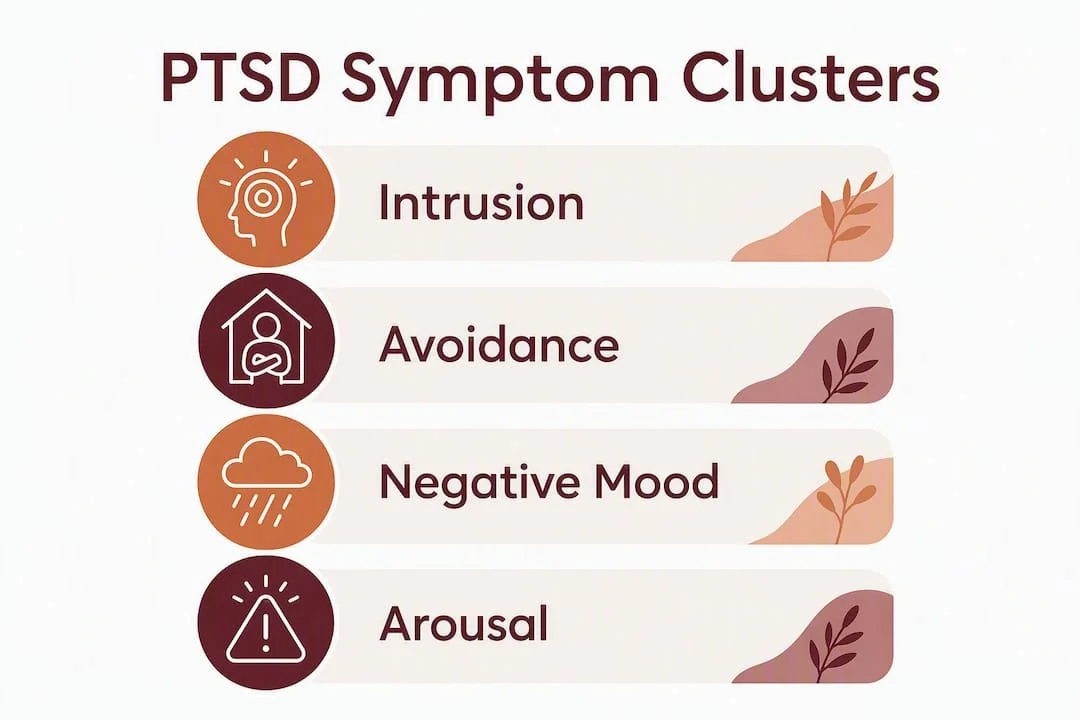
| Symptom Cluster | Minimum Required | Examples |
|---|---|---|
| Intrusion / Re-experiencing | 1 symptom | Flashbacks, nightmares, intrusive memories |
| Avoidance | 1 symptom | Avoiding trauma-related thoughts, people, or places |
| Negative cognition / mood | 2 symptoms | Persistent guilt, emotional numbing, distorted blame |
| Arousal / Reactivity | 2 symptoms | Hypervigilance, exaggerated startle, sleep problems |
Duration: All clusters must be present for at least one month. Symptoms appearing within the first month after trauma are classified as an acute stress reaction, not PTSD. The DSM-5 also recognizes a delayed-onset specifier when full criteria are not met until six months or more after the event.
Tracking symptoms with dates and severity notes before a clinical appointment gives a clinician a clearer picture than memory alone. MedlinePlus notes that acute stress reactions often resolve naturally; it's the persistence beyond one month that signals the need for a formal evaluation and treatment.
How PTSD affects adults: recognizing the four symptom clusters
Understanding PTSD in adults means seeing how textbook criteria translate into real situations. A flashback isn't always a dramatic cinematic episode. It can be a sudden, visceral sense of being back in the moment while sitting in a work meeting, triggered by a sound or smell that has nothing obvious to do with the original event.
Intrusion and re-experiencing
Unwanted memories: Vivid, distressing recollections that arrive without warning, often during routine tasks
Nightmares: Recurring trauma-related dreams that fragment sleep and leave the person exhausted and on edge by morning
Flashbacks: A brief or prolonged sense of reliving the trauma, ranging from a fleeting image to a full dissociative episode
Emotional and physical reactivity: Intense distress or physical symptoms (racing heart, sweating) when encountering reminders
A parent who survived a car accident may freeze at the sound of screeching tires while driving their children to school. That freeze response isn't a choice.
Avoidance
Adults with PTSD often restructure their entire lives around avoidance. Someone who experienced workplace violence may call in sick on days when a particular coworker is scheduled, or quit entirely. A sexual assault survivor may avoid physical intimacy, crowded spaces, or any media that references assault. The avoidance feels protective but steadily narrows the person's world.
Negative changes in cognition and mood
This cluster is frequently underrecognized because it overlaps with depression. Signs include persistent negative beliefs about oneself ("I am permanently broken"), distorted blame ("It was my fault"), emotional numbing, loss of interest in previously meaningful activities, and a pervasive sense of alienation from others. Some adults describe feeling like they are watching their own life from behind glass.

Arousal and reactivity
Hypervigilance, an exaggerated startle response, irritability or anger outbursts, reckless behavior, and difficulty concentrating all fall here. A veteran who sits with their back to the wall in restaurants, scanning exits, is managing hypervigilance. A parent who snaps at their child over a minor noise and then feels crushing guilt is experiencing the irritability and reactivity cluster.
Dissociative subtype
The DSM-5 also recognizes a dissociative presentation of PTSD, characterized by depersonalization (feeling detached from one's own body or thoughts) or derealization (the world feeling unreal or dreamlike). This subtype responds somewhat differently to treatment and is worth flagging with a clinician.
Pro Tip: Before your first clinical appointment, keep a simple daily log for two weeks: note the symptom, what triggered it (if known), its intensity on a 1–10 scale, and how long it lasted. This gives your clinician concrete data rather than a general impression, and it often speeds up accurate diagnosis.
How does PTSD affect your physical health over time?
PTSD is not a purely psychological condition. Research published in StatPearls shows that people with PTSD have 1.5–3 times higher rates of cardiovascular, metabolic, autoimmune, and musculoskeletal conditions compared with people who were not exposed to trauma. The body keeps a record.
The mechanism runs through two systems: the hypothalamic-pituitary-adrenal (HPA) axis and the autonomic nervous system (ANS). In PTSD, both systems become dysregulated. The HPA axis, which governs cortisol release, can shift toward either chronically elevated or blunted cortisol output depending on the individual and the trauma type. The ANS gets stuck in a sympathetic (fight-or-flight) dominant state. Together, these changes produce a cascade of physical symptoms that clinicians often see before they see the psychiatric ones.
Common physical effects include:
Sleep disturbance: UpToDate identifies sleep disruption as especially common and consequential for recovery. Poor sleep amplifies emotional reactivity, impairs memory consolidation, and reduces the brain's capacity to process and contextualize threat.
Gastrointestinal symptoms: — Nausea, irritable bowel syndrome, and appetite changes are frequent somatic complaints in PTSD patients.
Clinical note: Treating PTSD's psychological symptoms without addressing somatic complaints reduces overall treatment effectiveness. If you're managing PTSD, bring a list of physical symptoms to every appointment, and ask your clinician whether a medical workup is warranted.
Clinicians who screen only for psychological symptoms and miss the somatic picture are working with an incomplete map. The physical and psychological components of PTSD reinforce each other, and effective care addresses both.
How PTSD changes daily functioning, work, and relationships
The impact of PTSD on relationships and daily life is often where adults first recognize that something is seriously wrong. The symptom clusters described above don't stay in the therapy office. They show up at the dinner table, in performance reviews, and in the bedroom.
Common functional impacts:
Work performance: Difficulty concentrating, hypervigilance in open-plan offices, avoidance of conflict that leads to missed deadlines, and frequent absences
Parenting: Emotional numbing can make it hard to feel present with children; hyperreactivity can lead to disproportionate responses to normal child behavior
Intimate relationships: Avoidance of physical intimacy, emotional withdrawal, and communication breakdowns are frequent; partners often feel shut out without understanding why
Social engagement: Gradual withdrawal from friends, family gatherings, and community activities as avoidance expands
Substance use: Alcohol and other substances are commonly used to manage hyperarousal and intrusive symptoms, which can escalate into a separate substance use disorder
Consider a composite picture that clinicians see regularly: a 38-year-old project manager who survived a serious assault two years ago. She's still employed, but she leaves meetings when raised voices occur, works from home four days a week to avoid the open office, and has stopped attending her daughter's soccer games because the crowds feel unsafe. Her partner describes her as "gone" even when she's physically present. She drinks two or three glasses of wine every night to get to sleep. None of these behaviors are laziness or indifference. They are PTSD doing exactly what PTSD does.
Practical indicators of significant functional impairment may include frequent work absences, withdrawal from close relationships, and substance use to manage emotions. These signs suggest the need for clinical evaluation.

Who is most at risk for developing PTSD?
Most people exposed to potentially traumatic events do not develop PTSD. The World Health Organization estimates a global lifetime prevalence of approximately 3.9%, with substantially higher rates among survivors of violent conflict and sexual violence. Understanding why some people develop PTSD and others don't involves both the nature of the trauma and the person's circumstances before and after it.
Risk factors that increase vulnerability:
Trauma type and intensity: Sexual violence, combat, and prolonged captivity carry higher PTSD rates than single-incident accidents
Prior trauma: Childhood adversity, including abuse and neglect, sensitizes the stress response system and raises risk for PTSD after adult trauma
Lack of social support: Isolation after trauma is one of the strongest predictors of PTSD development
Gender: WHO data shows women are more likely to develop PTSD than men, partly due to higher exposure to sexual violence and partly due to biological differences in stress response
Traumatic brain injury (TBI): Co-occurring TBI complicates both diagnosis and recovery
Socioeconomic stressors: Financial instability, housing insecurity, and lack of access to care all extend the window of risk
Protective factors:
Strong, stable social connections after the trauma
Early access to trauma-informed care before symptoms become entrenched
Existing coping skills and a sense of personal agency
Community and cultural support systems
Populations with elevated vulnerability include refugees and asylum seekers, survivors of sexual violence, combat veterans, first responders, and people with histories of complex trauma from childhood.
PTSD comorbidities and suicide risk: what you need to know
PTSD rarely travels alone. StatPearls documents high rates of comorbidity and elevated suicide risk among people with PTSD, and clinicians are trained to screen for both at every contact. Understanding mental health comorbidity in the context of PTSD means recognizing that each co-occurring condition can amplify the others.
Common co-occurring conditions:
Major depressive disorder (MDD): Shares several symptoms with PTSD (numbing, loss of interest, sleep problems) but requires separate treatment targeting; untreated depression slows PTSD recovery
Anxiety disorders: Generalized anxiety, panic disorder, and social anxiety frequently co-occur; the hyperarousal cluster of PTSD feeds directly into anxiety symptom maintenance
Substance use disorder (SUD): Many adults use alcohol, cannabis, or other substances to manage intrusive symptoms and hyperarousal; SUD then becomes a separate clinical problem requiring its own treatment track
Personality disorders: Borderline personality disorder in particular overlaps with PTSD in symptom presentation, especially in adults with childhood trauma histories
Suicide risk in PTSD is clinically significant. Suicidal ideation, plans, and attempts occur at higher rates in people with PTSD than in the general population, and the risk increases when depression or substance use is also present.
Seek emergency care immediately if you or someone you know:
Is expressing intent to harm themselves or others
Has a plan and means to act on suicidal thoughts
Is in a state of acute dissociation or psychosis
Call 911 or go to the nearest emergency room. For non-emergency but urgent distress, call or text 988. Veterans: call 988 and press 1 for the Veterans Crisis Line.
What is the typical course and prognosis of PTSD in adults?
PTSD does not follow a single predictable path. Some adults recover within months of a traumatic event, especially with early support and treatment. Others develop a chronic course that persists for years. StatPearls estimates that approximately one-third of people diagnosed with PTSD still have symptoms at one year, and a subset remain symptomatic a decade later.
The typical trajectory looks something like this:
Acute stress reaction (0–4 weeks): Normal fear and distress responses after trauma. Many people recover naturally during this window without formal intervention.
Possible PTSD (1 month+): When symptoms persist beyond one month and impair functioning, a PTSD diagnosis becomes appropriate and treatment should be offered.
Recovery or chronicity: With evidence-based treatment, many adults achieve significant symptom reduction or full remission. Without treatment, symptoms often become entrenched. Delayed-onset PTSD, where full criteria aren't met until six months or more after the event, is also recognized and can catch people off guard.
One underappreciated finding from the research: many adults experience subsyndromal PTSD, meaning they have clinically significant impairment without meeting every DSM-5 threshold. Early intervention in these cases reduces the risk of progression to full PTSD. Waiting for a "complete" diagnosis before seeking care is not a strategy that serves the patient.
The NIMH notes that anyone can develop PTSD at any age, and that recovery is possible with appropriate care. Prognosis improves with early treatment, strong social support, and absence of ongoing trauma exposure.
What are the most effective treatments for adult PTSD?
The evidence on PTSD treatment options for adults is unusually clear: trauma-focused psychotherapies are the first-line treatments, and they work. The VA National Center for PTSD identifies trauma-focused CBT and EMDR as having strong evidence for reducing or eliminating symptoms.
Trauma-focused psychotherapies
| Therapy | What It Targets | Typical Course | Expected Outcomes |
|---|---|---|---|
| Prolonged Exposure (PE) | Avoidance and fear responses through gradual, controlled exposure to trauma memories and reminders | — | Significant reduction in intrusion and avoidance; improved functioning |
| Cognitive Processing Therapy (CPT) | Distorted beliefs about the trauma, self, and world | — | Reduction in guilt, shame, and negative cognition; improved mood |
| EMDR (Eye Movement Desensitization and Reprocessing) | Traumatic memory processing through bilateral stimulation while recalling distressing memories | — | Reduced emotional intensity of traumatic memories; improved quality of life |
EMDR works differently from traditional talk therapy. Rather than asking patients to narrate trauma in detail, EMDR uses bilateral stimulation (typically eye movements, taps, or tones) while the patient holds a traumatic memory in mind. The VA National Center for PTSD describes the goal as reducing the intensity of traumatic memories and emotional responses, helping patients regain quality of life rather than trying to erase the past. The role of therapy in PTSD recovery is particularly well-documented for adults whose PTSD stems from childhood experiences that surface in adult functioning.
One important caution from the research: forced or premature debriefing after trauma can worsen distress for some people. Effective trauma therapy focuses on controlled processing, stabilization, and pacing. A clinician who rushes into trauma narrative without establishing safety first is not following best practice.
Medications
Medications are not a substitute for trauma-focused therapy, but they can reduce symptom severity enough to make therapy more accessible. Commonly used classes include:
SSRIs (sertraline, paroxetine): FDA-approved for PTSD; reduce intrusion, avoidance, and mood symptoms
SNRIs (venlafaxine): Evidence for PTSD symptom reduction; useful when depression is also present
Prazosin: An alpha-1 blocker used specifically for trauma-related nightmares; not an antidepressant
Pro Tip: When interviewing a prospective therapist, ask three questions: (1) "What trauma-focused therapies are you trained in, and are you certified in EMDR?" (2) "How do you approach safety planning before beginning trauma processing?" (3) "What does the first few sessions look like before we start working directly on the trauma?" A clinician who can answer all three clearly is practicing within evidence-based standards.
Practical coping strategies while you arrange professional care
Self-help strategies are not a replacement for clinical treatment, but they can reduce distress and stabilize daily functioning while you wait for an appointment or between sessions. The key is choosing techniques that interrupt the nervous system's threat response without reinforcing avoidance.
Grounding techniques bring attention back to the present moment when intrusive symptoms spike. The 5-4-3-2-1 method asks you to name five things you can see, four you can touch, three you can hear, two you can smell, and one you can taste. It sounds simple because it is, and it works by redirecting cognitive resources away from the trauma memory and toward sensory reality.
Diaphragmatic breathing activates the parasympathetic nervous system directly. Inhale for four counts, hold for two, exhale for six. The extended exhale is what matters physiologically. Doing this for two minutes during a hyperarousal spike measurably reduces heart rate.
Sleep hygiene matters more in PTSD than in almost any other condition because sleep disruption amplifies every other symptom. Practical steps: keep a consistent wake time (even on weekends), avoid screens for 60 minutes before bed, keep the bedroom cool and dark, and avoid alcohol within three hours of sleep. Alcohol may feel like it helps with sleep onset, but it fragments sleep architecture and worsens nightmares.
For practical management strategies that go beyond the basics, including body-based approaches and structured self-monitoring tools, additional resources are available. If you are experiencing suicidal thoughts at any point, stop and call 988 before using any self-help strategy.
How to find trauma-informed care in the United States
Knowing you need help and knowing how to find it are two different problems. Here's a clear path through the U.S. mental health system for adults dealing with PTSD.
Step-by-step guide to finding a trauma specialist
Determine your level of urgency. Active suicidal ideation or intent: call 911 or go to an ER. Severe distress without immediate safety risk: call 988 or contact your current clinician same-day. Persistent symptoms without acute crisis: schedule a therapy intake within the next two weeks.
Search for trauma-specialized therapists. The SAMHSA Behavioral Health Treatment Services Locator (findtreatment.gov) and the ISTSS therapist directory (istss.org) both allow filtering by trauma specialization and location.
Verify credentials and training. Look for licensed clinicians (LCSW, MFT, PhD, PsyD) with documented training in PE, CPT, or EMDR. EMDR International Association (EMDRIA) maintains a therapist directory at emdria.org where you can confirm certification.
Check insurance and cost. Call your insurance's behavioral health line to confirm in-network trauma specialists. Ask prospective therapists about sliding-scale fees if cost is a barrier. Many community mental health centers offer income-based rates.
Prepare for your first session. Bring your symptom log, a list of current medications, and a brief timeline of the traumatic event(s). You do not need to tell the full story in session one. A good trauma clinician will spend the first sessions on assessment and safety, not trauma processing. Preparing for your first counseling session as a trauma survivor can make that first appointment significantly less daunting.
Key U.S. resources:
988 Suicide and Crisis Lifeline: Call or text 988 (24/7)
Veterans Crisis Line: 988, press 1
SAMHSA National Helpline: 1-800-662-4357 (free, confidential, 24/7)
VA National Center for PTSD: ptsd.va.gov (treatment locator, self-assessment tools, provider training)
NIMH: nimh.nih.gov (clinical information and research updates)
ISTSS: istss.org (therapist directory, treatment guidelines)
For veterans specifically, the VA system offers free PTSD treatment through VA medical centers and Vet Centers nationwide. The VA's PTSD Coach app (free, iOS and Android) provides evidence-based self-help tools between appointments.
What the research says: key findings on PTSD in adults
The evidence base for understanding and treating PTSD in adults is substantial and consistent across major institutions. Here's what the primary sources collectively establish:
Diagnosis and prevalence: The DSM-5 diagnostic framework, as documented by the VA National Center for PTSD, requires specific minimum symptoms across four clusters for at least one month. The WHO places global lifetime prevalence at approximately 3.9%, with significantly higher rates in conflict-affected populations and survivors of sexual violence.
Chronicity: Approximately one-third of diagnosed adults remain symptomatic at one year, and a subset carry symptoms for a decade or longer, per StatPearls. This underscores why early, evidence-based intervention matters.
Physical health links: StatPearls documents 1.5–3 times higher rates of cardiovascular, metabolic, autoimmune, and musculoskeletal conditions in PTSD populations. UpToDate identifies sleep disturbance as especially consequential for recovery. Treating only the psychological symptoms while ignoring somatic sequelae reduces overall treatment effectiveness.
Comorbidity and suicide risk: Depression, anxiety disorders, and substance use disorder co-occur at high rates with PTSD. Suicide risk is elevated, particularly when comorbidities are present.
Treatment effectiveness: Trauma-focused CBT (including Prolonged Exposure and CPT) and EMDR have the strongest evidence base. The VA National Center for PTSD identifies these as first-line treatments that can eliminate or significantly reduce symptoms for many adults.
Research limitations: Most large PTSD studies have been conducted in veteran and combat-exposed populations, which skews some prevalence and treatment data. Trauma type, cultural context, and socioeconomic factors all affect outcomes in ways that population-level statistics don't fully capture. Clinicians should interpret research findings in light of the individual patient's history and circumstances.
Key Takeaways
PTSD in adults involves four persistent symptom clusters, measurable physical health consequences, and strong evidence-based treatments that can significantly reduce or eliminate symptoms when accessed early.
| Point | Details |
|---|---|
| DSM-5 requires four clusters | Diagnosis needs at least 1 intrusion, 1 avoidance, 2 arousal, and 2 cognition/mood symptoms lasting over one month. |
| Physical health is affected | People with PTSD show 1.5–3 times higher rates of cardiovascular, metabolic, and autoimmune conditions than unexposed populations. |
| Chronicity is real but not inevitable | Roughly one-third of diagnosed adults remain symptomatic at one year; early treatment improves recovery odds significantly. |
| Treatment works | Trauma-focused CBT and EMDR are first-line treatments with strong evidence for symptom reduction and quality-of-life improvement. |
| Alvarado therapy offers specialized care | Alvarado therapy provides EMDR therapy, EMDR intensives, and individual counseling for adults with PTSD in California and New York. |
A perspective on what PTSD treatment actually requires
Most articles on PTSD stop at listing symptoms and naming therapies. What they understate is how much the structure of treatment matters, not just the modality.
The research on forced debriefing is instructive here. Asking someone to narrate their trauma before they have the internal resources to tolerate that narrative doesn't help. It can actively worsen distress. This is why the first phase of any evidence-based trauma therapy, whether EMDR, Prolonged Exposure, or CPT, is stabilization. Safety before processing. That sequencing isn't a formality. It's what separates effective trauma care from well-intentioned harm.
There's also a widespread misconception that PTSD treatment means reliving the trauma in exhaustive detail until it loses its power. EMDR in particular challenges that assumption. The bilateral stimulation protocol allows the brain to process traumatic memories at a neurological level without requiring the patient to verbalize every detail. For adults who have spent years avoiding the memory, that distinction is significant. It lowers the barrier to entering treatment.
The other thing worth saying plainly: PTSD that goes untreated doesn't stay static. The avoidance that feels protective in year one becomes a narrower and narrower life by year five. The substance use that manages hyperarousal at night becomes its own clinical problem. The relationship withdrawal that seems manageable becomes isolation. The trajectory of untreated PTSD is rarely stable. Getting into evidence-based care early, even when symptoms feel manageable, changes that trajectory.
Alvaradotherapy: trauma-informed PTSD care in California and New York
Adults with PTSD need more than a general therapist who has read about trauma. They need a clinician trained in the specific protocols that the research supports,
Alvaradotherapy is a trauma-informed practice serving adults in California and New York, with licensed therapists specializing in EMDR therapy, EMDR intensives, and individual counseling for PTSD and complex trauma. The practice offers bilingual care in English and Spanish, with a culturally responsive approach that recognizes how identity, immigration history, and community context shape trauma and recovery. Services include PTSD and complex trauma therapy, couples counseling when PTSD is affecting relationships, and support for victims of crime through VOCA. For adults who want to understand what the process looks like before committing, the what to expect page walks through the clinical process from first contact to active treatment. To schedule a consultation, visit alvaradotherapy.org/consultation.
This article provides general educational information about PTSD and is not a substitute for professional mental health diagnosis or treatment. If you are in crisis, call 988 or 911.
Useful sources and further reading
These are the primary and authoritative sources used throughout this article. Each is publicly accessible and regularly updated.
National Institute of Mental Health (NIMH) — Post-Traumatic Stress Disorder: Comprehensive clinical overview of PTSD symptoms, diagnosis, and treatment options; useful for patients and clinicians seeking a government-vetted summary.
VA National Center for PTSD — Understand PTSD: The leading U.S. resource for PTSD education, self-assessment tools, and provider training; includes the PTSD Coach app and treatment locator.
VA National Center for PTSD — Understanding PTSD Booklet: Accessible patient-facing booklet covering diagnosis, treatment options, and what to expect from trauma-focused therapy.
StatPearls / NCBI Bookshelf — Posttraumatic Stress Disorder: Peer-reviewed clinical reference covering epidemiology, pathophysiology, comorbidities, and treatment; updated regularly and freely accessible.
World Health Organization — PTSD Fact Sheet: Global prevalence data, risk factors, and treatment recommendations; useful for understanding population-level patterns.
MedlinePlus — Post-Traumatic Stress Disorder: Plain-language patient resource from the National Library of Medicine; good starting point for newly diagnosed adults.
UpToDate — PTSD in Adults: Epidemiology, Pathophysiology, Clinical Features: Detailed clinical reference on physical health effects and diagnostic nuances; subscription required for full access.
International Society for Traumatic Stress Studies (ISTSS): Professional organization publishing treatment guidelines and maintaining a therapist directory for trauma specialists.
Mayo Clinic — Post-Traumatic Stress Disorder: Clinically reviewed patient information on symptoms, causes, and when to seek care; accessible and reliable for general audiences.
Sources were accessed in 2026. Clinical guidelines and prevalence data are subject to revision as new research emerges. Always verify current recommendations with a licensed clinician or primary source.
