

TL;DR:
The first step after heartbreak or depression is to ensure safety and address basic needs.
Structured routines, social support, and professional help are crucial if symptoms persist beyond two weeks.
If you're heartbroken and depressed right now, the single most important first step is to secure your safety, then stabilize your basic needs before anything else. If you're having thoughts of suicide or self-harm, call or text 988 (the National Suicide & Crisis Lifeline) immediately, or call 911 if you're in immediate danger. The SAMHSA National Helpline is also available 24/7 at 1-800-662-4357, free and confidential, for anyone in mental health crisis.
Once you're safe, here's what to do in the next hour:
Safety check: If you have thoughts of self-harm, remove access to means (medications, sharp objects) and call someone you trust or dial 988.
Stabilize sleep and eating: Eat something small, drink water, and lie down even if sleep feels impossible.
Ground yourself right now: Try the 5-4-3-2-1 technique: name 5 things you can see, 4 you can touch, 3 you can hear, 2 you can smell, 1 you can taste. It takes 90 seconds and interrupts the panic loop.
Limit re-triggering contact: Mute your ex on all platforms. You don't need to explain it.
One small action: Call a friend, take a 10-minute walk, or do four slow box breaths (inhale 4 counts, hold 4, exhale 4, hold 4).
Clinicians consistently note that healing after a breakup is non-linear — rigid timelines create shame, not speed. Give yourself permission to feel this without a deadline.
Table of Contents
How to rebuild your identity and find meaning after a breakup
A simple 4-week action plan to move from survival to steady progress
Alvaradotherapy offers trauma-informed care for heartbreak and depression
What actually helps in the first 48 hours and two weeks
The acute phase after a breakup is genuinely one of the hardest neurobiological states the body goes through. Your brain is processing a real loss, and the distress is physiological, not just emotional. The goal in the first 48 hours isn't to feel better — it's to not make things worse.
The 48-hour checklist
Sleep basics: Aim for a consistent bedtime, even if sleep is broken. Avoid alcohol, which fragments REM sleep and amplifies emotional reactivity the next day.
Eat something real: Grief suppresses appetite. A small, protein-rich meal matters more than a full plate you can't finish.
Ground yourself twice daily: Use the 5-4-3-2-1 exercise or four rounds of box breathing. Both activate the parasympathetic nervous system within minutes.
Make one social contact: Text or call one person who won't push you to "just move on." You don't need advice — you need a witness.
Set a digital boundary: Mute or temporarily block your ex across all platforms. Each time you check their profile, you re-trigger the attachment bond and reset your nervous system's recovery clock — clinicians treat this the same way they treat interrupting an addiction craving cycle.
Pick one short distraction: A puzzle, a new podcast, a cooking video. Something cognitively engaging that pulls your attention without requiring emotional energy.
What prolongs distress (avoid these in the first two weeks):
Checking your ex's social media, even once
Substance use to numb the pain — it delays nervous-system processing
Immediately dating again as a distraction
Isolating completely with no social contact
Ruminating for hours without any scheduled break
Building a two-week routine
Structure is the underrated tool here. When your internal world feels chaotic, external routine gives the nervous system something to anchor to. Wake at the same time each day. Schedule one processing window (a short session of journaling or talking) and then close it — don't let grief bleed into every hour. Allowing grief through expressive techniques like journaling accelerates integration; suppressing it tends to prolong and complicate recovery.

Regular physical activity and social support are among the most evidence-backed tools for reducing acute distress after a breakup. Even a brief walk or phone call counts.
Pro Tip: Use structured distraction to interrupt rumination, not to avoid it. Choose a task that is novel and cognitively demanding — a new recipe, a crossword, a language app — so your brain has to focus. Then return to your scheduled processing window. This gives the nervous system recovery time without burying the grief.
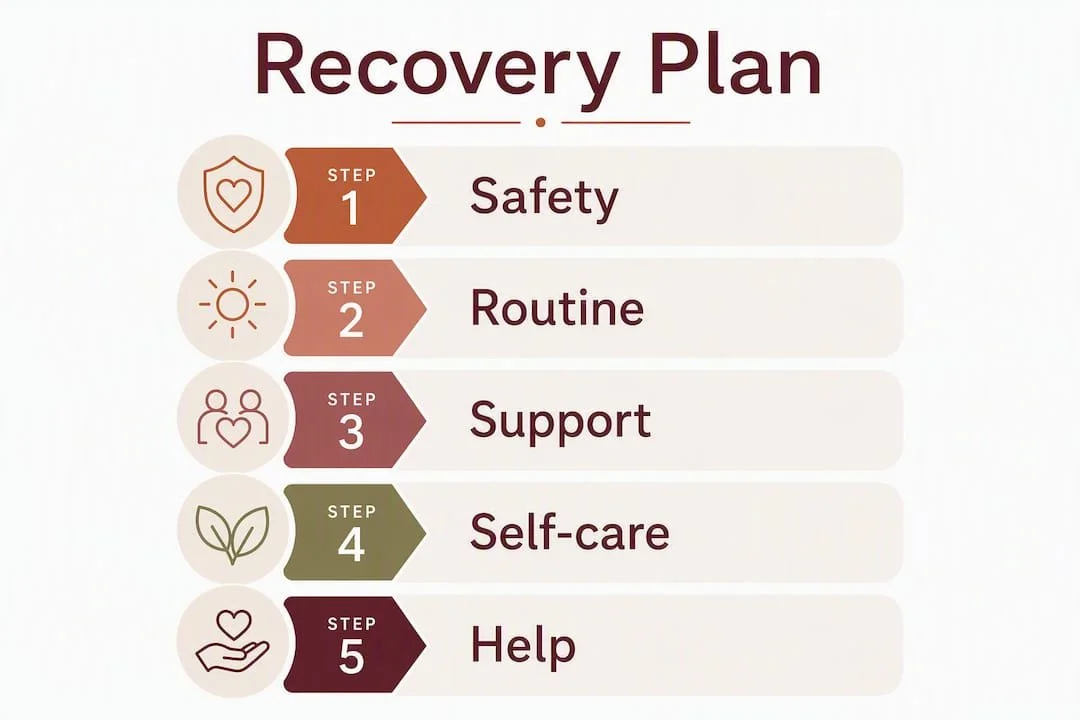
For a detailed post-breakup self-care workflow, Alvaradotherapy has a step-by-step guide built around the acute phase.
How to tell normal heartbreak from clinical depression
Most heartbreak is grief. It's painful, disorienting, and consuming — but it's a normal human response to loss. Clinical depression is something different, and the distinction matters because it changes what kind of help you need.
Warning signs that suggest clinical depression, not just grief:
Suicidal thoughts or thoughts of self-harm (seek help immediately)
Persistent hopelessness that doesn't lift even briefly
Loss of interest in nearly everything, including things that used to matter
Major changes in sleep patterns
Significant appetite changes with noticeable weight loss or gain
Inability to function at work, school, or in basic daily tasks for a prolonged period
Feeling worthless or excessively guilty beyond the breakup itself
The two-week threshold is the clinical benchmark: if symptoms like hopelessness, loss of interest, major changes in sleep or appetite, or suicidal thoughts persist or worsen beyond two weeks, or if there's any functional decline, professional help is warranted — not optional.
Recovery phases and approximate timelines
| Phase | Timeframe | What’s happening |
|---|---|---|
| Acute | Initial weeks | Neurobiological withdrawal, intense grief, sleep and appetite disruption |
| Processing | Following months | Emotional waves, identity questioning, beginning to integrate the loss |
| Rebuilding | Later months | Gradual re-engagement, meaning-making, renewed sense of self |
These phases follow a predictable arc, though the timeline varies significantly by relationship length and depth. Longer relationships typically require longer recovery — and that's not a failure, it's math.
One thing that consistently slows recovery: contact with an ex. Every interaction, including checking social media, re-triggers the attachment bond and resets the physiological recovery clock. No-contact isn't just etiquette — it's a neurobiological strategy.
When and how to get professional help now
If you have active suicidal thoughts or are in immediate danger, call 911 or go to your nearest emergency room. If you're in crisis but not in immediate danger, call or text 988 (available 24/7). The SAMHSA National Helpline (1-800-662-4357) connects you to local treatment referrals, free and confidential.
For everyone else: if you've had two or more weeks of severe symptoms, significant functional decline, or you simply can't manage this alone, it's time to find a therapist.
How to find the right clinician:
Check credentials: Look for a Licensed Clinical Social Worker (LCSW), Licensed Marriage and Family Therapist (LMFT), Psychologist (PsyD or PhD), or Psychiatrist (MD). Verify licensure through your state's licensing board.
Search strategies: Use your insurance's provider directory, Psychology Today's therapist finder, or Open Path Collective for lower-cost options. Telehealth platforms now make it possible to access licensed clinicians without leaving home.
Ask during intake: "Do you have experience with breakup grief or attachment trauma?" and "Do you use trauma-informed modalities like EMDR or compassion-focused therapy?" These questions help you assess fit quickly.
Medication: A psychiatrist may recommend antidepressants when depressive symptoms are severe or when therapy alone isn't producing relief. Medication and therapy together tend to be more effective than either alone for clinical depression.
Pro Tip: When you make that first call or send that first message, you don't need to have it all figured out. Say: "I'm going through a breakup and I'm struggling with depression. I'm looking for someone with experience in grief and trauma-informed care." That's enough to triage urgency and find the right match faster.
For readers in California or New York, EMDR vs. talk therapy is worth reading before your first intake call — it helps you ask better questions.
How to rebuild your identity and find meaning after a breakup
Long-term recovery isn't about forgetting. It's about building a life that has room for what happened and still moves forward. The Gottman Institute frames this as relearning trust rather than erasing the past — and that framing matters because it removes the pressure to "get over it" and replaces it with something more honest: growing through it.
Practical strategies for the longer arc:
Re-establish one daily ritual that belongs entirely to you (a morning walk, a specific playlist, a weekly class)
Reconnect with one hobby or interest that got sidelined during the relationship
Use journaling prompts for meaning-making: "What did this relationship teach me about what I need?" and "What part of myself do I want to reclaim?"
Rebuild social connection gradually — one coffee, one group activity, one new acquaintance at a time
Physical activity and nutrition aren't just wellness clichés here. Exercise raises BDNF (brain-derived neurotrophic factor), which supports mood regulation and neuroplasticity. Eating regularly stabilizes blood sugar, which directly affects emotional reactivity. These aren't optional add-ons — they're part of the physiological recovery.
Pro Tip: When you're ready to trust again, use what the Gottman Institute calls a "smell test": look for honesty, transparency, and consistency over time — not intensity or chemistry in the first weeks. Meaning-reconstruction therapy helps prevent re-enacting the same relational patterns with a new person. Pace your re-entry into dating the same way you'd pace returning to exercise after an injury — gradually, with attention to how your body responds.

A simple 4-week action plan to move from survival to steady progress
The goal of this plan is straightforward: safety and stabilization in week one, structure in week two, processing in week three, and identity work in week four. You don't need to do everything perfectly. You need to do something consistently.
Week 1: Stabilization
Confirm your safety and remove access to self-harm means if needed
Set no-contact with your ex across all platforms
Establish a consistent sleep and wake time
Practice one grounding exercise daily (5-4-3-2-1 or box breathing)
Make one social contact per day, even a text
Week 2: Routine and support
Add a 20-minute walk or light exercise to your daily routine
Eat three meals a day, even small ones
Schedule one 20-minute journaling or processing session per day
Research one therapist or call your insurance to ask about mental health coverage
Identify one cognitively engaging distraction activity for rumination breaks
Week 3: Structured processing
Attend a first therapy session or complete an intake call
Write one journaling entry using a meaning-making prompt
Reconnect with one friend or family member you've been avoiding
Limit social media to 30 minutes per day total
Week 4: Identity and community
Return to one hobby or interest you set aside
Attend one group activity (class, club, community event)
Write a short list of what you want your life to look like in six months
Review your week-one safety and sleep habits — adjust what isn't working
Common pitfalls to avoid throughout:
Substance use as a primary coping tool (alcohol, cannabis, or other substances delay nervous-system processing)
Rebound relationships before you've had time to process (they often re-enact old patterns)
Compulsive social-media checking of your ex's accounts
Skipping therapy because you feel "a little better" — the processing phase is when the real work happens
How trauma-informed therapy helps — and when to choose it
When heartbreak triggers something deeper than ordinary grief, trauma-informed therapy tends to be more effective than standard talk therapy alone. This happens when the breakup activates old attachment wounds, when the relationship involved emotional abuse or control, or when grief becomes clinically depressive and entrenched.
Compassion-focused and meaning-reconstruction approaches, as well as EMDR, are the recommended clinical tools for people stuck in acute grief or clinical depression after relationship trauma.
What these therapies target:
EMDR (Eye Movement Desensitization and Reprocessing): Processes distressing memories and attachment wounds at the nervous-system level, reducing their emotional charge without requiring you to talk through every detail. It's particularly effective when the breakup triggered trauma-level responses. Learn more about EMDR for grief and loss.
Compassion-focused therapy: Builds self-compassion and reduces the self-criticism and shame that often accompany breakup grief — especially when you're blaming yourself for the relationship ending.
Meaning-reconstruction therapy: Helps you make sense of the loss and build a coherent narrative about who you are after the relationship, preventing the reenactment of negative relational patterns in future connections.
Alvaradotherapy is a trauma-informed practice serving adults in California and New York, with licensed therapists offering EMDR, individual counseling, grief-informed care, and bilingual (English and Spanish) services. Sessions are available online, making it accessible regardless of where in California or New York you're located. The practice offers an easy consultation booking process for readers ready to take that first step.
Key Takeaways
Healing after heartbreak and depression requires safety first, then structure, social support, and professional care when symptoms persist beyond two weeks.
| Point | Details |
|---|---|
| Safety comes first | Call 988 or 911 for suicidal thoughts; SAMHSA’s helpline (1-800-662-4357) is free and available 24/7. |
| Two-week rule for professional help | If symptoms such as hopelessness, loss of interest, major sleep or appetite changes, or suicidal thoughts persist beyond two weeks, or if there is any functional decline, seeing a licensed clinician is warranted — not just self-help. |
| No-contact is neurobiological | Every interaction with an ex resets the physiological recovery clock; digital boundaries are a clinical strategy, not just a coping tip. |
| Structure and social support work | Daily routine, scheduled processing, and even brief social contact are evidence-backed tools for reducing acute distress. |
| Alvarado Therapy for deeper work | For attachment trauma or entrenched grief, Alvarado Therapy offers EMDR, compassion-focused care, and online therapy in California and New York. |
The part most healing guides skip
The conventional wisdom on heartbreak recovery tends to focus on timelines: "It takes half the relationship length," "21 days to move on," "you'll feel better by summer." These frameworks are well-intentioned and almost entirely unhelpful, because they turn grief into a performance. When you're still hurting past the expected date, you don't just feel sad — you feel like you're failing at being sad correctly.
What actually matters is something quieter. Effective long-term recovery tends to come from ordinary, repeated work: reestablishing daily structure, showing up to scheduled processing time, and letting the nervous system do its job without constantly interrupting it with contact, substances, or forced positivity. There's no breakthrough moment. There's just the accumulation of small, consistent choices that gradually shift the baseline.
The other thing worth saying plainly: some heartbreaks are traumatic, not just painful. When a relationship involves control, emotional abuse, or abandonment, the grief isn't just about missing a person — it's about a nervous system that learned to organize itself around someone who was unsafe. That kind of wound doesn't respond to journaling prompts and walks. It responds to trauma-informed care, and there's no shame in needing that level of support.
Permission to grieve is not a soft concept. It's a clinical one. The research is clear that forcing a recovery deadline creates secondary shame that slows integration. Letting yourself feel this, at your own pace, with the right support, is the most efficient path through it.
Alvaradotherapy offers trauma-informed care for heartbreak and depression
When grief after a breakup has moved into clinical depression, or when the relationship left wounds that feel older and deeper than this one loss, self-help alone rarely closes the gap. Alvaradotherapy offers clinician-led EMDR therapy, grief-informed individual counseling, and compassion-focused care for adults in California and New York — all available online, so geography isn't a barrier.
The practice is bilingual (English and Spanish), culturally responsive, and built around trauma-informed principles from the first session. Whether you're in the acute phase and need stabilization support, or you're months out and still struggling to feel like yourself, the what to expect page walks you through exactly what the process looks like before you commit to anything. Ready to talk to someone? Book a consultation directly at alvaradotherapy.org/consultation.
Trusted resources and further reading
SAMHSA National Helpline — Free, confidential, 24/7 treatment referral and information for mental health and substance use crises. Call 1-800-662-4357.
HelpGuide — Evidence-informed mental health articles on grief, depression, and coping strategies, written for a general audience.
Simply Psychology: Healing After a Breakup — Science-based overview of breakup recovery phases, no-contact rationale, and evidence-backed coping tools.
Psyche Guide: Easing Breakup Grief — Practical, clinician-informed guide to structured distraction and grief processing techniques.
Alvaradotherapy EMDR and Grief Resources — Specific application of EMDR for grief and loss, with information on what to expect from trauma-informed care.
This article is general information, not professional medical or mental health advice. If you're experiencing a mental health crisis or symptoms that interfere with daily functioning, please consult a licensed clinician or contact the resources listed above.
