
Top Online Mental Health Platforms for Trauma: 2026 Guide

Yes, trauma therapy can be delivered effectively online. The main options are trauma-informed teletherapy using evidence-based modalities (EMDR, TF-CBT, CBT, somatic approaches), coordinated psychiatry for medication management, and trauma-specific group or intensive formats. A 2021 review found parity between online and in-person trauma therapy for PTSD, anxiety, and depression across multiple studies, which means virtual care is not a compromise for most people — it is a clinically supported path.
The main categories to know:
Trauma-informed teletherapy: Live video or phone sessions with a licensed, trauma-trained clinician using EMDR, TF-CBT, CBT, somatic experiencing, or narrative therapy
Intensive formats: Multi-hour or multi-day EMDR intensives and structured treatment blocks, available from specialized practices like Alvaradotherapy
Group and peer formats: Online trauma-focused groups, often available through directories and some platforms, with meta-analysis support for PTSD symptom reduction
Integrated psychiatry: Platforms that pair therapy with medication management, important for PTSD that responds to combined treatment
Self-guided programs: Internet-based CBT programs with structured modules, useful as supplements but rarely sufficient as standalone care for complex trauma
All HIPAA-compliant platforms use encrypted video and secure messaging to protect your health information. The rest of this guide covers modalities, how to choose a clinician, what sessions look like, cost, safety planning, and where Alvaradotherapy fits.
Pro Tip: Before reading further, jot down two things: the type of trauma you experienced (single-incident vs. complex/relational) and whether you've tried therapy before. These two factors will shape which modality and format suit you best.
Table of Contents
Which trauma-focused modalities are actually available online?
How platforms and clinicians actually deliver trauma therapy online
What to expect in online trauma therapy sessions and how safety works
Special considerations for EMDR and somatic work delivered online
Cost, insurance, and how to make online trauma therapy more affordable
Alvaradotherapy's online trauma services for California and New York adults
What online trauma therapy is and whether it actually works
Online trauma therapy means receiving structured, evidence-based treatment from a licensed clinician over a secure video call, phone line, or — less commonly for complex trauma — asynchronous messaging. It is not a chatbot, a wellness app, or a meditation subscription. The clinician is real, licensed in your state, and trained in trauma-specific protocols.
The clinical evidence is solid. The 2021 review showing parity between online and in-person care for PTSD, anxiety, and depression is one of several that have reached similar conclusions. Internet-based CBT programs have also shown meaningful symptom reduction in controlled trials. That said, "online therapy" covers a wide range of quality, and the research applies to structured, clinician-delivered treatment — not to apps that offer journaling prompts and breathing exercises.
Clinical evidence note: A 2021 review found that online trauma therapy delivered via live video and internet-based CBT produced outcomes comparable to in-person treatment for PTSD and related conditions.
Practical limits matter here. State licensure means a therapist licensed in California cannot legally provide ongoing therapy to someone who has moved to Texas. Crisis coverage varies widely: some platforms have 24/7 crisis lines, others do not. And messaging-only formats are rarely appropriate as the primary modality for complex or developmental trauma, where pacing, attunement, and real-time safety monitoring matter.
Key things to confirm before starting:
The clinician holds an active license in the state where you are physically located during sessions
The platform is HIPAA-compliant (encrypted video, secure records)
There is a documented crisis protocol, not just a generic "call 911" disclaimer
For California residents, Alvaradotherapy's online therapy guide walks through how to evaluate platforms and locate trauma-focused modalities step by step.
Which trauma-focused modalities are actually available online?
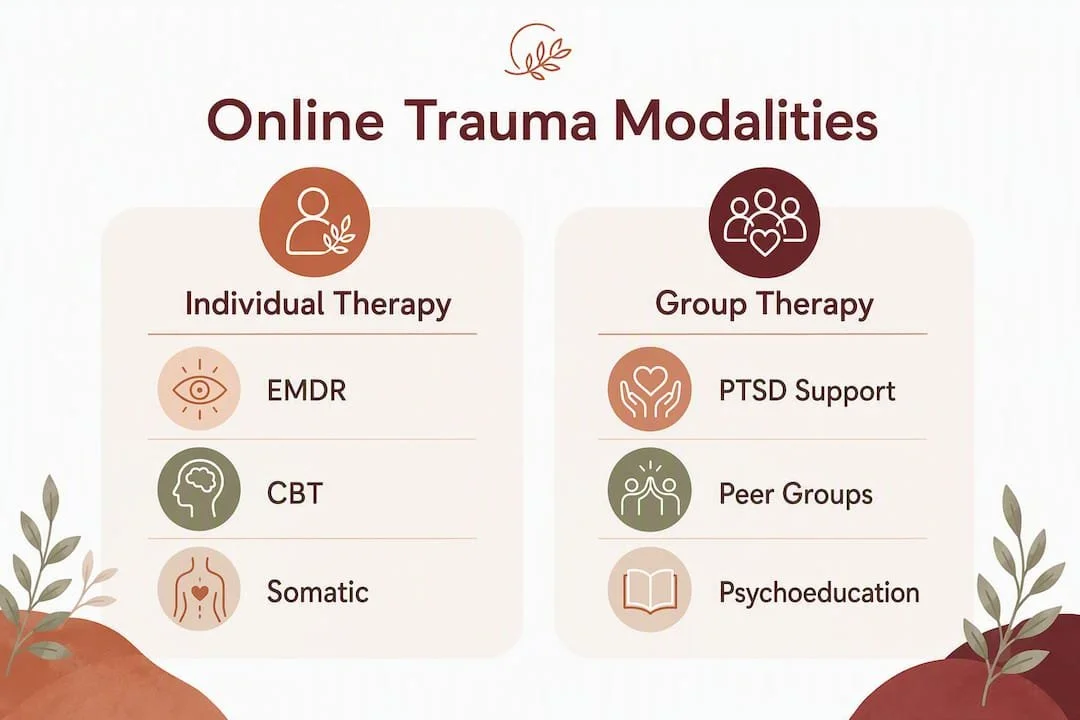
Most evidence-based trauma modalities translate well to video. A few require extra preparation or clinician training to deliver safely in a virtual format. Here is a practical breakdown:
EMDR (Eye Movement Desensitization and Reprocessing): The gold-standard for single-incident trauma and PTSD. Adapted for video using audio tones, tactile buzzers the client holds at home, or on-screen visual stimulation. Requires a trained, certified clinician. Works well online when the client has a private, stable environment.
TF-CBT (Trauma-Focused Cognitive Behavioral Therapy): Structured, phase-based, and highly suited to video. Originally developed for children and adolescents but adapted for adults. Combines psychoeducation, coping skills, and gradual trauma narrative work.
CBT (Cognitive Behavioral Therapy): Widely available online. Addresses trauma-related thought patterns, avoidance, and hyperarousal. Often the backbone of internet-based self-guided programs as well as live sessions.
Somatic Experiencing: Body-based trauma processing that tracks physical sensation. Translates to video with some adaptation — the clinician watches for subtle cues via camera. Requires a clinician trained specifically in somatic methods. Shorter session windows and strong stabilization work upfront are standard precautions.
IFS (Internal Family Systems): Parts-based model that works well via video. Particularly useful for complex or developmental trauma. No special equipment needed, though clinician training is essential.
Narrative Therapy: Externalizes trauma stories and reconstructs meaning. Naturally suited to video — it is largely verbal and relational.
ACT (Acceptance and Commitment Therapy): Builds psychological flexibility around trauma-related avoidance and shame. Widely available online and often integrated with CBT.
Mindfulness-based approaches: Used as stabilization tools and as standalone interventions for trauma-related anxiety. Accessible online, though they work best as complements to trauma processing rather than primary treatment for PTSD.
Attachment-based therapy: Focuses on relational patterns rooted in early trauma. Requires a strong therapeutic alliance and is well-suited to video when the clinician is experienced in relational work.
For a deeper look at how these trauma therapy types compare in practice, Alvaradotherapy's clinical blog covers each modality with specifics on what to expect.
Pro Tip: If you experienced relational or developmental trauma (neglect, attachment disruption, childhood abuse), prioritize IFS, attachment-based, or somatic approaches over standard CBT alone. The modality match matters more than the platform's brand name.

Group formats deserve a mention here. Meta-analysis evidence supports group-based interventions for PTSD symptom reduction, and many online directories now list trauma-focused groups. Groups work well for survivors who feel isolated or who benefit from peer validation — but they are not a substitute for individual processing work in moderate-to-severe PTSD.
How platforms and clinicians actually deliver trauma therapy online
The delivery format shapes the clinical experience more than most people realize. Live video is the standard for trauma work, and for good reason: the clinician can observe nonverbal cues, monitor dissociation, and adjust pacing in real time. Phone sessions are a reasonable backup when video is unavailable, but they limit the clinician's ability to track somatic responses.

Messaging-only formats — where you send text and receive a response hours later — are not appropriate as the primary channel for trauma processing. They can supplement between sessions (check-ins, homework review, grounding reminders), but asynchronous text cannot support the real-time attunement that trauma work requires.
Delivery formats and their clinical fit:
Live video: Best for EMDR, somatic work, IFS, TF-CBT, and any exposure-based protocol
Phone: Acceptable for CBT, psychoeducation, and check-ins; limited for somatic or EMDR work
Asynchronous messaging: Supplemental only; not appropriate as primary trauma treatment
Group video sessions: Useful for peer support, psychoeducation, and skill-building; less suited for individual trauma processing
EMDR intensives: Multi-hour sessions (often 3–6 hours across one or several days) that compress treatment; available from specialized practices and particularly useful for people with limited weekly availability
When evaluating a platform, the features that matter most for trauma care are:
Therapist bios that list specific trauma training and modalities (not just "trauma-informed")
A filter or matching system that surfaces clinicians with EMDR certification or somatic training
A clear therapist-switching policy so you can change clinicians without losing access
Integrated psychiatry for clients who may need medication alongside therapy
HIPAA-compliant video, encrypted messaging, and secure record storage
Coordinated psychiatry is a meaningful differentiator for people with severe PTSD who need both medication and therapy. Not all platforms offer it; those that do typically charge separately for psychiatric visits.
Pro Tip: Check a platform's privacy policy for two specific phrases: "HIPAA-compliant" and "end-to-end encrypted." If neither appears, ask directly before sharing any health information.
Large clinician networks and therapist-matching features are a real access advantage — they increase the odds of finding someone with the specific training you need, especially for less common modalities like EMDR or sensorimotor psychotherapy.
How to choose an online therapist or platform for trauma
The "best" platform is not universal. Clinician commentary consistently points to the therapeutic alliance, ease of therapist switching, insurance transparency, and availability of specialized modalities as the primary decision factors. A platform with a sleek interface and a large network means nothing if the clinician assigned to you has no trauma training.
Step-by-step selection checklist:
Confirm modality availability. Does the platform or clinician offer EMDR, TF-CBT, somatic work, or IFS? "Trauma-informed" is not the same as trauma-specialized.
Verify licensure. The clinician must hold an active license in the state where you will be located during sessions. Check the state licensing board directly if you are unsure.
Check session formats. Live video should be available. Confirm whether intensives or multi-session blocks are an option if you want faster progress.
Understand insurance and payment. Does the platform accept your insurance? Is there a sliding scale? Get this in writing before your first session.
Review the therapist-switching policy. You should be able to change clinicians without penalty if the fit is not right.
Ask about crisis protocols. What happens if you are in crisis between sessions? Is there a crisis line, a safety plan process, or a referral protocol?
Read the privacy policy. Confirm HIPAA compliance and data encryption before sharing any personal health information.
Red flags to watch for:
No specific trauma modalities listed (only "talk therapy" or "supportive counseling")
Clinician credentials are vague or not verifiable through a state board
No documented crisis or safety planning process
Cancellation and refund policies that are buried or punitive
Pressure to commit to long-term packages before a trial session
Questions to ask during an intake or initial consult:
What trauma modalities do you use, and what is your specific training in EMDR or somatic work?
How do you approach safety planning for clients processing difficult material?
What is your recommendation for session frequency and intensity given my history?
What happens if I need support between sessions or feel unsafe?
For California residents, the step-by-step guide to finding an online therapist from Alvaradotherapy covers the licensure and matching process in detail.
What to expect in online trauma therapy sessions and how safety works
The first session is almost never trauma processing. A competent trauma clinician will spend the first one to three sessions on assessment: your history, current symptoms, safety factors, and what you want from treatment. From there, they build a treatment plan that typically starts with stabilization before any exposure or processing work begins.
Typical session structure:
Check-in (5–10 minutes): Current mood, sleep, any events since the last session, and a brief window capacity check (are you regulated enough to do processing work today?)
Focused intervention (30–40 minutes): The core therapeutic work — EMDR reprocessing, somatic tracking, IFS parts work, or CBT restructuring, depending on the protocol
Closing and stabilization (10–15 minutes): Grounding exercises, a container technique if needed, and a check on your state before ending the call
Safety planning is not optional in trauma work. A licensed clinician will establish a safety plan early in treatment that includes emergency contacts, coping strategies, and clear steps for crisis situations. If you are experiencing suicidal ideation or feel unsafe, the immediate steps are:
Call or text 988 (Suicide and Crisis Lifeline, available 24/7 in the U.S.)
Call 911 or go to your nearest emergency room if you are in immediate danger
Contact your therapist's crisis line or after-hours number if the platform provides one
Reach out to a trusted person in your support network
Not all platforms are appropriate for people in active crisis. Experts are clear that those experiencing acute suicidal ideation or rapidly deteriorating functioning need specialized crisis-care programs or immediate emergency resources, not a standard teletherapy subscription.
Setting up a safe home therapy space:
Choose a private room where you will not be interrupted or overheard
Use headphones to protect confidentiality and improve audio quality
Have a glass of water and a grounding object (a textured item, a weighted blanket) nearby
Test your internet connection and camera before the session starts
Let someone you trust know you are in a session, especially for EMDR or intensive work
Pro Tip: Keep a grounding kit next to your device during trauma sessions: something cold (ice pack), something textured (a stone or fabric), and a short list of three things that make you feel safe. These are not just props — they are part of your in-session safety plan.
For a fuller picture of how mental health evaluations fit into trauma treatment planning, Alvaradotherapy's clinical resources explain the assessment process in plain language.
Special considerations for EMDR and somatic work delivered online
EMDR and somatic approaches require more preparation for online delivery than standard talk-based modalities. That does not make them less effective — it means the clinician needs specific training and the client needs a stable, private environment.
EMDR online adaptations:
Bilateral stimulation is delivered via audio tones through headphones, on-screen visual tracking (a moving dot or hand), or tactile buzzers the client holds at home
The clinician monitors your window of tolerance in real time and can pause or slow processing if you show signs of dissociation
Sessions typically include a longer preparation phase online than in-person, because the clinician cannot physically intervene if you become overwhelmed
What to ask an EMDR therapist before starting:
Are you EMDR-trained through EMDRIA-approved training (the EMDR International Association)?
How do you deliver bilateral stimulation in video sessions?
What is your protocol if I dissociate or become dysregulated during processing?
Do you offer a preparation session before we begin trauma reprocessing?
For somatic approaches, the clinician tracks body sensations and movement through the camera. This works, but it requires a client who can articulate internal experience and a clinician skilled at reading subtle cues on video. Shorter processing windows and strong stabilization work upfront are standard.
Stabilization checklist before intensive or exposure-based sessions:
You have a trusted person you can contact immediately after the session if needed
You have at least two grounding techniques you can use independently
You are not in an active crisis or experiencing acute suicidal ideation
You have a plan for the rest of the day (no high-stakes obligations immediately after)
Your therapist has your emergency contact information
Alvaradotherapy's EMDR specialist guide covers the specific credential checks and questions to ask when vetting an EMDR clinician in California.
Pro Tip: Ask any EMDR therapist for their EMDRIA membership number or training certificate. Legitimate EMDR training requires a minimum of 50 hours of supervised practice beyond the basic training. A therapist who cannot answer this question clearly is a red flag.
Consumer testing across more than 65 platforms consistently recommends trial consultations and explicit therapist-switching policies as the most reliable way to confirm fit and safety before committing to ongoing treatment.
Cost, insurance, and how to make online trauma therapy more affordable
Online trauma therapy pricing varies more than most people expect. The main models:
Per-session private pay: Typically $100–$250 per session for a licensed therapist, depending on the clinician's license level (LCSW, MFT, psychologist), specialty, and location. EMDR intensives run higher because of the extended session length.
Subscription platforms: Monthly fees that bundle a set number of sessions or unlimited messaging. These vary widely in what they actually include and whether the therapists have trauma-specific training.
Insurance-accepted sessions: Out-of-pocket cost drops significantly when a clinician is in-network. Many individual therapists and some platforms accept insurance; always confirm before booking.
Psychiatry visits: Psychiatric medication management sessions typically cost more than therapy sessions and are billed separately on platforms that offer integrated psychiatry.
Consumer guides summarize the main pricing shapes — subscriptions, per-session private pay, and platforms that accept insurance or offer sliding scales — and note that insurance acceptance varies by provider and clinician.
Practical steps to lower costs:
Use your insurance's in-network search to find trauma-trained therapists who accept your plan. Call your insurer directly to confirm mental health benefits and any session limits.
Ask about sliding scale fees. Many private-pay clinicians offer reduced rates based on income. Ask directly — it is not always advertised.
Consider EMDR intensives. A concentrated multi-day intensive can achieve in weeks what standard weekly sessions take months to accomplish, which can reduce total cost for some clients.
Community mental health centers often offer trauma-focused therapy on a sliding scale for uninsured or underinsured adults.
Check your employer's EAP (Employee Assistance Program). Many EAPs cover a set number of free therapy sessions per year, including trauma-focused care.
What the clinical evidence says and what survivors report
The clinical case for online trauma therapy is well-established. The 2021 review showing comparable outcomes to in-person care for PTSD, anxiety, and depression is consistent with a broader body of research on internet-based CBT and teletherapy. These are not preliminary findings — they reflect multiple studies across different populations and trauma types.
Group-based interventions also have meaningful meta-analytic support for PTSD symptom reduction. Online trauma groups, available through directories and some platforms, give survivors access to peer validation and shared experience that individual therapy cannot replicate.
What survivors consistently report matters alongside the clinical data. Themes that come up repeatedly in lived-experience accounts:
Safety and control: The ability to be in a familiar, chosen environment during sessions reduces avoidance and increases engagement
Therapist fit above everything: The relationship with the clinician matters more than the platform's features or price
Continuity of care: Not having to restart with a new clinician after a move or schedule change is a significant benefit of online care
Accessibility: Removing transportation barriers, waitlists tied to geography, and the need to take time off work makes consistent attendance more realistic
"The most critical factor for success in online trauma therapy is rapport and a sense of safety with the therapist. Clinicians often recommend a trial period and explicit switching policies so survivors can find the right fit."
— Healthline clinical commentary
Alvaradotherapy's resources on PTSD management strategies and the role of online therapy in trauma recovery reflect this evidence base and translate it into practical guidance for adults in California and New York.
Key Takeaways
Online trauma therapy is clinically supported, widely accessible, and effective when delivered by a licensed, trauma-trained clinician using evidence-based modalities — the platform matters far less than the clinician's training and the strength of the therapeutic relationship.
| Point | Details |
|---|---|
| Online trauma therapy works | A 2021 review found parity between online and in-person care for PTSD, anxiety, and depression. |
| Modality match is critical | Prioritize EMDR, TF-CBT, somatic, or IFS based on your trauma type — not just “trauma-informed” labeling. |
| Safety planning is non-negotiable | Confirm your clinician has a documented crisis protocol and that you know to call 988 in a U.S. crisis. |
| Cost can be managed | Sliding scales, insurance in-network searches, EAPs, and EMDR intensives all reduce out-of-pocket costs. |
| Alvarado Therapy | Offers licensed EMDR therapy, intensives, and bilingual care online for adults in California and New York. |
Why trauma-trained online care is worth the extra vetting
Most people searching for online trauma therapy will encounter platforms that market themselves as trauma-informed without specifying what that actually means in practice. "Trauma-informed" has become a branding term as much as a clinical one. A platform can call itself trauma-informed while matching you with a clinician whose only trauma training was a weekend workshop.
What actually separates effective online trauma care from generic teletherapy is the clinician's specific training in a structured trauma protocol — EMDR, TF-CBT, prolonged exposure, somatic experiencing — and their supervised experience applying it. That is not a minor distinction. Trauma processing done without adequate preparation, pacing, or stabilization can increase symptoms rather than reduce them.
The therapeutic alliance is the single strongest predictor of outcome in trauma therapy, online or in-person. A platform with a massive clinician network is only useful if you can actually find and stay with a clinician who is trained in the modality you need and with whom you feel genuinely safe. That is why therapist-switching policies and trial sessions matter so much — they are not conveniences, they are clinical tools.
Alvaradotherapy's approach reflects this: licensed clinicians, EMDR-certified therapists, clear intake and safety protocols, and bilingual care for Spanish-speaking clients. For adults in California and New York, that specificity is the point.
Alvaradotherapy's online trauma services for California and New York adults
If you are ready to move from research to treatment, Alvaradotherapy offers a focused set of trauma services delivered online to adults in California and New York.

Services available online include EMDR trauma therapy, EMDR intensives (compressed multi-session treatment blocks), individual counseling for PTSD and complex trauma, couples therapy for relational trauma, and immigration psychological evaluations. All sessions are conducted by licensed, trauma-trained clinicians in HIPAA-compliant video sessions. Bilingual care in English and Spanish is available.
New clients start with a consultation to review history, current symptoms, and treatment goals. You will leave that first conversation with a clear sense of the recommended modality, session frequency, and what to expect in early sessions. To learn more about the intake process, visit the what to expect page. For PTSD and complex trauma specifically, the PTSD and complex trauma service page covers modalities, outcomes, and how treatment is structured. When you are ready to schedule, book a consultation directly online.
Authoritative sources and crisis resources
If you are in crisis right now: Call or text 988 (Suicide and Crisis Lifeline, 24/7, U.S.). If you are in immediate danger, call 911 or go to your nearest emergency room. If you are outside the U.S., contact your local emergency services.
Sources used in this article and recommended for further reading:
Healthline: Online Trauma Therapy — 7 Best Teletherapy Options — Clinical commentary and 2021 review summary on online vs. in-person trauma therapy outcomes; useful for understanding the evidence base.
Verywell Mind: The 6 Best Online Trauma Therapy Services — Consumer-facing review covering therapist matching, group formats, and integrated psychiatry; good for understanding platform features.
Everyday Health: We Tested Over 65 Online Therapy Platforms — Hands-on platform testing with emphasis on trauma-trained clinicians, crisis protocols, and trial sessions.
HelpGuide: Best Online Therapy — Practical consumer guide to pricing models, insurance acceptance, and sliding scale options.
CDC: About Adverse Childhood Experiences — Primary source on the prevalence and health impact of childhood trauma; useful context for understanding why trauma-focused care matters.
Alvaradotherapy: Trauma Recovery Workflow — Clinical framework for staging trauma treatment, stabilization, and resilience-building.
Alvaradotherapy: How to Access Online Therapy in California — Practical steps for California residents navigating licensure, platform selection, and trauma-focused online care.
This article is general educational information, not professional medical or mental health advice. Confirm current treatment options and clinical fit with a licensed clinician for your specific situation.
