
Role of Online Therapy in 2026: Empowering Trauma Recovery

Struggling with trauma or anxiety can make getting help feel exhausting, especially if California traffic or busy schedules add to your stress. For many millennials and Gen Z, connecting with a licensed therapist from the comfort of home brings new hope—especially when options like online EMDR therapy match the care you would receive in person. This article clears up common misconceptions about online therapy, explains how digital approaches really work, and shows how proven methods can empower your healing.
Table of Contents
Key Takeaways
| Point | Details |
|---|---|
| Online Therapy Effectiveness | Research shows online therapy is as effective as in-person sessions for many mental health conditions, especially anxiety and trauma. The quality of the therapist-client relationship is crucial. |
| Types of Online Therapy | Various adaptable therapy modalities, such as EMDR, CBT, and Prolonged Exposure, work effectively in online settings. Matching the method to individual needs is essential for successful treatment. |
| Privacy and Security | Licensed therapists use secure, HIPAA-compliant platforms to protect client data, providing the same confidentiality as traditional in-person therapy sessions. |
| Accessibility Benefits | Online therapy offers increased convenience, flexibility, and accessibility, making it easier for clients to engage in treatment without logistical barriers. |
Defining Online Therapy and Common Myths
Online therapy delivers mental health services through internet-based platforms, allowing you to connect with licensed therapists from your California home. Unlike traditional in-person sessions, this approach uses video calls, messaging, or other digital channels to provide care. The technology isn't the treatment—your therapist is. The platform just changes where the conversation happens.
Many people confuse telehealth with online therapy. Telehealth covers all health services delivered remotely, while online therapy specifically focuses on mental health counseling and treatment. Think of telehealth as the umbrella and online therapy as one branch underneath it.
What Online Therapy Actually Includes
Online therapy comes in multiple formats:
Synchronous sessions (real-time video calls with your therapist)
Asynchronous communication (messaging exchanges over days, not minutes)
Hybrid approaches (combining both methods based on your needs)
Your therapist can offer EMDR therapy, trauma counseling, anxiety treatment, and other evidence-based approaches through these platforms. Online therapy can replicate many aspects of in-person care when therapists receive proper training and use secure technology.
Busting the Myths
Myth 1: Online therapy isn't as effective. Research shows it works equally well for many conditions, especially anxiety and trauma. Your therapeutic relationship matters more than the format.
Myth 2: Complex cases require in-person sessions. Wrong. Therapists successfully treat complex trauma, PTSD, and grief online. Online therapy is a valid alternative for complex cases, sometimes even preferred by clients.
Myth 3: Your privacy isn't protected online. Licensed therapists use encrypted platforms meeting HIPAA standards. Your data receives the same legal protection as in-office records.
Myth 4: You can't build real rapport with a screen. Therapeutic presence happens through genuine connection, not physical proximity. Many clients report deeper openness online because their home feels safer.
Online therapy works when your therapist is skilled, your technology is secure, and you're in a private space—three basics that most platforms handle well today.
What Makes It Different (Not Worse)
Online therapy requires specific adaptations from your therapist. They'll help you minimize distractions, establish session boundaries, and navigate the technical side. You're not getting a cheaper version of therapy—you're getting therapy designed for a digital environment.
The format suits your life in California. No commute to Pasadena or Ventura. No rescheduling because traffic made you late. Consistency matters for trauma recovery, and online sessions remove that barrier.
Pro tip: Before your first session, test your internet connection, find a quiet room, and treat your online space like you'd treat a therapist's office—private, distraction-free, and dedicated to healing.
Types of Online Therapy for Trauma and Anxiety
Not all therapy approaches work the same way online, but research shows that several evidence-based modalities translate effectively to digital platforms. The key is matching the right approach to your specific trauma or anxiety type. Your therapist at Alvarado Therapy can help determine which fits your situation best.
EMDR Therapy Online
Eye Movement Desensitization and Reprocessing (EMDR) is a specialized trauma treatment that processes traumatic memories through bilateral stimulation. Many people think eye movements require in-person proximity, but they work just as well through your screen.
Your therapist guides you through:
Identifying the traumatic memory or anxiety trigger
Following visual or auditory cues on screen while recalling the memory
Processing the trauma at your own pace in a safe environment
Reducing the emotional intensity attached to the memory
EMDR online delivers the same results as in-person sessions. You control your environment, which actually helps some people feel more secure during this intensive work.
Defining Online Therapy and Common Myths
Online therapy delivers mental health services through internet-based platforms, allowing you to connect with licensed therapists from your California home. Unlike traditional in-person sessions, this approach uses video calls, messaging, or other digital channels to provide care. The technology isn't the treatment—your therapist is. The platform just changes where the conversation happens.
Many people confuse telehealth with online therapy. Telehealth covers all health services delivered remotely, while online therapy specifically focuses on mental health counseling and treatment. Think of telehealth as the umbrella and online therapy as one branch underneath it.
What Online Therapy Actually Includes
Online therapy comes in multiple formats:
Synchronous sessions (real-time video calls with your therapist)
Asynchronous communication (messaging exchanges over days, not minutes)
Hybrid approaches (combining both methods based on your needs)
Your therapist can offer EMDR therapy, trauma counseling, anxiety treatment, and other evidence-based approaches through these platforms. Online therapy can replicate many aspects of in-person care when therapists receive proper training and use secure technology.
Busting the Myths
Myth 1: Online therapy isn't as effective. Research shows it works equally well for many conditions, especially anxiety and trauma. Your therapeutic relationship matters more than the format.
Myth 2: Complex cases require in-person sessions. Wrong. Therapists successfully treat complex trauma, PTSD, and grief online. Online therapy is a valid alternative for complex cases, sometimes even preferred by clients.
Myth 3: Your privacy isn't protected online. Licensed therapists use encrypted platforms meeting HIPAA standards. Your data receives the same legal protection as in-office records.
Myth 4: You can't build real rapport with a screen. Therapeutic presence happens through genuine connection, not physical proximity. Many clients report deeper openness online because their home feels safer.
Online therapy works when your therapist is skilled, your technology is secure, and you're in a private space—three basics that most platforms handle well today.
What Makes It Different (Not Worse)
Online therapy requires specific adaptations from your therapist. They'll help you minimize distractions, establish session boundaries, and navigate the technical side. You're not getting a cheaper version of therapy—you're getting therapy designed for a digital environment.
The format suits your life in California. No commute to Pasadena or Ventura. No rescheduling because traffic made you late. Consistency matters for trauma recovery, and online sessions remove that barrier.
Pro tip: Before your first session, test your internet connection, find a quiet room, and treat your online space like you'd treat a therapist's office—private, distraction-free, and dedicated to healing.
Types of Online Therapy for Trauma and Anxiety
Not all therapy approaches work the same way online, but research shows that several evidence-based modalities translate effectively to digital platforms. The key is matching the right approach to your specific trauma or anxiety type. Your therapist at Alvarado Therapy can help determine which fits your situation best.
EMDR Therapy Online
Eye Movement Desensitization and Reprocessing (EMDR) is a specialized trauma treatment that processes traumatic memories through bilateral stimulation. Many people think eye movements require in-person proximity, but they work just as well through your screen.
Your therapist guides you through:
Identifying the traumatic memory or anxiety trigger
Following visual or auditory cues on screen while recalling the memory
Processing the trauma at your own pace in a safe environment
Reducing the emotional intensity attached to the memory
EMDR online delivers the same results as in-person sessions. You control your environment, which actually helps some people feel more secure during this intensive work.

Cognitive Behavioral Therapy (CBT) Online
CBT is among the most adaptable therapies for online delivery. Internet-based CBT shows comparable outcomes to in-person treatment for anxiety disorders and PTSD. Your therapist helps you identify thought patterns fueling your anxiety, then teaches you to interrupt and reshape them.
CBT works particularly well online because:
Sessions involve conversation and worksheets (no special equipment)
Homework assignments naturally fit a digital workflow
You can practice techniques at home immediately
Progress tracking happens easily through messaging
If you're dealing with social anxiety or generalized anxiety, CBT online is a proven starting point.
Prolonged Exposure Therapy (PE)
PE addresses PTSD by gradually exposing you to trauma-related triggers in a controlled way. Your therapist helps you safely revisit the memory and situations you've been avoiding. This sounds intense, but it's remarkably effective.
Online PE includes:
Talking through the traumatic event (imaginal exposure)
Discussing feared situations you've been avoiding (situational exposure)
Building your confidence through repeated, safe exposure
Processing the memory without the threat being real
CBT, prolonged exposure, and EMDR are leading effective treatments used online. Your therapist adjusts the pace based on your readiness.
Alternative Approaches for Complex Trauma
If your trauma is complex or long-standing, psychodynamic therapy or somatic approaches may complement the above methods. These explore how past experiences shape current patterns and help you understand your body's trauma responses.
The most effective online therapy matches your trauma type, complexity, and personal preference—not a one-size-fits-all approach.
Choosing Your Approach
Your first session isn't about jumping into treatment. Your therapist will:
Understand your trauma history and symptoms
Discuss which modalities match your needs
Explain what each approach involves
Answer your concerns before starting
Some clients benefit from combining approaches. Others need one focused method. The flexibility of online therapy means you can adjust as you heal.
Here's how leading online therapy approaches compare for trauma and anxiety care:
| Therapy Type | Best For | Key Benefit | Typical Session Format |
|---|---|---|---|
| EMDR | PTSD, childhood trauma | Processes traumatic memories | Guided visual/audio exercises |
| CBT | Anxiety, social anxiety | Reshapes unhelpful thoughts | Conversation and worksheets |
| Prolonged Exposure (PE) | PTSD, specific trauma | Reduces avoidance safely | Gradual exposure discussions |
| Psychodynamic/Somatic | Complex or long-term trauma | Explores patterns, bodily responses | Reflective talk and awareness |
Pro tip: When discussing treatment options with your therapist, ask specifically how each approach works online and what results they’ve seen in clients similar to you—this clarity helps you commit to the process.
How Online Therapy Platforms Operate in 2026
Online therapy platforms in 2026 operate with sophisticated systems designed to match you with the right therapist, protect your privacy, and deliver consistent care. These aren't just video call apps—they're clinical systems balancing technology with human expertise.
Therapist Credentialing and Verification
Every therapist on legitimate platforms undergoes strict credentialing processes. Before you ever connect with someone, the platform has:
Verified current state licenses and specializations
Confirmed continuing education requirements are met
Checked background information and clinical history
Ensured compliance with regulatory standards
This happens continuously, not just once. Your therapist's credentials are regularly re-verified to maintain safety and quality standards.
How Platforms Match You With Therapists
Platforms use algorithmic matching to pair clients with therapists, considering your trauma type, preferences, and therapeutic needs. You're not randomly assigned. The system analyzes factors like your specific anxiety diagnosis, language preferences, therapist experience with your issues, and availability.
You typically get to:
Review therapist profiles before booking
Request specific specialists if needed
Switch therapists if the fit isn't right
Provide feedback that improves future matching
Communication Options and Flexibility
2026 platforms offer multiple ways to connect based on your comfort level and schedule. Care delivery formats include scheduled video sessions, asynchronous messaging, live chats, and structured therapeutic programs.
Choose what works for you:
Scheduled video sessions (real-time face-to-face)
Asynchronous messaging (write when you want, therapist responds within 24 hours)
Live chat during office hours
Combination approaches (video plus messaging)
This flexibility means you're not forced into a format that triggers your anxiety. If video feels overwhelming some weeks, messaging is there.
Privacy and Data Security
Your information is encrypted and protected under HIPAA regulations (the same federal law protecting in-office therapy). Platforms use military-grade encryption, secure servers, and strict access controls. Your therapist can't sell your data, and your sessions aren't monitored by anyone except clinical supervisors when needed.
Legitimate platforms prioritize your privacy as fiercely as they prioritize your healing—these aren't optional features but foundational requirements.
Clinical Oversight and Quality Control
Behind the scenes, licensed supervisors oversee therapist work through case reviews and consultation. This layered supervision ensures quality and catches problems early. It's part of what makes online therapy accountable.
Platforms also track:
Session attendance and engagement
Your reported progress and symptom changes
Therapist-client compatibility ratings
Adverse events or safety concerns
Pro tip: Before starting with any platform, verify it displays therapist credentials prominently, uses encrypted messaging, and has a clear privacy policy you can actually read—transparency here signals trustworthiness.
Legal, Ethical, and Privacy Standards in California
California has some of the strictest telehealth regulations in the country. If you're seeking online therapy in California, these protections exist specifically to keep you safe. Understanding what's required helps you know what to expect from legitimate therapists and platforms.
California Licensing Requirements
Your therapist must be licensed in California to provide therapy to you, even if they're physically located elsewhere. This is non-negotiable. Before your first session, verify your therapist's California license through the Board of Behavioral Sciences website.
Additionally, California therapists must verify your physical location at each session and confirm you're in California when therapy begins. This requirement exists to ensure consistent legal protections and clarity about which state's laws govern your care.
Informed Consent for Online Therapy
Your therapist must get your written consent before starting telehealth treatment. This isn't a signature-and-forget document. True informed consent covers:
How online therapy differs from in-person sessions
Specific risks of digital communication (technology failures, privacy concerns)
Benefits and limitations of telehealth
Your rights and how to report complaints
Emergency protocols if you're in crisis
You should receive this document before your first session and have time to ask questions. If a therapist skips this step, that's a red flag.
Confidentiality and Data Protection
HIPAA protections apply equally to online therapy. California also requires therapists to comply with state confidentiality regulations, use secure platforms with encryption, and maintain accessible emergency protocols. Your therapist can't record sessions without permission, can't share your information casually, and must use encrypted platforms.
Key protections:
Therapists use secure, HIPAA-compliant video platforms
Your therapy notes are stored securely and can't be accessed by tech support staff
Messages between sessions are encrypted
Breach notification laws require therapists to tell you if your data is compromised
Ethical Standards and Professional Competence
2026 California regulations mandate therapist competence in telehealth delivery. Therapists must demonstrate competence in telehealth and AI tool use, obtain client informed consent specific to digital modalities, and adhere to continuous license verification.
This means your therapist has:
Completed telehealth-specific training
Understood ethical challenges unique to online work
Maintained current knowledge about technology and regulations
Committed to ongoing professional development
California's telehealth standards protect you at every stage: licensing, consent, confidentiality, and competence—these aren't bureaucratic boxes but actual shields around your care.
Emergency Protocols and Crisis Response
Online therapy requires clear emergency procedures in case you're in crisis. Your therapist must have protocols for:
What to do if technology fails during a session
How to reach them in an emergency (out-of-hours contact)
Local crisis resources and emergency services
What happens if they become unavailable
This should be discussed during your informed consent conversation. You deserve to know exactly how your safety is protected.
See how online therapy platforms ensure quality and legal compliance in California:
| Requirement | Why It Matters | How Platforms Meet It |
|---|---|---|
| State Licensing | Ensures therapist is qualified | Continuous license and record checks |
| Informed Consent | Protects client autonomy | Detailed consent forms and review |
| Privacy (HIPAA/State) | Safeguards sensitive data | Encryption and secure record-keeping |
| Crisis Protocols | Prepares for emergencies | Clear steps for urgent situations |
Pro tip: Ask your therapist directly about their California license verification status, which encrypted platform they use, and their specific emergency protocol—their clear, detailed answers indicate a practice that takes legal and ethical standards seriously.
Benefits, Limitations, and Choosing Best Fit
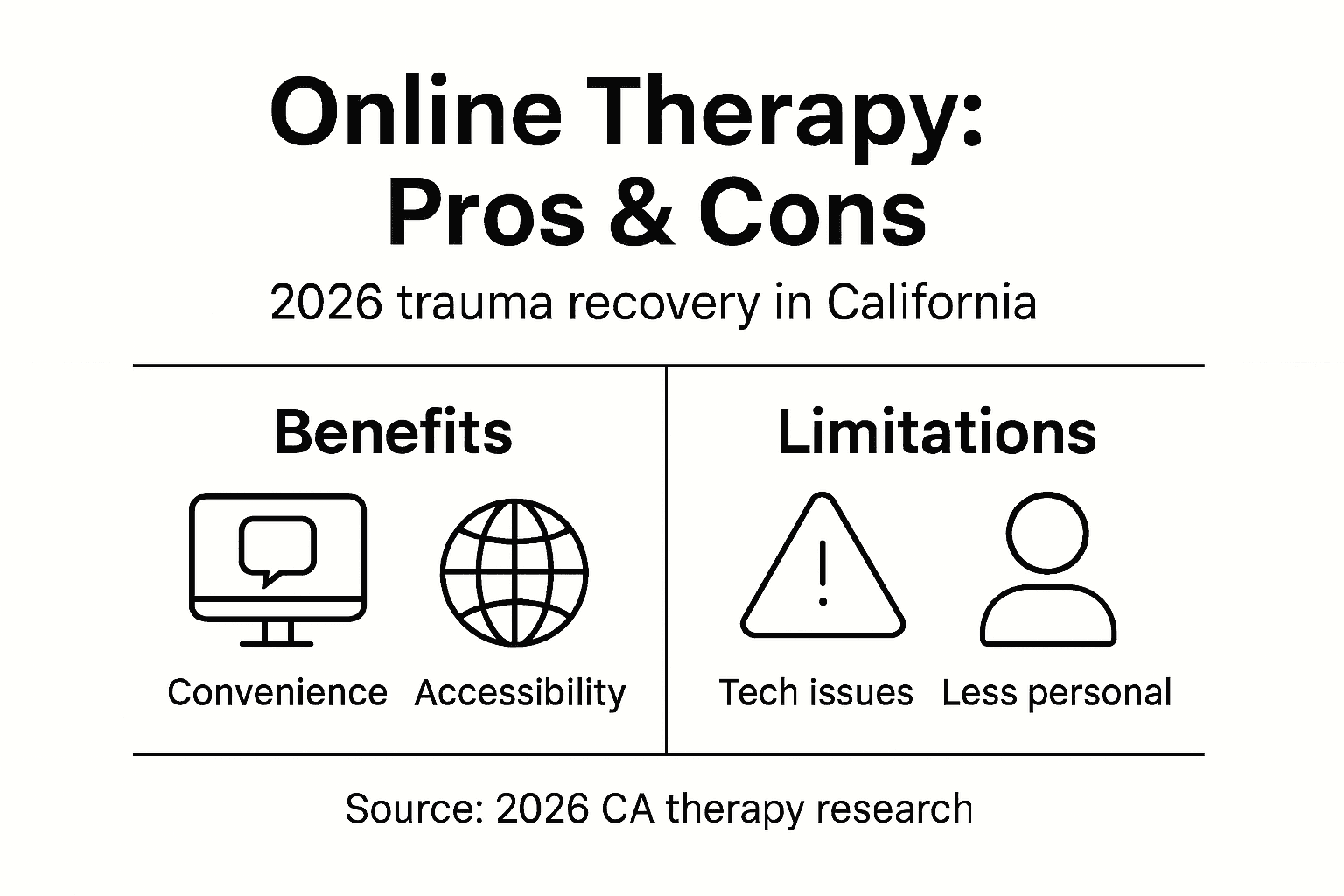
Online therapy isn't a perfect fit for everyone, but for many people dealing with trauma and anxiety in California, it's genuinely transformative. Understanding both sides helps you make a decision that actually serves your healing.
Real Benefits Worth Considering
Online therapy removes barriers that kept you stuck. No commute to Pasadena or Ventura. No rescheduling because traffic derailed your afternoon. No sitting in a waiting room triggering your anxiety before the session even starts.
Key advantages include:
Accessibility: Reach therapists who specialize in your specific trauma type
Convenience: Sessions fit your schedule without transportation stress
Cost-effectiveness: Often cheaper than in-person therapy
Safety: Your home becomes the therapeutic space, reducing external triggers
Flexibility: Switch between video and messaging based on your needs that day
Online therapy demonstrates accessibility, convenience, cost-effectiveness, and safety, especially for people managing complex trauma or anxiety who struggled with traditional appointments.
Honest Limitations You Should Know
Online therapy isn't ideal for everyone. Technical failures happen. Internet cuts out mid-session. Some people struggle to open up through a screen, especially early in treatment.
Limitations include technical difficulties, privacy concerns, and potential challenges in effectiveness for certain complex cases. If you're experiencing severe symptoms, active suicidal ideation, or substance abuse crises, you might need in-person care or hospitalization first.
Other challenges:
Limited ability to pick up subtle body language and non-verbal cues
Reduced therapist capacity to intervene quickly in emergencies
Requires reliable internet and private physical space
May feel less personal to some people initially
When Online Therapy Works Best
You're likely a great candidate if you:
Have reliable internet and a private space
Deal with anxiety, PTSD, or trauma (not acute psychosis)
Prefer flexibility over rigid scheduling
Live far from specialized trauma therapists
Feel safer in your own environment
Want to try therapy but feared the commitment
Honestly, most California millennials and Gen Z dealing with anxiety find online therapy more accessible and less intimidating than in-person.
Your best fit depends on your specific trauma, technology comfort, and what you need to feel safe enough to heal—not what works for your friend or what's trendy.
How to Choose a Provider
Don't just pick the first available therapist. Evaluate your options:
Verify California licensure before booking
Read therapist bios and specialization areas
Check if they have trauma-specific training (EMDR, CPT, PE)
Confirm they use encrypted, HIPAA-compliant platforms
Ask about their emergency protocols
Schedule a brief consultation call first
Your first session isn't locked in. If the fit feels wrong, switch therapists. The relationship matters more than the platform.
Pro tip: Request a 15-minute consultation call with your potential therapist before committing—their ability to explain their approach clearly and address your specific concerns tells you everything about whether they're the right fit for your trauma recovery.
Discover How Online Therapy Supports Your Trauma Recovery in California
Navigating trauma recovery can feel overwhelming especially when balancing the need for flexible, accessible care with the desire for specialized, trauma-informed treatment. The role of online therapy in 2026 offers a powerful solution by delivering tailored approaches like EMDR therapy and cognitive behavioral techniques right to your home. This format addresses common challenges such as convenience, privacy, and maintaining consistent healing progress without sacrificing the quality or safety of care.
Alvarado Therapy specializes in trauma-sensitive online therapy across California, connecting you with licensed therapists experienced in trauma, anxiety, and complex grief. With options to meet online or in person, and a bilingual team understanding cultural and identity-affirming needs, you gain reliable access to evidence-based care designed for your unique journey. Explore our dedicated Online — Meet Our Team — Alvarado Therapy for skilled clinicians ready to guide you through this process.

Take your first step toward healing by reaching out today. Whether you are in Pasadena, Ventura, or anywhere in California, our team at California — Meet Our Team — Alvarado Therapy is prepared to support you with compassion and expertise. Visit Alvarado Therapy now to book your initial consultation and experience trauma recovery adapted for your life in 2026.
Frequently Asked Questions
How effective is online therapy for trauma recovery?
Research indicates that online therapy is just as effective as in-person therapy for many conditions, especially anxiety and trauma-related issues. The quality of the therapeutic relationship is more crucial than the format of the sessions.
What therapy modalities are available online for trauma?
Common online therapy modalities for trauma include Eye Movement Desensitization and Reprocessing (EMDR), Cognitive Behavioral Therapy (CBT), and Prolonged Exposure (PE). These evidence-based approaches can all be effectively delivered through digital platforms.
What should I do to prepare for my first online therapy session?
It's essential to test your internet connection, find a quiet and private space for your session, and approach it as you would an in-person visit. Being distraction-free will help you focus on healing during your session.
Are online therapy sessions confidential and secure?
Yes, licensed therapists use HIPAA-compliant, encrypted platforms to ensure your privacy and confidentiality. Your data is protected with the same legal standards that apply to traditional in-office therapy.
Recommended
Why Choose Online Therapy: Flexibility and Healing Explained — Alvarado Therapy
How to Access Online Therapy California for Trauma Healing — Alvarado Therapy
Why Trauma Therapy Matters for Healing and Growth — Alvarado Therapy
Preparing for Online Therapy Session: Step-by-Step Guide — Alvarado Therapy
EMDR Therapy in Los Angeles | Mental Health & Addiction Treatment
