
EMDR Therapy for PTSD: What You Need to Know

TL;DR:
EMDR therapy is a highly effective, evidence-based treatment for PTSD that involves bilateral stimulation to reprocess traumatic memories without extensive talk therapy. It follows a structured eight-phase protocol, typically requiring six to twelve sessions, and does not compel clients to recount trauma in detail or complete homework. Recognized by major health organizations, EMDR offers rapid symptom relief and is accessible through qualified practitioners, including VA services for veterans.
Many people assume EMDR therapy for PTSD just means watching a therapist's finger move back and forth. That misunderstanding keeps a lot of trauma survivors from trying a treatment that actually works. EMDR stands for Eye Movement Desensitization and Reprocessing, and it is one of the most rigorously studied psychological treatments for PTSD available today. This article walks you through how it works, what the research says, what a real course of treatment looks like, and how to find qualified care so you can make a confident decision about your healing.
Table of Contents
Key takeaways
| Point | Details |
|---|---|
| Clinically endorsed therapy | EMDR is endorsed by the WHO, APA, and VA as a first-line PTSD treatment. |
| Structured 8-phase protocol | Treatment follows a specific process designed to reprocess traumatic memories safely. |
| No homework required | EMDR does not require prolonged trauma retelling or between-session assignments. |
| Strong evidence base | A 2025 meta-analysis found EMDR has the largest effect size among psychological PTSD treatments. |
| Accessible in multiple formats | EMDR is available in-person, via telehealth, and through intensive formats for faster relief. |
What EMDR therapy is and why it works for PTSD
EMDR was developed in the late 1980s by psychologist Francine Shapiro, who noticed that certain eye movements appeared to reduce the emotional charge of distressing thoughts. That observation grew into a structured, evidence-based therapy now used worldwide. Today, WHO, APA, and the VA all recognize it as an established PTSD treatment, placing it alongside the most credible interventions in mental health care.
The core mechanism involves bilateral stimulation. During sessions, a therapist guides rhythmic, side-to-side stimulation through eye movements, hand taps, or alternating auditory tones while you briefly hold a traumatic memory in mind. Researchers believe this activates neurobiological mechanisms similar to what happens during REM sleep, the phase of sleep where the brain consolidates and emotionally processes experiences. The result is that traumatic memories lose their grip without requiring you to narrate every detail.
This is what sets EMDR apart from traditional talk therapies. Cognitive behavioral therapy and prolonged exposure ask you to describe traumatic events repeatedly and practice coping skills outside sessions. EMDR works through memory reprocessing rather than verbal analysis or behavioral rehearsal. The difference matters because many trauma survivors feel shame, fear, or cultural barriers around speaking their experiences aloud.
"EMDR helps people move past pivotal negative events disrupting daily life by decreasing physiological and emotional distress." — Harvard Health
EMDR is not limited to combat trauma or single-incident PTSD. Therapists use it for childhood abuse, sexual assault, accidents, medical trauma, grief, complex PTSD, and anxiety disorders. The bilateral stimulation protocol adapts to a wide range of trauma profiles, making it one of the more flexible trauma-focused treatments available.
The EMDR treatment process and what to expect
One of the biggest fears people have before starting therapy is not knowing what will happen. With EMDR, the process is predictable because it follows a structured 8-phase protocol. Understanding each phase in advance removes a lot of the anxiety about starting.
Here is what the eight phases look like in practice:
History taking. Your therapist learns about your background, trauma history, and current symptoms to build a treatment plan.
Preparation. You learn stabilization techniques so you can manage distress during and between sessions.
Assessment. Together, you identify a specific target memory, the negative belief attached to it, and the emotions and physical sensations it produces.
Desensitization. This is the core phase. You hold the memory and related sensations in mind while receiving bilateral stimulation, allowing the distress level to decrease.
Installation. The therapist helps you strengthen a positive belief to replace the original negative one.
Body scan. You check for any remaining physical tension connected to the memory.
Closure. Every session ends with grounding techniques to return you to a stable state.
Re-evaluation. At the start of subsequent sessions, your therapist checks how the processed memory feels and whether new material has surfaced.
A typical course of EMDR treatment runs six to twelve sessions, scheduled one to two times per week, with each session lasting sixty to ninety minutes. That is a meaningful difference from some therapies that require months of weekly work before you notice significant change.
For those who need faster results, EMDR intensives compress multiple phases into full-day or multi-day blocks. This format is particularly helpful for people with limited scheduling flexibility or those who want to address trauma without stretching treatment over months. You can learn more about what this format involves in this EMDR intensive guide from Alvaradotherapy.

Pro Tip: Before your first session, write down two or three grounding techniques that already help you feel calm, whether that is deep breathing, cold water on your wrists, or a specific song. Sharing these with your therapist during preparation speeds up Phase 2 and gives you reliable tools for after session work.
Unlike many therapies, EMDR does not require homework or prolonged trauma narration. You control how much you disclose. The therapist is a guide, not an interrogator. That structure encourages people who have avoided therapy to finally try it, including those carrying shame around their experiences.
The evidence: how effective is EMDR for PTSD?
When people ask "is EMDR effective for PTSD," the research gives a clear answer. A 2025 network meta-analysis found that EMDR has the largest effect size and is among the most cost-effective psychological treatments for PTSD. That is not a minor finding. It places EMDR at the top of the evidence hierarchy for trauma care.
Comparative research supports this consistently. A network meta-analysis found EMDR effect sizes of approximately 2.07 versus waitlist or usual care at one to four months follow-up. Both EMDR and trauma-focused cognitive behavioral therapy show sustained improvements, but patients in EMDR trials often report faster symptom relief.
The evidence extends beyond clinical settings. A 2025 systematic review examining disaster and epidemic contexts found that EMDR significantly reduced PTSD symptom scores compared to usual care. What is notable is that treatment timing did not significantly affect outcomes, meaning EMDR worked whether applied early or later in recovery.
Veterans represent a particularly well-studied group. The VA endorses EMDR as a first-line PTSD treatment, offers it at medical centers, and has piloted telehealth formats with positive outcomes. Many veterans are unaware this option is available to them through VA care.
Here is a summary of how the research positions EMDR against other treatments:
| Treatment | Evidence strength | Typical sessions | Homework required |
|---|---|---|---|
| EMDR | Very strong (2025 meta-analysis) | 6 to 12 | No |
| Trauma-focused CBT | Very strong | 8 to 16 | Yes |
| Prolonged Exposure | Strong | 8 to 15 | Yes |
| Medication (SSRIs) | Moderate | Ongoing | No |
"Patients often report faster symptom reduction with EMDR compared to other trauma therapies." — clinical meta-analysis findings
For a deeper look at what lasting recovery looks like with EMDR, Alvaradotherapy has written about EMDR in PTSD recovery with attention to long-term outcomes and hope.
Accessing EMDR therapy and knowing if it is right for you
Finding a qualified EMDR therapist requires more than a Google search. EMDR is a specialty skill, and not every licensed therapist is trained in it. The EMDR International Association (EMDRIA) maintains a directory of certified practitioners, and Psychology Today's therapist search allows you to filter by EMDR specialty. These two resources are your best starting points.
Veterans can access EMDR through the VA healthcare system, which offers the therapy at many medical centers and through community care referrals. If your primary care provider or mental health team has not mentioned it, ask specifically. The VA's EMDR offering is underutilized largely because eligible veterans simply do not know it is available.
EMDR works well for a broad range of people, but it is worth knowing who benefits most and where caution applies:
Good candidates: Adults with single-incident trauma, complex trauma histories, childhood abuse, combat PTSD, medical trauma, and those who have found talk therapy difficult or incomplete.
Needs careful consideration: People with dissociative disorders, active psychosis, or significant personality disorders may need stabilization work before EMDR begins.
Practical note: Patient readiness matters. EMDR requires the ability to engage with internal experiences and stay connected to the present. Therapists address this in the preparation phase, but it is worth discussing your concerns openly before committing.
EMDR can be combined with medication, particularly SSRIs, which reduce overall arousal enough to make trauma processing more manageable. It can also follow other therapies if earlier treatment provided a foundation but did not fully resolve symptoms.
On cost, many insurance plans now cover EMDR because of its strong evidence base and clinical endorsements. It is worth calling your provider directly and asking whether EMDR with a licensed therapist is covered under your mental health benefits.
Pro Tip: When calling a potential therapist, ask how many EMDR cases they have completed, not just whether they are trained. Training certification and clinical experience are different things. Therapists who have processed dozens of trauma cases bring a confidence and adaptability that newer practitioners are still developing.
If you want a detailed look at what session preparation looks like, the EMDR preparation guide from Alvaradotherapy walks through it clearly.
Comparing EMDR to other PTSD therapies
Choosing a therapy is rarely straightforward, especially when every option comes with its own demands and trade-offs. EMDR stands out in several ways when placed next to common PTSD treatments, but it is not universally the best fit for every person or situation.
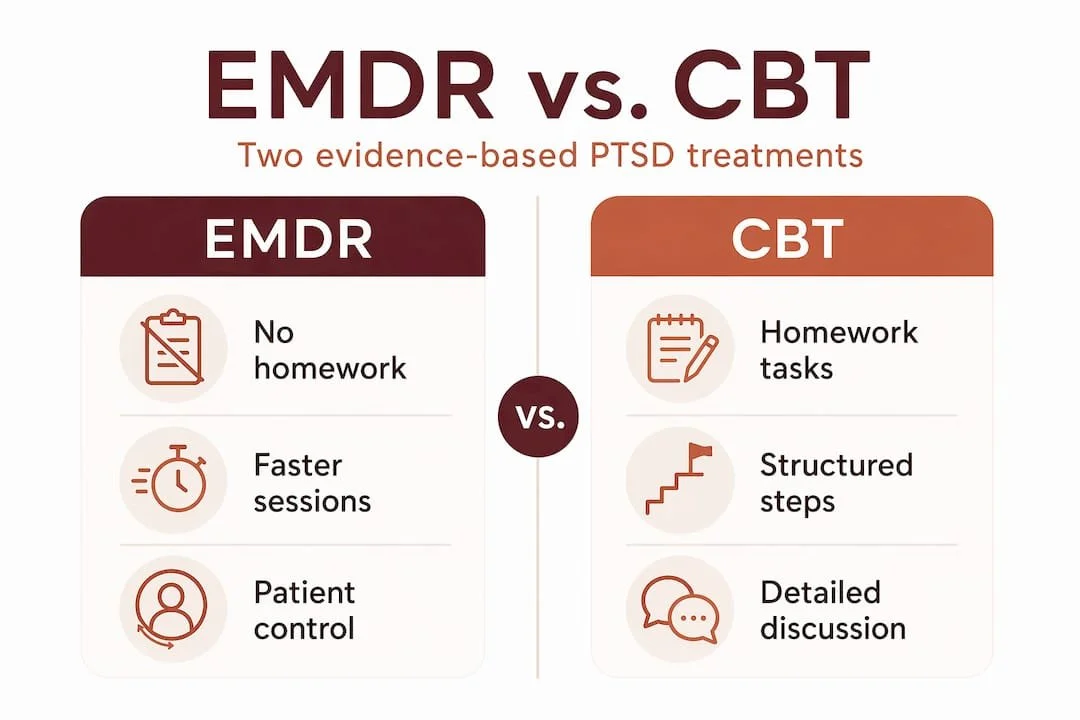
Trauma-focused CBT is equally well-supported by research, but it asks more from patients between sessions. Structured homework, thought records, and gradual exposure exercises are central to TF-CBT. For people with demanding work schedules, caregiving responsibilities, or limited energy, this can become a genuine barrier. EMDR, by contrast, keeps most of the therapeutic work inside the session itself.
Prolonged Exposure therapy works by having patients repeatedly confront trauma-related situations and memories until the fear response diminishes. It is effective, but dropout rates tend to be higher because the process feels deliberately uncomfortable. EMDR's approach, which allows the brain to process without sustained deliberate exposure, tends to feel more tolerable to many patients.
Medication, typically SSRIs like sertraline or paroxetine, can reduce PTSD symptoms meaningfully but rarely resolves the underlying trauma. Many people find medication most useful as a support alongside therapy rather than as a standalone approach.
One pattern worth noting: EMDR's structured approach without required homework and with patient-controlled disclosure makes it more accessible across cultural and shame-related barriers. For communities where discussing personal trauma with a stranger carries stigma, this feature alone can be the deciding factor.
My honest take on EMDR as a PTSD treatment
I've worked alongside trauma-focused care long enough to notice something: people arrive at EMDR therapy skeptical and leave wishing they had tried it sooner. The eye movement component looks strange from the outside, and that strangeness causes real hesitation.
What I've observed is that EMDR's real power is not in any single phase or technique. It is in giving the nervous system permission to complete something it could not finish when the trauma happened. Talk therapy asks you to understand what occurred. EMDR helps your brain stop responding as if it is still occurring. That is a different kind of change, and it shows up in ways people do not always anticipate, including better sleep, fewer intrusive memories, and a calmer response to everyday stress.
The one thing I would push back on is the expectation of a quick fix. EMDR can produce faster results than other therapies, but fast does not mean instant. Therapist skill and patient readiness both shape the outcome significantly. A well-trained EMDR therapist who takes time in the preparation phase produces very different results from someone who rushes into desensitization.
My advice: go in with openness and realistic expectations. EMDR is not a cure. It is a method for helping the brain do what it is actually built to do. That distinction matters for the patients who stick with it and the ones who give up too soon.
— Alvaradotherapy
Start your EMDR therapy journey with Alvaradotherapy
If this article has helped you see EMDR more clearly, the next step is finding care that is actually built around your needs. Alvaradotherapy is a California-based trauma-informed practice with licensed therapists who specialize in EMDR for PTSD and complex trauma. Sessions are available online throughout California, with both English and Spanish-speaking clinicians.

Whether you are early in exploring treatment or ready to start, Alvaradotherapy offers a range of options including online EMDR trauma therapy designed to fit real lives. For those dealing with complex or deeply rooted trauma, the PTSD and complex trauma program offers specialized support. You can also schedule a consultation to ask questions and find out whether EMDR is the right starting point for you.
FAQ
What is EMDR therapy used for in PTSD treatment?
EMDR therapy for PTSD helps the brain reprocess traumatic memories so they no longer trigger intense emotional or physical responses. It is endorsed by the WHO, APA, and VA as a first-line treatment for PTSD.
Is EMDR effective for PTSD compared to other therapies?
Yes. A 2025 meta-analysis found EMDR has the largest effect size among psychological PTSD treatments and is highly cost-effective. It shows outcomes comparable to trauma-focused CBT with fewer homework demands.
How many EMDR sessions does it take to treat PTSD?
Most people need six to twelve sessions, each lasting sixty to ninety minutes, scheduled one to two times per week. The number varies based on trauma complexity and individual response.
Do you have to talk about your trauma in detail during EMDR?
No. EMDR does not require prolonged verbal retelling of traumatic events. Patients engage with memories internally while the therapist guides bilateral stimulation, and you control how much you disclose throughout.
Can veterans get EMDR therapy through the VA?
Yes. The VA endorses EMDR as a first-line PTSD treatment and offers it at many VA medical centers, including telehealth formats. Veterans who have not been offered EMDR should ask their provider directly.
Recommended
EMDR Therapy in PTSD Recovery: Lasting Change and Hope — Alvarado Therapy
How to Prepare for EMDR Therapy: A Step-by-Step Guide — Alvarado Therapy
EMDR Therapy for Trauma: Steps, Effectiveness & Help in California — Alvarado Therapy
Step by Step EMDR Therapy Guide for Trauma Recovery — Alvarado Therapy
