

Trauma nightmares are recurring, distressing dreams whose content or emotional tone is tied to a traumatic event. They are not a sign that you are weak or "stuck." They are a common way the mind and body keep reacting to something that overwhelmed them, and they are treatable. This guide explains what is going on in your brain, how common this is, what to do in the minutes after you wake, and which approaches have evidence behind them.
Alvaradotherapy
Find Trauma-Informed Support
Alvarado Therapy offers trauma-informed care, including EMDR and individual counseling, for people navigating PTSD and other effects of trauma.
TL;DR
Trauma nightmares are recurrent emotional dreams about a past trauma, and they usually happen during REM sleep. They are a recognized PTSD symptom.
They tend to persist because the brain keeps hold of intense memories and stays on high alert, so the nightmare can turn into a repeating loop.
After waking, remind yourself the panic is a reaction to a dream, get up, orient to the present, and do something calming.
Nightmares can be targeted directly: sleep-focused CBT, medication discussed with a doctor, and trauma therapy are all options to raise with a professional.
If nightmares come more than once a week, last more than a month, or disrupt your days, talk with a doctor or mental health provider.
Table of Contents
What trauma nightmares are
Researchers describe trauma-related nightmares as recurrent emotional dreams that re-experience a previous trauma, or dream sequences first triggered by it, typically during REM sleep. The dream does not have to replay the event frame by frame. A 2022 study of posttraumatic nightmares defines them as dreams where either the content or the emotional tone relates to the trauma. So you might dream of a different place and different people but wake up with the same dread, helplessness, or sense of being chased that you felt at the time.
This is what sets them apart from an ordinary bad night. Insomnia shows up in many mental health conditions, but a 2023 review of sleep disturbances in PTSD notes that recurrent nightmares are specific to trauma-related disorders. The National Center for PTSD's sleep resources and clinical manuals treat nightmares as one of the intrusive re-experiencing symptoms of PTSD, in the same family as flashbacks and unwanted memories.
Common features people describe:
Waking suddenly with a racing heart, sweating, or a feeling of terror
Dreams that repeat the same scene, or the same feeling in different scenes
Difficulty getting back to sleep, or dreading bedtime
Daytime exhaustion, irritability, and trouble concentrating
If you recognize other daytime signs too, our guide to trauma symptoms adults should know walks through them.
Why trauma causes nightmares
There is no single switch, but several explanations fit together.
The mind is still working on the memory
Dr. Daniel J. Taylor's consensus patient manual describes trauma memories as stored improperly or not fully worked through. The nightmare is the mind's attempt to process intense feelings or images, and it can get stuck, like a record skipping on the same groove. Many people find that picture helpful: the dream is not a message or a prediction. It is processing that never finishes.
An alarm system that stays switched on
Harvard Medical School's overview of nightmares and the brain explains that post-traumatic nightmares may share mechanisms with daytime flashbacks and general anxiety, including an overactive or overly sensitive amygdala, the brain's threat detector. The same piece points toward a continuity between waking and sleeping states in people with PTSD. In plain terms, if your body is braced for danger all day, it is not surprising that it stays braced at night.
Nightmares become habits
A 2019 review on the aetiology and treatment of nightmare disorder proposes that chronic nightmares develop when impaired fear extinction combines with hyperarousal, and that trying to push thoughts away and the distress trauma brings can feed the process. The same review describes how nightmares can persist as learned "nightmare scripts," which replay even after the original stressor has faded. That is why nightmares can continue for months or years after you are physically safe, and why they often respond to treatments aimed at the habit itself.
How common are nightmares after trauma?
Very common, though the exact numbers depend on who is counted and how nightmares are defined.
The Taylor manual says about 30% of people exposed to trauma have nightmares, and about 70% of people diagnosed with PTSD do.
A 2023 review reports that trauma-related nightmares begin within three months of a traumatic event and persist in over 80% of PTSD patients.
Another 2023 review found prevalence of post-trauma nightmares ranging from 19% to 96%, largely because studies define and measure nightmares differently.
The takeaway is not a precise percentage. It is that if you are having these dreams after something frightening, you are in very large company. Many people also have insomnia alongside nightmares, which makes each problem worse.
Nightmares are not limited to combat or single dramatic events. Childhood abuse, neglect, accidents, medical trauma, violence, and losses can all leave the nervous system on guard. Our overview of PTSD and complex trauma covers how long-running experiences affect sleep and safety in the body.
What to do right after a trauma nightmare
The goal in the first few minutes is to tell your body the danger is over. The National Center for PTSD's guidance on coping with traumatic stress reactions suggests this sequence:
Name it. Remind yourself the panic is a reaction to a dream, not evidence of present danger.
Get up if you need to. Leave the bed, regroup, and orient yourself to the here and now.
Ground yourself. Grounding means focusing on your real surroundings. The VA's first-response materials describe asking what you can see, hear, and touch right now. If answering feels like too much, ease off rather than forcing it.
Do something calming and pleasant. Soothing music is one example the VA gives.
Talk to someone if possible, even by text.
If sleep has not come back after about 30 minutes, an American Psychological Association handout advises getting out of bed, doing something relaxing until you feel tired, and then returning. Lying there worrying tends to teach the brain that bed is a place of alarm.
Habits that protect sleep
The same sources recommend keeping a regular bedtime schedule, avoiding alcohol and other drugs, and limiting caffeine, especially later in the day. The VA also lists tobacco as something to avoid. Alcohol can feel like it helps you fall asleep, but it is on the list of things to skip when you are trying to recover steady sleep.
For more daily tools beyond sleep, see our guides on managing PTSD symptoms naturally and PTSD management strategies that work.
How to stop or reduce trauma nightmares
Self-care helps, but recurring nightmares often need targeted treatment. A 2023 review notes that sleep disturbances are often robust to trauma-focused treatment, so sleep symptoms deserve their own clinical attention. Here are the main routes to discuss with a professional.
Sleep-focused CBT
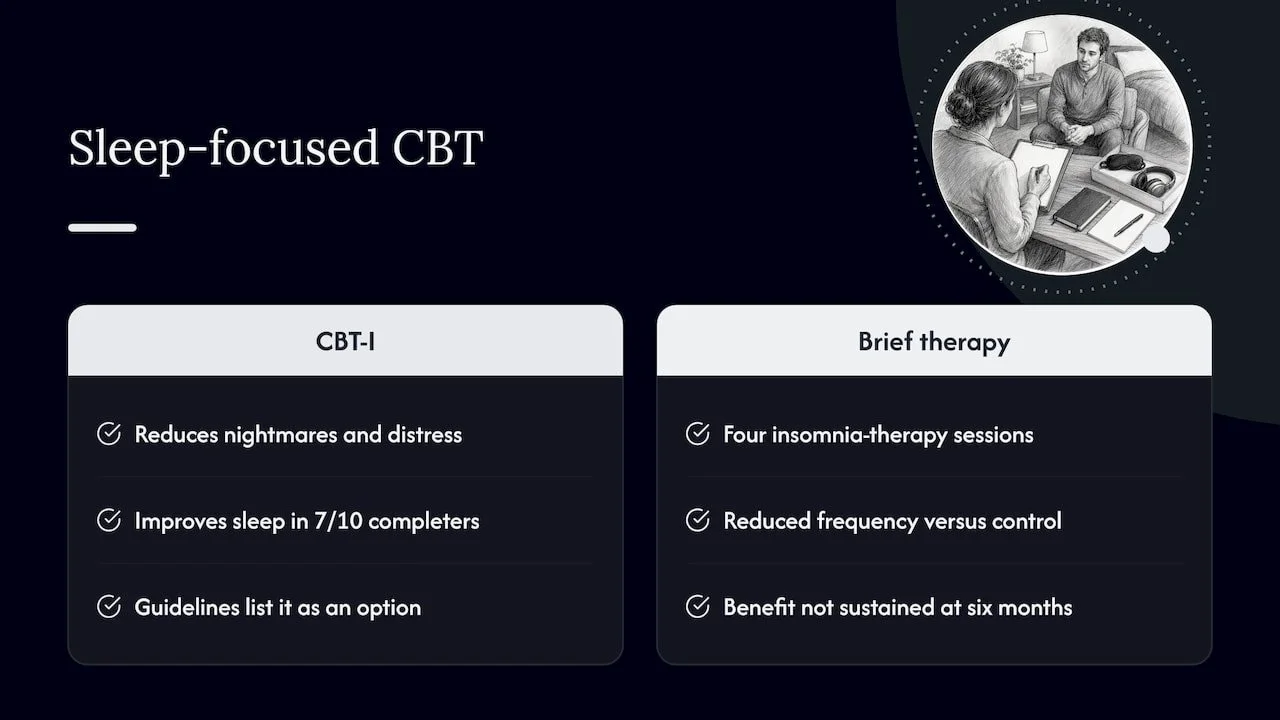
The National Center for PTSD says CBT for insomnia (CBT-I) reduces how many nightmares people have and the distress they cause, and that it improves sleep in 7 out of 10 people who complete it. The 2023 review of interventions adds that the 2018 American Academy of Sleep Medicine guidelines list CBT-I as a "may be used" option for trauma-related nightmares. The same review found that four sessions of a brief behavioral therapy for insomnia reduced nightmare frequency compared with a control group, but the benefit did not hold at six months. That is a useful reminder: short fixes may fade, so ask any provider what follow-up looks like.
Medication
The VA advises discussing recurring nightmares with a doctor because medication may help. The National Institute of Mental Health adds that PTSD treatment may involve psychotherapy, medication, or both, and that some medications can target sleep problems and nightmares. MedlinePlus cautions that you should not stop a newly started medicine without consulting your provider.
Trauma therapy
NIMH says PTSD treatment should involve a mental health professional experienced with PTSD. Because nightmares are tied to how the trauma is stored and reacted to, working directly on the memories and the body's alarm response is a logical place to look. At Alvarado Therapy we use EMDR, a structured therapy for processing traumatic memories, alongside individual counseling, and many clients tell us sleep is one of the first things they want back. Our article on the role of therapy in PTSD recovery explains what that work looks like, and trauma therapy myths clears up common worries about starting.
When the cause is work-related
Sometimes nightmares follow an injury or a traumatic event on the job. In that case, the financial side matters too, because treatment costs and time off add stress. Understanding your state's PTSD workers' comp rules can help you see what benefits might apply while you get care.
Our perspective
In our practice, nightmares are rarely the only thing a client is carrying, but they are often the thing that finally makes someone call. Waking up night after night in fear wears down everything else: patience, focus, relationships, the sense that your own home is safe.
We see nightmares as the nervous system's unfinished business. The memory is still being treated as a present threat, so the brain keeps rehearsing it. That is why we think the most durable relief comes from working on the memory and the body's alarm response, not only managing the night. We use EMDR for exactly this reason, and our EMDR intensives are designed to let clients make concentrated progress without waiting week by week.
Culture and language matter too. Many of the people we work with are Spanish-speaking, Latinx, BIPOC, or LGBTQ+, and have spent years explaining themselves to providers who did not quite understand. We offer therapy in English and Spanish because nightmares and the memories under them are easier to process in the language you dreamed or lived them in.
If your nights have been this hard for a while, you do not have to white-knuckle it. Asking for help is the practical, strong move.
Juiced
How a partner or loved one can help
Nightmares affect the person next to you as well. The VA's guidance on when PTSD disrupts your sleep suggests speaking softly and reminding your loved one they are safe when they wake from a nightmare. It also stresses that the sleep disruption is not their fault, and that persistent disruption affecting either partner is worth raising with a doctor or counselor.
The VA's guide for family and friends adds some planning ideas:
Decide together, in advance and when things are calm, what to do during a nightmare, flashback, or panic attack.
Check in regularly about which support strategies are actually working.
Offer to go with them to a doctor's appointment.
Partners also need rest and support. If sleep loss and fear are straining the relationship, our pieces on PTSD in relationships and the signs of PTSD in relationships may help you name what is happening, and couples therapy is available when you want to work on it together.
When to get professional help
Do not wait for nightmares to become unbearable. Reach out when:
Post-trauma symptoms last longer than a month, are very upsetting, or disrupt daily life, per the National Center for PTSD. Only a qualified mental health provider can diagnose PTSD.
Nightmares happen more than once a week or prevent adequate rest or normal activities for a prolonged period, per MedlinePlus.
Sleep trouble and nightmares are not improving over time. NIMH suggests starting with a primary care provider, who can refer you to a qualified mental health professional.
If you are struggling or having thoughts of suicide, call or text 988. In a life-threatening situation, call 911, as NIMH advises. The 988 Lifeline site also lists the Disaster Distress Helpline at 1-800-985-5990 for emotional support after community-level events.
Get help with trauma nightmares in California
If you live in California, our licensed therapists offer trauma-informed individual counseling and EMDR therapy in Pasadena, Ventura, and online, in English or Spanish. We also treat support for victims of crime through our Victims of Crime program.

If weekly sessions feel too slow, our EMDR intensives compress the work into longer blocks. A 1-Day Intensive of 4 hours is $1,500, a 1-Day Intensive of 6 hours is $2,250, and the 3-Day Intensive is $5,750. Not sure which format fits? Book a consultation and we will help you decide, or read what to expect from online EMDR trauma therapy.
FAQ
How often do PTSD nightmares occur?
It varies widely. Some people have them occasionally, others several times a week. MedlinePlus suggests contacting a provider when nightmares happen more than once a week or keep you from adequate rest. Frequency often rises during stress or when reminders of the trauma appear.
How do I get over a traumatic dream?
In the moment, remind yourself you are reacting to a dream, get up, look around and name what you see, hear, and touch, and do something soothing. Over the longer term, a regular sleep schedule and professional treatment aimed at nightmares and the trauma behind them can reduce how often they come back.
Can trauma nightmares go away without treatment?
Sometimes they fade, especially soon after an event. But research describes chronic nightmares as learned scripts that can persist after the danger has passed, and one review found trauma-related nightmares continue in over 80% of people with PTSD. If yours last more than a month, a professional evaluation is a sensible next step.
How do I help someone having a PTSD nightmare?
Speak softly and remind them they are safe, rather than shaking them or making sudden contact. Agree on a plan together when things are calm, and encourage them to talk to a doctor or counselor if nightmares keep disrupting either of your sleep.
Sources
Sleep Disturbances Associated With Posttraumatic Stress (PMC, 2023)
Consensus patient manual on nightmares, Dr. Daniel J. Taylor
Coping with Traumatic Stress Reactions, National Center for PTSD
