
Colorism, discrimination based on skin tone, can wear down self-esteem, raise anxiety and depression risk, and strain relationships and your sense of belonging. It often comes from inside your own family or community, which makes it harder to name and easier to carry alone. If this is your experience, it is real, it is documented, and therapy that understands the cultural context can help.
This guide explains what colorism is, how it differs from racism, what research says about its mental health effects, how to recognize it in your own life, and what to look for in a therapist.
Alvaradotherapy
Find Culturally Responsive Support
Alvarado Therapy offers identity-affirming, trauma-informed counseling in English and Spanish for people navigating discrimination and its emotional effects.
TL;DR
Colorism is bias that favors lighter skin over darker skin. It often happens within the same racial or ethnic group, so it can feel personal and confusing.
Research links daily discrimination, including skin-tone discrimination, with higher risk of depression, anxiety, loneliness and substance use.
Discrimination from your own group can hit self-esteem especially hard, according to a 2025 study.
Naming the experience, building community and working with a culturally responsive therapist are well-supported ways to start healing.
We offer identity-affirming, bilingual (English and Spanish) therapy, including EMDR, in California and online.
Table of Contents
What colorism is, and how it differs from racism
Colorism is skin-tone discrimination, often a preference for lighter skin over darker skin. Racism is discrimination based on race or ethnicity itself. The practical difference is that colorism frequently operates among people of the same racial or ethnic group. A Black, Latina, South Asian or Asian person can be treated differently from a sibling or cousin simply because their skin is lighter or darker.
The two are connected. Some researchers closely link colorism in the U.S. to the racist views and white beauty ideals that were common during slavery and persisted after it ended, according to the same WebMD overview. In other words, colorism is not a private family quirk. It is a legacy that families and communities absorbed and sometimes pass on without meaning to.
What it can look like day to day
Colorism rarely announces itself. It tends to show up as comments, assumptions and unequal treatment:
Being told to stay out of the sun, or being praised for "good" or "light" skin.
Relatives comparing siblings or children by complexion.
Being seen as more or less attractive, trustworthy, professional or "approachable" because of skin shade.
Feeling pressure to use lightening products, or to lean into or away from a particular look.
Dating dynamics where skin tone shapes who is considered desirable.
Being treated as not "Black enough," "Latino enough" or "authentic enough" because your skin is lighter, or being dismissed because it is darker.
Colorism can affect people at both ends of the spectrum, though not in the same way. Darker-skinned people often face more discrimination and its material costs. Lighter-skinned people can face questions about belonging, guilt or exclusion from their own community. Both experiences can be painful, and both deserve to be taken seriously.
What research says about colorism and mental health
Colorism is not only about feelings. It has measurable links to stress, health and well-being.
Anxiety, depression and daily discrimination
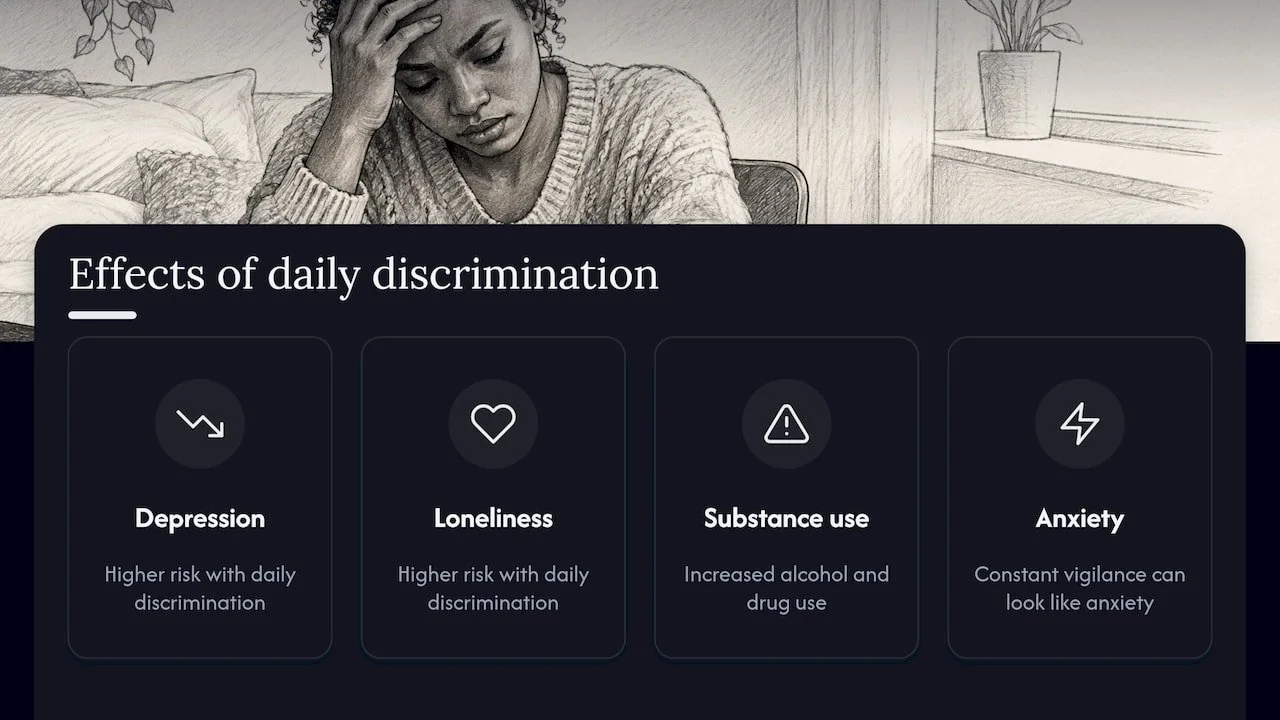
KFF Health News reports that people who feel they experience daily discrimination can be at higher risk for depression, loneliness, increased alcohol and drug use, and anxiety. The same reporting notes that darker-skinned Black and Hispanic adults reported more daily discrimination than lighter-skinned peers. That matters because discrimination that happens again and again does not give the nervous system a chance to settle. Over time, constant vigilance can look like anxiety, irritability, exhaustion or numbness.
A study of perceived colorism and lifetime psychiatric disorders, published in 2021 by H. Oh and colleagues, concluded that colorism predicts psychiatric disorders, while noting that more research is needed to understand why in-group and out-group experiences differ in their effects.
Self-esteem, worth and belonging
KFF also reports that colorism can harm self-esteem, self-worth, relationships, belonging and dignity. Children often internalize what they hear about their skin long before they have words to question it.
Who delivers the message matters. A 2025 study in Frontiers in Sociology found that ingroup colorism, discrimination from members of one's own racial group, was a stronger predictor of low self-esteem than outgroup colorism. When the people who are supposed to be your safe place make you feel "less than," the wound can go deeper and be harder to talk about.
Relationships and dating
Colorism also shapes how people see themselves as partners. In a study of 28 Black college women, lighter skin was perceived as more attractive and as carrying more value in dating and sexual appeal. Researchers examining skin shade and relationships among Black women in the UK describe fostering Black self-acceptance, celebrating natural Black beauty and creating spaces for dialogue between women of different skin shades as ways to address some of these effects.
If you have ever wondered whether a partner chose you, or passed on you, because of your complexion, you are not imagining a pattern that researchers have studied. That uncertainty can feed anxiety, comparison and difficulty trusting affection.
Why it can be hard to spot
Colorism can stay overlooked in mental health settings. KFF Health News and clinical psychologist Usha Tummala-Narra note that when professionals lack awareness of the cultural context of skin-tone discrimination, accurate diagnosis and effective treatment suffer. A therapist who never asks about skin tone, family messages or community standards of beauty can miss a central piece of your story.
How to recognize the emotional effects in yourself
There is no checklist for colorism's impact, and none of these signs prove anything on their own. They are prompts for reflection:
You monitor your appearance more than others seem to. You think about lighting, photos, sun exposure or makeup in ways that feel heavy rather than playful.
Certain family comments still sting years later. You can recall exact words about your skin, hair or features.
You feel like you do not fully belong. Your own community or family has made you feel too dark, too light or somehow outside.
You notice shame or comparison around dating. You wonder whether you are chosen or passed over because of shade.
You feel constant tension in certain settings. School, work or social spaces leave you braced, tired or on guard.
You have absorbed the message. You catch yourself judging other people, or yourself, by complexion and feel guilty about it.
If several of these ring true, that is useful information, not a flaw in you. If you are also dealing with persistent low mood, panic, sleep problems, or thoughts of self-harm, please reach out to a licensed mental health professional or call or text 988, the Suicide & Crisis Lifeline, in the U.S.
Ways to cope and start healing
Colorism is a social problem, so healing is not only about fixing yourself. Still, there are steps that many people find grounding.
Name it
Put language to what happened. Writing about specific moments, such as a comment at a family gathering or a remark from a coworker, helps you separate what was said to you from what is true about you. Our journals and workbooks are one place to begin that practice.
Find community
The researchers behind the UK study above point to dialogue across skin shades and celebrating natural beauty as protective directions. In practice, that can mean friendships, groups, books and creators that reflect the full range of your community, and spaces where your skin is neither a topic nor a problem.
Question the messages you inherited
Many families repeat colorist ideas out of fear, hoping to protect children from a biased world. You can understand that history with compassion and still decide not to carry it forward. Setting a boundary, such as "I am not going to talk about my skin like that," is a legitimate response.
Look after your body too
Chronic stress can show up physically, in sleep, appetite, headaches or tension. Some people pair therapy with regular medical care, and it helps to understand how diagnostic support in healthcare fits into a broader picture of well-being. Talk with your own doctor about any physical symptoms.
Work with a therapist who gets the context
This is often the step that changes the most, because you no longer have to explain the basics before you can be understood.
What culturally responsive therapy offers
The American Psychological Association's guidelines call for psychologists to provide assessment and intervention free from racial and ethnocultural bias and to reflect on how their own worldviews and positionalities affect their work. An APA chapter on multicultural therapy describes culturally responsive therapists as ethnoculturally fluent, meaning they assess their own assumptions and adapt to the cultural contexts of the communities they serve.
For someone dealing with colorism, that can translate into a therapist who:
Asks about family messages, community standards and your experiences with skin tone, rather than waiting for you to raise it.
Understands that the pain may come from people you love, and does not push you to cut ties or to excuse them.
Treats identity as part of the work, not a side topic.
Can work in your language. For Spanish-speaking clients, being able to describe family sayings and feelings in Spanish can make the work feel more natural.
If you want to read more about this approach, see our guides on what identity-affirming therapy is and why culturally responsive therapy matters for healing. If you live in California, our piece on why to seek identity-affirming therapy in California covers what to look for locally.
Our perspective
We see colorism show up in our work more often than people expect, and rarely under that name. It arrives as anxiety before family events, as shame about photos, as a feeling of never being quite enough in a relationship, or as grief over a sibling who was treated as "the pretty one."
Our approach is trauma-informed and identity-affirming. We do not treat your skin tone, your culture or your family's history as background noise. They are part of how your nervous system learned to protect you. When early messages about your body or worth were repeated often enough, they can function like trauma, and we treat them with the same care.
We are a bilingual, culturally responsive practice, and we work with Latinx, BIPOC and LGBTQ+ clients who often carry several layers of identity at once. EMDR therapy is one of the approaches we use for painful memories, and we offer it both weekly and in intensive formats for people who want to go deeper in a shorter span of time.
You do not have to convince us that this is real. You can start by telling us what you have been carrying.
Juiced
Support at Alvarado Therapy
We are a California-based, trauma-informed practice offering care in English and Spanish, with licensed therapists serving clients in Pasadena, Ventura and online across California. For painful memories tied to childhood, family or relationship experiences, our individual counseling and EMDR therapy is a good starting point.
If you prefer to focus your healing in a concentrated block, our EMDR intensives are published at $1,500 for a 1-day intensive of 4 hours, $2,250 for a 1-day intensive of 6 hours, and $5,750 for a 3-day intensive. Couples dealing with how skin tone, family messages or identity shape their relationship can look at our couples therapy. If you are not sure which fits, you can start with a consultation, and you can read about how online therapy works before you book.
FAQ
Is colorism the same as racism?
No, though they are linked. Racism is discrimination based on race or ethnicity, while colorism is discrimination based on skin tone, and it frequently happens within the same racial or ethnic group. Some researchers tie U.S. colorism to the white beauty ideals of the slavery era, according to WebMD.
Can colorism cause anxiety or depression?
Research points to a link. People who feel they face daily discrimination can be at higher risk for depression, loneliness, substance use and anxiety, KFF Health News reports. Colorism is one of many factors, so a licensed clinician can help you understand what is contributing to your own symptoms.
Does colorism affect lighter-skinned people too?
Yes, though often differently. Lighter-skinned people may be treated as having an advantage and still feel excluded, guilty or questioned about belonging within their community. Therapy can make room for that experience without ranking it against anyone else's.
What should I look for in a therapist if I have experienced colorism?
Look for someone who asks about culture, family and identity, reflects on their own assumptions and can work in your preferred language. The APA describes culturally responsive therapists as ethnoculturally fluent and committed to self-assessment. You should feel you do not have to explain the basics of your background first.
Can EMDR help with painful memories about skin tone?
EMDR is a trauma therapy used for distressing memories, and many people bring childhood and family experiences to it. Whether it fits you depends on your history and goals, which a licensed therapist can talk through with you in a consultation.
Sources
"I Feel Dismissed": People Experiencing Colorism Say Health Care Falls Short (KFF Health News)
Examining colorism, body image and self-esteem (Frontiers in Sociology, 2025)
The Influence of Skin Color on Heterosexual Black College Women's Dating (PMC)
Skin shade and relationships: how colourism pits Black and other women (PMC)
