

A boundary in a nonmonogamous relationship is a limit you set for yourself, about your own body, time, energy and health, and that you communicate to partners so they can make informed choices. It is different from a rule, which tries to control what someone else does, and from an agreement, which partners build together. The strongest open relationships tend to use all three on purpose, write the important ones down, and review them on a schedule.
This guide walks through the difference, how to find your own boundaries before you talk, the topics worth covering (safer sex, time, privacy, emotional intimacy), and what to do when a boundary is crossed or jealousy shows up.
Alvaradotherapy
Navigate Relationship Boundaries With Support
Alvarado Therapy offers individual counseling and couples therapy for relationship difficulties, with trauma-informed care in English and Spanish.
TL;DR
A boundary is about your own behavior and needs. A rule is about someone else's behavior. An agreement is a commitment you make together.
Work out your values and limits alone first, then talk with partners when everyone is calm and grounded.
Cover safer sex, testing, time, privacy, disclosure and emotional intimacy, and be specific about behaviors.
Boundaries are not permanent. Schedule check-ins and renegotiate by asking whether the current arrangement still serves everyone.
Consent can be withdrawn at any time. A crossed boundary deserves a direct, careful conversation, and sometimes outside support.
Table of Contents
What nonmonogamy means, and why boundaries matter more
Consensual non-monogamy (CNM) describes relationship styles with multiple intimate, romantic or sexual partners, with everyone's full knowledge and consent. That includes polyamory, open relationships and swinging. Cheating is different because it lacks consent. The APA Division 44 Task Force uses the same core idea: all partners explicitly agree.
CNM is more common than many people assume. The same task force reports that roughly one in 22 people currently in a romantic relationship identify as CNM, and about one in five people have engaged in it at some point.
In a two-person monogamous relationship, many expectations are assumed. In CNM, almost nothing is assumed, so what you do not say out loud can quietly become a source of hurt. Boundaries are how you say it out loud.
Research is reassuring about the format itself. The task force reports that people in CNM and monogamous relationships describe similar satisfaction, trust, commitment and psychological health, and that CNM should not be presumed dysfunctional. It also notes that CNM participants report stigma and discrimination in healthcare settings, which is one reason people sometimes feel hesitant to bring these questions to a professional.

Boundaries, rules and agreements: three different tools
People use these words interchangeably, and that causes real confusion. Here is a practical way to separate them.
| Tool | Whose behavior it covers | Example | Who decides |
|---|---|---|---|
| Boundary | Your own | "I won't have sex without barrier protection." | You |
| Rule | Someone else's | "You can't see anyone from our friend group." | Usually one partner, often with consequences |
| Agreement | Everyone involved | "We'll tell each other about new sexual partners before we have sex with them." | All partners, together |
A boundary says what you will do. "If you see her again, I'm leaving" is a threat dressed as a boundary. "I'm not comfortable staying in a relationship where I learn about new partners after the fact, so I need advance notice" states a need and a limit that belongs to you.
Rules are not automatically bad. Some people feel safest with more structure and are happy to defer to a partner on certain decisions, while others feel controlled by any rule at all. What matters is that the structure is chosen freely by everyone it touches. Many couples find that when a rule keeps being broken, it was really a boundary or a need that never got named. Moving from "you may not" toward "here is what I need, and here is what we agree on" tends to lower resentment.
If you have already been through broken trust, our guide on boundaries after betrayal offers scripts that translate well to this distinction, and our overview of a healthy boundaries workflow shows how to turn a vague discomfort into a clear statement.
Step 1: Find your own boundaries before the conversation
The University of Colorado Boulder's health team advises clarifying boundaries internally first, then communicating them. Its examples include how comfortable you are with a partner dating others, communication preferences, physical touch, social settings and activities you want to avoid. That order matters: if you walk into the talk without knowing what you feel, you will end up agreeing to whatever sounds easiest.
Feeld's guide to ENM agreements suggests reflecting on your values, the connections you want and have capacity for, your emotional-safety needs, and how you want to respond when you are activated. Turn that into questions you can answer in writing:
What do I want from opening the relationship, and what am I afraid of?
How much time and energy do I realistically have for more than one partner?
What do I need to feel secure: advance notice, regular time together, certain information?
What happens in my body and mind when I feel jealous, and what helps?
Which limits are non-negotiable for my health and safety?
If some answers bring up old wounds, such as abandonment, betrayal or past partners who ignored your limits, that is useful information. Trauma history often shapes which boundaries feel urgent, and a therapist can help you tell a current need from an old alarm.
Step 2: Have the conversation when everyone is grounded
Timing does more than wording. Feeld recommends starting difficult boundary talks when everyone is grounded, and it cites the HALT check-in: are you hungry, angry, lonely or tired? If so, eat, rest or wait. Do not open this subject at 11 p.m. after an argument.
A trauma-informed structure for the conversation looks like this:
Set a shared intention. The goal is to understand each other, not to win.
Lead with feelings and needs before requests. "I feel anxious when plans change late, and I need some notice" lands differently than "Stop canceling on me."
Reflect back what you heard before you respond.
Pause to regulate when someone is flooded, rather than pushing through. Agree beforehand that either person can call a break and that you will return to the topic.
Write agreements down. Feeld notes that written agreements can serve as a shared map, and that documentation can help trauma survivors who struggle to trust their memory of a heated conversation.
If conversations like this keep spiraling, couples therapy gives you a neutral space and a structure. Our pieces on what actually works in couples therapy and therapeutic approaches for couples explain what the process looks like.
What to cover: a topic checklist
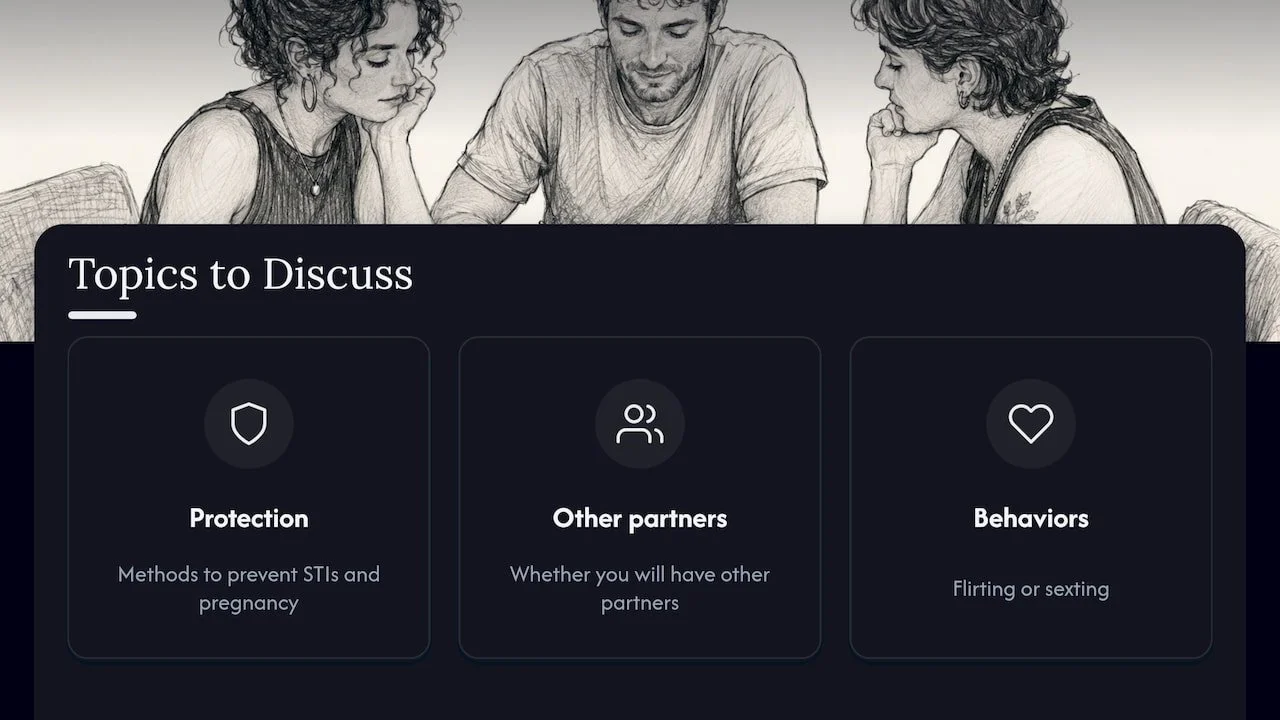
Be specific. "Be safe" and "be respectful" mean different things to different people. The American Sexual Health Association suggests talking about which methods you will use to prevent STIs and pregnancy, whether you will have other partners, and specific behaviors such as flirting or sexting. Use the categories below as a starting point.
Safer sex and testing
Planned Parenthood advises that the best time to talk about safer sex is before you start having sex, and that covers birth control, STI testing history and condom or dental dam use. For a multi-partner setup, turn that into concrete agreements:
Which barrier methods you use for which activities, with which partners
How often each person tests, and how you share results
What happens if a condom breaks or safer-sex practices were not followed: who gets told, how quickly, and whether you pause sexual contact until testing
Whether each person is free to set stricter limits with a given partner
One point from the same guidance is worth keeping in mind: if a partner refuses testing or protection, your health is not being treated as important, and that is a relationship concern worth addressing directly.
Disclosure and information
Decide what you want to know and when. Some people want advance notice of any new sexual partner. Others prefer to hear afterward, or only the basics. A few want no details at all. None is right for everyone. Agree on it explicitly, including how you will handle questions like "Do you want to hear about this date?" And treat each partner's right to make informed choices as part of the deal: someone sleeping with your partner deserves enough information about the risks involved.
Time and scheduling
Time is the boundary that quietly breaks most arrangements. Talk about how much time is protected for existing relationships, such as weekly date nights, daily check-ins or certain weekends. Talk about how much advance notice is needed when plans change, and what happens with holidays, birthdays and emergencies. Clarify what you do when two partners need you at once.
Privacy and shared spaces
Decide whether partners can stay overnight at home, whether shared beds are off limits for others, what happens with personal belongings, and how phones, photos and social media are handled. Privacy goes both ways: you can protect a metamour's information while also being honest with your partner about what you are doing.
Emotional intimacy
This is the hardest to define and the most important. Some people are comfortable with sex outside the relationship but feel unsettled by romantic dates, "I love you," or overnight stays. Others are the reverse. Name the specific behaviors that carry emotional meaning for you, rather than assuming your partner shares your definition of "too close."
Consent runs underneath all of it
The National Coalition for Sexual Freedom's 2024 guide for professionals states that consent in CNM should be explicit and detailed, that freely given consent is distinct from coercion, and that consent can be withdrawn. Agreeing to one activity does not imply agreement to another, or to the same thing next month.
The same guide offers a useful test for any set of agreements. Ask whether:
Everyone has an equal say in them
Everyone has enough information about the risks
Everyone clearly understands the others' desires and boundaries
Everyone's choices about STI and pregnancy prevention are respected
If the answer to any of these is no, the agreement is not finished yet, however neat it looks on paper.
Boundaries change: how to revisit them
HelpGuide notes that boundaries are not etched in stone, and that when you change one, you should explain the change and the reason so the other person is clear. In nonmonogamy this is even more true, because a new partner, a job change, a move, a pregnancy scare or a health diagnosis can shift what feels workable.
Two habits keep revisions from becoming fights:
Schedule check-ins. Feeld suggests regular relationship check-ins, monthly, quarterly or on whatever rhythm works for you, to talk about what is working, what has changed and what new needs are emerging. Put them on the calendar so nobody has to "bring something up" in the middle of a bad week.
Frame it as a shared problem. According to a 2026 piece from 3Cupid on difficult ENM conversations, a common mistake is saying "I want to change the rules" instead of asking whether the current arrangement is still serving you both and whether you can revisit it. The second version invites partnership. The first sounds like a demand.
A simple check-in agenda: what felt good since we last talked, what felt hard, what boundary needs adjusting, what do you need from me this month.
When a boundary is crossed or jealousy hits
Jealousy is information, not proof that nonmonogamy is failing. Slow down and ask what sits underneath it: fear of losing time, feeling replaced, a past betrayal, or an agreement that was never really clear. Then use the conversation structure above: calm first, feelings and needs, reflect back, request.
When a boundary has genuinely been crossed, take it in this order:
Prioritize health. If safer-sex agreements were broken, arrange testing and pause the relevant contact as you agreed beforehand. A clinician or local sexual health clinic can advise on testing windows.
Name the facts without character attacks. "We agreed on advance notice, and I found out afterward" is easier to work with than "You always lie."
Ask what happened and what was needed. Was the agreement unclear, unrealistic or deliberately ignored?
Decide on repair. That might be a revised agreement, a pause, or a conversation about whether the arrangement fits one of you at all.
Some situations go beyond a broken agreement. The NCSF takes first-person reports of consent violations, including assault, blackmail, revenge porn, stealthing (removing a condom during sex without consent), stalking and harassment, and assists people with issues involving kink and non-monogamy among consenting adults. If you have experienced something like this, you did not break an agreement; someone violated your consent. A licensed trauma therapist can help you process it, and our page on PTSD and complex trauma describes how we work with that.
Our perspective
When couples and individuals come to us with questions about opening a relationship, we rarely start with the rulebook. We start with safety. Can each person say "no" and be heard? Can each person feel a strong emotion without being punished for it? Those answers tell us more than any list of rules.
We believe boundaries work best when they come from self-knowledge, not fear. A boundary that grows out of an old wound can feel urgent but be hard to explain, and that is where trauma-informed therapy helps. Our clinicians work in a trauma-informed, identity-affirming way, and we provide care in English and Spanish, so people can explain what they need in the language they feel most themselves in.
We also know that people of color, LGBTQ+ people and others who live with minority stress often carry extra weight into relationship conversations. Our article on minority stress and mental health explains why. Good boundary work makes room for that context rather than ignoring it.
If you want support turning your needs into clear, kind language, couples therapy gives you a structured place to practice. If your reactions to certain situations feel bigger than the moment, individual work, including EMDR therapy, may help you understand what is being triggered.
Juiced
Getting support with boundary conversations
If you and your partners keep circling the same disagreement, or one conversation about boundaries leaves someone shut down, a neutral third person can help. Our couples therapy is offered online to Californians and New Yorkers, and our relationship therapy page explains how we approach connection, communication and trust. You can also start with an initial consultation to see whether we are the right fit.
If you are working through trust after a hurt, our guide to trust-based therapy for couples shows how repair is structured over time.
FAQ
What is the difference between a rule and a boundary in an open relationship?
A boundary describes what you will do to protect yourself, such as "I only have sex with barrier protection." A rule tries to control what another person does, such as "you can't date coworkers." Many people find agreements, which partners create together, a better middle ground than either one.
How often should we revisit our agreements?
There is no single correct schedule. Feeld suggests monthly, quarterly or another rhythm that works for everyone. Add an extra check-in whenever something major changes, such as a new partner, a move, a health issue or a shift in how much time anyone has.
What boundaries are most important before opening a relationship?
Start with safer sex and testing, how much time is protected for existing partners, what you want to be told and when, and which emotional behaviors feel too close. Be specific about behaviors like flirting, sexting or overnight stays rather than relying on general words like respect.
What if I agreed to something and now regret it?
Tell your partner as soon as you notice. Consent can be withdrawn, and agreements are meant to be revised. Open with what you are feeling and needing, and ask whether the current arrangement is still working, rather than announcing that the rules are changing.
Can therapy help with nonmonogamy boundaries?
Yes. A therapist can help you identify your own limits, practice communicating them, and sort out which reactions are about the present and which are about the past. Couples therapy and individual counseling are both options, and you can start with a consultation.
Sources
Setting Agreements and Boundaries in ENM and Poly Relationships (Feeld)
3 tips for dating in college (University of Colorado Boulder)
What Professionals Need to Know About Consensual Nonmonogamy (NCSF, 2024)
How to Have Difficult Conversations in ENM Relationships (3Cupid)
Incident Reporting & Response (National Coalition for Sexual Freedom)
