

Grief in your 20s is common, real and often lonely. Most of your friends haven't been through a major loss, you are still building your adult life, and the people around you may expect you to move on faster than you can. There is no normal timeline, no fixed order of feelings, and no "right" way to do it. What helps is understanding what your reactions mean, building a few reliable supports, and knowing when professional help makes sense.
Alvaradotherapy
Find Support for Grief
Alvarado Therapy offers individual counseling for grief, with trauma-informed care in English and Spanish for clients across California.
TL;DR
Grief in your 20s tends to feel isolating because your peers are usually not grieving, and because you lose someone while you are still figuring out who you are becoming.
Sadness is only one part of it. Sleep trouble, exhaustion, trouble concentrating, anger, guilt and even relief are all common reactions.
There is no normal length of grief. It comes in waves, and many people feel it again years later.
You don't have to wait a year to get help. Persistent trouble with work, relationships, sleep or safety is reason enough to talk to a licensed professional.
One peer who has lost someone, a plan for hard dates and one trusted listener do more than most big gestures.
Table of Contents
Why grief in your 20s feels different
What young adult grief can look like
How long does grief last?
Coping with grief and exhaustion day to day
When to consider grief counseling
Our perspective on grief in your 20s
Support at Alvarado Therapy
FAQ
Sources
Why grief in your 20s feels different
Losing someone at any age hurts. In your 20s, the loss lands in a particular spot. You are often away from home for the first time, starting a career, dating, or just working out your identity. Grief and trauma therapist Gina Moffa describes losing a parent in your twenties as like having the rug pulled out from under you while you're still learning how to stand on your own. She adds that you are grieving not only who the person was, but who you were becoming with their support nearby.
That is why a loss can feel like it has taken your future as well as your past. Plans you took for granted, such as a parent at your wedding or a grandparent meeting your child, suddenly look different.
You may be the only one in your circle
A 2019 study in Death Studies interviewed 15 adults aged 18 to 32 who had lost a parent. The researchers found mixed emotions, challenges tied to this stage of life, and a tendency toward resilience. They concluded that emerging adults need chances to connect with others who are grieving a parent's death, and may benefit from specialized support groups.
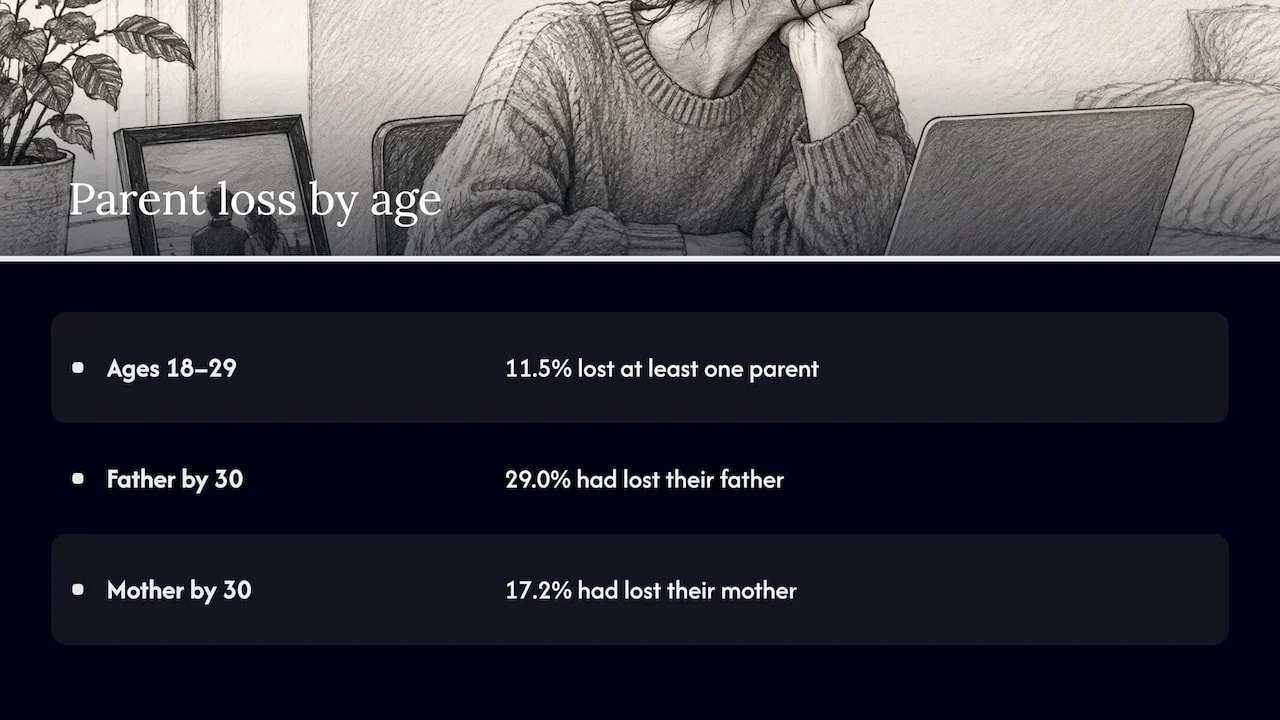
The isolation is not in your head. It also isn't a sign that you are handling things badly. How common is it? According to the U.S. Census Bureau's analysis of 2021 survey data, 11.5% of 18- to 29-year-olds had lost at least one parent. By age 30, 29.0% had lost their father and 17.2% had lost their mother. That is a sizable minority, but a minority, so it makes sense that you may not know many others.
"It must be easier because you're young"
Some people assume a young adult recovers faster, or that the surviving parent is the one who needs the care. A woman who lost her father at 20 describes the opposite in her story on Griefline. She says it is extremely difficult precisely because you are going through change, transition and self-discovery. She also says attention tends to go to the widowed parent, while the children whose world has been turned upside down get little care.
If that sounds familiar, your grief is not smaller because you are younger, and it doesn't need to compete with anyone else's.
Loss can touch identity, too
Grief can reach parts of you that are not obvious. Hannah, who lost her father at 27, says in the same Dazed piece that she lost connection to one side of her family and heritage. Her father was her Black parent, and she said it felt like losing her racial identity too. For many people, a loss also means losing a language, a set of traditions, or a cultural bridge. If that is part of your story, it is a legitimate part of the grief, and it is worth naming with someone who understands.
What young adult grief can look like
Most people expect sadness and crying. In practice grief shows up across your whole life. The National Center for PTSD lists common reactions in four areas:
| Area | Examples |
|---|---|
| Physical | Disrupted sleep, weakness, trouble breathing, restlessness, changes in immune function |
| Emotional | Sadness, loneliness, fear, anxiety, resentment, anger, guilt |
| Mental | Trouble accepting the loss, difficulty concentrating, identity changes, a disrupted sense of the future, avoidance or intrusive thoughts |
| Social | Withdrawal, loneliness, lack of confidence, emotional sensitivity, trouble forming new relationships |
A resource on young adults aged 18 to the mid-20s from Eluna adds that grief may show up as avoidance, isolation or risk-taking, aches and pains, a tight chest, loss of appetite and exhaustion. It also notes disruption in school or work, and a fracturing of personal identity development.
A 2020 study in Mortality of 236 emerging adults found the strongest effects were emotional, followed by cognitive, behavioral, physical and interpersonal ones. People who did not see the loss coming reported stronger grief than those who expected it.
Relief, guilt and numbness are normal
The National Center for PTSD says the extent of these reactions depends on the relationship, your personality and coping style, and your environment. Some people don't need to grieve as deeply as others, and relief can sit alongside sorrow, especially if the person who died had been suffering. Feeling relief does not mean you loved them less. If your relationship was complicated, your grief will be too.
How long does grief last?
There is no set answer. The National Center for PTSD states that there is no right or wrong way to grieve and no normal length of time. Grief doesn't follow neat stages. It is an ongoing process that comes in waves, and for some people it fades gradually over many years.
A review by Arizmendi and O'Connor makes a similar point: grief is rarely a steady progression from high distress to resolution. Research supports four common trajectories: resilience, chronic grief, depressed-improved and chronic depression. A small subset experience complicated grief many years after the loss.
Is it normal to grieve years later?
Yes. A wave can come at a graduation, a first apartment, a breakup or the birth of a friend's child. If you went numb or stayed busy at the time of the loss, the feelings may arrive months or years later. We write more about this in our piece on delayed grief and why loss can hit you later.
When grief becomes prolonged grief
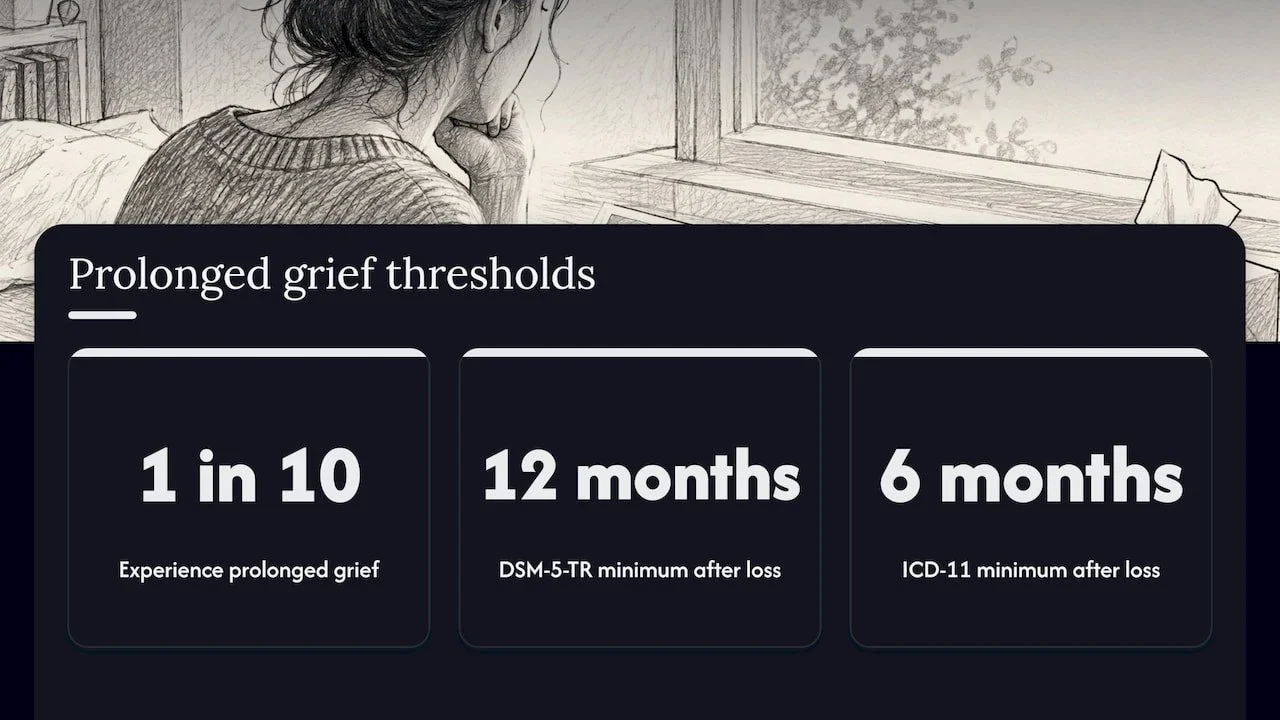
About 1 in 10 people experience a prolonged, impairing reaction called prolonged or complicated grief. The DSM-5-TR criteria, as described in JAMA Psychiatry, require that distressing symptoms continue at least 12 months after the loss. They include intense longing or preoccupation with the person nearly every day for at least the past month, plus at least three of eight other symptoms, such as identity disruption, disbelief, avoidance, emotional numbness, feeling life is meaningless and intense loneliness. The symptoms must cause clinically significant distress or impairment. A 2023 HHS report to Congress notes that ICD-11 uses a shorter window of at least 6 months.
Those are diagnostic thresholds for clinicians. They are not a countdown for when you must feel better, and they are not the point at which help becomes allowed. For a fuller look at recognizing persistent grief and the kinds of professional care available, this page on grief and mental health is a useful companion.
Coping with grief and exhaustion day to day
Grief is tiring. Your body and mind are doing heavy work while rent, classes and jobs keep going. These steps are modest on purpose.
Let the loss be real. CancerCare's guidance for young adults whose parent died includes acknowledging the reality and impact of the loss, allowing yourself to grieve, and recognizing that grief differs for each person.
Find one peer who gets it. The Grief Support Center says the single most protective factor for young adults is connection to at least one peer who has lost a parent. That person doesn't have to become your main support. Knowing someone nearby has been through it reduces isolation. Peer groups, campus groups and online communities for young adults can be a start.
Talk about it, even briefly. Pick one or two people and tell them directly what helps: "I don't need advice, I just need you to ask about my mom sometimes."
Protect the basics. Aim for regular meals, a consistent bedtime and some movement. Be careful with alcohol and drugs when you are sad, since they tend to make grief heavier rather than lighter.
Tell work or school what you can. A short note to a manager or professor can buy flexibility. Many people are more willing to help than you expect.
Plan for hard dates. CancerCare advises planning for important dates and milestones. Birthdays, holidays and anniversaries often bring surges. Decide ahead who you will be with and what you will do, and leave room to change your mind. Our guide to coping ahead for anniversary grief reactions walks through trauma-informed ways to do this.
What to say when friends don't know how to help
Peers your age often go quiet because they are afraid of saying the wrong thing. You can make it easier. Tell them which anniversaries matter, say you like hearing the person's name, and ask for specific help like a meal, a walk or company at a paperwork appointment. People tend to step up when they are given something concrete to do.
When the loss is not a death
Grief in your 20s is not only about death. Breakups, divorce, estrangement, a move far from home or the end of a friendship can bring real grief, and the same principles apply. If a relationship ending is what is weighing on you, see our article on grief counseling for divorce.
When to consider grief counseling
You don't need a diagnosis or a specific number of months. Consider reaching out to a licensed therapist, or your doctor, if:
grief keeps disrupting work, school, relationships, sleep or self-care;
you are avoiding so much that your daily life has gotten smaller;
you are relying on alcohol or other substances to get through the day;
your sleep, appetite or weight have changed significantly for months;
you feel that life has no meaning without the person who died;
you want support and the people around you are not enough.
These signs echo guidance from sources such as MemoriTree and Healthline, which notes you don't have to wait a year before talking to someone if grief is overwhelming and persistent.
If you are having thoughts of hurting yourself or are in immediate danger, call or text 988 (the Suicide & Crisis Lifeline) in the United States, or call 911. Don't wait for a scheduled appointment.
To see what grief work usually involves, our complete guide to grief counseling support and our overview of grief therapy approaches explain the options. If you are curious about why therapy at this age can matter so much, read why therapy for young adults matters.
Our perspective on grief in your 20s
At Alvarado Therapy, we see young adults who have been told to be strong, to stay busy and to stay out of the way of everyone else's grief. Many arrive exhausted, not because they are doing grief wrong but because they have been doing it alone.
We believe grief in your 20s deserves the same seriousness as grief at any other age. It is tangled up with identity, family, culture, money and the question of who you are becoming. That is why our work is trauma-informed, culturally responsive and identity-affirming. We offer care in English and Spanish, because grief is often held in the language you grew up in.
Sometimes a loss is also traumatic: it was sudden, violent or witnessed, or it stirs up older wounds. In those cases we use EMDR therapy alongside supportive counseling, working at a pace you can manage. We don't push anyone to "get over it." We help you carry the loss in a way that lets you keep living your life.
If you have been waiting until your grief is bad enough to deserve help, consider this your permission to start now.
Juiced
Support at Alvarado Therapy
We are a California-based, trauma-informed practice. Our licensed therapists work with grief, anxiety, trauma and relationship difficulties, in person in Pasadena and Ventura, and online throughout California. Sessions are available in English and Spanish.

For ongoing support, individual counseling and EMDR therapy gives you a regular space to process the loss. If your schedule makes weekly sessions hard, or the loss is tied to trauma, our EMDR intensives concentrate the work into longer sessions: a 4-hour one-day intensive is $1,500, a 6-hour one-day intensive is $2,250, and a 3-day intensive is $5,750. If a crime was involved in your loss, see our support for victims of crime. For more on how we think about grief, start with grief and trauma explained or modern, evidence-based grief counseling methods.
FAQ
What percentage of 20-year-olds have lost a parent?
The Census Bureau does not break this out by single year of age. Its analysis of 2021 data found that 11.5% of people aged 18 to 29 had lost at least one parent. By age 30, 29.0% had lost their father and 17.2% their mother.
Is it normal to grieve 20 years later?
Yes. The National Center for PTSD says there is no normal length of time to grieve and that grief comes in waves. Reminders such as milestones or new losses can bring it back. If the feelings keep interfering with daily life, a licensed therapist can help.
How long does grief exhaustion last?
There is no set duration. Fatigue is one of the common physical and emotional effects of grief, and it often eases unevenly over time. If exhaustion comes with changes in sleep or appetite that last for months, or with thoughts of self-harm, talk to your doctor or a therapist.
Do I need to wait a year before seeking grief counseling?
No. The 12-month mark applies to a prolonged grief disorder diagnosis, not to when you can seek help. Healthline notes you can talk to someone sooner if grief is overwhelming and persistent. Support early on can be useful, whatever the diagnosis.
Sources
Unique grief experiences: The needs of emerging adults, Death Studies (2019)
Emily's Story: What It's Like To Lose A Parent In Your 20s, Griefline
New 2021 Data Visualization Shows Parent Mortality, U.S. Census Bureau
Grief: Different Reactions and Timelines, National Center for PTSD
Holistically understanding and supporting bereaved emerging adults, Mortality (2020)
Prolonged Grief Disorder Diagnostic Criteria, JAMA Psychiatry
Bereavement and Grief Services in the United States, HHS/ASPE (2023)
Coping With the Loss of a Parent With Cancer as a Young Adult, CancerCare
