
If you flinch, gasp or feel your heart slam at a door closing, a car backfiring or someone walking up behind you, and you did not used to react that way, your nervous system is doing what it learned to do during a frightening event. An exaggerated startle response is one of the most common reactions after trauma. It is a recognized symptom, not a character flaw, and it responds to treatment, especially trauma-focused therapy such as EMDR.
This guide explains what the startle reflex is, why trauma turns up its volume, how it connects to hypervigilance and PTSD, what you can do day to day, and when it makes sense to talk to a professional.
Alvaradotherapy
Find Support for Trauma Responses
Alvarado Therapy offers trauma-informed care, including EMDR and individual counseling, for adults healing from PTSD and other effects of trauma.
TL;DR
The startle response is a fast, automatic brainstem reflex. After trauma, the brain's threat system can make it bigger and slower to settle.
Being jumpy at sudden noises is a common reaction after trauma. On its own it does not mean you have PTSD.
A heightened startle reaction is one of several arousal symptoms clinicians look at when they assess for PTSD.
Trauma-focused therapies, including EMDR, are among the first-line treatments recommended in the 2023 VA/DoD guideline.
If the jumpiness lasts weeks, disrupts sleep or work, or comes with flashbacks and nightmares, book an assessment with a trauma-informed clinician.
Table of Contents
What the startle response actually is
Why trauma makes the reflex stronger
Startle response and hypervigilance
Does a strong startle reaction mean you have PTSD?
What an exaggerated startle can look like day to day
What helps: everyday steps
What helps most: trauma-focused therapy
Our perspective
When to get professional help
Working with us
FAQ
Sources
What the startle response actually is
The startle response is a reflex. A sudden loud sound or unexpected movement triggers a quick contraction of your muscles: shoulders rise, eyes blink, the head pulls in. A 2022 review describes it as a simple brainstem circuit in which signals from the auditory system reach a structure called the reticularis pontis caudalis, which then activates spinal motor pathways. It happens before you have had time to think.
Everyone has this reflex, and it is useful. It gets you out of the way of a falling object before you have consciously registered it. In a person who feels safe, the reaction is short. The heart rate spikes, then settles within seconds, and you may laugh at yourself.
What changes after trauma is not the existence of the reflex but how large it is, how long the body stays activated afterward, and how little it fades with repetition.
Why trauma makes the reflex stronger
The amygdala turns the volume up
The same review explains that projections from the central amygdala to the startle circuit act like a gate. When the brain judges the environment as high threat, the gate opens wider and the reflex gets bigger. Another academic paper proposes that amygdala hyperactivity in PTSD and the resulting brainstem activation likely produce the exaggerated startle symptom. It notes that in rodent studies, amygdala lesions abolished the heightened fear-potentiated startle, while low-level stimulation of the amygdala heightened it.
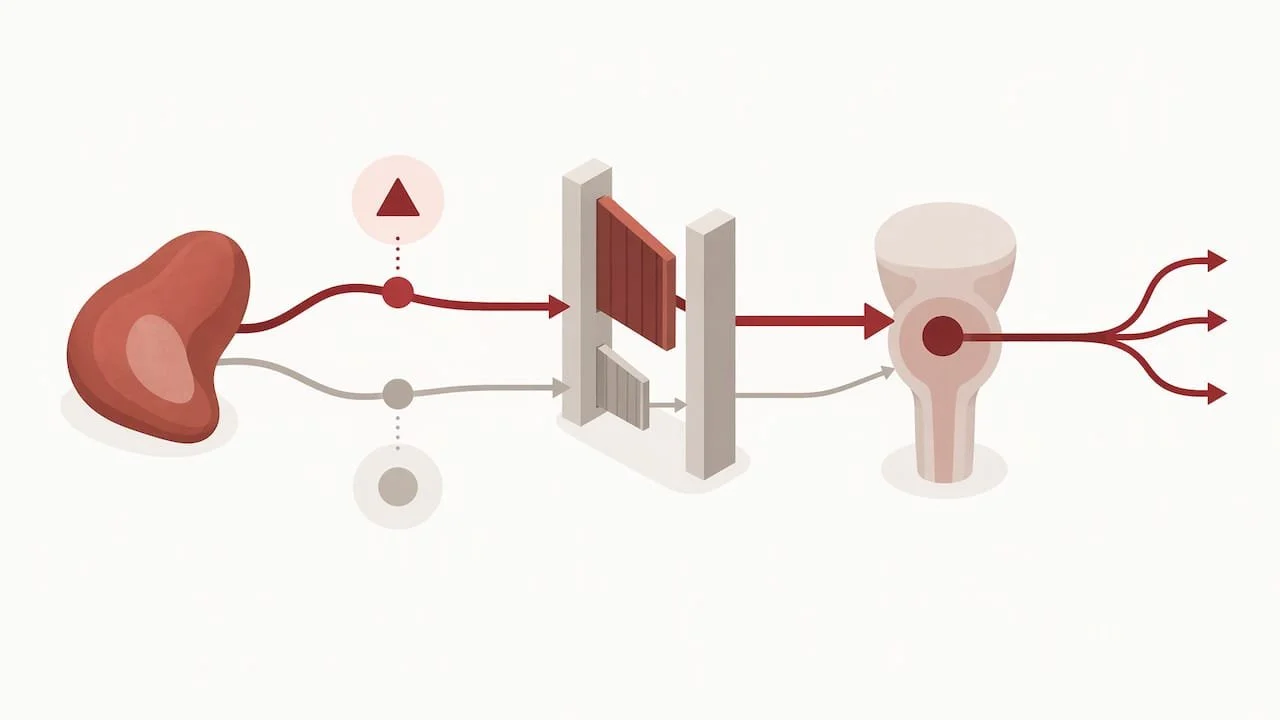
In plain terms: your alarm system is set to a lower trigger point, so ordinary sounds get treated as possible danger.
It is about context, not just noise
The 2022 review makes a point that many people find validating. The exaggerated startle is not an abnormal response to sudden intense stimuli by itself. It is an augmented fear response to the context in which those stimuli occur. People with PTSD showed stronger startle eyeblink responses under contextual threat, and that response appeared independent of explicit threat cues and relatively resistant to safety cues.
That matches what many survivors describe. You can know, with your thinking mind, that you are in your own kitchen and nothing is wrong. Your body does not take that information on board. The jumpiness is not a failure of logic. It is a body-level prediction that something bad could happen at any moment.
The body stays in a state of high arousal
The National Center for PTSD explains that traumatic events can create a high level of arousal, a feeling of being alert or "on guard." That can make people react strongly to sounds and sights, feel jumpy, and stay on guard all the time.
Research also shows physical signs. A meta-analysis cited in a 2013 review found that PTSD is associated with elevated resting heart rate, skin conductance and blood pressure, along with exaggerated heart rate, eyeblink and skin conductance responses to acoustic startle and slower habituation. Habituation is the process by which a repeated sound stops bothering you. After trauma, your system may keep reacting to the fifth beep as strongly as to the first.
So when you say "I can't get used to it," there is a measurable physiological basis for that.
Some people were already more reactive
A 2008 prospective study found that hypersensitivity to contextual threat, higher sympathetic reactivity to explicit threat, and slower adaptation to repeated aversive stimuli were pre-existing vulnerability factors for more severe PTSD symptoms after trauma exposure. This does not mean you caused your reaction. It means nervous systems differ, and a strong startle response after trauma reflects biology plus experience, not weakness.
Startle response and hypervigilance
These two often show up together and are easy to confuse.
Hypervigilance is a sustained state: scanning rooms, sitting with your back to the wall, noticing every exit, monitoring people's tone and movements.
Exaggerated startle is the reflex that fires when something breaks through that scanning without warning.
The Ressler review notes that people with PTSD are often in a state of hypervigilance and have an increased startle response, which they describe as feeling "jumpy" or overly reactive to slight or unexpected noise. Think of hypervigilance as the guard standing watch and startle as the alarm bell when something surprises him.
Both appear in the arousal and reactivity group of PTSD symptoms. The National Center for PTSD's summary of the diagnostic criteria lists a heightened startle reaction alongside hypervigilance, irritability, risky behavior, trouble concentrating and trouble sleeping, and requires that these began or worsened after the trauma.
Does a strong startle reaction mean you have PTSD?
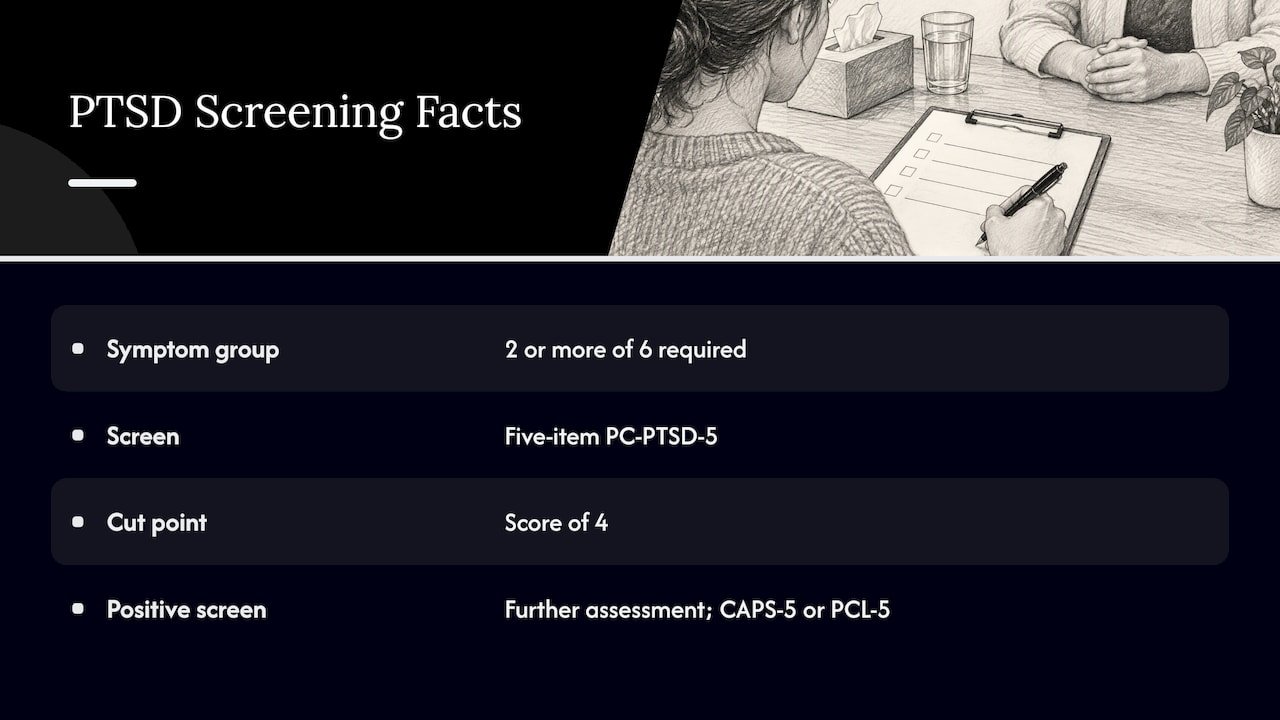
Not by itself. The DSM-5-TR criteria summarized on the VA/DoD PTSD pocket card include exaggerated startle response as one of six arousal and reactivity symptoms, and two or more of the six are required within that group. A diagnosis also requires other symptom groups, such as intrusion symptoms (flashbacks, nightmares, unwanted memories) and avoidance, plus a time and impairment threshold.
So jumpiness is a meaningful signal, but it is one piece. Many people have a strong startle in the weeks after a frightening event and then settle. Others find it continues or grows.
If you want to know where you stand, a screening is the usual first step. The 2023 VA/DoD guideline recommends the Primary Care PTSD Screen for DSM-5 (PC-PTSD-5) for screening, with a score of 4 as the cut point that best balances false negatives and false positives in VA primary care patients. The National Center for PTSD describes it as a five-item screen that identifies probable PTSD. A positive screen leads to further assessment, preferably a structured interview such as the CAPS-5 or the PCL-5 self-report measure.
A screen is not a diagnosis, and a diagnosis is not a label that defines you. It is a map that helps match you to the right treatment. If you are curious what a full evaluation involves, our guides on what patients need to know about PTSD assessment and the complete PTSD evaluation process walk through it.
What an exaggerated startle can look like day to day
People rarely say "I have an exaggerated startle response." They say things like:
"I almost jumped out of my skin when my coworker said my name."
"I can't be in a restaurant when a plate drops."
"I flinch when my partner touches me from behind, and then I feel awful."
"Fireworks, car doors, even a notification sound sends my heart racing for ten minutes."
"I'm exhausted by 3 p.m. because I've been braced all day."
The last one matters. A body that is always braced burns energy. Poor sleep, irritability and trouble concentrating often follow, and they feed the jumpiness in a loop. The cost also shows up in relationships: partners may take a flinch personally, and survivors may avoid affection or social events to avoid being caught off guard.
What helps: everyday steps
These are supports, not substitutes for treatment of PTSD. They help your system feel a little safer between sessions.
Name what is happening. Silently saying "that was my startle reflex, I am safe right now" gives your thinking brain a job and shortens the aftershock.
Exhale slowly. After a jolt, a long exhale, longer than the inhale, is a simple way to cue your body to come down. Do it a few times.
Orient to the room. Look slowly around and name five things you can see. This tells your threat system the surroundings are known.
Reduce surprise where you can. Tell housemates to announce themselves, face the door in rooms where you spend time, and lower the volume of alerts. This is not avoidance gone wrong. It is lowering the load while you heal.
Protect sleep and movement. A tired body startles more. Regular sleep times, daylight and gentle exercise support a calmer baseline.
Tell people you trust. A line like "If I flinch, it's not about you" prevents a lot of hurt on both sides.
Structured worksheets can make these habits easier to keep. Our journals and workbooks are made for tracking triggers, sleep and body cues between sessions.
What helps most: trauma-focused therapy
Coping skills lower the temperature. Therapy addresses why the alarm is set so sensitively in the first place.
The 2023 VA/DoD guideline recommends three trauma-focused psychotherapies, Prolonged Exposure, Cognitive Processing Therapy and EMDR, as the most effective treatments for PTSD. A 2023 state-of-the-art review agrees that trauma-focused therapies are recommended for adults and are generally delivered weekly over 8 to 16 sessions. The same review describes them as experiential treatments that aim to create corrective states of habituation, safety, coping and self-efficacy, and notes they have larger effect sizes than currently accepted medications yet are underused.
Habituation is the key word for startle. Trauma-focused therapy helps the brain relearn that the cues attached to the event are memories, not current danger, so the alarm stops firing at everything nearby.
Medication is a separate option to discuss with a prescriber. The National Center for PTSD's clinician guide reports that the 2023 guideline recommends sertraline and paroxetine as having the strongest evidence for reducing PTSD symptoms, and suggests prazosin for trauma-related nightmares but not for global PTSD symptoms. Only a licensed prescriber can advise on whether a medication is right for you.
The guideline also supports getting care from home: it recommends secure video teleconferencing for delivering recommended treatments when the format is validated or other options are unavailable. That makes online therapy a legitimate route if you live far from a trauma specialist.
How EMDR works on a jumpy nervous system
In EMDR, you briefly hold a distressing memory in mind while following bilateral stimulation, such as guided eye movements, with a trained therapist. The aim is to help the brain reprocess the memory so it no longer carries the same physical charge. Many clients notice that body reactions, including startle, ease as the memories that fuel them are processed. Our guides explain the step-by-step EMDR process, what the research shows about EMDR and how EMDR compares with talk therapy.
If you are weighing approaches, this overview of CBT and EMDR compared lays out how the two differ for trauma. For a wider view, see our summary of seven types of trauma therapy.
Our perspective
We meet many people who arrive apologizing for their reactions. They tell us they feel dramatic, that they should be over it, that their partner or coworkers are tired of the flinching. Our first job is usually to take the shame out of the room.
A startle that is too big is the nervous system doing its job too well. It learned that the world can turn dangerous in a second, and it has not been given enough evidence that the danger is over. We do not try to talk anyone out of that. We work with the body and the memory together, because that is where the alarm lives.
That is why we use EMDR and other trauma-informed approaches, and why we build care around the person: bilingual sessions in English and Spanish, culturally responsive and identity-affirming, for clients who need a therapist who understands the context of their lives. For people who cannot spread work across months, we also offer EMDR intensives, which concentrate the processing into longer sessions designed for faster relief.
Startle is rarely the only thing a client brings. It travels with poor sleep, tension, flashbacks, grief or relationship strain. We treat the whole picture, at a pace you help set.
Juiced
When to get professional help
Consider reaching out when:
the jumpiness has lasted more than a few weeks after a frightening or violent event;
it keeps you from sleeping, working, driving, parenting or being close to people;
it comes with nightmares, flashbacks, numbness, or avoiding places and reminders;
you are using alcohol or other substances to take the edge off;
the trauma happened long ago, but the reactions are getting stronger rather than fading.
It can help to know that assessment itself can feel hard. The VA/DoD guideline acknowledges that being assessed for PTSD can cause a temporary increase in symptoms because you describe distressing events, and that clinician-administered interviews can take time, but it concludes the benefits of an accurate diagnosis outweigh those costs. A good clinician paces this carefully and checks in with you throughout.
If you are in crisis or thinking about harming yourself, call or text 988, the Suicide & Crisis Lifeline in the US, or go to the nearest emergency room.
Working with us
We are a California-based, trauma-informed practice offering EMDR and individual counseling, with licensed therapists in Pasadena and Ventura and online across California and New York. If you are looking for online EMDR trauma therapy, we can walk you through what to expect.
Your options include weekly individual counseling and EMDR therapy and EMDR intensives, which compress the work into concentrated time. Current published rates are $1,500 for a 1-day intensive of 4 hours, $2,250 for a 1-day intensive of 6 hours, and $5,750 for a 3-day intensive. If you are not sure which fits, start with a consultation. You can also read more on our PTSD and complex trauma page.
FAQ
Is an exaggerated startle response normal after trauma?
Yes, it is one of the most common reactions. Trauma raises arousal, so sudden sounds and movements set off a stronger reaction than before. For many people it eases within weeks. If it persists or disrupts your life, it is worth an assessment.
How long does an exaggerated startle response last?
There is no single timeline. It can fade as you recover from an event, or continue for months or years if the nervous system stays in threat mode. Trauma-focused therapies are usually delivered weekly over about 8 to 16 sessions, and many people notice arousal symptoms easing as treatment progresses.
Can the startle response be treated without medication?
Yes. The 2023 VA/DoD guideline recommends trauma-focused psychotherapies, including EMDR, Prolonged Exposure and Cognitive Processing Therapy, as leading treatments for PTSD. Medication is a separate decision to make with a prescriber, and some people use both.
What is the difference between hypervigilance and being easily startled?
Hypervigilance is a constant state of scanning for danger. Being easily startled is the reflex that fires when something surprises you anyway. They often occur together, and both are listed among the arousal symptoms of PTSD.
Can I do trauma therapy online?
Yes. The 2023 VA/DoD guideline supports delivering recommended treatments by secure video when the approach is validated for it or other options are unavailable. We offer online sessions for clients in California and New York.
Sources
Post-traumatic stress disorder: clinical and translational neuroscience review, PMC
Posttraumatic Stress Disorder: A Theoretical Model, Frontiers in Psychiatry
Prospective Prediction of PTSD Symptoms Using Fear Potentiated Auditory Startle, PMC
VA/DoD Clinical Practice Guideline for Management of PTSD and Acute Stress Disorder
Primary Care PTSD Screen for DSM-5, National Center for PTSD
Overview of Psychotherapy for PTSD, National Center for PTSD
Treatment of Posttraumatic Stress Disorder: A State-of-the-art Review, PMC
Clinician's Guide to Medications for PTSD, National Center for PTSD
The management of posttraumatic stress disorder and acute stress disorder, VA/DoD guideline article
