

EMDR can help with trauma-related guilt and shame, especially when your therapist names them as treatment targets instead of treating them as side effects. The work focuses on the memories behind the feelings, the beliefs you hold about yourself ("it was my fault," "I am bad"), and the body sensations that come with them. Below we explain how guilt differs from shame, what a session involves, how EMDR handles a real mistake versus something you could not control, and what to expect along the way.
Alvaradotherapy
Explore Trauma-Informed EMDR Support
Alvarado Therapy offers EMDR for trauma and related concerns, with bilingual care in English and Spanish for clients across California.
TL;DR
Guilt says "I did something bad." Shame says "I am bad." EMDR can work on both, but they call for slightly different beliefs and targets.
EMDR may reduce trauma-related guilt and shame, particularly when they are assessed and treated directly. Research on this specific use is still developing.
For a real mistake, good EMDR does not erase responsibility. It helps you see the full context and move toward repair and self-compassion.
Preparation matters: you learn calming skills first, and you can stop processing at any time.
Our practice offers EMDR in California, online and in person, in English and Spanish, including intensives.
Table of Contents
Guilt and shame are not the same thing
Can EMDR help with guilt and shame?
The beliefs EMDR works with
What a course of EMDR for guilt and shame looks like
A real mistake versus something you could not control
What can make the work harder, and how it is handled
Our perspective
Working with us
Signs it may be time to reach out
FAQ
Sources
Guilt and shame are not the same thing
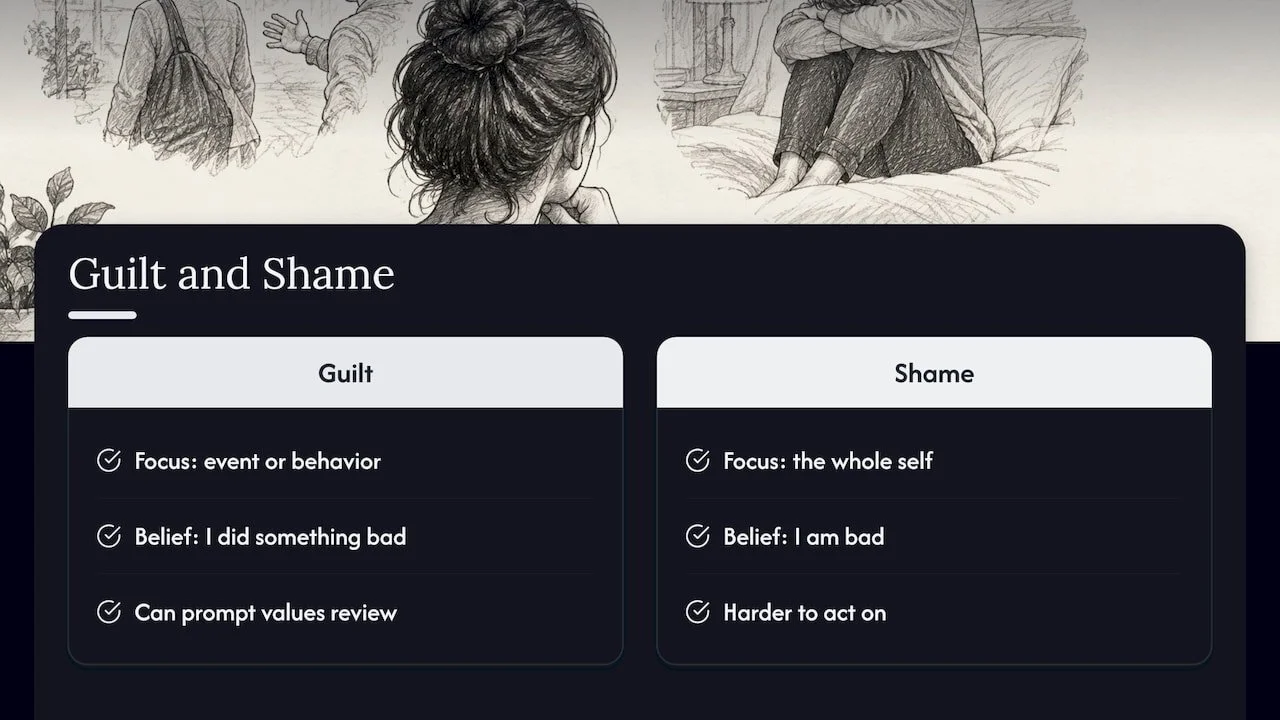
The two feelings often arrive together, which is why they are easy to blur. The VA's National Center for PTSD separates them in its moral injury guidance: guilt is distress and remorse about an event ("I did something bad"), while shame is what happens when that belief spreads to the whole self ("I am bad because of what I did").
That difference matters in therapy. Guilt is about behavior, and it can be useful. A 2022 review of Trauma-Informed Guilt Reduction Therapy describes trauma-related guilt as arising when a person blames themselves for all or part of a bad outcome, and shame as a negative judgment of the entire self. Shame is harder to act on. There is nothing to repair when the problem is who you are.
Clinicians at the VA describe how this can go wrong: guilt can be adaptive when it prompts you to look at your values and recommit to them, but when avoidance keeps you from ever examining the event, it can harden. Event-specific guilt then turns into global shame.
Where guilt and shame come from after trauma
People we work with describe a handful of common patterns:
Survivor guilt: "Why did I get out and someone else didn't?"
Self-blame in childhood: "If I had been quieter or better, it wouldn't have happened."
Guilt during grief: words left unsaid, a decision about care, a missed last visit.
Shame after betrayal or abuse: feeling stained or responsible for what someone else did.
Moral injury: acting, or failing to act, in a way that violates your own values. The VA lists guilt, shame, betrayal, disgust and anger as hallmark reactions, and notes that moral injury overlaps substantially with PTSD without being identical to it.
If your guilt began with a work injury or a traumatic event on the job, it can help to know your options outside therapy too, such as PTSD workers' compensation rules in your state. Therapy and practical support often run side by side.
Can EMDR help with guilt and shame?
Yes. The 2026 VA-authored clinical review, Optimizing Trauma-Focused Treatments to Address Guilt and Shame, reports that EMDR may reduce trauma-related guilt and shame, particularly when those feelings are explicitly assessed and made part of the treatment plan. The review also notes that findings are mixed across studies and populations, so the practical lesson is about how the work is done: name the guilt and shame, aim at them, and adjust as you go.
The broader evidence base for EMDR in PTSD is also worth knowing. The VA's EMDR treatment summary says a review found EMDR may reduce PTSD symptoms compared with a waitlist. If you want a plain-language walk through the research, see our page on what the research shows about EMDR effectiveness.
Why EMDR suits self-blame
Guilt and shame live in memories and in the beliefs those memories carry. EMDR is built around exactly that pairing. According to the VA review, the therapist identifies a distressing memory, a negative self-belief, a preferred positive belief, the emotions and the body sensations. You attend to the material in brief doses while bilateral stimulation (such as guided eye movements or taps) supports reprocessing, until distress decreases and more adaptive beliefs take hold.
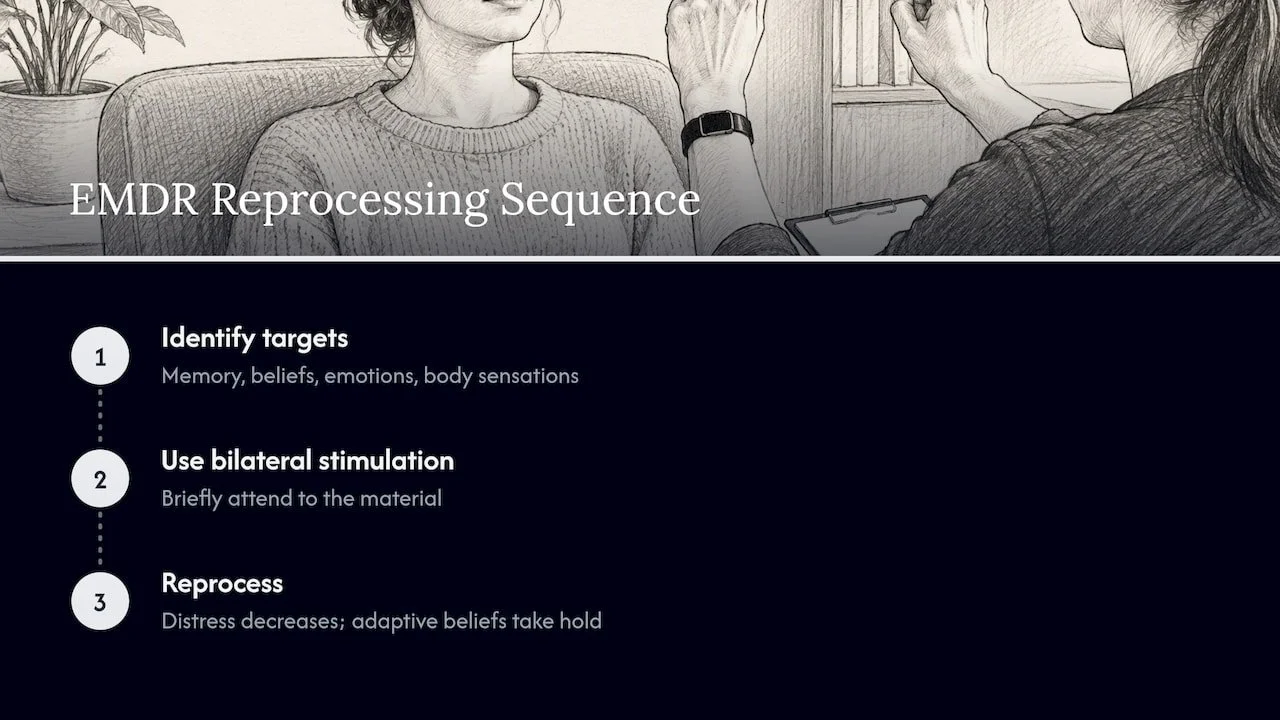
The underlying model is called Adaptive Information Processing. In the VA's description, bilateral stimulation is used while the memory is accessed so new connections with healthier information can form, arousal drops, and more adaptive self-beliefs emerge. For a general introduction, our guide What Is EMDR Therapy? covers the basics.
The beliefs EMDR works with
In EMDR, the negative belief you hold about yourself is called a negative cognition, and the belief you would rather hold is the positive cognition. The EMDR 2.0 protocol separates two families of beliefs that map neatly onto guilt and shame:
| Type | Negative belief examples | Preferred belief examples |
|---|---|---|
| Responsibility (guilt) | "I am guilty," "It's my fault" | "I did what I could," "I'm innocent," "I've learned from it" |
| Self-esteem (shame) | "I'm worthless," "I'm a bad person" | "I am okay," "worthwhile," "competent," "strong" |
A good therapist listens for which family your belief belongs to. "It's my fault" and "I'm a bad person" can sound alike in conversation, but they point to different work. One asks, "How much was actually yours?" The other asks, "Where did you learn that your worth depends on this?"
What a course of EMDR for guilt and shame looks like
The APA describes EMDR as an eight-phase treatment: history-taking, preparation, assessment of the target memory, processing through to adaptive resolution, and evaluation of treatment. The VA adds that you can expect an explanation of the method, stress-management skills, and sets of roughly 20 to 40 bilateral movements while your therapist checks in on what comes up.
Step by step
History and planning. You and your therapist map the memories, relationships and beliefs that feed the guilt or shame. Telling the whole story is not required at this stage.
Preparation. The EMDR International Association says this phase builds trust, explains the process and teaches calming skills. You can stop processing with a hand signal, and if a target is incomplete you should be grounded before you leave.
Assessment. You choose an image from the memory, name the negative and preferred positive belief, rate your distress, and notice where you feel it in your body.
Processing. You focus on the memory while the therapist guides sets of bilateral movement. Between sets, you report what shifted. The VA says this continues until distress is greatly reduced and the adaptive self-appraisal takes hold.
Body scan and future work. The therapist checks for leftover tension and may address current or anticipated triggers.
The APA says processing of a specific memory generally takes one to three sessions. The VA describes treatment as commonly weekly individual sessions of up to 90 minutes over about three months, varying with your needs and response. Most people carry more than one memory, so the total timeline depends on how many are connected to the guilt or shame. Our step-by-step EMDR guide walks through each phase in more detail.
Preparation made for shame
Shame can make people want to hide, go numb or end the session early. The VA review recommends preparation strategies for this: calm-place imagery paired with shame-countering beliefs, mastery imagery, self-compassion work, and techniques that soften harsh self-critical beliefs before reprocessing begins. Spending time here is not a delay. It is how the later work stays tolerable.
The EMDR International Association also notes that you may have new insights and shifts in images, feelings or beliefs after each set, and some material may surface between sessions. Our article on bilateral stimulation and at-home exercises covers grounding practices you can use between appointments.
A real mistake versus something you could not control
This is the question most people with guilt are quietly asking: "But what if it really was my fault?" Honest EMDR does not answer with false comfort. The approach differs depending on the situation.
When you did make a mistake
According to the VA review, EMDR should not minimize culpability. The therapist may help you consider the full context of the event and process the emotions tied to it. The Cambridge clinical review Working with guilt and shame frames self-forgiveness as acknowledging actual harm, assessing your degree of responsibility, understanding your state of mind at the time, and developing self-compassion. The goal is responsibility and repair, not pretending the event never happened.
That same review distinguishes proportionate guilt, where acknowledgment and repair may fit, from disproportionate guilt, where an accurate appraisal of responsibility and self-compassion do most of the work. Often the target belief shifts from "I am a terrible person" to something like "I made a mistake and I can learn from it."
When it was outside your control
For guilt about something you could not control, the VA review says the therapist may explore what you knew at the time, which options were actually available, and what was within your power. Hindsight tends to make the outcome look obvious. Careful questions put you back in the moment as it was.
Some situations leave no good option. The 2022 TrIGR review notes that guilt can become especially persistent when a person believes every available choice would have led to a bad outcome, as in some combat situations. It also describes a guilt-shame cycle that can feed PTSD, depression, substance use, suicide risk and poor engagement in treatment. If you are having thoughts of suicide, call or text 988, the Suicide & Crisis Lifeline, or go to your nearest emergency room.
What can make the work harder, and how it is handled
Guilt and shame can be sticky. The VA review lists several things your therapist watches for: shutdown or avoidance, overwhelming reactions that bring on dissociation, panic or hyperarousal, repetitive loops, feeder memories and blocking beliefs. None of these means you are doing therapy wrong. They are signals the plan needs adjusting.
Here is what that looks like in practice:
Blocking belief. When shame itself is stopping progress, the therapist may rate its strength and distress, use bilateral stimulation with the belief, identify and process an earlier feeder memory, then return to the original target.
Looping. If the same thought repeats without change, the therapist may change how they guide the set or look for a related memory.
Too much, too fast. Stopping signals, grounding and more preparation bring intensity back to a workable level.
A clinician trained in EMDR and trauma will build these adjustments into the plan from the start. For childhood roots in particular, our pages on phase-based care for childhood trauma and EMDR for attachment trauma explain why pacing matters.
Our perspective
We see guilt and shame in nearly every trauma story that comes through our practice. Often a client has already processed the frightening part of what happened and still feels stuck, because the belief "it was my fault" or "something is wrong with me" was never the target.
Our approach is to name those beliefs early, build stability first, and then work on them directly with EMDR. For many of the adults we work with, including Latinx, BIPOC and LGBTQ+ clients, shame is shaped by family expectations, immigration stories, cultural messages and identity. Being able to work in English or Spanish, with a therapist who understands that context, changes what you can say out loud.
We also believe in being honest with clients. If you did cause harm, we will not tell you that you didn't. We help you hold responsibility without being crushed by it. For those who prefer concentrated work, our EMDR intensives are designed to give focused time for a memory cluster without a week of waiting between sessions.
Juiced
Working with us
We are a California-based, trauma-informed practice offering EMDR therapy in person and online across California, in English and Spanish. If you want steady weekly work on guilt, shame, grief or trauma, start with individual counseling and EMDR therapy.

If you would rather work in longer blocks, our EMDR intensives are published at $1,500 for a 1-day format of 4 hours, $2,250 for a 1-day format of 6 hours, and $5,750 for the 3-day intensive. Not sure which fits? Book a consultation and we will talk through your goals. You can also read how online EMDR sessions work, or see our page on PTSD and complex trauma.
Signs it may be time to reach out
Self-help and time work for some people. A therapist is worth considering when:
The same memory or thought returns daily and your distress does not ease.
Guilt or shame leads you to avoid people, places or relationships.
You feel like a bad person in general, not just regretful about one choice.
Grief is mixed with self-blame that keeps you from remembering the person fondly.
Past talk therapy helped you understand what happened, but the feeling in your body did not change.
When you look for a clinician, ask about their EMDR training, how they prepare clients before reprocessing, and whether they will work with guilt and shame as explicit targets. If shame shows up around relationship betrayal, couples therapy can sit alongside individual work. If the trauma involved a crime, we also support victims of crime.
FAQ
Is EMDR good for shame specifically?
It can be. EMDR targets the memories and self-beliefs that hold shame in place, such as "I'm worthless" or "I'm a bad person." The VA review says results are best described as promising when shame is directly assessed and treated, and that findings across studies are mixed.
Will EMDR make me feel less guilty about something I really did?
It is not designed to erase responsibility. Your therapist helps you look at the whole context, your state of mind at the time and your actual degree of responsibility. Many people move from crushing self-condemnation toward acknowledgment, repair and self-compassion.
Do I have to tell my therapist every detail?
Not necessarily. Preparation focuses on trust and calming skills first. During processing you notice and report what shifts, and you can stop with a hand signal if it becomes too much.
How many sessions does it take?
The APA says processing a specific memory generally takes one to three sessions. The VA describes weekly sessions of up to 90 minutes over about three months as common. Your timeline depends on how many memories are connected to the guilt or shame and how you respond.
Can I do EMDR for guilt and shame online?
Many people do. We offer online EMDR for clients in California, with preparation, grounding and session structure adapted for video. Read our what-to-expect page for details.
Sources
Optimizing Trauma-Focused Treatments to Address Guilt and Shame
Working with guilt and shame (Advances in Psychiatric Treatment)
