
Disenfranchised Grief: Meaning, Examples and How to Cope
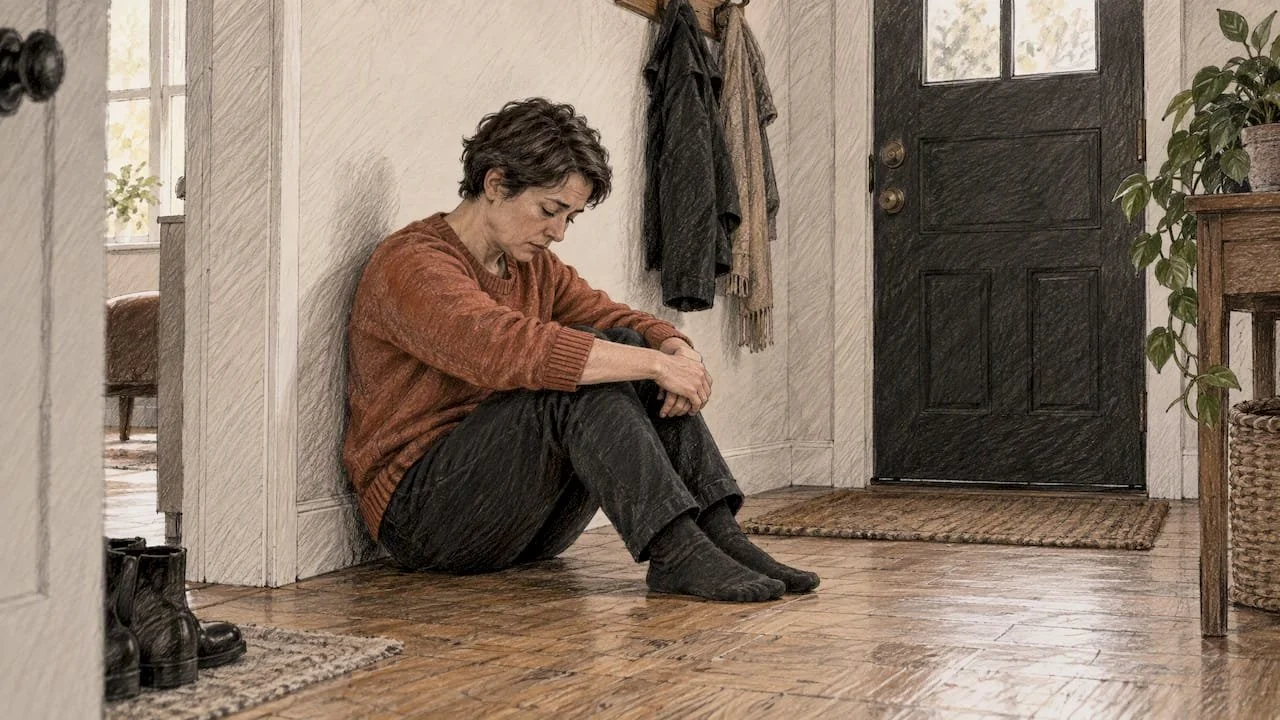
Disenfranchised grief is grief that the people around you, or society at large, don't openly acknowledge, publicly mourn or support. The loss is real. What's missing is permission to grieve it. The APA Dictionary of Psychology describes it as grief that society limits, doesn't expect, or may not allow a person to express. Psychologist Kenneth Doka coined the term in 1989. If you've ever heard "it was just a pet," "you weren't even married," or "you should be over this by now," you already know how it feels.
This guide explains what the term means, gives concrete examples, lists the signs, and covers what helps, including when it's time to see a licensed clinician.
Alvaradotherapy
Support for Grief That Feels Unseen
Alvarado Therapy offers trauma-informed individual counseling for grief, with licensed therapists serving clients in California and online.
TL;DR
Disenfranchised grief is a description of the social context around a loss, not a diagnosis. It means your loss, your relationship, you as a mourner, or the way you grieve isn't recognized.
Common examples include pet loss, miscarriage, the death of an ex or an unmarried partner, losses tied to suicide or overdose, and non-death losses like home, health or identity.
It can bring isolation, shame, guilt and anger. Research links stigma and low support with higher risk of depression, anxiety, PTSD and prolonged grief, but it doesn't mean a disorder is inevitable.
Naming the loss, finding one validating person, creating a ritual and keeping basic routines are practical first steps.
If grief is intense, traumatic or still disrupting daily life, a trauma-informed therapist can assess what you need.
Table of Contents
What disenfranchised grief means
Most of us absorb an unwritten rulebook about grief: who gets to mourn, for whom, for how long, and in what way. Disenfranchised grief is what happens when your loss falls outside that rulebook. A Critical Incident Stress Management fact sheet from the Center for the Study of Traumatic Stress puts it as grief that is not or cannot be openly acknowledged, publicly mourned or socially supported, or that is misunderstood or trivialized.
Two points are easy to miss:
It's about recognition, not size. The defining issue is whether others permit and support the mourning, not how big, legitimate or long-lasting your feelings are. The same loss may be fully supported in one family or community and dismissed in another.
It's not a mental health condition. Clinicians use the term to describe the circumstances around grief. It sits alongside, not in place of, diagnoses like prolonged grief disorder, depression or PTSD.
The term is also called hidden grief or hidden sorrow, which is exactly what it feels like: mourning you carry privately because nobody gave you a script for it.
The four ways grief gets disenfranchised
The CSTS summary of Doka's framework shows that recognition can be withheld in different places. It helps to ask which one fits you.
| What is denied | What it sounds like | Example |
|---|---|---|
| The relationship | "They were only your ex / coworker / friend." | Losing a former partner or a same-sex partner whose family never accepted the relationship |
| The loss itself | "It's just a pet." "You can have another baby." | Pet loss, miscarriage, stillbirth |
| You as the griever | "They were too young to understand." | A child, an older adult, or someone with a disability whose grief is brushed aside |
| How you grieve | "Why aren't you crying?" or "Why are you still crying?" | Someone who grieves privately, or in a way their culture or faith shapes differently from their family's |
More than one can apply at once. A person mourning a partner who died of an overdose may face a stigmatized death, a relationship the family disapproved of, and a community that goes quiet. The loss is the same size, but the support is much smaller.
Examples of disenfranchised grief
The same CSTS fact sheet groups circumstances into minimized losses, stigmatized deaths, mass-casualty situations and being unable to mourn in line with cultural or religious practice. Here is what that looks like in real life.
Losses society tends to minimize
Pet loss. The APA lists the loss of an animal companion as a classic example.
Miscarriage or stillbirth. The APA also gives the grief of parents for stillborn babies as an example. Abortion and infertility belong in this group too, because the loss is often private and rarely acknowledged.
Ex-partners, breakups and divorce. There's no funeral and no casseroles when a marriage ends or an ex dies.
Non-biological or unrecognized relationships. This includes unmarried partners, same-sex partners and step-relatives.
Professional grief. The APA gives teachers grieving students and nurses grieving patients as examples. Clinicians, first responders and caregivers often carry losses nobody expects them to feel.
Deaths that carry stigma
Losses connected with suicide, overdose, homicide, AIDS, addiction, incarceration or crime often come with judgment instead of comfort. A study of 26 family members of people on death row found recurring social isolation, shame, guilt, lowered self-esteem, family conflict and chronic despair. Their situation is extreme, but the pattern, grief tangled up with shame, shows up across stigmatized losses.
Non-death losses
Grief doesn't require a death. People mourn the loss of a home, health, independence, identity, safety, culture, employment or the future they hoped for. Immigration, estrangement from family, a coming-out that costs a relationship, or leaving a country and a community behind can all create grief that has no name in the workplace or at the dinner table.
When rituals are taken away
The COVID-19 years made this visible to millions. A review of COVID-19 and disenfranchised grief describes how isolation, stigma and disrupted rituals can add a second injury to the original loss, and how supportive acknowledgment and appropriate rituals can help even though the loss can't be changed.
If a funeral wasn't possible, if your family's faith traditions weren't honored, or if you couldn't travel home to say goodbye, that is a real part of what you're carrying.
Signs you may be carrying disenfranchised grief
There's no checklist that proves it, but these patterns are common:
Doubting whether you have the right to be this sad
Hiding your grief, or rehearsing how to answer "how are you?"
Shame or guilt, sometimes about the loss itself and sometimes about grieving it
Anger at people who minimize the loss
Withdrawing from friends or family
Trouble concentrating, low mood or anxiety
Conflict with relatives who grieve differently than you do
Grief that feels stuck, or more intense than you expected
Academic literature links disenfranchisement and stigma with reduced social support and a higher risk of depression, anxiety, PTSD and prolonged grief. These are risk associations. They do not prove that disenfranchised grief will cause a disorder, and many people move through it with the right support.
Disenfranchised grief versus ordinary grief
All grief hurts. The difference is what surrounds it. Ordinary grief usually arrives with some social scaffolding: condolences, time off, rituals, people who check in. With disenfranchised grief, that scaffolding is missing, so the work of grieving falls entirely on you, and you may also have to defend your right to do it.
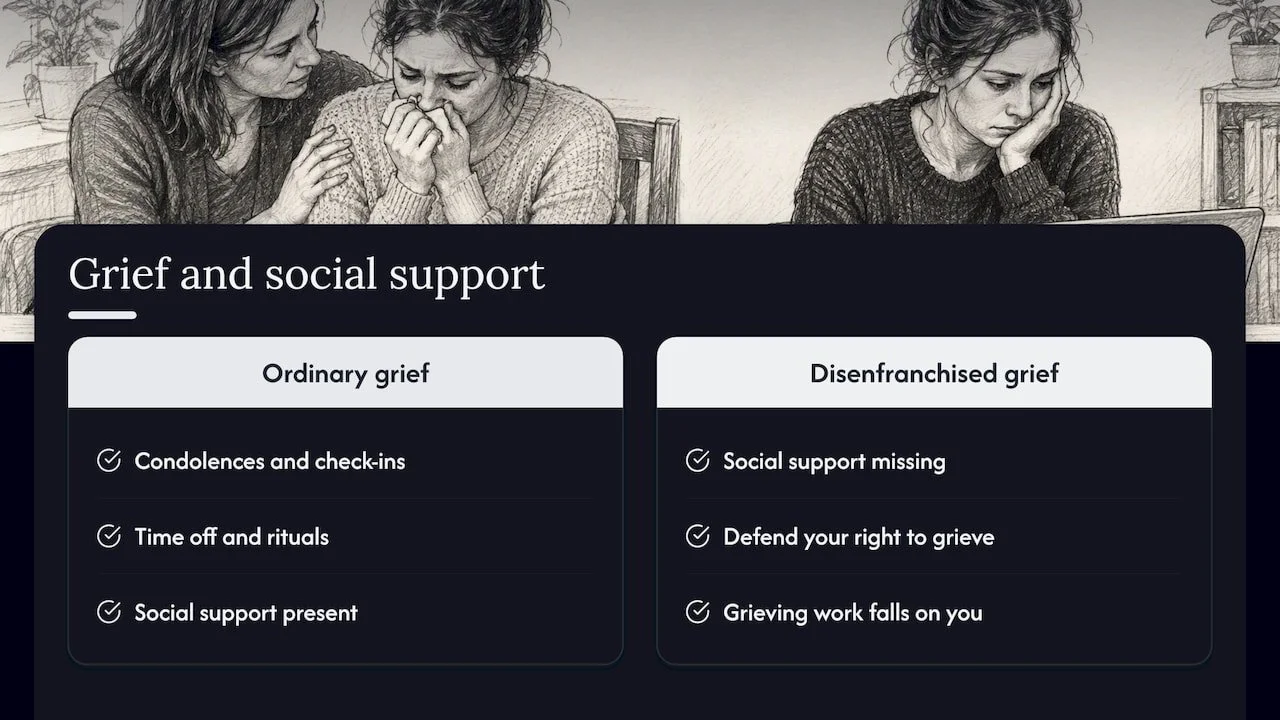
That gap is practical as well as emotional. In California, for example, AB 1949 gives eligible employees up to five days of bereavement leave after the death of a qualifying family member, as summarized by a California employment law firm. The law covers a defined list of relatives. A close friend, a former partner or a pet is not on that list, and neither is a non-death loss. Check your employer's policy and the statute's definitions to see where you fall. The point is that the law, like most social norms, sets lines that real attachments don't always follow.
What helps: practical first steps
The CSTS guidance and the clinical literature point to a short list of things that restore some of the structure recognition would normally provide.
State the loss plainly. Say it out loud or write it down in specific terms: "I lost my brother's partner, who was my friend for 15 years," not "I'm just having a rough time." Naming the exact loss makes it harder to dismiss, including by you.
Challenge the message that you shouldn't grieve. Notice phrases like "it's not that big a deal" and ask whose rule that is. You can disagree with it.
Find one validating person. You don't need a whole community, though a peer or community group for your type of loss (pet loss, pregnancy loss, loss to overdose, LGBTQ+ bereavement) can help. One person who says "that makes sense" matters.
Create a ritual. A candle, a letter, a walk to a meaningful place, a small gathering, a photo book, a day you set aside each year. If no one else will hold a funeral for this loss, you can hold a private or shared one.
Protect the basics. Keep sleep, meals and movement as steady as you can. Grief is physical work.
Use writing. Journaling helps some people put words to a loss no one else names. It doesn't have to be tidy.
Ask for specific help. "Can you sit with me Sunday night?" is easier for people to say yes to than a vague appeal.
For more on grief support options, our guides on support resources for bereavement and grief support tips for California adults go deeper.
When to see a therapist
Most people adapt to loss without specialized treatment, and grief is not an illness. But disenfranchised grief can make it harder to reach the support that helps people adapt, so it's worth knowing when to look for professional care.
Consider seeing a licensed clinician if:
Your grief is intense and painful and you're having real trouble functioning at work, at home or in relationships
You're having traumatic memories, nightmares, flashbacks or avoidance tied to the loss or how it happened
Guilt or shame is taking over
You're using alcohol or other substances to cope
It has been a long time and nothing is shifting
If you're having thoughts of suicide, don't wait for an appointment. In the US, call or text 988, the Suicide & Crisis Lifeline, or go to your nearest emergency room.
Prolonged grief disorder: what the timeline means
Prolonged grief disorder (PGD) is now a recognized diagnosis. The National Center for PTSD explains that it's distinct from ordinary grief, depression and PTSD. A review of grief and prolonged grief disorder says PGD should be considered when intense, painful grief and difficulty adapting persist beyond one year in adults, or six months in children and adolescents, and cause significant impairment. The same review estimates it affects as many as 7% of bereaved people.
A calendar date isn't a verdict. A good clinician also screens for major depression, PTSD, substance use and suicide risk instead of relying on a cutoff alone. That works in both directions: not every intense reaction is a disorder, and ongoing impairment is not something you simply have to endure. Our article on how clinicians tell grief from depression explains what that assessment looks like, and delayed grief covers losses that surface long after they happen.
What good treatment looks like
There's no single best method. The VA's clinical education materials stress that the approach should match your symptoms and presentation. Prolonged-grief-specific therapy, developed by M. Katherine Shear, MD, is a short-term, evidence-based option when PGD is the issue. Trauma-focused psychotherapies are first-line treatments for PTSD. Assessment should also take your cultural context into account: APA educator Ann Steffen, PhD, ABPP, emphasizes culturally congruent treatment, which matters when family, faith, language, immigration history or LGBTQ+ identity shape what mourning can safely look like.
A careful therapist should be able to tell you:
Whether they're treating grief, PTSD, depression, or a mix
What method they propose and why
How the work will be paced, what the risks are, and what the alternatives are
How they'll coordinate with your doctor if medication is part of your care
If traumatic memories, guilt, shame or PTSD symptoms are central to your grief, EMDR may be one option to consider. It isn't a universal treatment for every grief experience, and the right fit depends on assessment and enough stability to do trauma processing safely.
Our perspective at Alvarado Therapy
We see disenfranchised grief most often in people who've been told, directly or indirectly, that their loss doesn't count. Many of our clients are Latinx, BIPOC or LGBTQ+, and many are bilingual. For them, grief rarely arrives alone. It can come with immigration separation, family estrangement, a relationship a family never accepted, or a community that expects silence.
Three things guide how we work with it:
Validation first. Before any technique, you should hear that your loss makes sense. For people who've spent months or years being told otherwise, that alone can change the room.
Sorting out what's grief and what's trauma. Some losses are sad. Some are traumatic. Many are both. We distinguish grief counseling from PTSD treatment and explain the plan, so you know what you're agreeing to.
Culture and language aren't extras. Grieving in Spanish, or in the rituals of your family's faith, is different from grieving in a language and frame that aren't yours. Care that's identity-affirming and culturally responsive is part of the treatment, not a bonus.
We also don't treat EMDR as a cure-all for grief. When traumatic memories are at the center, it can be a strong tool. When the main issue is a lack of recognition, the first job is often just helping someone feel allowed to mourn.
— Juiced
Working with us
Alvarado Therapy is a trauma-informed practice serving clients in Pasadena, Ventura and online throughout California, in English and Spanish. If your grief is tangled up with trauma, individual counseling and EMDR therapy is a good place to start. If you'd like concentrated time to work on a specific traumatic memory, we offer EMDR intensives: a 4-hour one-day session at $1,500, a 6-hour one-day session at $2,250, or a 3-day intensive at $5,750. Intensives aren't right for everyone, and we screen for suitability before starting.
If the loss involves a crime, our victims of crime page explains the support available. If a loss is straining your relationship, couples therapy can help partners who grieve differently. For more reading, start with modern grief counseling methods or what PTSD after loss looks like.
FAQ
What is an example of disenfranchised grief?
Losing a pet and being told "it was only an animal" is one of the most common. Others include a miscarriage, the death of an ex-partner, or the loss of someone to suicide or overdose where family members avoid the subject. Non-death losses, like losing a home or a country, can also be disenfranchised.
What is the difference between grief and disenfranchised grief?
Grief is the response to a loss. Disenfranchised grief is grief that others don't acknowledge, publicly mourn or support. The pain may be the same, but with disenfranchised grief you also lack the recognition, rituals and comfort that usually help people through.
How do you cope with disenfranchised grief?
Start by naming your loss plainly and finding at least one person who validates it. Create a ritual of your own, keep up sleep, meals and movement, and consider a peer group for your type of loss. If the grief is intense, traumatic or disrupting your life, a licensed therapist can help assess what kind of support fits.
Is disenfranchised grief a mental illness?
No. It describes the social context of a loss, not a diagnosis. It can raise the risk of problems like depression, anxiety or prolonged grief, but it doesn't mean you have one. A clinician can assess whether another condition is present.
Who coined the term disenfranchised grief?
Kenneth J. Doka introduced it in 1989, in his book Disenfranchised Grief: Recognizing Hidden Sorrow. The concept has since been widely used in psychology, nursing, social work and bereavement care.
Sources
When Losses of Loved Ones Are Not Acknowledged: Understanding Disenfranchised Grief (CSTS)
Prolonged Grief Disorder and Its Treatment (National Center for PTSD)
