
Understand grief and loss: key definitions and support
TL;DR:
Grief is a complex, individualized emotional response to loss that does not follow a set path.
Healthy grieving involves oscillating between processing pain and restoring daily life, not linear stages.
Severe, persistent grief beyond a year may require professional support for complicated grief.
Grief is one of the most universal human experiences, yet it remains one of the most misunderstood. Many Californians carry silent assumptions about how grief is supposed to look, how long it should last, and what it means to "move on." These misconceptions can leave people feeling broken, behind, or alone in their pain. The truth is that grief does not follow a script. Whether you are weeks into a loss or years out and still struggling, this guide will walk you through what grief, bereavement, mourning, and loss actually mean, how they unfold, and when and how to find real support.
Table of Contents
Key Takeaways
| Point | Details |
|---|---|
| Grief is natural | Grief is your unique emotional response to loss and is not a sign of weakness. |
| Healing isn’t linear | Everyone’s grief timeline and experience are different, and ups and downs are normal. |
| Help is available | If grief feels overwhelming or stuck, specialized therapy and support in California can make a difference. |
| Models guide, not dictate | Coping theories like the dual process model show there’s no single right way to grieve. |
Defining grief, loss, bereavement, and mourning
These four words get used interchangeably all the time, but they are not the same thing. Understanding the difference matters because it shapes how you talk about what you are going through and what kind of support actually helps.
Here is how each term breaks down:
Grief is the internal emotional response you feel after a significant loss. It includes sadness, anger, confusion, numbness, and even relief. It is deeply personal.
Loss is the event itself, the absence of someone or something that mattered to you. Loss can be a death, but it can also be a relationship ending, a diagnosis, or a major life change.
Bereavement is the period of time following a death. It is the state of being in loss, not just the feeling.
Mourning is how grief gets expressed outwardly, through rituals, funerals, wearing certain clothing, or cultural practices that mark the loss publicly.
As the National Institutes of Health explains, grief is the emotional response to loss, bereavement is the period following the death, and mourning is the public expression of grief.
One of the most common misconceptions is that grief is just sadness. It is not. Grief can look like irritability, exhaustion, difficulty concentrating, or even a strange sense of calm. Some people laugh at a funeral. Others feel nothing for weeks and then fall apart in a grocery store months later. None of these responses are wrong.
Another misconception is that grief follows a predictable path. The famous five stages model (denial, anger, bargaining, depression, acceptance) was never meant to be a checklist. It was developed by Elisabeth Kübler-Ross to describe the experiences of people facing their own terminal illness, not necessarily the experience of those left behind.
Grief is a unique emotional experience. It is shaped by your relationship to the person you lost, your own history, your cultural background, and the circumstances of the death. You can read more about navigating healing in California to explore how these factors play out in real life.
How people experience grief: Symptoms and timelines
Grief affects the whole person, not just your emotions. Knowing what to expect can make the experience feel less alarming.
Common symptoms of grief include:
Emotional: Sadness, anger, guilt, anxiety, loneliness, relief, numbness
Physical: Fatigue, changes in appetite, sleep problems, chest tightness, weakened immune response
Cognitive: Difficulty concentrating, forgetfulness, intrusive thoughts, disbelief
Behavioral: Withdrawing from others, crying unexpectedly, restlessness, avoiding reminders of the loss
Here is a general picture of how symptoms tend to shift over time, though individual experiences vary widely:
| Time after loss | What many people experience |
|---|---|
| 0 to 3 months | Intense shock, disbelief, acute emotional pain |
| 3 to 6 months | Waves of grief, beginning to re-engage with daily life |
| 6 to 12 months | Gradual stabilization, though anniversaries and triggers remain hard |
| 1 to 2 years | Most people adapt; grief becomes less disruptive |
| Beyond 2 years | For most, grief integrates into life rather than disappearing |
Normal grief symptoms lessen over 6 months to 2 years, and most people adapt within a year. But that word "most" matters. A significant number of people do not follow this path, and that is not a personal failure.
Setbacks are extremely common. You might feel like you are doing better and then get hit hard by a birthday, a song, or a random Tuesday. This is normal.
Pro Tip: Healing from grief is not a straight line. If you have a hard week after a few good ones, that does not mean you are back at square one. It means you are human.
If grief symptoms remain severe and interfere with daily functioning well beyond a year, it may be worth exploring therapy approaches for grief to understand what professional support looks like.
The dual process model: A healthier way to relate to grief
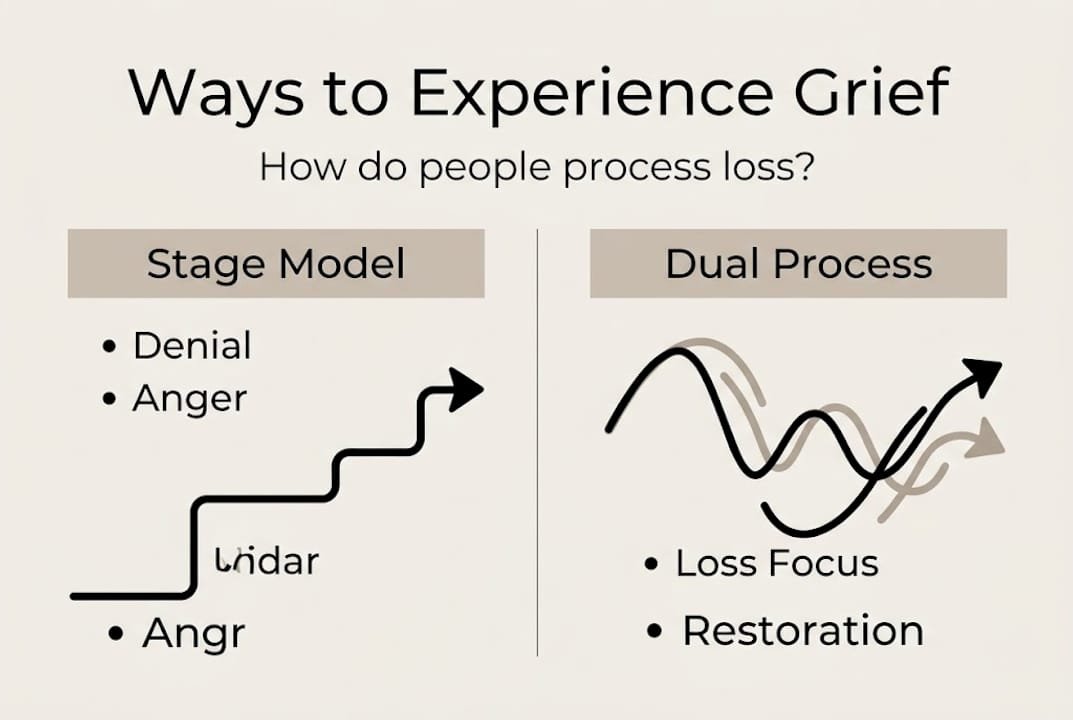
For decades, stage-based models dominated how people thought about grief. The idea was that you move through predictable phases and eventually reach acceptance. The problem is that this framing can make people feel like they are doing grief wrong if they do not follow the sequence.
A more flexible and research-supported framework is the Dual Process Model, developed by Stroebe and Schut in 1999. According to this model, healthy grieving involves oscillating between two orientations: loss-oriented coping and restoration-oriented coping.
Here is what those two orientations look like in practice:
Loss-oriented coping: Actively facing and processing the grief. Crying, talking about the person, looking at photos, feeling the pain directly.
Restoration-oriented coping: Focusing on practical life tasks and adjustments. Paying bills, returning to work, building new routines, even laughing with friends.
The key insight is that moving back and forth between these two modes is not avoidance. It is healthy. You do not have to be in pain every moment to be grieving properly.
| Model | Core idea | Flexibility |
|---|---|---|
| Stage model | Linear progression through fixed phases | Low |
| Dual process model | Oscillation between grief and daily life | High |
For expert insights on coping, research continues to support the dual process model as a more accurate description of how people actually heal.
Pro Tip: If you spent an afternoon laughing with friends and then felt guilty about it, let that guilt go. Taking a break from active grief is not a betrayal of the person you lost. It is part of healing. You can find practical grief support resources to help you balance both orientations.
Complicated grief and when to seek help
Many people heal in time, but for some, grief lingers or gets worse. So when does it turn into something that needs extra support?
Prolonged Grief Disorder, or PGD, is a clinical condition recognized in both the DSM-5-TR and ICD-11. It is defined by grief that remains intense and debilitating well beyond what is expected given cultural norms, typically persisting beyond 12 months after the loss.
PGD affects 4 to 7% of bereaved adults, with symptoms including intense yearning for the deceased, persistent disbelief about the death, bitterness, and avoidance of reminders.
Red flags that may indicate complicated grief:
Feeling that life is meaningless without the person
Inability to trust others since the loss
Persistent disbelief that the person is gone
Feeling emotionally numb or detached for months
Avoiding all reminders of the deceased, or the opposite, being unable to stop focusing on them
Significant impairment in work, relationships, or daily functioning
PGD prevalence00354-X/abstract) ranges from 2.4 to 7.9% in representative samples, with higher rates among those who had a very close relationship to the deceased or who lack strong social support.
Certain types of loss also carry higher risk. Sudden or violent deaths, losses involving trauma, disenfranchised grief (where the loss is not socially recognized, such as a miscarriage or the death of an ex-partner), and anticipatory grief (grieving before a death occurs) can all complicate the healing process. You can learn more about edge cases of grief and how they are understood clinically.
If any of this sounds familiar, reaching out is the right move. Exploring types of grief counseling or reading a complete guide to therapy in grief recovery can help you understand your options.
Our perspective: Why grief looks different for everyone
After working with Californians across a wide range of backgrounds and losses, one thing stands out clearly: grief does not follow a universal script, and expecting it to often causes more harm than the grief itself.
We have worked with clients who felt profound relief after losing someone who caused them pain, and then felt ashamed of that relief. We have worked with people who seemed fine for two years and then fell apart. We have seen how cultural expectations shape whether someone feels permission to grieve openly or must carry it privately.
The modern grief perspectives emerging in research increasingly support what many clinicians have known for years: continuing bonds with the deceased are normal and healthy. Grief does not have to end with "letting go." Many people carry their loved ones with them in meaningful, life-affirming ways.
What matters most is not how long you grieve or whether you follow any particular model. What matters is whether your grief is allowing you to still live. Self-compassion and community are not extras in healing. They are the foundation. If you are looking for practical grief support tips for California adults, you are already taking an important step.
How Alvarado Therapy can support your healing journey
Reaching out for support is not a sign that you are failing at grief. It is a sign that you take your healing seriously.
At Alvarado Therapy, our licensed therapists work with Californians navigating grief, trauma, and loss using evidence-based, trauma-informed approaches. Whether you are early in your loss or years out and still struggling, we offer individual therapy, EMDR, and specialized grief counseling in Pasadena, Ventura, and online across California. You can learn what to expect from trauma therapy or explore trauma support options tailored to your needs. When you are ready, we invite you to schedule a consultation and take the next step toward healing.
Frequently asked questions
What is the difference between grief and bereavement?
Grief is your emotional response to loss, while bereavement is the period you experience after someone dies. One is internal, the other describes the broader situation you are in.
How long does normal grief last?
Grief symptoms typically ease within 6 months to 2 years, and most people adapt within a year, though this varies widely based on the person and the loss.
What are signs of complicated grief?
Intense yearning, persistent disbelief, and avoidance lasting over a year may signal Prolonged Grief Disorder, especially when daily functioning is significantly affected.
Can therapy help with grief and loss?
Yes. Evidence-based psychotherapy, including Complicated Grief Therapy and CBT variants, has been shown to be effective for complicated grief in clinical trials.
