
Ambiguous Loss: What It Is, Examples, and How to Cope

Ambiguous loss is grief for someone or something that is gone in one sense but not in another, with no clear ending. A person may be physically missing but still present in your mind. Or they may be physically here while who they were has changed or faded. Because nothing confirms the loss, no funeral marks it and few people acknowledge it. That is why it can feel so hard to name, and why naming it is where healing starts.
Alvaradotherapy
Find Support Through Grief
Alvarado Therapy offers trauma-informed counseling and EMDR therapy for people navigating grief and the experiences that may accompany it.
TL;DR
Ambiguous loss is grief without closure. It comes in two forms: a person who is physically absent but psychologically present, or physically present but psychologically absent.
Common examples include a missing person, deportation, dementia, brain injury, addiction, chronic mental illness, estrangement, and some breakups and divorces.
Closure is not the goal. Research-based approaches focus on meaning, resilience, and living with uncertainty, not on forcing an ending.
Feeling two opposite emotions toward the same person, such as love and resentment, is normal and does not mean you are grieving wrong.
When the loss is tangled up with trauma, trauma-focused therapy such as EMDR can help you get enough stability to do the longer work of grieving.
Table of Contents
What ambiguous loss means
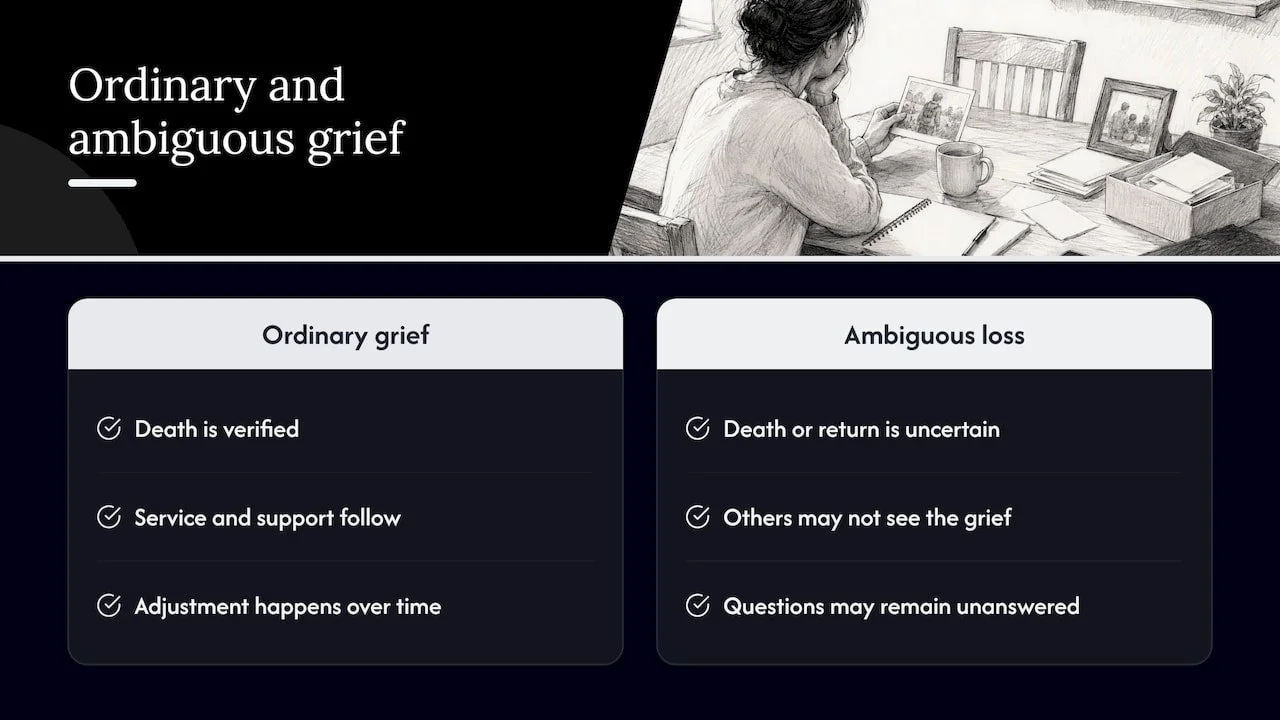
The term comes from Dr. Pauline Boss, who developed it more than 40 years ago. According to her FAQ on ambiguousloss.com, it differs from ordinary loss because there is no verification of death and no certainty that the person will return or go back to the way they were.
The Cleveland Clinic describes it in its simplest sense as loss without closure. Boss has also stressed that it is a relational experience: the loss involves someone you are attached to, and the ambiguity makes both loss and coping harder, as she lays out in her talk on loss, trauma and resilience.
This matters because most of us learned grief as a sequence: someone dies, there is a service, people bring food, and over time you adjust. Ambiguous loss skips all of that. You are left with questions that may never be answered, and often with people around you who do not see anything to grieve.
The two types of ambiguous loss
Boss describes two main types.
Type one: physically absent, psychologically present. The person is gone, but you do not know for certain whether they are alive, whether they will come back, or what happened. Examples include missing persons, kidnapping, and deportation.
Type two: physically present, psychologically absent. The person is in the room, but the relationship you had is slipping away or has changed. Examples include dementia, traumatic brain injury, addiction, and chronic mental illness.
| Type one | Type two | |
|---|---|---|
| Body | Absent | Present |
| Mind or personality | Present in your thoughts | Absent or altered |
| Typical examples | Missing person, deportation, kidnapping | Dementia, brain injury, addiction, severe mental illness |
| Core question | Are they alive? Will they return? | Who is this person now? Where did the one I knew go? |
Ambiguous loss examples
The clearest cases are the ones above. But Boss's own site notes that nearly everyone meets ambiguous loss in some form, whether through a breakup, aging parents, or children leaving home. A hospice resource summarizing her book also lists soldiers missing in action, empty nest, divorce, brain injury, and Alzheimer's among the situations it describes.
Here are some situations people bring to therapy:
A parent with dementia. You still visit, but the person who knew your childhood does not recognize you.
A family member with addiction. They are alive and sometimes present, and you keep hoping the "real" person returns. Addiction recovery has its own grief too, as this piece on grief in early sobriety shows from the perspective of the person getting sober.
Deportation or immigration separation. A parent, partner, or child is alive but out of reach, and the legal process has no predictable end.
A child's diagnosis. Parents of autistic children, for instance, can grieve an imagined future while loving the child in front of them. One clinical social work study of a support group for mothers of autistic adolescents used ambiguous loss as its lens for exactly this reason.
Estrangement. A sibling or parent is alive and unreachable by choice, theirs or yours.
A relationship that ends without explanation. Ghosting, a partner who leaves without saying why, or an affair that rewrites your shared past.
A missing or unsolved case. A loved one who disappeared, or a death with no answers.
Is a breakup an ambiguous loss?
Sometimes. A clean breakup with a clear reason is usually ordinary grief. A breakup where you never learned why, where the person stays in your social circle, where you share children, or where you keep hoping they will return carries the ambiguity that defines this kind of loss. The test is not how big the loss looks from outside. It is whether the situation leaves you unable to say what, exactly, has ended.
Signs of ambiguous grief
Because there is no event to mark it, ambiguous grief can show up as something else. Clinicians describe clients stuck in what is often called frozen grief or grief limbo, unable to move forward without clear markers such as a funeral or official news.
Common signs include:
Looping thoughts about what happened, or about whether things might go back to how they were
Sadness, anxiety, or numbness you cannot attach to a single event
Feeling guilty for grieving someone who is still alive, or for "giving up" hope
Swinging between hope and despair, sometimes within a day
Feeling alone because others do not see it as a real loss
Difficulty making decisions about the future, such as whether to date, move, or divorce
Anger at the person and love for them at the same time
These are not signs that something is wrong with you. Boss's work points out that the ambiguity is an external stressor, not a personal pathology. You are reacting normally to a situation with no resolution.
Why closure is the wrong goal
Well-meaning people say you need closure. For ambiguous loss, that advice can do harm. In a 2025 paper, Boss and colleagues' framework holds that closure is not a realistic end-goal here, and that pressing someone to resolve a situation with no resolution adds to their burden. The goal shifts to resilience and a higher tolerance for uncertainty.
That can sound bleak. In practice it is a relief for many people. You stop measuring yourself against a finish line that does not exist.
Coping with ambiguous loss: six guidelines
The therapeutic framework described in the 2025 article rests on six guidelines. They are not steps. You move back and forth between them.
Finding meaning. Name what is happening. Saying "this is an ambiguous loss" gives the experience a shape. Naming the loss is the critical first step out of isolation, as clinical work with parents also shows. Meaning does not have to be positive. It can be as simple as "this is a real loss and my grief makes sense."
Adjusting mastery. You cannot control whether someone returns or recovers. You can control how you spend your days, whom you lean on, and what you decide. Many people find relief in separating what is in their power from what is not.
Reconstructing identity. Who are you now: still a spouse, a daughter, a parent, a sibling? Roles can become unclear when someone is missing or changed. Try writing down which roles you keep, which you set down, and which you are still deciding about.
Normalizing ambivalence. Love and resentment, hope and exhaustion, wanting them back and wanting it to be over. Clinicians treat holding opposing feelings as a natural response to unresolvable situations, not a sign you are failing at grief.
Revising attachment. You can keep a bond with someone while changing its form. A caregiver may relate to a parent with dementia differently than they used to, without loving them less. Someone who has lost a partner to uncertainty may let go of the daily hope while keeping the memory.
Discovering new hope. Not hope that the situation will resolve, but hope for connection, purpose, and good days within the uncertainty.
Practical things that help day to day
Say it out loud to one safe person. Choose someone who will not rush you toward closure.
Create your own rituals. If there is no funeral, make a small marker: lighting a candle on a particular day, writing a letter you do not send, or visiting a place that matters.
Keep routines steady. Sleep, meals, and movement matter more when your mind has no resting place.
Allow both feelings. If you notice "I love them" and "I am furious at them," you do not have to settle it.
Build resilience skills deliberately. Self-compassion and coping skills are habits you can practice, and resources like this overview of self-affirmation and coping skills can give you ideas to try. Treat these as support, not a substitute for professional care.
Find your people. Support groups for caregivers, families of missing persons, or others in your situation reduce the sense that your loss is invisible.
When ambiguous loss is mixed with trauma
Some ambiguous losses come with frightening events: a sudden disappearance, violence, a deportation raid, or a crisis involving a loved one's illness or addiction. Research notes that traumatic events are often accompanied by the loss of loved ones and can give rise to traumatic grief.
In those cases you may have two things going on at once: the open-ended grief, and trauma symptoms such as intrusive images, jumpiness, nightmares, or a body that will not settle. Trying to work on meaning and identity while your nervous system is in alarm is very hard.
A clinical chapter on EMDR and traumatic grief describes EMDR as a therapy that can help with grief and bereavement-related distress and adapting to the loss. To be clear about the limits: EMDR does not resolve the ambiguity itself, and nothing can. What it can do is reduce the intensity of specific traumatic memories and physical arousal, which creates room for the slower, non-linear work above.
If you want to read more on how this works, our articles on EMDR therapy for grief and on what happens when trauma blocks grief explain the approach in plain language. If you are new to the method, start with what EMDR therapy is. For broader support, see our grief counseling guide.
Our perspective
We see ambiguous loss most often in people who have not told anyone about it, because they assume it does not count. A client says, "My mother is still alive, so I should not be this sad." Or, "He was deported, not killed, so why can't I move on?" The first thing we do is tell them it counts.

Many of the people we work with carry losses that are tied to immigration, family separation, or cultural and identity pressures. Some are also surviving trauma, and some do not feel safe in settings where their story is not understood. That is why we offer care in English and Spanish and aim to be identity-affirming. Grief does not stay inside one language, and neither does the sense of being unseen.
Our view is simple. Closure is not the finish line, and nobody should be made to feel they are behind schedule. Good care for ambiguous loss steadies the body first when trauma is present, names the loss, makes room for mixed feelings, and helps you rebuild a life that includes the uncertainty instead of waiting for it to end.
— Juiced
Working with us
If your ambiguous loss is entangled with trauma, we offer individual counseling and EMDR therapy with licensed, trauma-informed therapists in Pasadena, Ventura, and online across California, in English and Spanish. If you were affected by a crime, see our victims of crime support. If you would rather concentrate the work into a short block of time, our EMDR Intensives are available as a 4-hour 1-day session at $1,500, a 6-hour 1-day session at $2,250, or a 3-day intensive at $5,750. For couples facing a loss that sits between them, there is couples therapy. If symptoms feel overwhelming, see our page on PTSD and complex trauma.
If you are in crisis or thinking about harming yourself, call or text 988, the Suicide & Crisis Lifeline, or go to the nearest emergency room.
FAQ
What is an ambiguous loss?
It is a loss without clarity or closure. Either a person is physically gone but still psychologically present, such as a missing person, or physically here but psychologically absent, such as someone with dementia. The term was coined by Dr. Pauline Boss, and her FAQ explains it in more depth.
What is the hardest loss to grieve?
There is no official ranking, and any such answer would be a guess. Losses that lack verification or acknowledgment tend to be especially hard, because you grieve without the usual rituals and support. Ambiguous loss and other unrecognized grief fall into this group.
Can you grieve someone who is still alive?
Yes. Grief responds to the loss of a relationship, a role, or a future, not only to a death. Grieving a parent with dementia or an estranged child is a normal response to a real change.
How do I know if I need therapy for ambiguous loss?
Consider talking to a licensed therapist if you feel stuck for weeks, if sleep, work, or relationships are suffering, or if you have trauma symptoms such as flashbacks or nightmares. A therapist trained in grief and trauma can help you name the loss and build ways to live with it. If you have thoughts of harming yourself, contact 988 right away.
Sources
Quantify or Classify? Recommendations for Ambiguous Loss Versus Boundary Ambiguity
The Unexpected Comfort of Feeling It All: A Support Group for Mothers of Autistic Adolescents
What Ambiguous Loss Is and How To Deal With It (Cleveland Clinic)
