
EMDR for OCD: What the Research Says and When It Helps

EMDR is not a first-line treatment for obsessive-compulsive disorder. Exposure and response prevention (ERP) is. But EMDR may earn a place in your care as an add-on, especially if your OCD is tangled up with trauma, or if your symptoms began after a frightening or painful experience. This guide covers what the studies found, where EMDR fits next to ERP, what to ask a therapist, and what to do if you are not getting better.
Alvaradotherapy
Explore EMDR for Trauma-Linked OCD
Alvarado Therapy offers EMDR and trauma-informed counseling for California clients, including those exploring how trauma relates to their symptoms.
TL;DR
ERP is the gold-standard psychotherapy for adult OCD. The International OCD Foundation (IOCDF) says more research is needed before EMDR can be considered a standard OCD treatment.
Two randomized trials gave encouraging results, but they are small and exceptions in a thin field.
EMDR makes the most sense as an adjunct when OCD overlaps with PTSD, childhood trauma or other distressing memories.
Your therapist should know OCD-specific protocols, not just generic EMDR, so the work does not feed compulsions.
If you have OCD without a trauma history, start with an ERP-trained clinician.
Table of Contents
Does EMDR help OCD?
Sometimes, for some people, and the evidence is still early. EMDR (Eye Movement Desensitization and Reprocessing) was built to treat PTSD. It asks you to hold a distressing memory in mind while following bilateral stimulation, such as guided eye movements or tapping, so the memory loses its emotional charge. The IOCDF notes that EMDR was developed for PTSD, and that although research supports it for PTSD, more research is needed before it should be considered a standard OCD treatment.
That is not the same as "it does not work." It means the proof is thinner than the proof for ERP, which has decades of large trials behind it. A fair summary for a reader deciding what to do:
ERP: first-line, strong evidence, should be the backbone of OCD treatment.
EMDR: promising in small studies, reasonable as an adjunct, not a replacement.
If you want a plain-language primer on the method itself, our guide What Is EMDR Therapy? A Clear Guide for Adults walks through it.
What the studies actually found
The research on EMDR for OCD is mostly small samples and case reports. A few controlled studies stand out.
EMDR compared with an SSRI (2011)
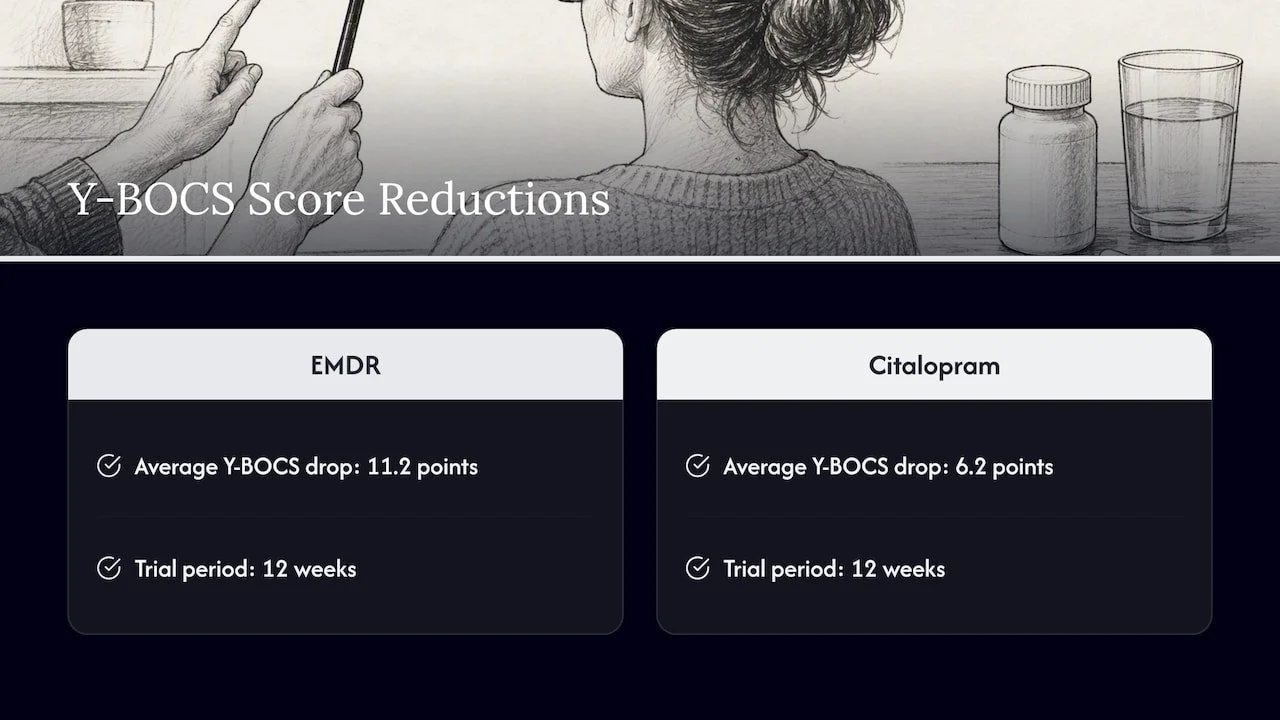
A randomized trial of 90 participants compared EMDR with citalopram, an SSRI, over 12 weeks. As reported in the IOCDF-linked research summary we reviewed, the EMDR group's Y-BOCS scores (the standard OCD severity scale) dropped by an average of 11.2 points, against 6.2 in the citalopram group. That is a striking gap, but it is one study, and it was not compared against ERP.
EMDR compared with CBT (2017)
A randomized controlled trial of 55 participants compared EMDR and cognitive behavioral therapy. Completion rates and clinical outcomes were comparable, with roughly 30% of participants reaching reliable improvement, and 61.8% completed treatment. Read that two ways: EMDR held its own against CBT, and a majority of people did not reach reliable improvement with either approach.
Early evidence reviews
A 2021 paper in the Journal of EMDR Practice and Research, Examination of Initial Evidence for EMDR as a Treatment for OCD, opens from the premise that ERP is the front-line intervention, and that many people do not fully benefit from it. That gap is the reason researchers keep studying alternatives and add-ons.
How to read all this
| Question | Honest answer |
|---|---|
| Is there any controlled evidence for EMDR in OCD? | Yes, a few small randomized trials |
| Is it as well proven as ERP? | No |
| Could it work alone? | Possible for some, but not recommended as the plan |
| Where is it most plausible? | OCD with co-occurring trauma or PTSD |
For a wider look at how EMDR performs across conditions, see our post EMDR Treatment Effectiveness: What the Research Shows.
Why trauma changes the picture
The main reason some clinicians consider EMDR for OCD is overlap. Many people with OCD have also lived through frightening, humiliating or unsafe experiences. Because EMDR is a trauma-focused therapy, it may help process the memories that appear to fuel some symptoms. The IOCDF describes this logic as the potential overlap between OCD and traumatic experiences.
Here is how that can look in practice. These are illustrative patterns, not patient stories:
Contamination fears that began after an illness, a medical emergency or a violent event.
Checking or "just right" rituals that intensified during a chaotic or unpredictable childhood.
Intrusive thoughts about harm that spike when a person is reminded of an old loss.
In these cases, ERP targets the compulsion cycle, while EMDR can target the memory that keeps the alarm system primed. Neither replaces the other. If trauma history is part of your story, our guides on how EMDR helps adults heal from trauma and the steps of EMDR therapy show what that processing involves.
EMDR versus ERP: how they differ
| ERP | EMDR | |
|---|---|---|
| Main target | The obsession-compulsion cycle | Distressing memories and their emotional charge |
| Core move | You face triggers and resist the ritual | You recall a memory while using bilateral stimulation |
| Evidence in OCD | Strong, first-line | Early, small studies |
| Typical use | Foundation of OCD care | Adjunct, mainly with trauma |
The IOCDF treatment guide says ERP protocols typically run 12 to 20 weekly sessions, and that intensive formats can also be effective. If you have tried ERP and found it too overwhelming to start, a trauma-focused therapist may help you build tolerance first. Some clinicians also borrow EMDR elements such as the flash-forward protocol, a technique where you imagine a feared future scene, as part of exposure work. Whether that suits you is a decision for you and a clinician who knows both methods.
Risks and what to watch for
EMDR can stir up strong feelings. Temporary distress while reprocessing upsetting thoughts or memories is a known part of the method. With OCD there is one more concern: a generic protocol could accidentally become a reassurance ritual or amplify an intrusive thought. The paper in the Journal of EMDR Practice and Research is a good starting point for clinicians on protocol choices, and you can ask your therapist how they would adapt.
Signs the work is going sideways:
You start doing the EMDR session itself as a ritual, such as repeating a memory until it feels "right".
You seek reassurance from the therapist about whether a thought means something about you.
Compulsions get more frequent for more than a short stretch after sessions.
If any of these show up, tell your therapist right away. If you are ever in crisis or thinking about harming yourself, call or text 988, the Suicide & Crisis Lifeline, or go to the nearest emergency room.
Questions to ask before you start
Whether you work with us or someone else, ask:
Have you treated OCD, and do you use ERP? Will ERP be part of my plan, or will I be referred for it?
If trauma is involved, how will you sequence EMDR and exposure work?
How do you prevent reassurance-seeking and ritualizing in session?
What will we measure, such as Y-BOCS scores, so we know whether this is working?
When would you change the plan or bring in a prescriber?
If you need an OCD specialist, the IOCDF Resource Directory lists over 2,700 clinicians, groups and programs, with filters for treatment strategies, insurance and race or ethnicity. Inclusion does not equal endorsement, so still ask the questions above.
Our perspective
We are a trauma-informed practice, and EMDR is central to our work. That is exactly why we are careful about OCD. We do not tell people that EMDR is the answer to OCD, because the research does not say so. What we see, and what our clients tell us, is that symptoms rarely arrive alone. Anxiety, grief, childhood trauma and relationship pain often sit in the same story as obsessive thoughts.
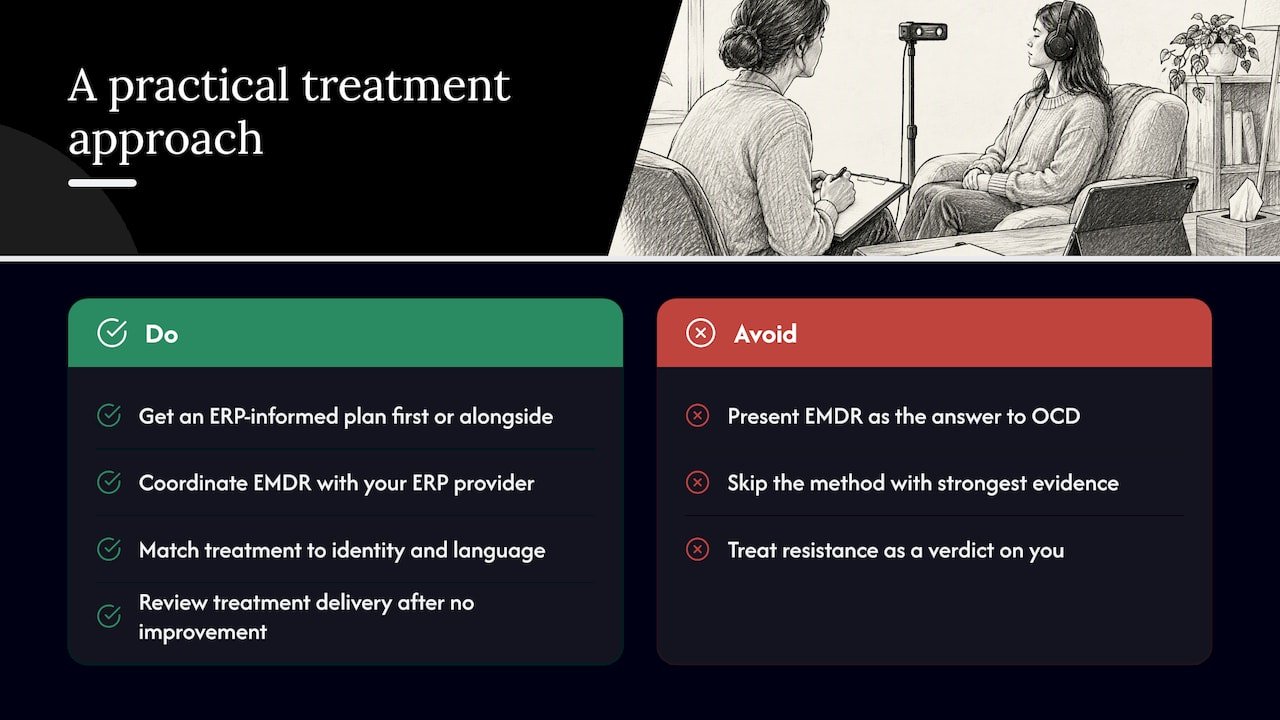
So our view is practical. If you have OCD, get an ERP-informed plan first, or alongside anything else. If your history includes trauma that still hurts, EMDR can be a sensible parallel track, ideally coordinated with whoever provides your ERP. We work in English and Spanish, and we know that for many Latinx, BIPOC and LGBTQ+ clients, feeling understood by the therapist decides whether treatment sticks. Treatment that fits your identity and language matters, but it never excuses skipping the method with the strongest evidence.
We also think "treatment resistance" is a signal about the protocol, not a verdict on you. If you have not improved, the next step is a review of how treatment is being delivered, not despair.
— Juiced
If treatment is not working
People often ask what to do after months of therapy with little change. The clinical literature points to a review rather than a hop to a new method. A 2021 update on CBT for OCD emphasizes that effective care often combines cognitive and behavioral techniques, and that lack of response calls for a multidisciplinary look at whether ERP is being delivered at enough strength, or whether medication management is needed.
A useful checklist:
Count hours. Low-intensity ERP is often defined as up to 10 therapist hours, and standard protocols run longer.
Ask whether exposures are actually hard enough and whether rituals are truly being blocked.
Ask a psychiatrist or other prescriber whether an SSRI is worth discussing.
If trauma symptoms such as flashbacks, nightmares or numbness persist, consider adding trauma-focused work like EMDR.
Support groups and apps
Groups can ease isolation. The IOCDF lists over 300 support or treatment groups, some clinician-led and some peer-run. For example, there is a free online monthly support group for adults and a virtual drop-in group listed in the directory. Clinician-led groups can range from free to about $90 per session, depending on provider and insurance.
Meditation and wellness apps are a different matter. Medical News Today notes that apps such as Calm are wellness tools rather than regulated medical treatments, and they do not provide the exposure hierarchy that OCD recovery needs. Use them for stress, not as your OCD treatment.
Working with us
If your OCD sits alongside trauma, we can help with the trauma side. Our options for EMDR include weekly individual counseling and EMDR therapy and EMDR intensives, which compress the work into longer blocks:
1-day intensive, 4 hours: $1,500
1-day intensive, 6 hours: $2,250
3-day intensive: $5,750
We see clients in California and New York, in person in Pasadena and Ventura, and online. Not sure what fits? Book a consultation and tell us about your OCD care so far, so we can plan around your ERP provider rather than in place of it. You can read how intensives work in What is EMDR intensive therapy? A 2026 guide.
FAQ
Can EMDR cure OCD?
There is no evidence that EMDR cures OCD, and no treatment is promised to. Small trials show symptom reductions for some people, but the IOCDF says more research is needed before it is a standard OCD treatment. Ask a clinician about ERP first.
What if EMDR doesn't work for my OCD?
Tell your therapist, then review the plan rather than blaming yourself. Check whether you are getting ERP at sufficient intensity, whether medication is worth discussing with a prescriber, and whether trauma symptoms need their own focus. A different or additional approach is a normal next step.
Is EMDR better than ERP?
No. ERP remains the first-line therapy with far more evidence behind it. One 2017 trial found EMDR and CBT had comparable outcomes in a small sample, but that does not make EMDR a substitute for ERP.
Can I do EMDR online for OCD-related trauma?
Often yes. Many trauma therapists offer EMDR by video, and we provide online EMDR trauma therapy for clients in California and New York. Make sure your therapist can adapt the protocol for OCD and has a plan for stabilizing you between sessions.
