
Attachment Injuries: Three Steps to Repair Trust Beyond Apologies

An attachment injury is a betrayal or abandonment during a moment of real need that teaches you a partner is no longer a safe place to turn. Ordinary repair stalls because the relationship's safe-haven function is damaged. Healing is possible, and it usually follows three steps: stabilizing the reactive cycle, processing the injury with vulnerability, and rebuilding new patterns, often with a therapist.
TL;DR:
An injury differs from an ordinary hurt when betrayal, secrecy, or abandonment occurs during illness, crisis, or another moment of serious need.
Demand and withdrawal reinforce each other: pressure can prompt retreat, and retreat confirms fears, so couples should stabilize this loop before discussing the injury.
Therapy typically stabilizes conflict first, then supports vulnerable disclosure, accountability, comfort, and new habits; repair works best without ongoing betrayal or abuse.
Seek structured help when distress disrupts sleep, work, or concentration, panic or intrusive memories occur, or conflict affects a child or teen.
Family therapy focused on attachment can address caregiver and adolescent ruptures, while EMDR is used for trauma linked symptoms such as flashbacks.
Alvaradotherapy
Find Support for Relationship Healing
Alvarado Therapy offers couples therapy and trauma-informed counseling for Californians navigating relationship difficulties and trauma.
Table of Contents
What counts as an attachment injury, and what triggers one?
Researchers define an attachment injury as a violation of the expectation of comfort and caring during a critical time of danger or distress, and it tends to show up as a recurring impasse in the relationship. The idea was formalized in the original construct paper from the Emotionally Focused Therapy tradition, where betrayal or abandonment at a moment of critical need redefines the relationship as insecure.
Typical triggers include:
Sexual or emotional betrayal, including affairs and hidden online relationships
Abandonment during illness, childbirth or a family emergency
Secrecy or major lies, especially about money, health or safety
Violated boundaries that you explicitly asked your partner to respect
Threats to safety or livelihood, such as a partner who gambles away savings or dismisses a real danger
What separates an injury from an ordinary hurt is the stakes at the time. A forgotten anniversary stings. Being left alone in a hospital room, or discovering that your partner was lying while you were in crisis, changes what you believe about the person you rely on most.
That is also why a simple apology rarely closes the wound. The injured partner is not only upset about an event. They are asking whether this person will show up next time, and an apology cannot answer that question on its own. When the same argument keeps returning with the same heat, even years later, you are probably looking at an unresolved injury rather than a communication problem.
Why do attachment injuries block repair?
An injury reshapes what psychologists call internal working models, the expectations you carry about whether people will be reliable when you need them. Attachment research describes these models as the lens through which secure, anxious and avoidant patterns form, and an injury can push the lens toward suspicion.
The body joins in. Reminders of the event can trigger a threat response: a racing heart, a tight chest, sudden anger or numbness. When your nervous system reads your partner as a possible source of harm, vulnerable sharing feels risky, even when you want closeness. Shame complicates things on both sides. The hurt partner may feel foolish for having trusted, while the partner who caused the injury may feel so ashamed that they get defensive or go quiet.
This is why explanations and apologies, even sincere ones, often fall flat early on. The injured person does not need a better argument. They need evidence, over time, that comfort will be there. Reflective, responsive care helps people shift from defensive self-protection toward connection, because it widens the space where vulnerable emotions can be tolerated. Until that space exists, even well-meant repair attempts get read as threats or empty words.
Which communication cycles keep the wound open?
Two overlapping patterns show up again and again. In the demand–withdraw pattern, one partner criticizes, pressures or asks for change while the other avoids, shuts down or leaves the room. The APA Dictionary notes that this pattern predicts marital deterioration and that, although it has historically been tied to female demand and male withdrawal, the roles vary.
The pursuer–distancer cycle is a close cousin. The pursuer moves toward the partner to restore connection, often with intensity, and the distancer moves away to protect themselves from feeling overwhelmed or blamed. Here is the paradox: the harder the pursuer pushes, the more the distancer retreats, and the retreat convinces the pursuer that their fear was right. After an injury, each partner's move confirms the other's worst belief.
A meta-analysis found a meaningful link between demand–withdraw and relationship distress, with stronger associations in clinical samples. In other words, the pattern is most pronounced in couples who are already struggling.
Those cycles matter for repair in practical ways:
They crowd out the calm conversation needed to process the injury itself
They reduce conflict resolution and encourage negative tactics, as the broader meta-analytic review documents
They let both partners feel unheard, which keeps the original wound untouched
Breaking the cycle is therefore the first job, long before anyone expects forgiveness.
How do attachment injuries affect individuals and families?
For the person who was hurt, the effects often include emotional dysregulation, persistent anxiety, withdrawal from friends, and a corrosive sense of shame or self-doubt. Low mood and depression can follow, particularly when the injury stays unaddressed for months. The partner who caused the injury may carry guilt, avoidance and fear of being seen as irredeemable.
Within the relationship, the costs compound. Conflicts go unresolved, the same impasse returns, and intimacy erodes because closeness feels unsafe. Couples sometimes describe living like polite roommates, or swinging between explosive fights and icy silence.
Children feel it too. Parents who are preoccupied, tense or emotionally unavailable have less bandwidth for responsive caregiving, and rifts between parents can spill into parenting. Teenagers in particular may withdraw or act out, which can open a second attachment rupture between caregiver and child.
Some signs suggest the impact calls for a more structured clinical approach rather than self-help:
Daily functioning is affected: sleep, work, appetite or concentration
Intrusive memories or panic reactions arrive without warning
Conversations about the event regularly end in shouting, shutdown or threats to leave
A child or teen is showing distress that tracks the family conflict
If several of those fit, treat that as information about how deep the injury runs, not as a verdict on the relationship.
What does structured repair look like in therapy?
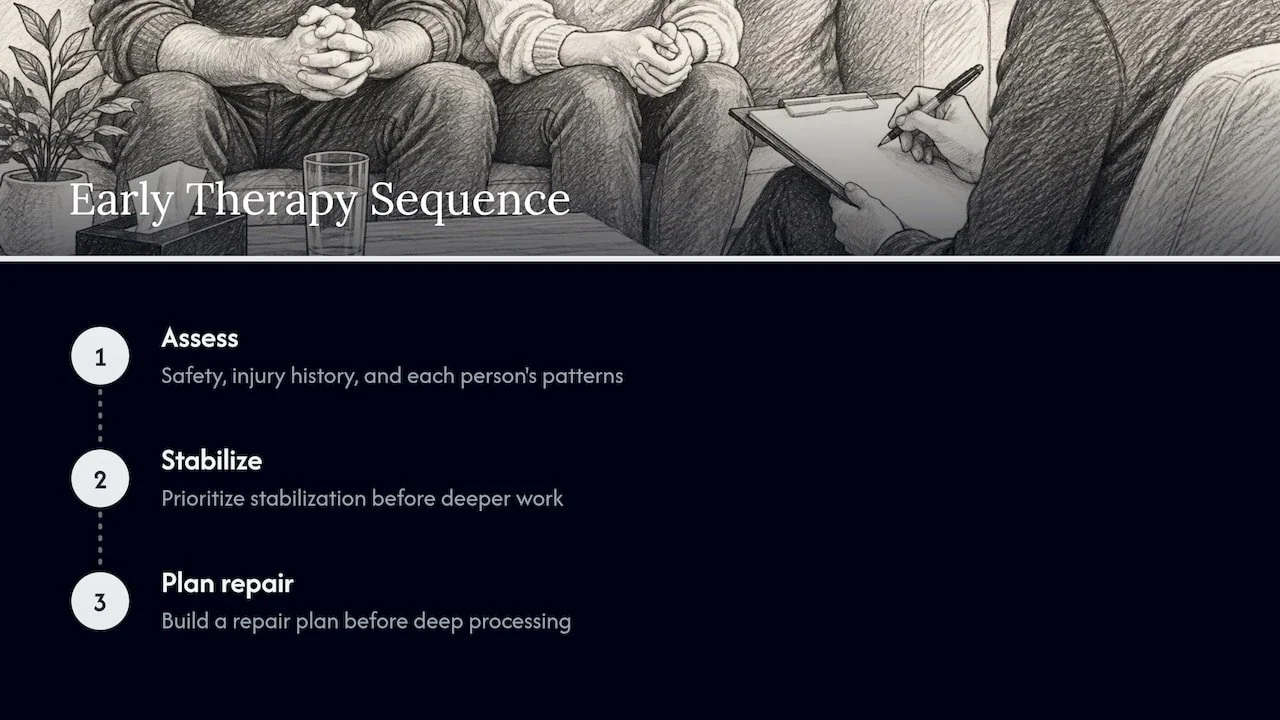
Clinicians generally follow a phased path, and we recommend you look for one that works in this order:
Stabilize the reactive cycle. The couple learns to recognize the pursue-withdraw loop and call it the problem, rather than blaming each other.
Process the injury. In Emotionally Focused Therapy, the Attachment Injury Resolution Model (AIRM) guides the hurt partner to express the pain and what it meant, while the other partner listens, takes responsibility and responds with care.
Create an antidote bonding event. This is a moment of real comfort, where the hurt partner asks for reassurance and the other partner offers it in a way that finally answers the original unmet need.
Integrate new patterns. The couple practices fresh ways of turning toward each other until safety becomes habitual.
Other models fit specific situations. Attachment-Based Family Therapy (ABFT) is a structured, empirically supported approach for repairing caregiver–adolescent ruptures, using in-session corrective conversations and caregiver responsiveness, with measurable outcomes for adolescent depression and suicidality. EMDR therapy is used when an attachment injury has left trauma-like symptoms such as flashbacks or body-based alarm, and we explain more in our piece on the role of EMDR in relationships.
Pro Tip: Ask any prospective therapist how they handle stabilization before processing, and what training and supervision they have in the model. Deep injury work done too early, or without that grounding, can reopen the wound instead of healing it.
Preconditions matter. Repair works best when there is no ongoing betrayal or abuse, when both people can tolerate some vulnerability, and when the clinician is trained to pace the work. Our overview of trauma-informed approaches to rebuilding trust describes how we think about that pacing.
What can you try on your own right now?
Small, safe moves can lower the temperature and prepare both of you for structured repair. They are not substitutes for therapy when the injury is serious.
If you were hurt:
Notice your body's alarm signals and name them before reacting ("I'm getting flooded right now")
Say what you need in one sentence, such as "I need to hear that you understand how alone I felt"
Ask for conversations at a set time instead of ambushing your partner mid-day
If you caused the injury:
Offer accountability without explanations that sound like excuses
Take concrete safety-building actions: transparency, follow-through, predictable check-ins
Resist defensiveness; "I can see why that hurt you" does more than a rebuttal
For both of you:
Agree on a structured time-out: one partner says "I need a break," names a return time, and actually returns
Set rules for vulnerable sharing, such as no interrupting and no re-litigating details
Pause the conversation and call a professional if it turns frightening or keeps looping
Pro Tip: Write down, separately, what you most needed in the moment of injury. Bring those notes to your first therapy session. They often reveal the real wound faster than retelling the event.
When should you seek professional help?
Consider reaching out when the same impasse keeps repeating, when distress is severe or disrupting daily life, when there are safety concerns, or when children are being affected. Therapy is also reasonable when you simply do not know where to start.
Several approaches treat attachment injuries: EFT with the AIRM, EMDR for trauma-linked symptoms, ABFT for caregiver–adolescent ruptures, and trauma-informed couples work. In early sessions, a therapist typically assesses safety, the history of the injury, and each person's patterns, then prioritizes stabilization and builds a repair plan before any deep processing begins.
How do childhood attachment styles shape vulnerability to injury?
How you learned to seek comfort as a child influences how you read and react to a partner's behavior as an adult. Attachment styles, whether secure, anxious or avoidant, work as templates for relationship expectations. Someone with an anxious style may scan constantly for signs of abandonment, so a partner's distraction can register as a major wound. Someone with an avoidant style may have learned that needing others is unsafe, which makes them more likely to withdraw when a partner is in pain, unintentionally creating an injury.
None of this is destiny. Longitudinal work shows that significant life events can lead to enduring changes in adult attachment in roughly a quarter of cases, which means security can be lost, but it can also be built. A healthy partnership, a responsive therapist or a deliberate effort to understand your own patterns can all move you toward greater security.
Parents who want to understand how secure bonds form in the first place may find this parent-focused guide to secure attachment a helpful foundation. And if early experiences left their own marks, our article on the role of trauma in relationships explains how those marks surface later.
How do culture and identity affect injury and healing?
What counts as abandonment, betrayal or adequate care is not the same everywhere. In some families and communities, loyalty to extended relatives, duty to elders or silence around marital problems shapes how a wound is experienced and who is allowed to talk about it. Immigration stress, discrimination, religious expectations and gender norms can all deepen an injury or make it harder to name.
Identity matters in the therapy room as well. A queer person who has been rejected by family may carry an earlier injury into a partnership, and a person raised in a collectivist culture may feel torn between healing the couple and protecting family honor. Language also plays a role. Many people can describe pain more precisely in the language they grew up with, which is why bilingual care can change what is possible.
Healing works best when the therapist treats culture as part of the injury's meaning rather than as background detail. Questions like "What did this betrayal mean in your family?" or "Who else is affected by how you handle this?" help the work fit the person instead of forcing the person to fit a model.
What do people get wrong about attachment injuries?
A few myths come up often:
"It's just a fight, and time heals everything." Time without repair tends to harden the impasse. Silence can look like peace while the injury quietly shapes every interaction.
"If I forgive, it should be over." Forgiveness is a decision. Trust is rebuilt through repeated, reliable behavior, so the two run on different clocks.
"Only affairs count." Betrayal is one trigger among many, along with abandonment in crisis, secrecy and threats to safety.
"My attachment style is fixed." Research shows attachment can shift, in both directions, across a lifetime.
"Needing therapy means the relationship is failing." Seeking help is often what protects a relationship that matters to both people.
"The hurt partner just needs to get over it." Pressure to move on usually reproduces the original abandonment.
Dropping these beliefs often lowers shame, and lower shame makes the next honest conversation more possible.
A clinician's note on hope and quick fixes
Pain like this is normal, and it is not a sign that you are too sensitive or that your relationship is beyond saving. There is no shortcut, though. Quick fixes tend to skip the stabilization and trust-rebuilding that make repair last. Our work is trauma-informed, bilingual, and includes couples therapy and EMDR intensives, and we encourage you to seek clinicians trained and supervised in deep repair models.
— Juiced
How can our therapists help you start repairing?
We offer couples therapy, individual counseling and EMDR therapy, and EMDR intensives, with online sessions available. If you are ready to stop circling the same argument, we listen to what happened, assess safety, and map out a stabilization plan and treatment options that fit you or the two of you.
Our 1-Day EMDR Intensive (4 hours in one day) is $1,500 and the 3-Day EMDR Intensive is $5,750, both listed on our EMDR intensives page. Book a consultation with us to find the right first step.
This article is general information, not a substitute for advice from a qualified doctor. Consult a qualified healthcare professional about your own circumstances before acting on anything here.
FAQ
How can you help a child with attachment issues?
Start with steady, predictable and responsive caregiving, and seek therapy when problems persist. Early treatment improves long-term outcomes, and engaging caregivers is part of what makes child therapy effective.
What are the different attachment styles?
The main styles are secure, anxious (preoccupied) and avoidant (dismissive). They describe the working models of expectations people carry into relationships and shape how they seek or avoid comfort.
Can I change my attachment style?
Yes, attachment security can change over time. Research finds that a quarter of significant life events lead to lasting shifts, and therapy focused on interpersonal functioning is a primary route for building security.
How does an attachment injury differ from an ordinary argument?
An ordinary argument fades once the issue is settled. An attachment injury involves a violation of care during real distress, so the impasse keeps returning until the injury itself is addressed.
Sources
ATTACHMENT INJURIES IN COUPLE RELATIONSHIPS: A NEW PERSPECTIVE ON IMPASSES IN COUPLES THERAPY
Attachment-Based Family Therapy: Theory, Clinical Model, Outcomes, and Process Research - PMC
