
Grief often gets louder when the holidays arrive, and that is a normal response to loss, not a sign that you are doing it wrong. The most useful things you can do are plan for the hardest moments, give yourself permission to change or skip traditions, tell people what you need, and reach out for professional support if your grief is worsening or getting in the way of daily life.
This guide explains why the season hurts, what helps in practice, how to honor the person you lost, and when counseling makes sense.
Alvaradotherapy
Support for Grief Through the Holidays
Alvarado Therapy offers individual counseling for grief, with trauma-informed support in English and Spanish for clients across California.
TL;DR
Holidays make absence visible. Feeling heavier than usual, especially during the first holiday after a death, is common and expected.
Plan ahead: decide which gatherings you will attend, set an exit plan, and line up one person you can call.
Traditions can be kept, changed, simplified or skipped. You can also add a small ritual that honors your person.
Seek help if grief worsens over time or interferes with work, sleep, eating or relationships. In a crisis, call or text 988.
Table of Contents
Why grief can feel stronger during the holidays
Holidays are built on togetherness, routine and memory. When someone is missing, every one of those threads can pull on the loss. The American Psychological Association describes the season as a poignant reminder of the absence, particularly during the first holiday after a death, when traditions may feel broken.
There is also a social squeeze. Psychologist Sherry Cormier, quoted by the APA, describes a kind of cognitive dissonance: you are heartbroken, while the world around you expects gratitude and cheer. Many people respond by hiding how they feel, which makes the season lonelier.
Research points to a few more mechanics:
Special occasions redirect your attention. A 2013 study of bereaved people suggests that occasions can lead mourners to re-focus on the painful feelings tied to the death.
The quiet after can hurt as much as the event. The same researchers note that isolation can become more noticeable, particularly for older widowed people, once the festivities end and family members leave.
Anniversary reactions are normal. Mayo Clinic materials explain that strong reactions to dates like holidays are not a setback. They reflect how much the person mattered in your life.
If you want a deeper look at why dates trigger waves of grief, our piece on coping ahead for anniversary grief reactions walks through the pattern and trauma-informed steps.
What holiday grief can look like
It does not always look like crying. The University of Nebraska Medical Center describes holiday grief as an emotional roller-coaster that can include sadness, joy, numbness, anxiety and confusion, along with physical effects such as low energy or tension.
You might notice:
Tearing up at a song in a grocery store, then laughing at a memory ten minutes later
Feeling nothing at all at a gathering and wondering what is wrong with you
Dreading the season weeks in advance, sometimes starting in the fall
Irritability, trouble sleeping, or no appetite
Guilt when you enjoy something, or anger at people who seem untouched
Mixed feelings are part of the process. Mayo Clinic materials stress that laughing and crying at the same celebration is common and healthy.
The UNMC framing is a good anchor: grief is not a problem to be fixed. It is a human experience to move through with self-compassion.
Make a plan for the hard moments
SAMHSA recommends a concrete plan for stressful moments, such as calling a supportive contact, doing a favorite activity or taking a walk. A plan works because grief makes decisions harder in the moment. Deciding in advance spares you from improvising when you are overwhelmed.
A simple holiday plan you can write in ten minutes
List the dates and events that worry you most. Often it is two or three, not the whole season: the day itself, the dinner, the first morning.
Decide your yes, no and maybe for each. A "maybe" is allowed. You can say, "I'll come if I feel up to it."
Build an exit plan for any gathering. Drive yourself, tell the host you may leave early, and pick a signal or a person who will understand. UNMC advises setting boundaries on gatherings, with an exit plan.
Name your standby person. AARP suggests having a supportive friend on standby if you attend events.
Schedule something after the big day. Mayo Clinic suggests planning specific distractions or time with supportive friends to ease loneliness. The day after a holiday can be the hardest.
Protect the basics. SAMHSA's list includes rest, nutrition and movement. None of it fixes grief, but a depleted body makes every feeling harder to carry.
Tell people what you need
Most relatives are guessing. AARP advises being honest about your needs, including whether you want the person you lost to be talked about. Some people want the name said out loud. Others cannot hold it at the table. Both are valid, and a short text before the event can save you an awkward evening.
Something like: "This will be a hard Thanksgiving for me. I'd love to hear stories about Mom, but I may step outside for a few minutes. Please don't take it personally."
Traditions: keep, change or let go
There is no rule that says you must repeat the old holiday exactly. UNMC encourages being flexible, including simplifying traditions or choosing not to participate.
Here is a way to sort them:
| Option | When it helps | Example |
|---|---|---|
| Keep it | The tradition comforts you more than it hurts | Opening the same ornament box, with a pause for the person you lost |
| Change it | You want the ritual but not the pain around it | Eating at a restaurant instead of the family home |
| Shrink it | You have less energy this year | A small meal with two people instead of a full table |
| Skip it | It feels impossible right now | Taking a trip, volunteering, or a quiet day at home |
| Start something new | You want a place for your person in the season | A candle, a recipe, a walk at their favorite spot |
You can change your mind next year. Skipping a tradition this year does not cancel it forever.
Ways to honor the person you lost
Honoring someone gives your grief somewhere to go. The APA suggests making their favorite dish, lighting a candle, donating to a cause they cared about, or sharing memories and stories, and making it personal.
Some practical variations:
Set a place or leave a chair. Or put their photo on the table.
Invite stories. Ask each guest to share one memory, written on a card if speaking is hard.
Cook their dish with someone. Even a failed attempt becomes a story.
Give in their name. A donation, a toy drive, a meal for a neighbor.
Write them a note. Keep it, or tuck it into a stocking or a book.
Create a lasting tribute. Some families build an online memorial where relatives near and far can add photos and messages, which can help when people are spread across states.
If you are supporting someone else who is grieving, these ideas also give you something to offer other than "let me know if you need anything."
When you are far from family or have little support
Not everyone has a table to sit at. Holiday grief hits hard if you live far from relatives, lost your main companion, or are estranged from the people who remain. The National Institute on Aging notes that online support groups, virtual therapy and books are accessible options for people who are isolated or have limited local support.
If you are building a circle from a distance, a good starting point is online grief support resources that gather options in one place. Our own roundup of grief support resources for healing and our bereavement support guide cover groups, hotlines and therapy types in more detail.
How to support a friend who is grieving
If you are the friend, small and specific beats large and vague.
Listen first. You do not need to say anything wise.
Use the name. Unless they ask you not to, mention the person who died. Most grieving people fear being forgotten.
Offer concrete help. "I can bring dinner Tuesday" or "I'll drive you and we can leave whenever you want" is easier to accept than an open offer.
Ask about the plan. "What would make the day easier?" respects their lead.
Check in after the holiday. The silence in January is real.
Skip the silver linings. Phrases like "they're in a better place" often land as dismissal.
When grief needs more than self-care
Holiday grief usually softens with time and support. Sometimes it does not. Mayo Clinic advises seeking help if grief worsens over time or interferes with your ability to function, because unresolved or complicated grief can lead to depression or other health problems.
Consider talking to a licensed professional if:
You cannot work, care for yourself or your family, or keep up with basic routines
You feel stuck in intense yearning, guilt or numbness many months after the loss
The loss was sudden, violent or traumatic and you have flashbacks, nightmares, or avoid anything that reminds you of it
You are drinking or using substances more to cope
You feel hopeless, or you think about harming yourself
The last item is urgent. SAMHSA lists the 988 Suicide & Crisis Lifeline, which you can call or text at 988, and its National Helpline at 1-800-662-HELP (4357) for confidential support and treatment referrals. If you are in immediate danger, call 911. FindSupport.gov and FindTreatment.gov, also listed by SAMHSA, help you locate care.
A grief counselor or support group can help too. Mayo Clinic notes that connecting with people who understand can offer new perspectives and confirm that what you feel is normal. For an overview of what the work looks like, see our guides to effective grief counseling and grief therapy approaches.
Our perspective on holiday grief
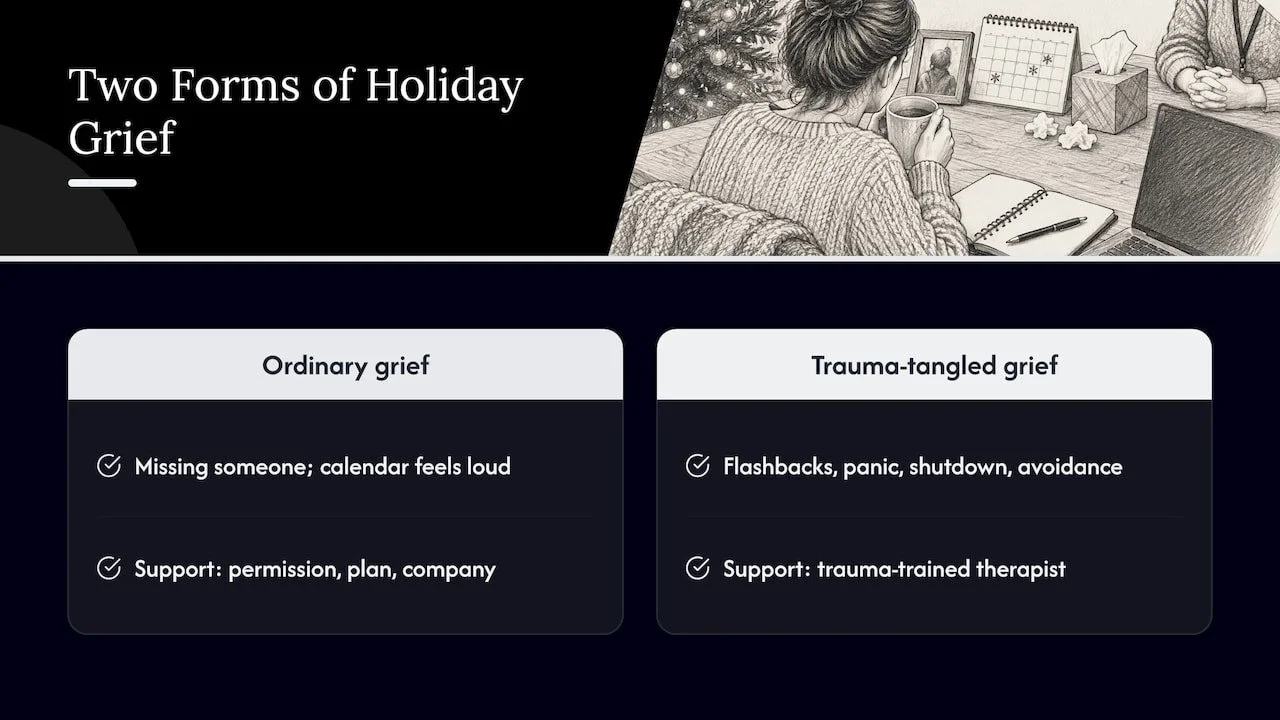
We are a trauma-informed practice, and we see holiday grief show up in two forms. The first is the ordinary, heavy kind: you miss someone, and the calendar makes it loud. That kind usually needs permission, a plan and company.
The second is grief that is tangled with trauma. A sudden death, a loss tied to violence, a complicated family history, or a loss layered on earlier childhood wounds can make the holidays feel less like sadness and more like being pulled back into the event. Flashbacks, panic, shutdown and avoidance are signs that the nervous system, not just the heart, is carrying something. In that case, advice to "stay busy" or "focus on gratitude" can backfire, and working with a trauma-trained therapist is often more useful than pushing through.
We also know that grief has a cultural shape. Many of our clients are Latinx, BIPOC or LGBTQ+, and holidays can mean mourning in a family where you are not fully seen, or honoring a loved one through traditions from more than one language and culture. We offer care in English and Spanish, and we work to keep your rituals and identity at the center of the work instead of asking you to fit a generic model.
Our practical advice: do not wait for the day itself. If the season is already pressing on you, a few sessions in the weeks before can help you build a plan, rehearse the hard conversations and decide what to keep.
— Juiced
Counseling support at Alvarado Therapy
If you want help carrying this season, our licensed therapists offer individual counseling and EMDR therapy for grief, anxiety, and trauma connected to loss, in person in Pasadena and Ventura and online in California. You can read how sessions work on our what to expect page, or book a consultation to talk through what fits.
For people whose loss is tied to traumatic memories and who prefer concentrated work, we also offer EMDR intensives: a 1-day format of 4 hours at $1,500 or 6 hours at $2,250, and a 3-day intensive at $5,750. If you are a partner grieving together, couples therapy can help you grieve side by side instead of apart. For help choosing a format, see our overview of types of grief counseling in California.
FAQ
Is it normal for grief to feel worse during the holidays?
Yes. Holidays highlight absence, break routines and bring social pressure to appear cheerful, so grief often intensifies. Mayo Clinic materials describe strong reactions to such dates as normal anniversary reactions rather than a setback. They show how much the person mattered.
Should I skip the holidays after a loss?
You can. There is no obligation to keep every tradition, and simplifying or opting out is a legitimate choice according to UNMC. If you are unsure, try a middle path: attend part of an event with an exit plan, or create a smaller gathering with people who feel safe.
How long does holiday grief last?
There is no fixed timeline, and the first holiday after a death is often the hardest. What matters more than the length is the direction. If your grief is worsening or interfering with daily functioning over time, Mayo Clinic advises seeking professional help.
When should I see a grief counselor?
Consider counseling if you cannot keep up with work, caregiving or basic routines, if the loss was traumatic and you are having flashbacks or avoidance, or if you are leaning on alcohol or drugs. If you have thoughts of harming yourself, call or text 988 right away.
Can online grief counseling help if I live far from family?
It can. The National Institute on Aging lists virtual therapy and online support groups as accessible options for people who are isolated or have limited local support. Online sessions also let you meet with a therapist from home during a season when leaving the house feels like too much.
Sources
Are you grieving this holiday season? Here are ways to cope (American Psychological Association)
Do Special Occasions Trigger Psychological Distress Among Older Bereaved Spouses? (PMC)
Living with Loss: Grief Triggers: Holidays, Special Occasions (Mayo Clinic material)
Take care: Managing grief during the holidays (University of Nebraska Medical Center)
Supporting Your Mental Health During the Holiday Season (SAMHSA)
Tips for Dealing With Grief and Loss Over the Holidays (AARP)
