

Dissociation is a disconnection from your thoughts, feelings, memories, body, surroundings or sense of identity. It comes in several forms: everyday absorption, depersonalization (feeling detached from yourself), derealization (the world feeling unreal), dissociative amnesia, identity-related dissociation, and the dissociative subtype of PTSD. Some of these are ordinary and harmless. Others are clinical conditions that deserve a proper assessment. This guide walks through each type, explains the difference between the ones people confuse most, and tells you when it is time to talk to a professional.
Alvaradotherapy
Find Support for Trauma-Related Dissociation
Alvarado Therapy offers trauma-informed individual counseling and EMDR therapy for adults in California, in English and Spanish.
TL;DR
Dissociation runs on a spectrum, from daydreaming and highway autopilot to symptoms that interfere with daily life.
Depersonalization is feeling detached from yourself. Derealization is feeling that the world around you is unreal. They are distinct but often occur together.
The DSM-5-TR names five dissociative disorders: depersonalization/derealization disorder, dissociative amnesia, dissociative identity disorder, other specified and unspecified dissociative disorder.
"Levels of dissociation" is a popular way to describe severity, not an official diagnostic ladder.
Persistent or distressing symptoms are worth an evaluation, especially if they follow trauma.
Table of Contents
What dissociation is
Dissociation is a mental process in which your mind separates from something it would normally keep together: your attention, your memories, your emotions, your body or your identity. Everyday examples include becoming so absorbed in a book or film that you lose track of your surroundings, or driving a familiar route and arriving without remembering the trip.
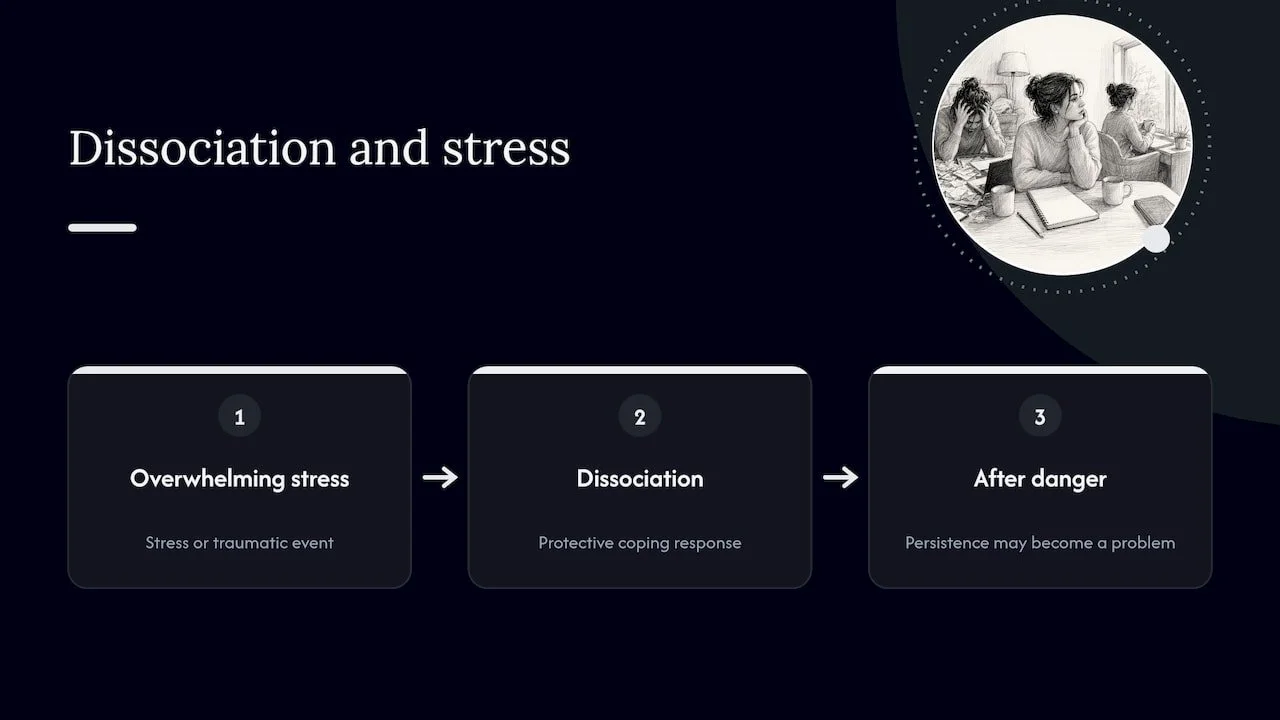
It is also one of the ways the mind copes when stress becomes too much. The same source notes that dissociation can follow a one-off or ongoing traumatic event, or abuse, and that episodes may last from hours or days to weeks or months.
The VA's National Center for PTSD describes the protective logic well. Depersonalization and derealization can work like a defense cascade, creating the perception that an overwhelming event "is not happening to me," which can let a person keep functioning under extreme conditions. In other words, dissociation usually begins as a survival skill. It becomes a problem when it keeps running after the danger has passed.
The main types of dissociation
Clinicians and educators group dissociation in slightly different ways. The list below follows the experiences people most often describe, and marks which ones correspond to formal diagnoses.
| Type | What it feels like | Formal diagnosis? |
|---|---|---|
| Everyday dissociation | Zoning out, absorption, autopilot | No, a normal experience |
| Depersonalization | Feeling detached from your body, thoughts or self | Yes, as depersonalization/derealization disorder when persistent |
| Derealization | The world looks foggy, flat, dreamlike or unreal | Yes, same diagnosis |
| Dissociative amnesia | Memory gaps beyond normal forgetting | Yes |
| Dissociative identity disorder | Distinct identity states with memory gaps | Yes |
| Other specified / unspecified | Dissociative symptoms that do not fit the other categories | Yes |
| Dissociative subtype of PTSD | PTSD plus depersonalization or derealization | Yes, a specifier of PTSD |
Everyday dissociation
This is the mildest and most common form. You get lost in a podcast, miss your exit, or realize you have been staring at a screen for twenty minutes. Researchers describe a range that begins with benign experiences such as daydreaming or flow and extends to entrenched symptoms that impair functioning. Everyday dissociation alone is not a disorder and does not need treatment.
Depersonalization
Depersonalization is a sense of being detached from yourself. People describe watching themselves from outside, feeling like a robot, or feeling that their body or thoughts do not belong to them. Emotions can feel muted or far away. The experience can be unsettling, and many people fear they are losing their mind. They are not: the hallmark of this condition is that you know something feels off.
Derealization
Derealization is the same kind of detachment pointed outward. Surroundings and people may seem foggy, flat, distant or unreal or dreamlike. A familiar room can feel like a movie set. If someone tells you it feels "like being high," this is often the kind of altered, unreal quality they mean, although dissociation involves no substance.
Dissociative amnesia
Dissociative amnesia involves memory gaps about yourself or past events that are more severe than normal forgetfulness and are not caused by another medical condition. The missing material is often connected to stressful or traumatic events. This is different from forgetting where you left your keys, and different from memory loss caused by injury, illness or substances, which a medical provider needs to rule out.
Dissociative fugue
Fugue, in which a person travels or wanders away and may be confused about who they are, is the type that many older articles list separately. In current classification it is treated as a feature of dissociative amnesia rather than a standalone disorder. It is rare, and it is the form most often exaggerated in movies.
Dissociative identity disorder
Dissociative identity disorder (DID), once called multiple personality disorder, involves identity states that differ from one another, along with memory gaps that cannot be explained by ordinary forgetting. It is among the five conditions the DSM-5-TR lists, along with depersonalization/derealization disorder, dissociative amnesia, unspecified and other specified dissociative disorder. DID is among the most misunderstood diagnoses. It is a trauma-related condition, not a personality quirk, and it is diagnosed by an experienced clinician rather than by an online quiz.
Other specified and unspecified dissociative disorders
These two categories exist for people whose symptoms are real and distressing but do not meet every criterion of the named disorders. They matter because a person can have significant dissociation and still need care. "Other" does not mean "lesser."
Dissociative subtype of PTSD
Some people with PTSD have the usual symptoms plus prominent depersonalization or derealization. Researchers recommended a dissociative subtype of PTSD defined by exactly that. The VA's National Center for PTSD reports that approximately 15 to 30% of veterans and civilians with PTSD report depersonalization and derealization symptoms. If your trauma history includes repeated or early harm, our guides to complex trauma and the difference between PTSD and C-PTSD can help you place what you are experiencing.
Derealization vs. depersonalization
This is the comparison most people search for, and the simplest way to hold it is by direction.
Depersonalization points inward. I feel unreal, detached, or like an observer of my own life.
Derealization points outward. The world feels unreal, distant or dreamlike.
The two are distinct, but they frequently occur in the same person, which is why the diagnosis combines them. Depersonalization/derealization disorder is characterized by persistent feelings of detachment from one's body or experiences, such as feeling that things are unreal or dreamlike.
One more detail separates this condition from psychosis. According to the Merck Manual, a diagnosis requires that reality testing stays intact. You know your perceptions are not literally true, even while they feel convincing. That is often reassuring to hear in the middle of a frightening episode.
A quick way to tell them apart
Ask yourself what feels wrong. If the answer is "I don't feel like me," "my hands look like someone else's," or "I'm watching myself talk," that leans toward depersonalization. If the answer is "the street looks like a painting," "everything seems far away," or "it feels like a dream," that leans toward derealization. Many people say both on the same day, and that overlap is expected.
Levels of dissociation: what people really mean
Searchers often ask about "levels" or "stages" of dissociation. There is no official, numbered ladder in the diagnostic manuals. What exists is a continuum. The research describes experiences that run from daydreaming or flow to entrenched symptoms that impair functioning and lead to a diagnosis.
A practical way to think about it, which is a description and not a clinical scale, is to look at three things:
Frequency. Does it happen once in a while, or most days?
Duration. Does it pass within minutes, or last hours, days or longer?
Impact. Does it get in the way of work, school, driving safely, relationships or your sense of safety?
Mild dissociation is brief, happens when you are tired or absorbed, and does not disrupt your life. Moderate dissociation shows up under stress and may leave you feeling numb or foggy for hours. Severe dissociation is persistent, repeated, or involves losing time and memory, and it usually deserves a professional evaluation. Those labels are for orientation only. A clinician decides whether symptoms meet criteria.
What dissociation can feel like in daily life
Beyond the named types, people tend to describe a handful of recurring experiences: feeling emotionally flat, feeling cut off from the body, seeing the world as hazy or two-dimensional, or struggling to remember recent events. Whether any of these is a sign of a disorder depends on how long they last and how much they interfere with your life, not on any single symptom.
Dissociation can also overlap with other trauma responses. Shutting down, going numb or "checking out" can be part of a freeze response, which we explain in types of trauma responses. Difficulty naming what you feel is a related pattern, covered in our piece on alexithymia and trauma. For a broader list of signs, see key examples of trauma symptoms adults should know.
What causes dissociation
The most common explanation is the mind's response to overwhelm: too much stress, a one-off or ongoing traumatic event, or abuse. When fight or flight is impossible, the mind may step back instead. Repeated in childhood, when a child cannot leave a harmful situation, that pattern can become a habit that follows a person into adulthood. Our list of childhood trauma impacts on adult life shows how widely this can reach.
Not every case traces to trauma. Dissociative symptoms can also appear alongside other conditions, so careful assessment matters.
When to seek an assessment
See a licensed mental health professional or your primary care provider if:
Detachment or unreality lasts for days or keeps returning.
You lose time, or find yourself somewhere with no memory of getting there.
Symptoms are affecting work, school, parenting or relationships.
Dissociation began after a traumatic event, or you also have flashbacks, nightmares or hypervigilance.
You feel unsafe. If you are in crisis or thinking about harming yourself, call or text 988, the Suicide and Crisis Lifeline, or go to the nearest emergency room.
A clinician will first consider whether symptoms are secondary to another medical or psychiatric condition. If so, treating that underlying problem comes first. If symptoms persist, the next step is referral to a psychiatrist to consider primary depersonalization/derealization disorder. Clinicians may also use structured tools, such as the Multidimensional Inventory of Dissociation, to assess dissociative symptoms. Please do not diagnose yourself or anyone else from a checklist.
Our perspective
At Alvarado Therapy we see dissociation as intelligence, not weakness. Almost always, it is a pattern that once protected someone. Our work with trauma survivors in Pasadena, Ventura and online across California starts from that view. We do not push anyone to relive painful memories before they are ready.
That matters for EMDR in particular. EMDR is a structured, phase-based therapy, and the early phases are about preparation and stability, not about processing right away. When someone dissociates easily, we slow down, build grounding skills and check readiness first. If you want to see how that screening thinking works, read our screening questions to ask before EMDR for dissociation and our overview of EMDR and phase-based care.
We also work in English and Spanish, and we know that language, culture and identity shape how people describe feeling "not here." Being understood in the words you grew up with can be part of what makes a person feel safe enough to come back into their body.
— Juiced
Getting support with us
If dissociation is part of your trauma story, we can help you work out what you are dealing with and what pace is right. Our individual counseling and EMDR therapy is available in Pasadena, Ventura and online for California residents, in English or Spanish.
For people who want focused time, we also offer EMDR intensives: a 1-day option of 4 hours for $1,500, a 1-day option of 6 hours for $2,250, or a 3-day intensive for $5,750. Whether an intensive is appropriate depends on your history and stability, which we assess together before any processing begins.
FAQ
Is derealization the same as depersonalization?
No. Depersonalization is feeling detached from yourself, while derealization is feeling that the world around you is unreal. They are distinct experiences, but they often occur in the same person, and in the DSM-5-TR they sit together in one diagnosis.
Can dissociation feel like being high?
Many people describe it that way, because the world can seem dreamlike, distant or unreal. Dissociation happens without any substance, though. If the feeling appears after drug use, a medical provider should evaluate it, since substances and medical conditions need to be ruled out.
Are there official levels of dissociation?
No formal levels exist in the diagnostic manuals. Dissociation is understood as a continuum from daydreaming and flow to symptoms that impair functioning. Clinicians look at how often it happens, how long it lasts and how much it disrupts your life.
Is dissociation always a sign of trauma?
Not always. Everyday dissociation like zoning out is common and normal. Persistent dissociation often connects to stress, trauma or abuse, but only an assessment can tell you whether that applies to you.
What is the dissociative subtype of PTSD?
It is PTSD with prominent depersonalization or derealization added to the usual symptoms. The VA's National Center for PTSD says roughly 15 to 30% of people with PTSD report those symptoms.
