
High-Functioning Anxiety: Signs, Causes and What Helps

High-functioning anxiety describes people who keep up with work, family and social life while living with constant worry, self-doubt and tension underneath. You may be the reliable one, the early one, the one who never drops anything. Inside, you feel wound tight. It is not an official diagnosis, but the distress is real, and it responds to treatment. This guide explains what it looks like, how it differs from conditions it gets confused with, what you can do on your own, and when it is time to talk to a therapist.
Alvaradotherapy
Find Support for Anxiety
Alvarado Therapy offers individual counseling and trauma-informed care for anxiety, with licensed therapists serving clients online throughout California.
TL;DR
High-functioning anxiety is an informal label for ongoing anxiety that hides behind achievement. It is not a formal diagnosis, but the symptoms can still meet the criteria for an anxiety disorder.
Common signs include overthinking, perfectionism, people-pleasing, trouble relaxing, poor sleep and physical tension.
Grounding tools like the 3-3-3 rule can calm a spike, but they do not remove the cause.
If anxiety drives your choices, wrecks your sleep or keeps you from enjoying what you earned, therapy is worth trying. Trauma-focused approaches such as EMDR can help when old experiences feed the worry.
Table of Contents
What high-functioning anxiety means
The term describes someone who appears successful on the outside and struggles with persistent anxiety on the inside. The Mayo Clinic News Network describes these people as often successful in their careers or other roles while privately dealing with stress, self-doubt and a fear of not measuring up.
It is not a clinical term. High-functioning anxiety is not included in the DSM-5, the manual clinicians use to diagnose mental health conditions. That matters in two ways. First, you will not see it on an insurance form. Second, the lack of a diagnosis does not mean your experience is minor. A clinician may look at the same pattern and recognize generalized anxiety disorder, social anxiety, or another anxiety condition.
The word "functioning" is the trap. It measures what other people can see: deadlines met, emails answered, family dinners hosted. It says nothing about the cost to you. Many people go years without help because nothing appears to be broken.
Signs of high-functioning anxiety
The signs fall into three groups: thoughts, behaviors and body. You do not need all of them. Look for a pattern that has lasted for months.
Thoughts and feelings
Constant overthinking. You replay conversations, rehearse conversations that have not happened and scan for what could go wrong.
Perfectionism and harsh self-criticism. A strong result feels like the minimum, and a small mistake feels like proof you are failing.
Fear of letting people down. You say yes before you check whether you have the capacity.
Difficulty relaxing. Rest feels unproductive, so even a vacation comes with a to-do list.
Dread that does not match the situation. A good review still leaves you waiting for the catch.
Behaviors
Overpreparing. You write the script, check the email four times and arrive 30 minutes early.
Procrastination followed by a late push. Fear of doing it imperfectly delays the start, then panic delivers the result.
Reassurance seeking. You ask a partner or coworker whether it is okay, then doubt the answer.
Avoiding what you cannot control. You skip opportunities where the outcome is unpredictable, even ones you want.
Nervous habits. Queensland Health lists nervous chatter, fiddling with hair and cracking knuckles among the visible signs.
Physical signs
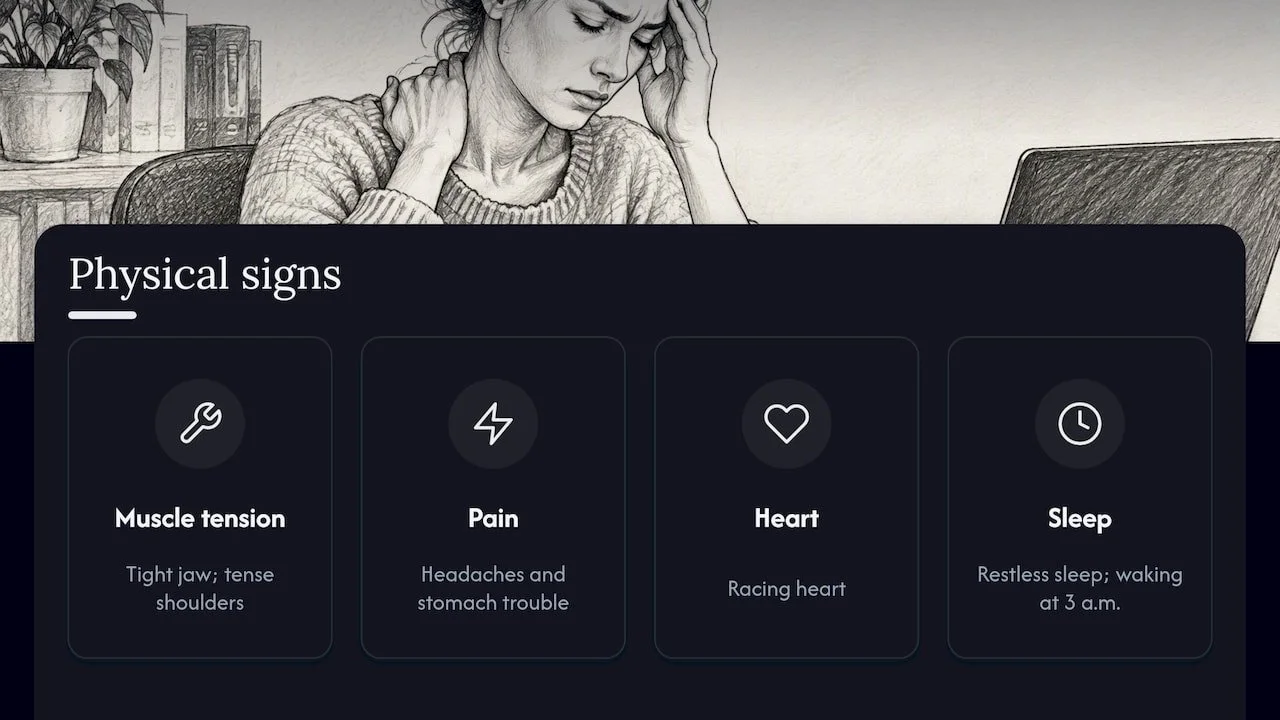
Anxiety lives in the body as much as the mind. People commonly report a tight jaw, tense shoulders, headaches, stomach trouble, a racing heart, restless sleep or waking at 3 a.m. with a full mind. If you want a closer look at how anxiety shows up physically, this guide to the physical symptoms of anxiety is a good place to start. Because these symptoms also have medical causes, mention them to a primary care provider, especially if they are new, severe or come with chest pain or fainting.
How it shows up in daily life
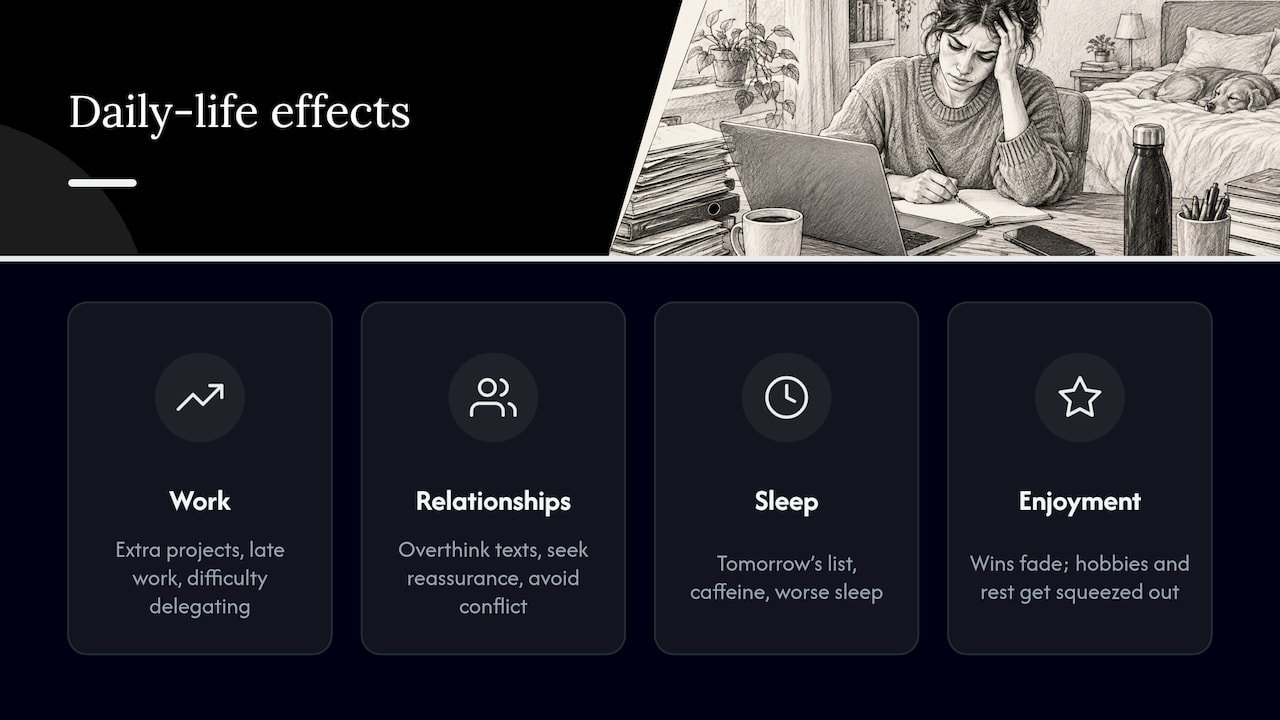
The effects spread quietly across several areas.
Work. You may be the person who takes on extra projects, works late and cannot delegate. Managers see a star. You feel a low hum of fear that stopping will expose you. Over time this can lead to burnout, irritability or sudden exhaustion after a long push.
Relationships. Anxiety can make you hard to reach even when you are present. You might overthink a delayed text, need frequent reassurance, or take on everyone else's problems to avoid conflict. Partners sometimes feel shut out, because you look fine and say you are fine. If this sounds familiar, our posts on coping tips for anxiety in relationships and managing anxiety in relationships go deeper.
Sleep. Nights are when the distractions fall away. Many people lie awake running tomorrow's list, then rely on caffeine to get through the day, which can worsen anxiety and sleep in a loop.
Enjoyment. Perhaps the biggest cost is that wins do not land. You hit the goal and immediately move the bar. Friends, hobbies and rest get squeezed out because they feel optional.
How it differs from other conditions
People often ask whether what they feel is something else. Only a licensed clinician can sort that out after an evaluation, but these distinctions help you prepare for that conversation.
| Condition | What it centers on | How it differs from high-functioning anxiety |
|---|---|---|
| Generalized anxiety disorder (GAD) | Excessive, hard-to-control worry about many things, on most days, for months | A formal diagnosis. High-functioning anxiety is often a way of describing GAD or a similar condition when it is well hidden |
| Everyday stress | A response to a specific demand, such as a deadline or a move | Stress usually eases when the demand ends. High-functioning anxiety keeps going when things are calm |
| ADHD | Difficulty with attention, impulse control and organization | Can look similar (restlessness, procrastination, poor sleep), but the core issue is attention regulation, not fear. The two can also occur together |
| Social anxiety | Fear of judgment in social or performance situations | Narrower. Many people with high-functioning anxiety are comfortable with others but fear failure or disappointing them |
| Burnout | Exhaustion from prolonged work demands | Burnout is often the result of years of unmanaged anxiety driving overwork |
| Trauma-related anxiety | Hypervigilance and reactivity rooted in past experiences | The anxiety may be a survival strategy learned early, so overachieving feels like safety |
The last row is worth a pause. For many adults, high achievement began as a childhood strategy: be good, be useful, avoid conflict, stay ahead of the next problem. The habit worked, and it kept working long after the danger ended.
Why it develops
There is rarely one cause. Genetics and temperament play a part. Environments that rewarded performance, or where love felt conditional on being helpful, play another. Chronic stress, immigration and cultural expectations of sacrifice, discrimination, caregiving responsibilities, and unresolved trauma all add weight. Many of the people we work with are first-generation professionals, children of immigrants or caregivers, for whom being "fine" and "strong" was a family value. Wanting to succeed is not the problem. The problem is when fear is doing the driving.
Is it ever helpful?
Anxiety does push people to prepare, notice problems and care about quality. That is why some people hold onto it. The question is the price. If your motivation depends on dread, and you cannot enjoy results or rest without guilt, the benefits are borrowed against your health, sleep and relationships.
What you can do on your own
Self-help does not replace treatment, but it can lower the baseline and help you notice patterns.
Name what is happening. Try "my anxiety is telling me this must be perfect" instead of "this must be perfect." Naming creates a little distance.
Use the 3-3-3 rule when you spike. Look around and name three things you see, name three sounds you hear, then move three parts of your body, such as ankles, fingers and shoulders. It is a grounding exercise that pulls attention to the present. It calms a moment. It does not treat the root cause.
Schedule worry. Set 15 minutes for it. When worries appear at other times, jot them down and defer them.
Practice good-enough. Pick one low-stakes task each week and deliberately finish it at 80 percent. Observe what actually happens.
Protect sleep. Keep a consistent wake time, stop work screens well before bed, and keep a notepad by the bed to empty the to-do list.
Set one boundary. Decline one request this week without an elaborate explanation.
Move your body. Walking or exercise helps discharge the physical tension anxiety builds.
For more structure, see our guides to managing anxiety daily with trauma-informed strategies, an effective daily workflow for anxiety and practical anxiety coping tips for California adults. Young adults may prefer these coping ideas for anxiety in young adults. A broader read on practical strategies to ease anxiety symptoms can add more options to try.
It also helps to map your triggers. Our article on examples of anxiety triggers and how therapy helps gives common patterns, from inbox pressure to family dynamics.
How it is treated
Treatment depends on what a clinician finds. Anxiety disorders are commonly treated with psychotherapy, medication or both. Cognitive behavioral therapy is a common starting point, because it teaches you to test anxious predictions and change avoidance and overpreparing habits. Acceptance-based and mindfulness approaches help you stop fighting the feeling. A psychiatrist or other prescriber can discuss medication if symptoms are severe.
When anxiety is tied to earlier experiences, such as a chaotic childhood, emotional neglect, a frightening event or years of discrimination, talk-based skills alone may not reach the source. That is where trauma-focused therapy comes in. EMDR (eye movement desensitization and reprocessing) helps the brain reprocess distressing memories so they stop triggering today's alarm. You can read more in our posts on EMDR for anxiety treatment, the benefits of EMDR for anxiety and why people choose EMDR for anxiety.
Our perspective
In our practice, the people who describe themselves as high-functioning are rarely lacking in insight. They have read the articles, tried the apps and can explain their patterns better than most clinicians. What they cannot do is switch the pattern off. When we look closely, the anxiety is often a learned protection: stay useful, stay ahead, stay unnoticed. For that reason we treat the overachieving as a skill that was once necessary, not as a flaw to be scolded away.
We also see how culture and identity shape this. For many Latinx, BIPOC and LGBTQ+ clients, and for children of immigrants, performing well was tied to safety and belonging. Therapy that ignores that context can feel like being told to care less about the people you love. So we work in English and Spanish, and we build care around your values rather than against them. The goal is not to take away your drive. It is to let you choose it, instead of being chased by it.
If you recognize yourself here, you are not exaggerating and you are not being dramatic. Being capable and being in pain can both be true.
— Juiced
When to seek professional help
Consider booking an appointment with a licensed therapist or your primary care provider if:
Worry has been present most days for several months.
Your sleep, appetite or concentration has changed.
You avoid things you want to do, or you cannot stop doing things you want to stop.
You rely on alcohol, cannabis, overwork or other habits to turn the noise down.
Physical symptoms, such as a racing heart or stomach problems, keep recurring.
Relationships are strained because you are tense, withdrawn or constantly seeking reassurance.
Anxiety is tied to a past event or a long stretch of difficult experiences.
If you ever have thoughts of harming yourself, call or text 988, the Suicide & Crisis Lifeline, or go to the nearest emergency room. Do not wait for an appointment.
Working with us
We are a trauma-informed practice with licensed therapists serving clients in Pasadena, Ventura and online throughout California, in English and Spanish. Ongoing weekly work is available through individual counseling and EMDR therapy, and relationship patterns can be explored in couples therapy.
If weekly sessions have not been enough, or your schedule makes them hard to sustain, an EMDR intensive concentrates the work into longer blocks. We offer a 1-day intensive of 4 hours for $1,500, a 1-day intensive of 6 hours for $2,250, and a 3-day intensive for $5,750. Intensives suit people who want focused progress on a specific set of memories or patterns. If you are not sure which format fits, start with a conversation about your goals.
FAQ
Is high-functioning anxiety a real diagnosis?
No. It is an informal term, and it does not appear in the DSM-5. A clinician may diagnose an anxiety disorder such as generalized anxiety disorder based on your symptoms. The informal label does not make your distress any less real.
Is high-functioning anxiety a form of ADHD?
No, they are separate. ADHD involves difficulty regulating attention and impulses, while anxiety centers on fear and worry. They can look alike, because both may involve restlessness, procrastination and poor sleep, and some people have both. An evaluation with a licensed clinician is the way to tell them apart.
What is the 3-3-3 rule for anxiety?
It is a quick grounding exercise. You name three things you can see, three sounds you can hear, and move three parts of your body. It brings attention back to the present, which can take the edge off a spike. It works best as a short-term tool alongside therapy or other longer-term strategies.
How do you treat high-functioning anxiety?
Treatment depends on your symptoms and history. Therapy, such as CBT, mindfulness-based approaches or trauma-focused EMDR, is common, and a prescriber may discuss medication. Lifestyle changes like regular sleep, movement and boundaries support the work. A licensed therapist can help you choose a starting point.
