
Anxious Attachment and Dating: A Practical Guide for 2026

Dating with an anxious attachment style is hard because your nervous system treats uncertainty as danger. A slow reply, a canceled plan or a vague "let's see how it goes" can feel like the start of being left. You can date well with this pattern. It takes three things: knowing your triggers, slowing the pace, and choosing partners who respond consistently. This guide covers all three, plus the point where therapy does more than tips can.
Alvaradotherapy
Explore Support for Relationship Patterns
Alvarado Therapy offers trauma-informed individual counseling for adults navigating relationship difficulties, anxiety, and the roots of painful patterns.
TL;DR
Anxious attachment is a learned pattern of fearing abandonment. It is not a flaw, and it can shift toward security over time.
The early rush of intense chemistry is often anxiety, not compatibility. Judge people by consistent actions over weeks, not by how a date felt.
Say your needs early, calmly and directly. Do not test people, hint, or flood them with texts.
Your partner's steadiness matters as much as your own work, so choose people who are reliable and not overwhelmed by reassurance.
If dating keeps reopening old wounds, trauma-focused therapy such as EMDR can address the roots rather than just the symptoms.
Table of Contents
What anxious attachment looks like when you date
Attachment styles describe how we learned to seek safety in close relationships. With an anxious (sometimes called preoccupied) style, you tend to crave closeness and worry that it will be taken away. In dating, that usually shows up in recognizable ways:
You get attached quickly, often fantasizing about a future after two or three dates.
You scan for signs of interest: reply time, emoji use, whether they initiated.
You shape yourself around what you think the other person wants, and lose track of what you want.
Silence feels like a verdict, so you fill it with reassurance-seeking, apologies or protest behavior.
You stay in situations that feel bad because the occasional warmth feels like a reward.
The last point matters. Simply Psychology's guide to attachment styles and dating describes how the intensity of anxious attachment can create powerful early feelings that feel like certainty before you actually know the person well. That feeling is real, but it is not information about them.
Why it is not just "being too much"
A common story is that anxious people are needy and that the fix is to need less. Research does not support such a one-sided picture. Researchers working on dyadic regulation, including Jeffry Simpson, find that the quality of an insecurely attached person's relationship depends heavily on how their partner responds under stress. A partner who is consistent and non-retaliatory can calm the system. A partner who is hot and cold will set it off.
Work by Lorne Campbell and colleagues points the same way: the behaviors people dislike about themselves, such as reassurance-seeking and conflict escalation, appear mainly when the attachment system feels threatened. In a calm, predictable situation, they often do not appear at all. That is good news. Your worst dating behavior is not your personality. It is a threat response, and threat responses respond to the right conditions.
What triggers anxious attachment in dating
Triggers are specific. Naming yours in advance is the most useful thing you can do before a first date.
| Common trigger | What your mind tells you | A more grounded read |
|---|---|---|
| Slow or missing text reply | "They lost interest." | Most people are at work, tired, or bad at texting. One data point is not a pattern. |
| Vague plans ("let's play it by ear") | "I'm not a priority." | It may be style. Ask a clear question and watch how they answer. |
| They are still seeing other people | "I have to compete or I'll lose them." | Early on, this is normal. It is also a legitimate reason to decide what you need. |
| A warm date followed by distance | "I did something wrong." | Inconsistency says something about their availability, not your worth. |
| Compliments and intensity too fast | "This is the one." | Intensity is not intimacy. See below. |
On the third trigger, Psychology Today has written that dating someone who is seeing several people can be especially difficult with an anxious style. You are allowed to decide that is not an arrangement you want, without it being a character defect.
Chemistry is not compatibility
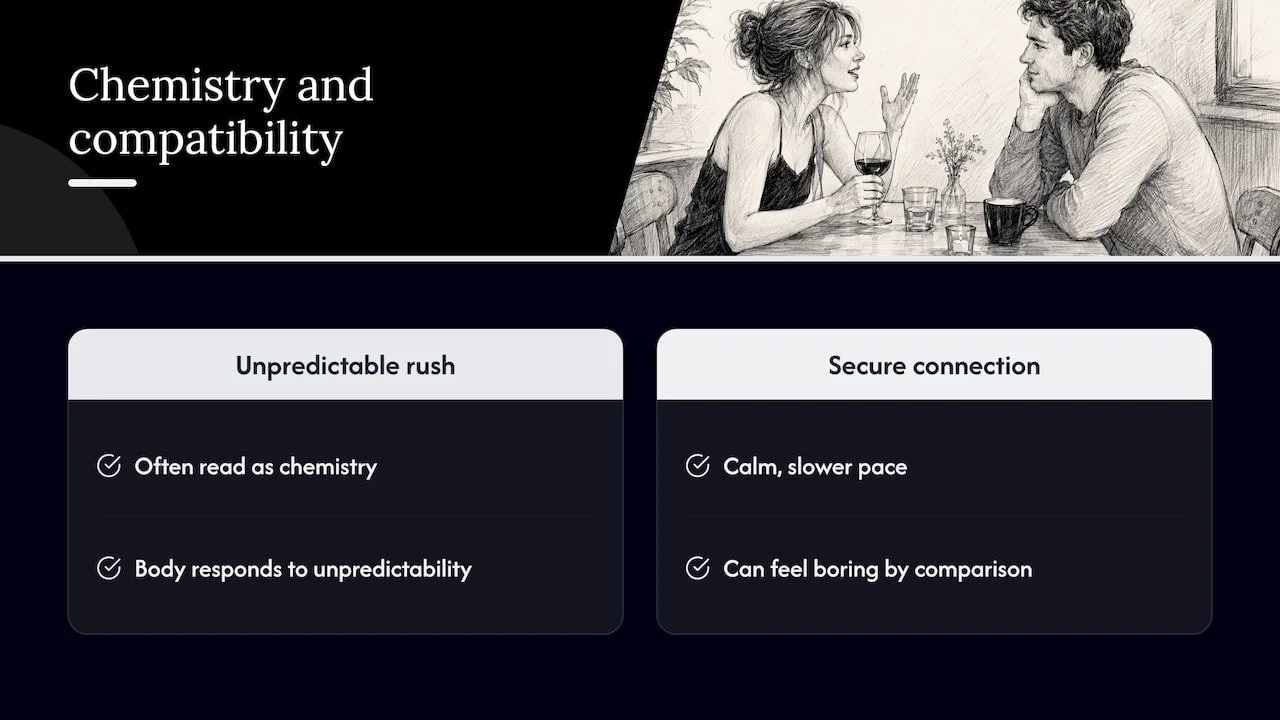
The most counterintuitive part of dating anxious is that the people who feel most thrilling are often the least safe. Relationship coach Stephanie Rigg, speaking on the On Attachment podcast, argues that the rush many anxious daters read as chemistry is often the body responding to unpredictability. The calm, slower pace of a secure connection can feel boring by comparison, and that is the point.
A useful test: after a date, do you feel settled or activated? Excited and settled is a good sign. Obsessively checking your phone and replaying the conversation is information about your nervous system, not proof of a soulmate.
How to date with an anxious attachment style
These steps work best when you use them together.
1. Get clear on your values and needs before you swipe
Write down three to five things you need in a relationship: for example, someone who communicates plans, who is emotionally available, and who is open about their intentions. Then write down what you will not trade for excitement. When you feel the pull toward a person who ticks none of those boxes, you have something to hold against the feeling.
2. Slow the pace deliberately
Anxious attachment speeds things up: more texting, earlier exclusivity, earlier "what are we." Try structural limits instead of willpower:
Meet in person before you invest in long message threads.
Space dates out, with a couple of days between, so you can notice how you feel in between.
Keep your own routine: friends, exercise, hobbies. You need a life the dating does not replace.
Hold off on sharing your deepest history until the person has shown you consistent behavior.
3. Handle texting without spiraling
The On Attachment episode notes that texting can create an addictive loop: each reply gives a small dopamine hit, followed by anxiety while you wait. A few practical habits help:
Turn off read receipts and message previews while you are in early dating.
Do not check the phone during the "gap." Set a time to look, and do something else until then.
Before sending a follow-up, ask yourself whether it is a question or a request for reassurance. If it is the second, wait ten minutes.
Draft the text you want to send, then don't send it. Often the urge passes.
4. Communicate needs early, calmly and directly
The research on dyadic regulation suggests that replacing withdrawal or protest with direct communication about needs helps interrupt the cycle of distress and reactivity. In practice, that sounds like:
Instead of going quiet after a vague plan: "I like seeing you. Are you free Saturday evening?"
Instead of testing: "I'm someone who likes to hear from the person I'm dating a few times a week. Does that work for you?"
Instead of apologizing for having needs: "That left me feeling anxious. Can we talk about it?"
How they respond is the data. A person who answers with care, even if they cannot give you everything, is a very different person from one who gets defensive or punishes you for asking.
5. Watch actions, not words
It is easy to build a story from what someone says and ignore what they do. Over several weeks, look at how consistently they show up, whether they follow through on small things, and whether you feel more like yourself or less like yourself around them. Consistency is the thing your nervous system most needs to learn to trust.
6. Avoid self-abandonment
One of the quietest risks is shape-shifting: agreeing with everything, hiding preferences, or dropping your own plans to be available. If you notice you have no opinions left on a third date, that is a sign to slow down and re-anchor in what you like.
Choose partners who can regulate with you
Most advice is about fixing yourself. The research adds something: partners can act as a buffer. Work on partner buffering of attachment insecurity describes how some partners find ways to emotionally and behaviorally regulate an insecurely attached person, which makes the relationship better than it would otherwise be. The same body of work suggests that someone who offers steady reassurance without being overwhelmed can help you feel safer over time.
In practical terms, look for people who:
Say what they will do, then do it.
Stay present in disagreements instead of disappearing or retaliating.
Are curious about your needs and can state their own.
Can tolerate you being anxious sometimes without taking it as an attack.
This is not about finding someone to "fix" you. It is about choosing conditions in which you can grow, and being a steady presence for them too.
Should you date at all while anxious?
Yes, in most cases. Avoiding dating protects you from rejection but also from the experiences that teach your system that closeness can be safe. The more useful question is whether you have the support to do it well. Some signs you may want help before or alongside dating:
You feel panicky or physically ill when someone does not reply.
You repeatedly end up with people who are unavailable or unpredictable.
Rejection or silence brings up memories or feelings that seem far bigger than the situation.
You find yourself checking, monitoring or contacting people in ways you regret afterward. Research indicates that higher attachment anxiety is linked with more pursuit behavior after breakups and more problems in online dating, so this is a pattern worth taking seriously, not a reason for shame.
If the distress ever becomes overwhelming, call or text 988. The 988 Lifeline is free, confidential and available 24/7 in English and Spanish. If you are unsure whether to call 988 or 911, our guide to 988 vs 911 explains the difference.
Is it anxious attachment, or is this person not good for you?
Not every anxious feeling is your attachment style. Sometimes you are anxious because the person is being inconsistent, evasive or controlling. Ask yourself:
Would most people feel uneasy in this situation?
Is my anxiety showing up with everyone, or mainly with this person?
Do I feel better when I express a need, or worse?
If your anxiety is high with one person and low with someone else, you are not broken. You are reacting to different conditions. And if intensity, fear and relief are tangled together in a way that is hard to leave, read our piece on trauma bonding versus attachment, which explains why power imbalance, not just intensity, is what separates the two.
Can an anxious attachment style change?
Yes. Studies of attachment patterns emphasize they are not fixed. Experience in steady relationships, self-awareness and therapy can all move people toward what researchers call earned security. A meta-analytic review of 73 studies covering 21,602 people confirmed that attachment anxiety predicts lower romantic relationship quality, which is why it is worth working on, and not only enduring.
If you want a plain-language overview of how therapeutic support can shift these patterns, this explainer on attachment styles and toxic relationship patterns is a good companion read. For our own take, see Attachment Theory Explained.
Our perspective: the pattern usually has a history
At Alvarado Therapy, we are a trauma-informed practice. When someone tells us they are anxiously attached, we rarely start with dating tactics. We start with a question: when did closeness first feel unsafe or unreliable?
For many people, the answer is childhood: a caregiver who was warm and then absent, a home where love depended on performance, or a loss that was never processed. For others, it is a betrayal or a breakup that confirmed their worst fear. In those cases, the dating behavior is the symptom, and tips will only go so far. Telling yourself "don't text him" does not help when your body believes you are about to be abandoned.
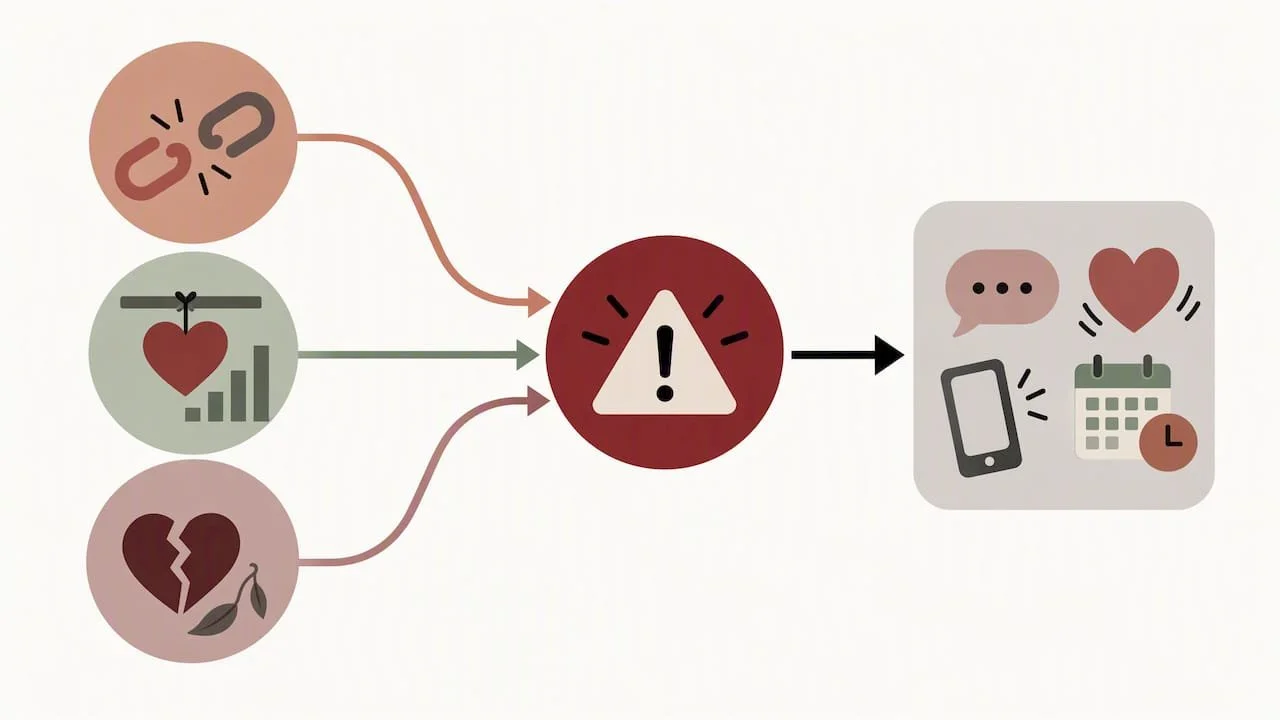
That is why we use EMDR (eye movement desensitization and reprocessing) alongside conventional counseling. EMDR is built to help the brain reprocess distressing memories so they stop firing in the present. We also see how cultural background shapes attachment: family expectations, immigration separations, and identity-related rejection all affect how safe closeness feels. We offer care in English and Spanish, and we work with Latinx, BIPOC and LGBTQ+ clients in a way that treats identity as part of the picture, not a side note.
We will not promise that therapy makes you secure by a certain date. What we can say is that people often find the anxiety loud at first, then quieter once the old material has somewhere to go. If you are curious whether EMDR could help with anxiety in social or dating situations, that is a good question to bring to a first session. We will tell you honestly what it can and cannot do for your situation.
— Juiced
When to consider therapy, and what kind
Therapy is worth considering if the patterns above show up across relationships, if dating leaves you shaken for days, or if you recognize a trauma history behind them. Types of help you might compare:
Individual counseling: a steady place to understand your patterns and practice new responses.
EMDR therapy: targets the memories and experiences feeding the fear, rather than only managing it.
Couples therapy: when you are already in a relationship and the anxious-avoidant cycle is the problem. Both partners learn to regulate each other.
Self-guided work: worksheets and journals can support, though they do not replace therapy for deeper trauma.
If you are already in a relationship, our articles on coping with anxiety in relationships, what relationship anxiety is and repairing attachment injuries may help you decide next steps.
Working with us
We offer individual counseling and EMDR therapy online throughout California and in person in Pasadena and Ventura. If you want focused, concentrated work instead of weekly sessions, our EMDR intensives are available as a 1-Day Intensive of 4 hours for 1500 USD, a 1-Day Intensive of 6 hours for 2250 USD, or a 3-Day Intensive for 5750 USD. If dating patterns are playing out inside a current relationship, see our couples therapy page. You can book online from our site.
FAQ
How do you deal with anxious attachment when dating?
Start by noticing your triggers, then slow the pace: space out dates, limit texting and keep your own routine. Say your needs clearly and early, and watch how the person responds. Over time, consistent partners and, when needed, therapy help your system learn that closeness can be safe.
Should I date if I have an anxious attachment?
Yes, most people with an anxious style can date and build good relationships. Avoiding dating tends to reinforce the fear. If rejection or silence leaves you overwhelmed for days, or you often end up in painful dynamics, consider working with a therapist alongside dating.
What triggers anxious attachment in dating?
Common triggers are delayed replies, vague plans, a partner who is still seeing other people, and hot-and-cold behavior. Research shows these reactions appear mainly when the attachment system feels threatened, so steady, predictable behavior from a partner tends to reduce them.
Can EMDR help with anxious attachment or social anxiety?
EMDR is designed to reprocess distressing memories, and attachment fears often trace back to such experiences. It is not a quick fix, and results vary. A consultation with a licensed therapist can help determine whether it fits your history and goals.
Sources
Campbell and colleagues on attachment-related processes (PubMed)
Psychology Today: How to Date Someone Who Is Seeing Other People
Li and Chan (2012): meta-analytic review of attachment and relationship quality
