
Immigration Evaluation Sample: What a Report Contains

A sample immigration evaluation shows you the architecture of a forensic psychological report: who referred the person, what history was gathered, what the clinician diagnosed, and how those findings connect to the legal question. It does not show you what your report will say, because no two cases are alike and there is no single government-issued template. This guide walks through the sections of a typical report, using an invented, composite illustration so no real person's story is exposed, and explains how to use a sample without being misled by it.
Alvaradotherapy
Understand Your Immigration Evaluation
Alvarado Therapy provides immigration psychological evaluations, with bilingual, culturally responsive care for clients across California.
TL;DR
There is no official standardized "sample" for immigration psychological evaluations. Reports follow professional guidelines, and structure varies by clinician and case type.
Most reports share the same spine: referral and purpose, consent, sources of information, history, testing and interview findings, diagnostic impressions, and a legal-psychological analysis.
A diagnosis alone rarely carries a case. The part adjudicators weigh is the link between your symptoms and the specific legal consequence of removal or denial.
Use samples to understand format, never to copy wording. Your attorney decides which questions the report must answer.
An evaluation is a forensic assessment, not therapy. The evaluator's role is objectivity, and that is what makes the report credible.
Table of Contents
Why there is no single official sample
People search for a sample hoping for a form to fill in. Immigration psychological evaluations are not forms. According to the American Board of Professional Psychology, they are assessments done for a legal purpose that address specific psycholegal referral questions, typically examining trauma-related symptoms and related functioning. The questions come from the legal claim, so the report changes with the claim.
What does exist is professional guidance. A 2022 paper, Professional guidelines for psychological evaluations in immigration proceedings, sets out practice standards intended to help psychologists add reliable information to immigration proceedings. The standards emphasize objectivity, cultural humility, and trauma-informed assessment. Any clinician worth hiring works from guidance like this rather than from a fill-in-the-blanks template.
That is why samples you find online look different from each other. A report for an asylum claim reads differently from one supporting a hardship waiver, and both differ from a report for a U visa, where the focus is the psychological impact of a qualifying crime.
The anatomy of an immigration evaluation report
Professional reports usually include an introduction covering the referral source and purpose, a detailed clinical history, diagnostic impressions based on the DSM-5, a case formulation linking mental health to the specific legal claim, and recommendations, as described in ABPP's overview. Here is how that looks in practice, section by section.

1. Identifying information, referral source and purpose
The opening states who the evaluee is, who asked for the evaluation (usually an attorney), the type of case, and the questions to be answered. An illustrative line might read: "Ms. R. was referred by her attorney for evaluation of psychological symptoms and the anticipated effect of her husband's removal on her functioning, in support of a hardship waiver application."
This section tells the reader at once what the evaluation is for. If a sample you find leaves out the purpose, treat it as incomplete.
2. Informed consent and limits of confidentiality
Consent in a forensic evaluation is more involved than in therapy. Published guidance on reporting to immigration clients, in Professional Psychology: Research and Practice, stresses accessible reporting and explaining results in a person's own language. In practice the evaluator explains that the report will go to an attorney and possibly an immigration court or USCIS, that confidentiality works differently than in therapy, and that no treatment relationship is being created.
A good report records that this conversation happened, and in which language.
3. Sources of information
This lists everything the evaluator relied on: the clinical interview (with its length and language, and whether an interpreter was used), standardized measures, and records such as medical files, school records, police reports, or declarations. Reports that rest on a single interview are easier to challenge than reports that triangulate several sources.
4. Background and clinical history
This is usually the longest section. It covers family of origin, childhood, migration history, experiences of violence or persecution, relationships, work, health history, and current stressors. For a hardship case it also describes the qualifying relative: health, finances, caregiving roles, and ties to the community.
A composite example: "Mr. L. describes growing up in a household where he witnessed violence. He migrated at nineteen after threats from a local group. He reports nightmares several nights a week since arriving in the United States." The best reports stay specific and sourced to what the person said, with the evaluator noting where records agree or disagree.
5. Behavioral observations and mental status
The clinician describes how the person presented: affect, speech, attention, and how they handled distressing topics. This is observation, not interpretation. Samples often keep it to a short paragraph.
6. Assessment results and diagnostic impressions
Here the evaluator reports structured questionnaires or tests, and any diagnoses such as PTSD, major depressive disorder, or an anxiety disorder, with the DSM-5 criteria explained. Credible reports also address consistency and the possibility of over- or under-reporting, because evaluators serve the court's need for accuracy, not the applicant's wish for a particular result.
7. Psycholegal analysis
This is the section that separates a useful report from a clinical summary. Guidance from the Executive Office for Immigration Review in a 2026 Board of Immigration Appeals decision shows why: the Board held that a person's own testimony about a medical or mental health condition will generally be insufficient to establish exceptional and extremely unusual hardship where expert reports or medical evidence exist or could be obtained. The practical lesson is that expert evidence matters, and that it needs to speak to the legal standard.
A diagnosis is a starting point. The analysis explains how the symptoms would function if the person were removed, or if a qualifying relative were separated from them: loss of treatment access, caregiving gaps, risk of deterioration, effects on children.
8. Conclusions and recommendations
The report ends with a clear opinion, in plain language, and often with treatment recommendations. It states the limits of the opinion. It should not say that the case "should" be approved, since that decision belongs to the adjudicator.
A short composite excerpt, and how to read it
Here is an invented excerpt for a hardship-style case, shown only to illustrate tone:
"Mr. D. meets criteria for posttraumatic stress disorder. His symptoms include intrusive memories, avoidance of reminders, and sleep disturbance. He has received no treatment in the United States. His spouse, a U.S. citizen, reports that she manages his appointments and daily medication reminders. In the evaluator's opinion, separation would likely worsen his symptoms, and the spouse's own anxiety would likely increase given her reliance on a shared household routine."
Notice what it does. It names a diagnosis, connects symptoms to daily functioning, links the qualifying relative, and states an opinion in measured language. It does not exaggerate. It also does not decide the legal outcome.
If you want to see a public example of this kind of document, the Tahirih Justice Center publishes an asylum sample psychological evaluation. It is built for asylum, so a hardship case will look different.
How the report differs by case type
| Case type | What the report usually focuses on |
|---|---|
| Asylum or withholding | Trauma history, symptoms consistent with reported harm, fear of return, effect of trauma on memory and testimony |
| Hardship waiver (such as I-601A) | Impact of separation or relocation on the qualifying relative: mental and physical health, dependence, finances, children |
| Cancellation of removal | Exceptional and extremely unusual hardship to a qualifying relative, often with medical and educational factors combined |
| U visa | Psychological consequences of being a victim of a qualifying crime |
| VAWA self-petition | Effects of abuse and the applicant's current functioning |
The case type decides the referral question, and the referral question decides what the report must contain. That's the reason to talk to your attorney before choosing an evaluator.
What makes a report persuasive, and what undermines it
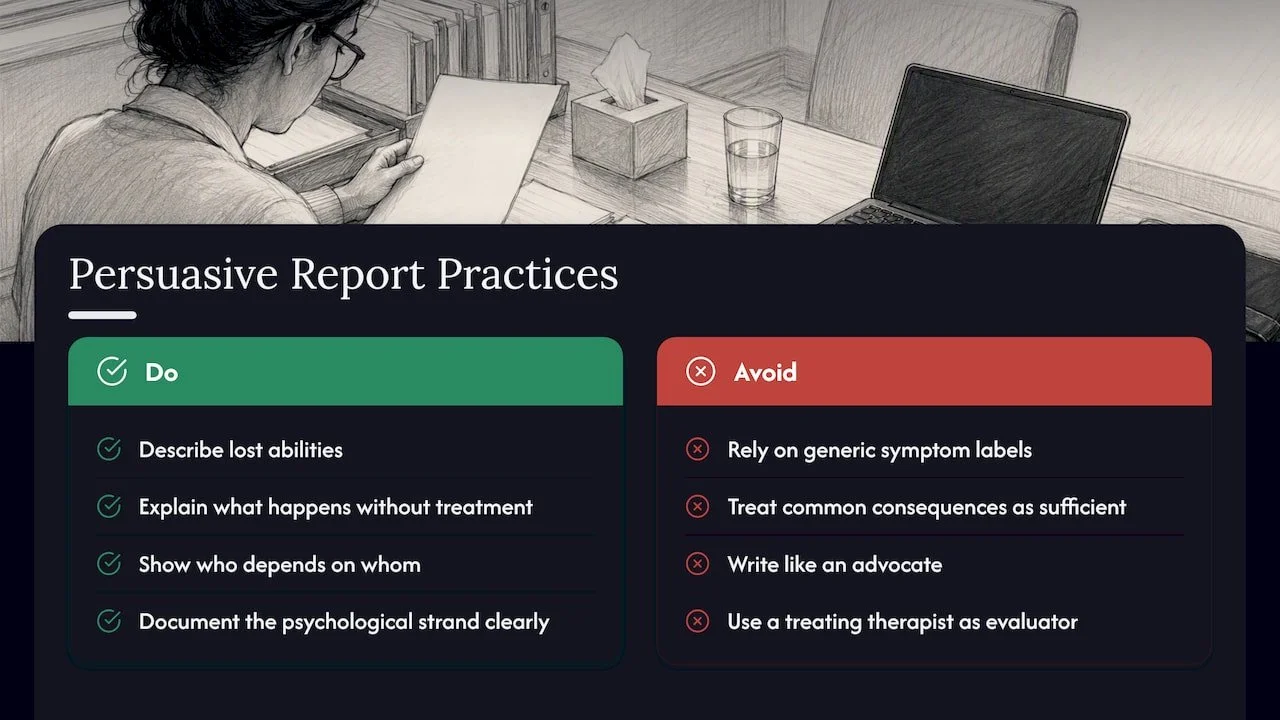
Specificity. Adjudicators see many reports that say a person is "anxious and depressed." The ones that help describe what the person can no longer do, what would happen without treatment, and who depends on whom.
Aggregation of factors. Common consequences of removal, such as financial loss, family separation, or cultural readjustment, are generally not enough on their own to meet a high hardship standard, according to USCIS. Success often depends on showing several factors together: financial, medical, psychological, educational. A strong report documents the psychological strand clearly and leaves the others to the attorney's evidence.
Neutral tone. Evaluators are forensic experts, not advocates. A report that reads like a plea is weaker than one that reads like a careful assessment.
Consistency with other evidence. If the history in the report contradicts the declaration filed with the application, credibility suffers. Tell your evaluator and your attorney about any inconsistencies you know of before the report is written.
Role clarity. Being both treating therapist and forensic evaluator creates a dual-role conflict, as ABPP notes. Ask any evaluator how they handle this. If you already see a therapist, that person usually should not write your forensic report; they can provide treatment records instead.
Our perspective on evaluations
We see the same worry again and again: people fear that they must "prove" their suffering, or that a report will turn their worst experiences into paperwork. The way we think about it is different. A good evaluation is a careful, respectful record of what a person has lived through and how it affects them now, written so that a stranger who has never met you can understand it.
Because we are a trauma-informed, bilingual practice, we pay attention to how an evaluation feels as well as what it produces. Telling a trauma history in a second language is harder, and being asked about it by a stranger is harder still. We offer care in English and Spanish, and we believe a person should be able to explain their life in the language they think and feel in. We work with Latinx, BIPOC and LGBTQ+ clients, and identity-affirming practice means we do not treat a person's culture or identity as an obstacle to be explained away.
We also believe in honesty about limits. A report cannot guarantee an outcome, and we would never promise one. What it can do is give an adjudicator a clear, credible picture they would not otherwise have. Evaluation and therapy are separate roles, and we explain that difference at the start so there are no surprises later.
— Juiced
How to prepare for your own evaluation
Talk to your attorney first. Ask what legal standard applies and what questions the evaluator should address. Your attorney may want to share the declaration and key records.
Gather documents. Medical records, prescriptions, school records for children, police or court records, and any prior mental health treatment notes.
Think through your timeline. Dates and places matter. If you are unsure of a date, say so rather than guessing. Honest uncertainty is more credible than invented precision.
Choose your language. Ask for the evaluation in the language you are most comfortable in. If an interpreter is used, ask how that will be documented.
Plan for a hard day. The interview covers painful material. Arrange rest, food, and support afterward, and tell the evaluator if you need a break.
Ask about timing. Reports take time to write and review, and your filing date may be fixed. Share any deadline at the first contact.
Ask how the report will be shared. The report generally goes to your attorney, who decides whether to submit it.
For a deeper walk-through of the process, see our immigration evaluation process guide and our immigration psychological evaluation guide. If you want to understand why evaluations carry weight in court, why immigration evaluations matter covers it.
Red flags in samples and in evaluators
A sample presented as a template to copy. Reusing language across clients is a warning sign. Each report should reflect the individual.
Guaranteed results. No honest clinician can promise how a judge or officer will rule.
No explanation of consent or confidentiality. This should be covered before any questions are asked.
Diagnosis without analysis. A report that lists symptoms but never links them to the legal question leaves the hardest work undone.
No attention to language and culture. If you are asked to complete a lengthy trauma interview in a language that is not yours, without an appropriate plan, the findings may be less accurate.
Working with Alvarado Therapy
We provide immigration psychological evaluations in California and New York, in English and Spanish, with a trauma-informed approach. Evaluations are for people whose attorneys need a clear clinical record for a case; the details of your legal claim stay with your attorney. You can read more and get in touch on our immigration evaluations page. Pricing for evaluations is not published, so please contact us for specifics.
If you are also struggling with the weight of the process, our practice offers individual counseling and EMDR therapy, which is a separate service from a forensic evaluation.
FAQ
Can I download a sample immigration evaluation to use for my case?
You can find public samples, but they should be used to understand structure only. Your report must reflect your own history and answer your attorney's questions. Copying another person's wording could damage credibility.
What is asked during an immigration psychological evaluation?
Expect questions about your childhood, family, migration, experiences of harm, current symptoms, sleep, mood, health, work, and relationships. For hardship cases you will also be asked about the qualifying relative. The interview can be emotional, and you can ask for breaks.
Is an immigration evaluation the same as therapy?
No. It is a forensic assessment for a legal purpose, and the report goes to your attorney and possibly the court. That is why the evaluator keeps a neutral role, and why a treating therapist usually should not also be your evaluator.
How much does an immigration evaluation cost?
Fees vary by clinician, case type, and the amount of record review and testing involved. We do not publish a price for our evaluations, so please contact us to ask about your situation.
Does a diagnosis guarantee my case will succeed?
No. Adjudicators look at whether your symptoms and circumstances meet the legal standard for your claim. A diagnosis helps only when the report explains how it connects to that standard, and the legal decision belongs to the judge or officer. Your immigration attorney can tell you how the report fits your case.
Sources
Professional guidelines for psychological evaluations in immigration proceedings
Professional Psychology: Research and Practice, accessible assessment reports for clients
Asylum Sample Psychological Evaluation, Tahirih Justice Center
