
Acculturation Stress: Signs, Causes and What Helps

Acculturation stress is the strain that comes from adapting to a new culture: a new language, new unwritten rules, a changed social world, and often a quiet sense that you no longer fully belong in either place. Researchers usually call it acculturative stress. It is not a diagnosis or a personal weakness. It is a predictable response to a hard transition, and it can be understood, named and treated.
This guide explains what it looks like in daily life, why it hits some people harder than others, how it relates to grief for the world you left behind, and what kind of therapy tends to help.
Alvaradotherapy
Find Culturally Responsive Support
Alvarado Therapy offers bilingual, trauma-informed counseling in English and Spanish for Californians navigating anxiety, grief, and life transitions.
TL;DR
Acculturative stress is the set of thoughts, feelings, body reactions and behaviors that arise while adapting to a new culture, according to a standard psychology reference.
It is linked to anxiety, depression and distress. A meta-analysis of international students found a moderate average correlation (r=0.39) with psychological outcomes.
Grief for your lost social world, often called cultural bereavement, is a normal response to migration, not automatically a disorder.
Language, fear of deportation and discrimination can make the stress heavier, and language barriers also keep many people from care.
Therapy works best when it is culturally responsive and, ideally, in the language you think and feel in.
Table of Contents
What acculturation stress actually is
Acculturation is what happens when people from different cultures live in sustained contact and each changes. Most of the change falls on the person who moved, or on the child of someone who did. Stress appears when the demands of that change outrun the resources you have to meet them.
A ScienceDirect overview describes acculturative stress as cognitive, affective, physiological and behavioral responses shaped by societal, attitudinal, family and environmental factors. In plain words: it shows up in your thoughts, your mood, your body and your actions, and it depends as much on the surroundings as on you.
The idea is not limited to people who crossed a border last year. It applies to:
Recent immigrants and refugees
International students and workers
Children of immigrants who translate, mediate and straddle two sets of expectations
People who moved between regions or communities with very different norms
Immigrants and their U.S.-born children are a large group. A systematic review of immigrant mental health service use notes that immigrants and children of immigrants make up about 24% of the U.S. population, so this is not a niche experience.
Signs and symptoms you might notice
There is no checklist that proves you have it, and symptoms overlap with anxiety, depression and trauma reactions. Still, certain patterns are common.
In your mind and mood
Constant second-guessing: "Did I say that right? Did I offend them?"
Feeling like an outsider at work, at school or in your neighborhood
Sadness, irritability or numbness that you cannot tie to one event
Shame about your accent, your food, your family's customs, or about wanting to leave them behind
Guilt toward the people and places you left
In your body
Trouble sleeping, tension headaches, stomach problems
A wired, on-guard feeling in public spaces or around officials
Exhaustion from operating in a second language all day
In your behavior
Pulling away from both communities: the one you came from and the one around you
Overworking to prove you belong
Avoiding situations that might expose language gaps or immigration questions
Increased alcohol or other substance use as a way to cope
A review of acculturative stress and mental health in international students found a moderate average correlation (r=0.39) with psychological distress and depression. That is a correlation, not proof that stress alone causes illness, but it tells us the connection is real and consistent enough to take seriously.
Examples from everyday life
The concept feels abstract until you see it in a situation:
A software engineer who speaks fluent English in meetings but freezes when a coworker uses slang, then replays the moment for hours that night.
A teenager who translates medical letters for her parents, then is told at school to "be more independent," and at home to "respect the family."
A mother who stopped cooking the foods her kids find embarrassing and now feels she is erasing her own childhood.
A graduate student who is thriving on paper but eats alone every day because friendship rules here feel impossible to read.
A man with a pending immigration case who avoids any official building and startles at unexpected calls.
None of these people is failing. Each is carrying a load that people who never moved rarely see.
Why some people carry more of it
How you adapt matters
The best-known framework comes from psychologist John Berry, whose work on acculturative stress is among the most cited in the field. It describes four broad strategies: integration, assimilation, separation and marginalization. A systematic review of acculturation strategies and migrant mental health examined how each is tied to wellbeing. Broadly, people who feel cut off from both cultures (marginalization) tend to fare worst, and those who keep ties to their heritage while building ties to the new setting tend to do better. The review also reminds us that strategies are shaped by what society permits, not only by personal choice.
Structural pressure
For Latinx immigrants in particular, a systematic review of trauma-informed treatment describes how language barriers, fear of deportation and discrimination can compound acculturative stress. When your legal status is uncertain, "adjusting" is not only a social task. It is a survival task, and the nervous system treats it that way.
Past trauma
Many people migrate because of violence, instability or loss. Acculturative stress can then sit on top of earlier trauma, and each makes the other harder to bear. If you recognize this, a trauma-informed approach matters more than a general stress-management class.
Cultural bereavement: the grief inside the stress
Something often missing from stress lists is grief. Migration means losing a social world: the neighbors who knew your family, the rhythms of the day, the humor, the sense of being understood without explanation.
A paper on migration, cultural bereavement and cultural identity argues that this grief is a natural response to migration, involving lost social structures, cultural values and self-identity. It also warns that Western diagnostic criteria can misread it as pathology, and that unaddressed loss can lead to complications. The concept was first laid out as a clinical framework for interviewing refugees.
What this means for you:
Missing home does not mean you made the wrong choice.
Grief may arrive years later, at a wedding, a funeral you could not attend, or when your child does not speak your language.
A good clinician will not hand you a rigid timeline for how long grief should last.
If your sadness feels heavy, lasts, or interferes with sleep, work or relationships, that is a reason to talk with a licensed mental health professional. If you have thoughts of harming yourself, call or text 988, the Suicide & Crisis Lifeline, or go to the nearest emergency room.
Why many people never get help
Language is the biggest barrier. The same review of immigrant service use reports that higher English proficiency is associated with significantly greater use of mental health services. In one study it cites, 51% of English-speaking immigrants in need received services, compared with 8% of non-English speakers.
Other barriers are easy to understand:
Fear that a provider will ask about immigration status
Stigma around therapy in some families
Cost and not knowing how to find a clinician
Past experiences of being misunderstood or stereotyped
The gap is not a lack of need. It is a lack of care that fits.
What helps
Small steps you can start now
Name it. Saying "this is acculturative stress" separates a situation from a character flaw.
Protect a piece of home. Keep food, music, language and calls with family in your week, even when busy.
Build a bridge person. One friend or mentor who understands both worlds can explain unwritten rules without judgment.
Track the pattern. Notice when the stress spikes: at work, in official settings, with family. Patterns point to what to change.
Do not isolate. Withdrawing from both communities is the pattern most associated with poor outcomes.
These are supportive habits, not a treatment. If symptoms persist, see a licensed therapist.
What good therapy looks like
Therapy for acculturative stress is not about "fixing" your culture. Clinicians writing on Latinx families say effective care puts cultural humility and the client's own explanatory model at the center, including family values, language preference and the effects of migration.
Some concrete markers:
A cultural interview. The Cultural Formulation Interview is a set of questions published by the American Psychiatric Association that asks how you and your community understand the problem. A 2020 update reports preliminary evidence that it improves rapport and helps clinicians gather cultural information in a relatively short time.
Evidence-based trauma treatment, adapted. The Pepperdine review identifies Cognitive Processing Therapy and Prolonged Exposure as first-line trauma treatments for Latinx immigrants, with better engagement when they are modified for family values and social support.
Structural awareness. Culturally responsive trauma-informed care also means naming structural stressors such as discrimination and anti-immigrant policy rather than treating them as private weaknesses.
Your language. Being able to describe a memory or feeling in the language you lived it in is not a luxury.
Our perspective
At Alvarado Therapy, we meet acculturative stress most often when it is tangled up with something else: childhood trauma, a frightening migration journey, grief, a relationship strained by two cultures, or the pressure of an immigration case. Rarely does someone arrive saying "I have acculturative stress." They say they are tired, anxious, ashamed, or that nobody around them understands.
Our view is that the first job is to stop treating culture as background. We offer care in English and Spanish because translating trauma through a second language, or through an interpreter, can flatten exactly the details that matter. Identity-affirming care is not an add-on for us. It shapes how we listen, what we ask, and which methods we choose, and we put particular focus on Latinx, BIPOC and LGBTQ+ clients.
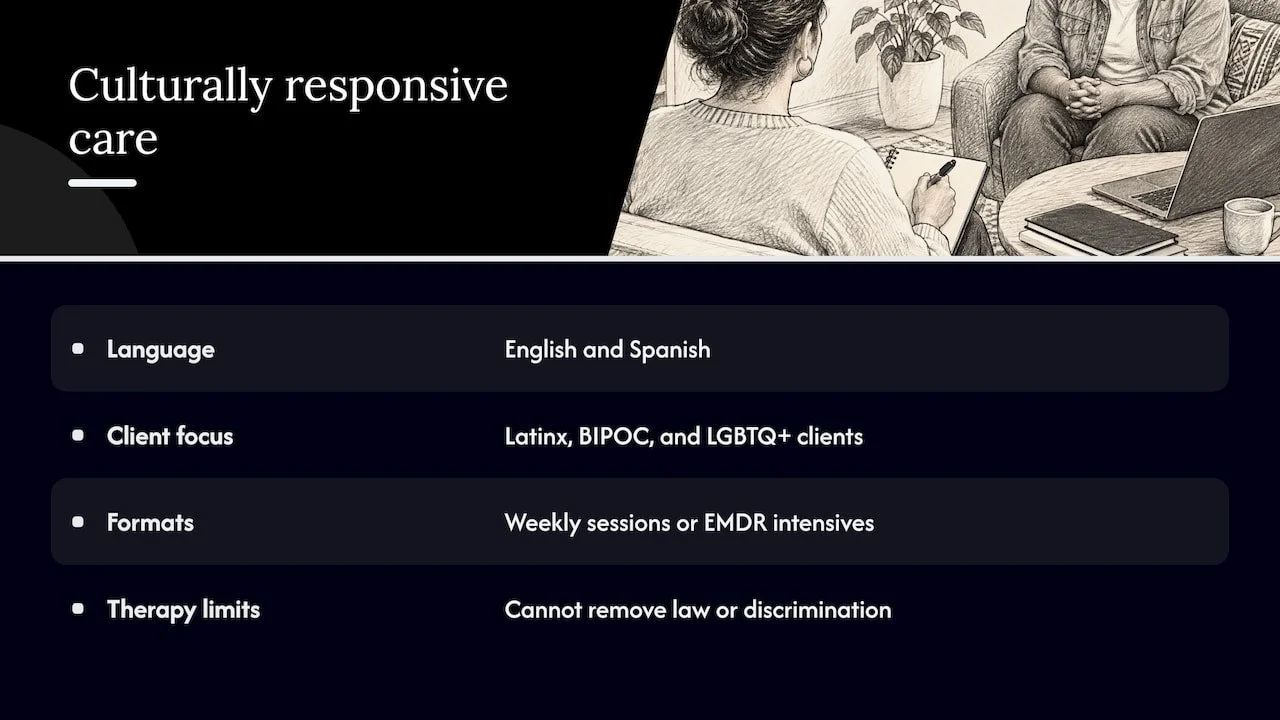
We also think timing matters. Weekly sessions suit many people. Others are juggling jobs, family and travel, and a concentrated format fits better. That is why we offer EMDR intensives alongside individual counseling. If you want to see how we think about this work, our posts on why culturally responsive therapy matters and what 103 studies say about immigrant trauma therapy go deeper.
No therapy removes the realities of immigration law or discrimination. What it can do is make sure you are not carrying them alone, in a language that is not yours.
— Juiced
Support at Alvarado Therapy
We are a California-based, trauma-informed practice with licensed therapists serving Pasadena, Ventura and online across California. Depending on what you need, these are the places to start:
Individual counseling and EMDR therapy for ongoing work on trauma, anxiety, grief and identity stress, in English or Spanish.
EMDR intensives for people who prefer concentrated sessions. Our published fees are $1,500 for a 1-day intensive of 4 hours, $2,250 for a 1-day intensive of 6 hours, and $5,750 for the 3-day intensive. Read about the bilingual 3-day format for immigrants.
Couples therapy when two cultures meet inside a relationship.
Immigration evaluations and support for victims of crime, for those facing a case or recovering from a crime.
We can also talk through which option fits when you book. You can see everything on our main site.
FAQ
What is the difference between acculturation stress and culture shock?
Culture shock usually describes the disorientation of the first weeks or months in a new place. Acculturative stress is broader and can last years, because it covers ongoing pressures such as language, discrimination, identity conflict and family expectations. It can also affect people who were born in the country but live between two cultures.
Is cultural bereavement a mental illness?
No. Clinical writing on migration describes cultural bereavement as a natural response to losing your social world. It can become a problem if it goes unaddressed or is misread, so it is worth discussing with a clinician who understands culture. If grief keeps you from sleeping, working or functioning, seek professional help.
Can bilingual therapy really make a difference?
It often does. Research shows that language is one of the strongest predictors of whether immigrants receive mental health care at all, and being able to speak in your own language lets a therapist hear nuance that translation can lose. At Alvarado Therapy we offer sessions in both English and Spanish.
Does therapy mean my immigration status will be questioned?
Not as a condition of receiving therapy at our practice. Fear of that question keeps many people from seeking care, so ask any provider about confidentiality and what they document before you begin. If you need a psychological evaluation for an immigration case, that is a separate service with its own purpose.
Sources
Mental Health Service Use Among Immigrants in the United States: A Systematic Review
Systematic review: Acculturation strategies and migrant mental health
Efficacy of trauma-informed treatment for undocumented Latinx immigrants: systematic review
Cultural Formulation Interview, American Psychiatric Association
