

Spanish trauma therapy is trauma treatment delivered by a licensed clinician who speaks Spanish fluently and understands the cultural world you come from. You describe what happened, and what it feels like in your body, in the language you lived it in. The research on this is encouraging but not settled, and we will tell you where it is strong and where it is thin. We will also give you a practical checklist for finding the right therapist, in person or online.
Alvaradotherapy
Find Trauma Support in Spanish
Alvarado Therapy offers bilingual, culturally responsive trauma-informed care in English and Spanish, with online sessions across California.
TL;DR
Trauma therapy in Spanish means more than translation: the clinician works in your language, with the idioms, family values and community context that shape how you understand what happened.
Studies link culturally considerate trauma treatment to lower PTSD symptoms, but no study yet shows it beats the same treatment without adaptation. Speaking your first language has its own documented advantages in care.
Ask any therapist about their Spanish fluency, trauma training, and how they handle culture and immigration stress before you commit.
Online sessions can work well, especially where bilingual clinicians are scarce. Confirm the therapist is licensed where you are located.
You can call or text 988 in Spanish at any time, and you do not have to be in crisis to do so.
Table of Contents
What Spanish trauma therapy actually involves
Most people picture a therapist who simply switches languages. Good Spanish trauma therapy goes further. A 2025 scoping review of culturally considerate trauma-focused treatment for Latine/x people describes adaptations such as delivering care in Spanish, using culturally relevant idioms and examples, and working with values like familismo (the central place of family) and personalismo (warm, personal connection with the provider).
Those are not decorations. They change how treatment feels from the first session:
Language you can think in. Memories from childhood in Mexico, El Salvador, Colombia or Puerto Rico are often stored in Spanish. Telling them in English can mean translating while you are already overwhelmed.
Idioms of distress. Many people describe trauma as nervios, susto or a heaviness in the chest rather than "intrusive thoughts." A trained clinician hears these as real symptoms, not as vague complaints.
Family and community context. Loyalty to family can make it hard to name harm that happened inside it. Therapy that respects that loyalty, instead of pathologizing it, tends to feel safer.
Stressors that go with migration. Fear of deportation, family separation, discrimination and language barriers can be part of the trauma picture. They are not side issues.
The U.S. Department of Veterans Affairs' National Center for PTSD offers training for clinicians on conducting trauma-focused treatment with Latinx patients. Its strategies include building trust and rapport, culturally informed assessment, psychoeducation, optimizing exposure exercises, challenging beliefs with cultural humility, and solving practical barriers that keep people from staying in treatment. If a therapist can explain how they do these things in their own words, that is a good sign.
What the research says about the benefits
Here is the honest picture, because Spanish-language care is sometimes oversold.
What is supported
The 2025 scoping review found that culturally considerate treatment was associated with PTSD symptom reduction across the studies it covered. One example is a 2011 pilot trial of prolonged exposure with Spanish-speaking participants in Puerto Rico, which found significant drops in PTSD symptoms in both the prolonged exposure group and the usual-care group.
Language match also shows up in patient experience. A 2021 paper in the American Journal of Psychotherapy reports that when patient and clinician share a language, patients report greater satisfaction, more interpersonal care and more health education. Therapy depends on trust, and that trust is easier to build when you do not have to work around a language gap.
There is also work on why your first language matters for trauma in particular. In a study of Spanish-speaking participants in Spain, the link between PTSD symptoms and changes in distress and arousal while processing a negative childhood memory was stronger in the native language than in a foreign language. In plain terms, emotional memories seem to carry more weight when you revisit them in the language you learned them in. That is one reason many clients find Spanish sessions reach material that English sessions keep at arm's length. Note that this study was done in Spain, not with U.S. Latino communities, so it points to a mechanism rather than proving a U.S. outcome.
What is still uncertain
The same scoping review is clear about a limit: none of the studies compared an adapted treatment with the standard version of the same treatment, so the added benefit of adaptation is unknown. The authors call for larger randomized studies that make that comparison. We think this matters. It means the strongest claim you can make is not "Spanish therapy works better," but "trauma therapy works, and Spanish-language, culturally informed delivery removes real barriers to getting it and staying in it." For many people, that is reason enough.
There is also a supply problem. The 2021 paper notes that national need for Spanish-language psychiatric care exceeds the number of bilingual clinicians. That is why searching beyond your own neighborhood, including online, is often necessary.
Which trauma treatments can be offered in Spanish
Language is the container. What matters just as much is the treatment inside it. Common options for PTSD, childhood trauma and complex trauma include:
Cognitive behavioral treatments. The American Psychological Association's 2017 guideline strongly recommends approaches such as cognitive processing therapy and prolonged exposure for adults with PTSD.
Written exposure therapy. The 2023 VA/DoD guidelines also recommend written exposure therapy, a brief, narrative-based option.
Emotion-focused therapy. This is an individual treatment for complex trauma that addresses the effects of childhood maltreatment and unresolved issues with past perpetrators, often attachment figures.
Relational, somatic and attachment-based work. Researchers have argued that fear-based CBT models do not capture everything trauma involves, especially when harm came from the people who were supposed to protect you. They advocate flexible, relational approaches over a one-size-fits-all model.
EMDR (eye movement desensitization and reprocessing). This is a structured therapy in which you briefly focus on a distressing memory while following bilateral stimulation. It is a core part of our work, and it can be done in Spanish. If you want to understand how it works in practice, see what to expect from online EMDR trauma therapy.
No single method suits everyone. A good clinician will explain why they recommend one, what a session looks like, and how you will both know if it is helping.
How to find a licensed Spanish-speaking trauma therapist
Decide what you need first. Is it individual therapy, couples work, support after a crime, or documentation for an immigration case? Each needs different training.
Search broadly. Directories of bilingual clinicians, your insurance network, community clinics and university training centers are all places to look. The federal FindTreatment.gov locator is an official resource for finding mental-health and substance-use treatment in the United States and its jurisdictions, and it works in Spanish.
Verify the license. Look up the clinician on your state licensing board's website. A license type such as LMFT, LCSW, or psychologist tells you they are legally able to practice.
Book a short consultation. Many practices offer a brief call before the first session. Use it to hear how the clinician speaks, not only what they say.
Give it two or three sessions. Fit is a real factor in outcomes. If something feels off, say so, or move on without guilt.
Questions to ask before you commit
The 2021 paper recommends checking that the clinician is fluent in your preferred language and understands the cultural beliefs and backgrounds of the patients they serve. Turning that into specific questions:
Fluency. "Do you conduct all of your sessions in Spanish? Are you comfortable discussing intimate or painful topics in Spanish, including body sensations and family matters?" Fluency in a casual conversation and fluency in a trauma session are different things.
Training. "What trauma approaches are you trained in? How many clients with my kind of history have you worked with?"
Culture. "How do you work with family expectations, religion, or immigration stress when they come up in therapy?"
Regional differences. Spanish varies by country. It is fair to ask whether the therapist is comfortable with the expressions and background of your community.
Interpreters. If your only option is care through an interpreter, ask whether the interpreter can also serve as a cultural broker, advocate or clarifier. The same paper argues those expanded roles can strengthen the therapeutic alliance when direct language-matched care is not available.
Practicalities. "What are your fees? Do you offer online sessions? What happens if I need to pause?"
Our perspective: why we practice bilingually
We built Alvarado Therapy as a bilingual, trauma-informed practice because we kept seeing the same pattern: people who had tried therapy in English and left feeling that nobody understood what they were really saying. Our clinicians offer care in both English and Spanish, with a focus on identity-affirming work for Latinx, BIPOC and LGBTQ+ clients.
We do not think language alone heals. A fluent therapist who does not know trauma treatment will not help much, and a skilled trauma therapist who cannot hear you will struggle too. The two have to come together. We also respect that the evidence for adaptation is still developing, and we would rather say so than promise guaranteed results. What we can say from our work is that clients often tell us the first session in Spanish felt different: less performing, more telling.
We also think about what the person is carrying besides the memory itself. Many clients come to us with childhood trauma, complex trauma, grief or relationship wounds, and some are also dealing with the fear of an immigration process. Our guide to bilingual therapy for Spanish-speaking adults lays out how we approach this, and our piece on why culturally responsive therapy matters for healing explains the thinking behind it.
— Juiced
Online Spanish-language trauma therapy: what to consider
Online therapy can be a good fit for Spanish-speaking clients, particularly because bilingual clinicians are unevenly spread across the country. You can reach a specialist who is not in your city. Practical points to weigh:
Licensing and location. Therapists are licensed state by state. Ask which states the clinician is licensed in, and confirm they can treat you where you will be during sessions. We offer online therapy to people located in California.
A private space. Trauma work can stir strong feelings. Pick a room where you will not be overheard, and plan something calming for after the session, like a walk or a meal.
Technology. Use a stable connection and a device with a screen big enough to see the therapist's face. Ask what platform they use and how they protect your privacy.
Safety planning. A good online therapist will ask where you are and who can help if you become unsafe, and will agree on a plan with you.
Fit with the method. Many trauma treatments, including EMDR, can be done on video. Ask your therapist how they adapt the method for a screen.
If you want to see how this works at our practice, read about our online EMDR trauma therapy in California and New York.
Beyond individual therapy: couples, immigration and crime-related support
Trauma does not stay inside one person. Betrayal, infidelity or long-term stress can strain a relationship, and language can make conflict harder to untangle when partners grew up speaking different languages. Our article on bilingual couples therapy for English and Spanish speakers covers how that works, and you can read about couples therapy at our practice.
For people living without legal status or going through an immigration case, trauma care has its own concerns, such as fear of being reported and mistrust of institutions. We wrote about bilingual trauma care for undocumented immigrants for that reason. We also provide immigration psychological evaluations and support for victims of crime.
Working with us
If you want to start with a single focused block of work rather than weekly sessions, our EMDR intensives compress treatment into one or more long sessions. Our published fees are $1,500 for a 1-day intensive of 4 hours, $2,250 for a 1-day intensive of 6 hours, and $5,750 for a 3-day intensive. You can see the details on our EMDR intensives page.
If weekly sessions fit better, our individual counseling and EMDR therapy is offered in English and Spanish, in Pasadena, Ventura and online across California. Not sure which path suits you? Book a consultation and we will talk it through. If you want background first, our overview of PTSD and complex trauma is a good start.
When you need support right now
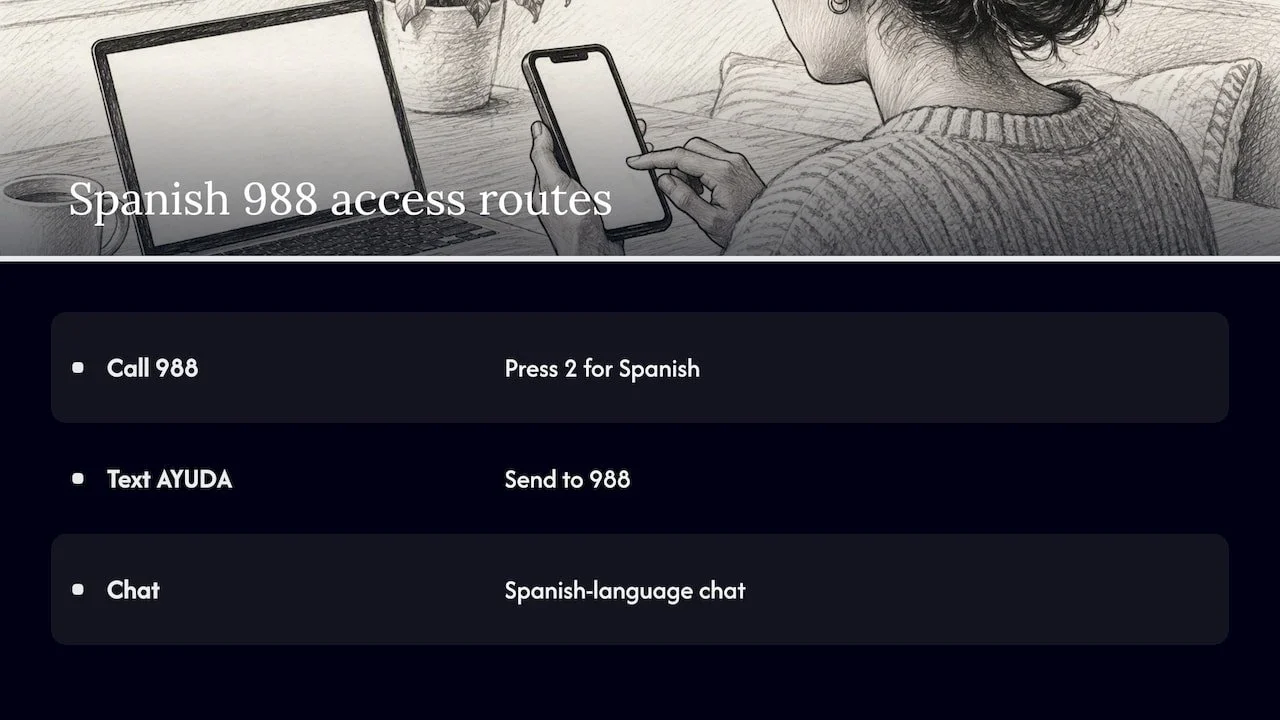
Therapy is not an emergency service. If you are in distress between sessions, or before you have found a therapist, the 988 Lifeline offers Spanish-language support around the clock. You can call 988 and press 2, text AYUDA to 988, or use the Spanish-language chat. You do not have to be in crisis to reach out. They can also answer general mental-health questions and share resources. If you are in immediate danger, call 911.
FAQ
Is therapy in Spanish more effective than therapy in English?
The evidence does not yet say so directly. Studies link culturally considerate trauma treatment to lower PTSD symptoms, but none has compared it head to head with the standard version. What is well documented is that language match improves patient satisfaction and understanding, and that this can make it easier to engage in treatment.
Do I need to be fluent in Spanish to benefit from Spanish-language therapy?
No. Many clients are bilingual and switch languages depending on the topic. Some find that emotional memories are easier to reach in Spanish, even if they use English at work. A bilingual therapist can follow you in either language.
Can I do trauma therapy in Spanish online?
Yes, if the therapist is licensed where you are located and uses a secure platform. Online care also widens your choices, since bilingual clinicians are in short supply in many areas. Ask how they adapt trauma methods like EMDR for video sessions.
What if I only find a therapist who uses an interpreter?
Ask whether the interpreter can also act as a cultural broker or advocate, not only translate. Research suggests those roles can help build trust when direct language-matched care is not available. Keep looking for a bilingual clinician in parallel, since direct care is usually preferable.
How do I know if a therapist is trained in trauma?
Ask which trauma treatments they use, where they trained, and how often they treat clients with histories like yours. Verify their license on your state board's website. A good clinician will answer plainly and will not promise a fixed outcome.
Sources
Culturally considerate trauma-focused PTSD treatment for Latine/x populations (scoping review, 2025)
Psychotherapy, Spanish, and Hispanic patients with limited English proficiency (2021)
Processing negative autobiographical memories in a foreign language (2023)
Psychological Trauma: Theory, Research, Practice, and Policy (PTSD guideline review)
Clinical practice guideline for PTSD (written exposure therapy)
