

If you feel nothing with a partner you once felt a lot for, you are not broken, and it does not automatically mean the love is gone. Emotional numbness in a relationship is most often a protective shutdown: your nervous system turns the volume down because feeling everything has become too much. It can come from trauma, anxiety, depression, exhaustion, repeated hurt, or a medical issue. It can also change, usually when you work on safety first and feelings second.
This guide explains what numbness feels like, what can sit underneath it, how to tell whether it points to the relationship or to something else, and what you can do, on your own and with a therapist.
Alvaradotherapy
Explore Support for Emotional Numbness
Alvarado Therapy offers trauma-informed individual and couples therapy, including EMDR, for people navigating trauma, anxiety, grief, and relationship difficulties.
TL;DR
Emotional numbness is a common protective response, not proof that you have stopped loving your partner.
Common drivers include trauma and PTSD, anxiety, depression, dissociation, substance use, burnout, betrayal, and some medical conditions.
Reconnection works through safety and small, low-pressure steps, not by forcing yourself to feel.
Seek professional help if it lasts two weeks or more and interferes with work, home, or your relationship. If you are in crisis, call or text 988.
Trauma-focused therapy such as EMDR can help when numbness traces back to past overwhelming experiences.
Table of Contents
- What emotional numbness in a relationship feels like
- Does feeling numb mean you don't love your partner?
- What can cause emotional numbness
- How numbness affects closeness and communication
- How to start reconnecting without forcing feelings
- When to get professional help
- What therapy for emotional numbness looks like
- Our perspective: numbness is protection, not failure
- Working with us
- FAQ
- Sources
What emotional numbness in a relationship feels like
People describe it in surprisingly similar ways. Clinicians at Cleveland Clinic describe it as a heavy fog in which you can still function but struggle to feel, including toward people you care about. The same source lists feeling flat, losing interest in things you used to enjoy, physical and mental fatigue, and a sense of running on autopilot.
Inside a relationship, that tends to look like this:
You go through the motions of date night, affection, or sex and feel like you are watching yourself do it.
Your partner shares good news or bad news and you register it intellectually but feel little.
You cannot cry, even when you know the situation is sad.
Saying "I love you" feels like reciting a line.
You feel relief when your partner is out of the house, then guilt about the relief.
Arguments no longer upset you. You just go quiet and wait for them to end.
Numbness is different from simply being tired of someone. Numbness tends to be broad: it dulls joy, interest, and sadness together, and it often shows up outside the relationship too, at work, with friends, with hobbies. Indifference toward one person, with the rest of your emotional life intact, is a different pattern worth looking at honestly.
Does feeling numb mean you don't love your partner?
Not necessarily, and this is the fear that drives most people to search for answers at 2 a.m.
Numbness is an absence of access to feeling, not a verdict on the feeling underneath. When the nervous system is overloaded, it can mute all emotional sensation, and that includes love, desire, and tenderness along with fear and grief. A person who is shut down cannot reliably tell whether they love someone, in the same way that you cannot judge the taste of food with a bad cold.
That said, numbness can be a signal about the relationship. A few questions help sort the two apart:
When did it start? If it began after a specific event, such as a betrayal, a loss, a move, a birth, or a trauma, the event is the first place to look.
Is it only with your partner? Numbness everywhere points toward your own nervous system, mood, or health. Numbness only in one relationship may point to what is happening there.
Do you feel safe with them? If you are afraid of your partner, or the relationship involves control, threats, or violence, numbness may be a survival response to danger. That is a safety issue, not a communication problem.
Do you still feel anything about the idea of losing them? Even a faint pang of dread or sadness is information.
You do not have to answer these alone, and you do not need to decide anything about the relationship while you are numb. Big decisions made from a shutdown state are hard to trust in either direction.
What can cause emotional numbness
There is rarely one cause. The most common ones fall into a few groups.
Trauma, PTSD, and dissociation
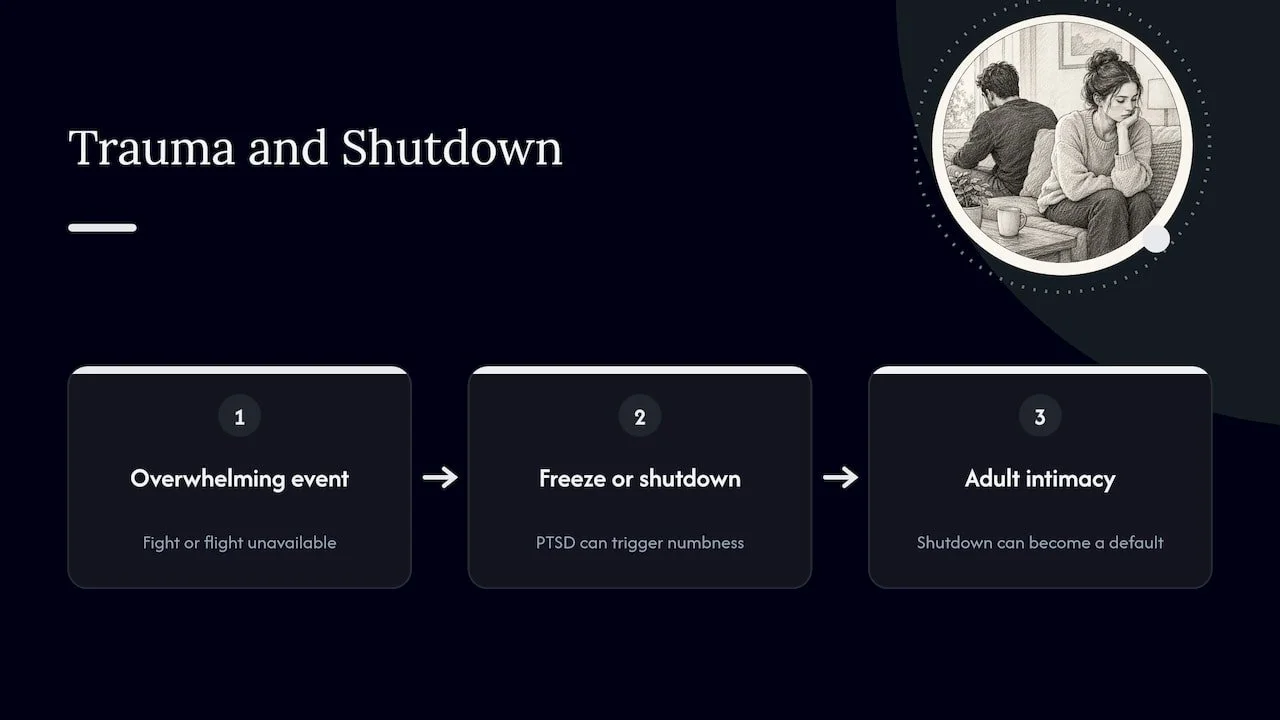
When something overwhelming happens and you cannot fight or flee, the body can move into a freeze or shutdown response. PTSD can trigger emotional numbness, which Cleveland Clinic describes as a common reaction to difficult moments. For people with childhood or complex trauma, that shutdown can become a default setting that follows them into adult relationships, especially when intimacy feels like exposure.
Dissociation, the sense of being detached from your body, your surroundings, or yourself, is closely related. A study supported in part by NIMH found that derealization symptoms after trauma were associated with greater PTSD and depression symptoms three months later, and NIMH highlights the value of screening for dissociation after trauma. If the world or your partner sometimes feels unreal, foggy, or far away, mention that to a clinician specifically.
Anxiety, depression, and substance use
Cleveland Clinic lists anxiety, depression, dissociative disorders, and substance use among the conditions that can trigger emotional numbness. Depression in particular can flatten positive feelings first, which is why people often notice it in the relationship before they name it as depression. Some medications can blunt emotion as well, so if numbness began after a medication change, raise it with the prescriber rather than stopping anything on your own.
Medical causes
The same Cleveland Clinic source notes that neurological conditions such as multiple sclerosis or dementia, along with anemia and thyroid problems, can contribute to emotional numbness. If your numbness comes with persistent fatigue, physical changes, or memory problems, a primary care visit and basic bloodwork are a reasonable first step before assuming it is purely emotional.
Relationship-specific triggers
Some numbness is built inside the relationship itself:
Conflict fatigue. After years of the same fight, shutting down becomes the only way to get through it.
Unmet bids for connection. When your small attempts to reach your partner (a comment, a touch, a question) are repeatedly missed or dismissed, you eventually stop reaching.
Betrayal and repeated hurt. After infidelity, broken promises, or ongoing criticism, numbness can act as armor. Feeling less means being hurt less.
Chronic caretaking or overfunctioning. If you carry most of the emotional and practical load, there may be nothing left to feel with.
These are patterns, not character flaws. They are also workable, particularly in couples therapy.
How numbness affects closeness and communication
Numbness protects you in the short term and costs you in the long term. When you cannot feel, you cannot show up emotionally, and your partner usually experiences that as rejection, coldness, or loss of interest. They may push harder for reassurance, which feels like pressure, which deepens the shutdown. This pursue and withdraw loop is one of the most common patterns couples bring to therapy.
The effects tend to show up in a few places:
Conversation: talk becomes logistical (schedules, kids, bills) while anything personal is avoided.
Affection and sex: touch feels mechanical or disappears, and desire drops.
Repair: after conflict, you may not be able to apologize or accept an apology with real feeling, so the hurt lingers.
Identity: you may start to believe something is wrong with you, which adds shame on top of the numbness.
When trauma is involved, the effects can be broad. NIMH notes that in severe forms, PTSD can significantly impair functioning at work, at home, and socially. If you recognize that picture, our guides on how PTSD impacts relationships and PTSD relationship struggles, signs, and healing go deeper, including what partners can do.
How to start reconnecting without forcing feelings
The common mistake is to treat numbness as a motivation problem and try to push through it: forcing a romantic evening, interrogating yourself about whether you love your partner, or demanding that feelings return on schedule. Pressure is a threat signal, and threat is what keeps the system shut down. What tends to help is the opposite: safety, small steps, and patience.
1. Name it, to yourself first
Say it plainly: "I am numb right now." Naming a state without judging it often takes some of the charge out of it. You do not have to explain why yet.
2. Tell your partner what it is and is not
You do not need a perfect speech. Something like this is enough: "I have been feeling shut down lately. It is not about you not mattering. I am trying to understand it and I would like your patience." This removes the guessing game that often makes a partner feel rejected.
3. Work with the body before the emotions
Numbness lives in the nervous system, so body-based practices are a reasonable way in. Slow breathing with a longer exhale, noticing your feet on the floor, holding something cold or textured, a walk where you name five things you can see, or gentle stretching all help you register physical sensation. Sensation is the doorway back to emotion. Our list of daily PTSD coping strategies includes several grounding practices you can try.
4. Choose very small points of contact
Aim for low-stakes, low-demand closeness rather than intense emotional conversations:
Ten minutes of sitting side by side with no agenda.
A short walk together.
Cooking a meal together, or watching something you both like.
One honest sentence a day about how your day felt, even if the sentence is "flat."
You are not trying to generate a feeling. You are giving your system repeated, safe evidence that being near this person is okay.
5. Answer the small bids
If the relationship has gone quiet, notice the little attempts your partner makes, a comment, a joke, a hand on the shoulder, and respond with a nod, a smile, or a few words. Partners rebuild trust through these tiny turns toward each other far more than through grand gestures.
6. Write, if talking is hard
Journaling can help you trace when the numbness appears, what came before it, and which situations soften it. Patterns you can see on paper are easier to bring to a therapist or partner. A structured option is our PTSD recovery journal with reflective prompts, or browse our workbooks.
7. Reduce what is draining you
Sleep, alcohol, overwork, and constant stimulation all deepen shutdown. You cannot fix a trauma response with a sleep schedule, but you can stop making the baseline worse.
What to avoid
Testing your feelings repeatedly ("Do I love them? Do I?"), which usually raises anxiety.
Using alcohol or other substances to feel something, or to feel nothing.
Ending or committing to the relationship while you are at your most shut down, unless safety is at stake.
Expecting your partner to be your only support. A therapist or trusted friend takes pressure off the relationship.
When to get professional help
Self-help has limits, especially when numbness has a trauma root. SAMHSA's guidance is to seek help when changes in thoughts, mood, or the body last two weeks or more and make it hard to manage work, school, home, or relationships. Numbness that has lasted months or years almost certainly qualifies.
Book an appointment sooner if you notice any of these:
Numbness began after a traumatic event, or you have flashbacks, nightmares, or startle responses.
You lose chunks of time, feel outside your body, or the world seems unreal.
You are using alcohol or drugs to cope.
You feel hopeless, or you have thoughts of harming yourself.
You are afraid of your partner, or your partner is controlling or violent. In that case, a therapist trained in trauma and relationship safety, or a domestic violence advocate, is the right first call.
If you are in crisis or emotional distress, you can call or text 988 at any hour. The 988 Suicide & Crisis Lifeline is available 24/7 in the United States. If the numbness comes with physical symptoms, see a medical doctor to rule out causes like thyroid problems or anemia.
What therapy for emotional numbness looks like
The right approach depends on the root. A good clinician will ask when the numbness started, what else is going on in your life and body, and whether trauma is part of the picture.
Individual trauma therapy when numbness is tied to PTSD, childhood trauma, or dissociation. The VA and Department of Defense patient guide notes that PTSD treatment can improve symptoms, relationships, functioning, and quality of life.
Couples therapy when the numbness grew out of conflict fatigue, betrayal, or years of missed connection, and both partners want to rebuild. Some practices, such as individual and couples psychotherapy services, offer both formats so the work can happen alone and together.
Medical and psychiatric care when depression, anxiety, medication effects, or a physical condition is driving the shutdown.
Pacing matters. Trauma-informed therapists do not push you to feel before your system is ready. They build stability and safety first, then work on the memories and patterns that keep you shut down. Our guide on the role of therapy in PTSD recovery explains how that sequence typically works.
Our perspective: numbness is protection, not failure
We see emotional numbness in our practice constantly, and almost always the person describing it is more worried about their partner than themselves. They say, "I think something is wrong with me, because I should feel something." Our first response is usually the same: you are not defective, you adapted.
Many of the people who come to us learned early to shut feelings down to stay safe, whether through childhood trauma, unpredictable caregivers, or years of being the one who holds everything together. That skill works until intimacy asks for exactly what it switched off. So we do not treat numbness as the problem to remove quickly. We treat it as a signal that something once needed protecting, and we ask what.
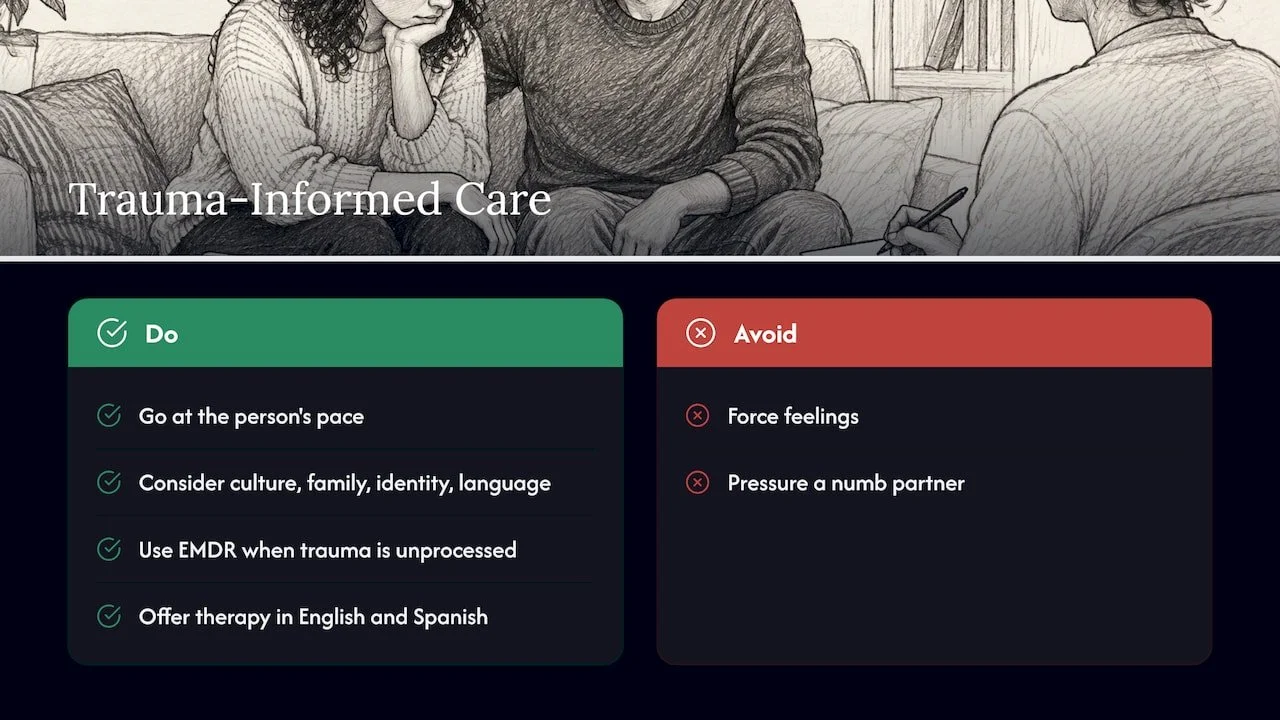
In trauma-informed work, that means three commitments. We go at your pace, because forcing feeling reinforces the shutdown. We look at the whole person, including culture, family expectations, identity, and language, which is why we offer therapy in both English and Spanish and aim for care that is affirming for Latinx, BIPOC, and LGBTQ+ clients. And when unprocessed trauma is underneath, we use approaches such as EMDR, which is designed to help the brain reprocess distressing memories so they stop driving present-day shutdown. You can read more about what the research shows on EMDR and EMDR for PTSD.
For partners on the other side of the numbness: it is rarely about you, and you cannot fix it by trying harder to be lovable. Patience, steadiness, and your own support do more than pressure ever will.
— Juiced
Working with us
If numbness is tied to trauma, we offer EMDR therapy and counseling for individuals, couples therapy, and online sessions across California and New York, in English and Spanish. Individual counseling and EMDR therapy is the starting point for most people, and couples therapy is available when you want to work on the relationship together.
If weekly sessions do not fit your life, our EMDR intensives compress the work into longer blocks: a 1-day intensive of 4 hours is $1,500, a 1-day intensive of 6 hours is $2,250, and a 3-day intensive is $5,750.
Not sure which fits? You can book a consultation and we will help you work out the right next step.
FAQ
Why do I feel numb in my relationship even though I care about my partner?
Caring and feeling are not the same thing. Your nervous system can mute emotional sensation when it is overloaded by stress, trauma, depression, anxiety, or accumulated hurt, so you know you care but cannot feel it. A clinician can help you find which driver applies to you.
Can I feel numb and still be in love?
Yes. Numbness often dulls every feeling, including love, so it is not a reliable measure of how you feel underneath. As it eases, many people find their affection was there all along. If it does not return, a therapist can help you understand why without rushing to a conclusion.
Can trauma or PTSD make it hard to feel emotions or cry?
Yes. PTSD can trigger emotional numbness, and dissociation can make emotions feel distant or unreal. Trauma-focused therapy can help, and the VA/DoD guide notes that treatment can improve symptoms and relationships.
How long does emotional numbness last?
It varies widely. After a short, intense stressor it may pass in days or weeks. When it is tied to long-term trauma, depression, or a relationship pattern, it usually persists until the root is treated. If it has lasted two weeks or more and affects daily life, it is time to talk to a professional.
Should I tell my partner I feel numb?
Usually yes, in simple terms and without blame. Explaining that you are shut down, and that it is not a judgment on them, spares your partner from guessing and personalizing it. If the conversation feels unsafe, or you fear their reaction, talk to a therapist first.
Sources
9 Causes of Emotional Numbness and What To Do, Cleveland Clinic
Feelings of Detachment After Trauma May Signal Worse Mental Health Outcomes, NIMH
