

EMDR (Eye Movement Desensitization and Reprocessing) is one of the most studied therapies for trauma, and it can help adults whose distress traces back to childhood abuse or neglect. It does not erase the past. It helps your brain store difficult memories so they stop feeling raw, present and dangerous. This guide explains how that works, what the sessions look like, what the research does and does not show, and how to pick a therapist who can pace the work safely.
Alvaradotherapy
Explore EMDR for Childhood Trauma
Alvarado Therapy offers trauma-informed EMDR therapy for adults healing from childhood trauma, with licensed therapists serving clients across California.
TL;DR
EMDR is a structured, trauma-focused therapy. You recall a memory or trigger in small doses while following bilateral stimulation, such as eye movements, tapping or tones.
The EMDR International Association describes it as an effective approach for adults recovering from childhood trauma, including trouble with emotional regulation and self-image.
Preparation comes first. A good therapist assesses readiness and builds coping tools before any deep memory work begins.
You do not need a clear memory of what happened. Work can begin with present-day triggers and symptoms.
Evidence is strong for PTSD overall and encouraging for complex childhood trauma, though studies in that area are still few and varied.
Table of Contents
How EMDR helps adults with childhood abuse
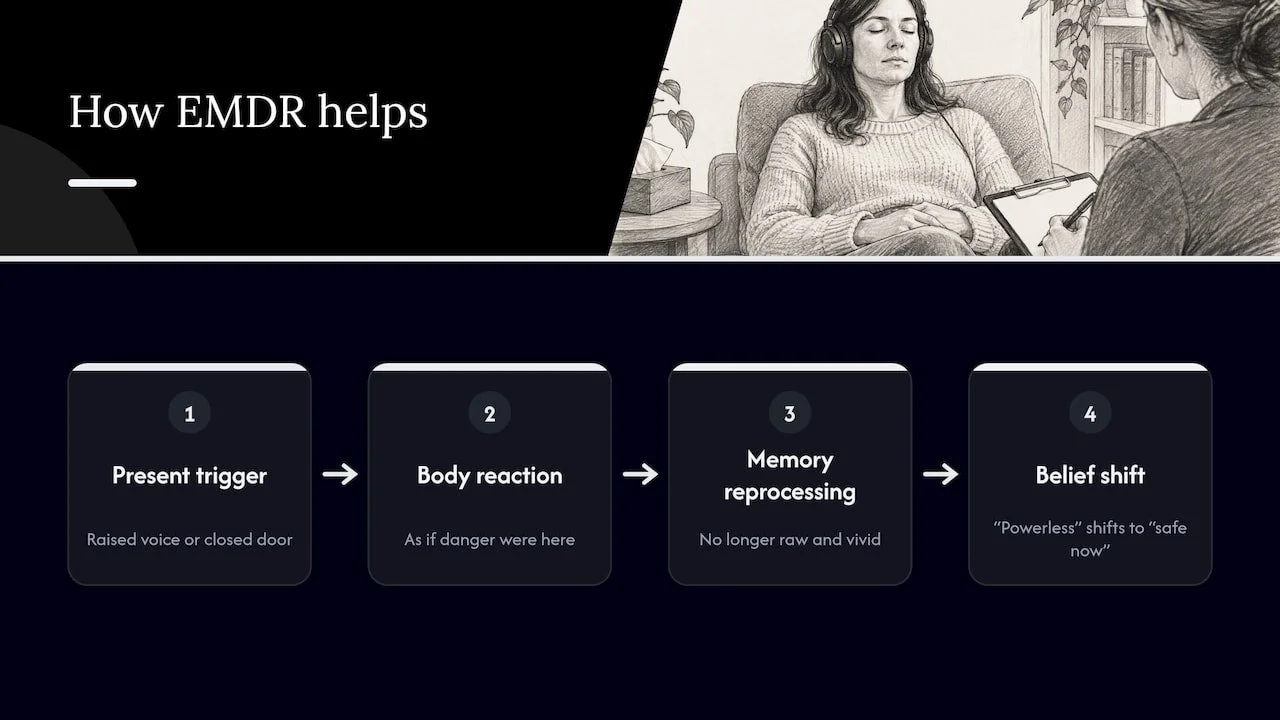
Childhood abuse rarely stays in the past. Adults who lived through it often describe the same pattern: a present-day moment, such as a raised voice, a certain tone from a partner or a closed door, sets off a reaction far bigger than the moment deserves. The body reacts as if the old danger were here now.
EMDR targets that pattern. According to the EMDR International Association (2024), the therapy helps people reprocess events so they are no longer held in a raw, vivid state. It also addresses what abuse leaves behind in how you see yourself: beliefs like "I am powerless" or "it was my fault" can shift toward "I am safe now" and other beliefs that fit your present life.
This is why many adults describe EMDR as different from talk therapy. You are not asked to narrate everything in detail or to analyze why it happened. The work is about how the memory is stored and what it still tells you about yourself today.
What counts as childhood abuse and trauma
The word "abuse" covers physical, sexual and emotional harm. Neglect belongs in the same conversation: not being comforted, protected or noticed leaves marks too, even when no single event stands out. Many adults who seek EMDR have a mix of all of these, sometimes across years. That is often called complex trauma, and it usually calls for slower, more careful pacing than a single-incident trauma such as a car accident.
If you recognize this picture, our page on PTSD and complex trauma explains how we think about it.
What happens in EMDR sessions
EMDR follows a defined sequence. The U.S. Department of Veterans Affairs' National Center for PTSD outlines the components: history-taking, preparation including stress-management skills, assessment of the target image, desensitization with bilateral stimulation, a body scan, and work on current and future triggers.
Here is how that tends to look in practice.
History and planning. Your therapist learns what brought you in, what symptoms you live with, and which memories or triggers matter most. You do not have to tell the whole story.
Preparation. You learn ways to calm your body and return to the present, and you identify inner and external resources, such as a safe-place image or a trusted person.
Assessment. You choose a target, such as a memory or a trigger, along with the negative belief attached to it and the belief you would like to hold instead.
Reprocessing. You hold the target in mind while following bilateral stimulation, which can be eye movements, tapping or tones. This is meant to reduce distress, as the same VA page describes it. You report what you notice in short check-ins, and the therapist keeps you in control of the pace.
Installation and body scan. The preferred belief is strengthened, and you check for leftover tension in the body.
Closure and re-evaluation. Each session ends with a return to calm, and the next session starts by checking what shifted.
If you want to see the same process in more detail, our step-by-step EMDR guide walks through each phase. We also explain how bilateral stimulation works, including exercises to try at home.
How many sessions will it take?
No honest therapist can promise a number in advance. The EMDR International Association says the amount of therapy needed depends on how many traumatic incidents there were, how long ago they happened, how old you were, and what support you received afterward. Longstanding or repeated abuse in early childhood generally takes longer than one event in adulthood.
Preparation and safety come first
The most common worry about EMDR for childhood abuse is that it will stir up too much, too fast. A well-run course of treatment is built to prevent exactly that.
According to the EMDR International Association, therapists assess readiness, help you build coping tools and resources, and help you return to calm and close the work at the end of each session. They are also expected to stay mindful of your cultural and personal context. That last point matters. Family, language, faith, immigration history and identity all shape how abuse was lived and what healing needs to look like.
What preparation can include:
Grounding skills you can use mid-session and in daily life
A way to signal a pause or stop at any time
Identifying who and what supports you outside therapy
Screening for dissociation, which affects pacing (see our screening questions to ask before EMDR for dissociation)
Practical planning for the hours after a session, such as rest and food
Our guide to preparing for EMDR therapy covers what to arrange before your first reprocessing session.
When stabilization is short, and when it is long
Not everyone needs months of preparation. Some people are steady enough in daily life to start processing sooner, while others need extended skills work first. The right answer depends on your history, your current stability and how you respond in early sessions. We discuss that decision in when to skip stabilization in EMDR for complex PTSD. If you are in an unsafe situation now, or in crisis, safety and stability come before trauma processing.
What if you don't remember much of your childhood?
This is a common concern, and it should not stop you. Memories from early childhood may be patchy, or you may know the outline of what happened without much detail. Some people only have a sense that something was wrong.
The EMDR International Association notes that when the past feels too overwhelming to approach right away, or memories are unclear, the work can focus on current triggers or symptoms. The therapist can later connect those to earlier events as they surface. You do not need to dig for memories or prove anything happened. Treatment starts with what you feel and do today.
The same holds for emotional neglect, where there may be no dramatic event to point to. Present-day patterns, such as difficulty asking for help, harsh self-criticism or going numb in close relationships, can be the starting point.
What the research says
EMDR has a solid evidence base for PTSD. The National Center for PTSD calls it one of the most studied PTSD treatments, lists 38 randomized controlled trials in its PTSD repository, and says recent meta-analyses suggest EMDR reduces PTSD symptoms and the likelihood of keeping a PTSD diagnosis.
For childhood abuse specifically, the picture is promising but less settled:
A 2018 systematic review found EMDR associated with reduced PTSD symptoms, depression and anxiety in children and adults exposed to complex childhood trauma. The authors cautioned that few trials exist and they differ a lot in length and populations, so firm conclusions are limited.
A review of studies through June 2023 reported that in one study, control participants were 23 times more likely to have PTSD at one month than the EMDR group. The same review noted that the included studies did not use specific quality-of-life measures, which it flags as a gap for future research.
A 2024 Dutch study found that phase-based treatment, with skills training (STAIR) followed by either EMDR or narrative therapy, effectively treated PTSD in adult survivors of childhood interpersonal trauma.
Taken together: EMDR is a reasonable, well-supported option, and a staged approach with preparation seems to suit survivors of childhood interpersonal trauma. It is not guaranteed to work for everyone, and research on complex childhood trauma is still growing. For a plain-language look at the evidence, see what the research shows on EMDR effectiveness. Our article on phase-based EMDR care for adults healing from childhood trauma connects that research to what treatment looks like.
EMDR compared with talk therapy
Many survivors have already tried talk therapy and found it helped them understand what happened without changing how their body reacts. EMDR is aimed at that gap. The differences in how it feels:

Our perspective
We see the same worry from adults who have lived with childhood abuse: "If I start, I will fall apart." We take that seriously. Our approach is trauma-informed, which means you decide the pace, and nothing is processed before you have ways to come back to the present.
We also believe the context around the abuse matters as much as the memory. For many of our clients, including Latinx, BIPOC and LGBTQ+ adults, family expectations, language, immigration experience and identity shape how harm was lived and who it was safe to tell. Therapy that ignores those pieces can feel unsafe in its own right. That is why we offer care in English and Spanish, with identity-affirming, culturally responsive work.
And we do not think healing needs a perfect memory or a polished story. If you only have fragments, or a body that reacts before your mind knows why, that is enough to begin.
— Juiced
How to choose an EMDR therapist for childhood abuse
The EMDR International Association advises working with a qualified therapist and asking about their training and experience with both EMDR and childhood trauma. Those are two separate skills. Questions worth asking at a consultation:
What EMDR training have you completed, and how long have you used it with adults who experienced childhood abuse?
How do you decide when I am ready to begin reprocessing?
What do we do if a session brings up more than I can handle?
How do you screen for dissociation and adjust pacing?
How do you take my culture, language and identity into account?
Can sessions be in person or online, and what does a typical plan look like?
Pay attention to how the therapist answers. A good one explains the process plainly, welcomes questions, never pushes you to disclose details before you are ready, and does not promise a quick or guaranteed result.
Starting EMDR with Alvarado Therapy
Our licensed therapists provide individual counseling and EMDR therapy in Pasadena and Ventura, and online throughout California, in English and Spanish. If you prefer concentrated time, our EMDR intensives are published at $1,500 for the 1-day 4-hour format, $2,250 for the 1-day 6-hour format and $5,750 for the 3-day format. Individual sessions do not have a published price on our site.

If you are unsure which format fits, begin with the individual counseling page and book a first conversation. We will talk through your history at your pace and help you choose.
If you are in immediate danger or thinking about harming yourself, call or text 988, the Suicide and Crisis Lifeline, or call 911.
FAQ
Is EMDR effective for childhood sexual abuse?
EMDR is an established trauma-focused therapy, and reviews link it to reduced PTSD, depression and anxiety symptoms in people with complex childhood trauma. The research on this group is still limited, with few and varied trials. A qualified therapist can help you judge whether it fits your situation.
Do I have to talk about the abuse in detail?
No. In EMDR you hold the memory or trigger in mind and report what you notice briefly, rather than retelling the full story. You can start with present-day triggers and symptoms if the past feels like too much. You control the pace.
Can EMDR work if I can't remember what happened?
Often, yes. According to the EMDR International Association, work can begin with current triggers or symptoms, and the therapist can later link them to earlier events as they emerge. You do not need clear memories to start.
Will EMDR make me feel worse before I feel better?
Some people feel tired or emotional after reprocessing, which is why preparation and closing steps are part of the method. Your therapist should teach you coping tools first and help you return to calm at the end of each session. Tell them if anything feels too intense.
How long does EMDR take for childhood trauma?
It depends on the number of incidents, how long ago they occurred, your age at the time and the support you had afterward. Repeated early abuse usually takes longer than a single event. Your therapist can give a rough plan after the first few sessions and revise it as you go.
Sources
EMDR Therapy & Childhood Trauma, EMDR International Association
Eye Movement Desensitization and Reprocessing for PTSD, National Center for PTSD
Revisiting Eye Movement Desensitization and Reprocessing, review of studies through June 2023
Skills training followed by either EMDR or narrative therapy, 2024 study
