
Bilingual Trauma Care in the U.S. for Undocumented Immigrants
If you are undocumented and need therapy, start with crisis lines like 988 and then search HRSA's Find a Health Center or SAMHSA's treatment locator for low cost, language accessible care. Ask any provider about privacy practices and sliding scale fees before you book. Reduced fee networks like Open Path and bilingual trauma informed practices offer additional paths to support.
TL;DR:
Federal tools like HRSA's Find a Health Center and SAMHSA's Treatment Locator help locate low-cost, sliding-scale mental health services that accept undocumented clients, often offering telehealth options.
Emergency rooms provide immediate help regardless of immigration status, with some states extending Medicaid coverage for urgent care following a crisis.
When vetting therapists, ask about immigration status acceptance, interpreter services, confidentiality protections, and sliding-scale fees to ensure trauma-informed and culturally responsive care.
EMDR, trauma-focused cognitive behavioral therapy, and culturally adapted approaches are effective for immigration-related trauma, especially when provided by bilingual and culturally sensitive clinicians.
Foster trust by confirming providers do not require unnecessary identification or promise immigration outcomes, and prepare for appointments with a clear safety plan and private environment.
Alvaradotherapy
Find Culturally Responsive Trauma Care
Alvarado Therapy offers bilingual, trauma-informed therapy in English and Spanish, online throughout California and in Pasadena and Ventura.
Table of Contents
How do you vet a therapist who feels safe and trauma-informed?
Which therapy approaches work for immigration-related trauma?
What are your privacy rights when seeking mental health care?
Where to get immediate crisis help right now
If you or someone you love is in crisis, help is available tonight, not just during business hours. You do not need insurance, a Social Security number, or proof of immigration status to call, text, or chat with a crisis counselor.
Call or text 988 to reach the Suicide and Crisis Lifeline, available 24/7 in English and Spanish.
Text HOME to 741741 to reach the Crisis Text Line if speaking out loud does not feel safe.
Ask the crisis counselor for an interpreter in your language if 988's Spanish line does not cover your needs.
Go to the nearest emergency department if you or someone nearby is in immediate physical danger.
Most HRSA funded health centers reported offering mental health services through telehealth recently, according to HRSA's Bureau of Primary Health Care, which means a crisis contact can often connect you to a same-week virtual follow up appointment rather than leaving you to search alone. Emergency rooms generally cannot turn away someone in crisis regardless of immigration status, and some states extend Emergency Medicaid to cover that visit. If you are safe but shaken, write down who you can call, where you can go, and what helps you calm down: that short list is the start of a safety plan.
How to find low-cost and sliding-scale therapy near you
Two federal tools do most of the heavy lifting here, and both are free to use.
Search HRSA's Find a Health Center tool by zip code to locate a Federally Qualified Health Center near you. These centers use sliding fee scales based on income, serve patients regardless of ability to pay or immigration status, and many now offer telehealth mental health visits.
Use the SAMHSA Treatment Locator and filter by "mental health," "telehealth," and "payment assistance" to narrow results to clinics that will not turn you away over cost.
Call ahead and ask directly whether the clinic serves patients without documentation. Most FQHCs do, but confirming saves you a wasted trip.
Beyond those two locators, other low-barrier options exist:
Open Path connects clients to a nationwide network of therapists offering reduced-fee sessions for a modest membership cost.
University training clinics often provide low-cost sessions supervised by licensed faculty.
Community mental health centers and faith-based organizations frequently run free or donation-based counseling.
Peer-support networks such as Immigrants Rising and United We Dream offer community-based emotional support groups, which can complement formal therapy.
Telehealth has widened this map considerably. If no local therapist speaks your language or understands immigration-related trauma, a virtual directory can connect you to a culturally matched clinician anywhere in your state.
How do you vet a therapist who feels safe and trauma-informed?
Not every therapist is trained to work with immigration-related trauma, so a short intake call before your first real session is worth the time.
Ask: "Do you provide services regardless of immigration status?" A provider who hesitates or asks for documentation beyond basic contact information is a signal to look elsewhere.
Ask: "Do you use professional interpreters, and is that service free?" Federally funded clinics are generally required to provide this.
Ask: "How do you protect client privacy, and what are the limits of confidentiality?" A trauma-informed provider should answer this clearly, without vague reassurance.
Ask: "What are your fees, and do you offer a sliding scale?" Get a number, not just "it depends."
Watch for red flags: a provider who demands ID beyond what is needed for billing, or who promises a specific legal or immigration outcome, is overstepping their role. Therapists treat mental health; they do not adjudicate immigration cases.
Pro Tip: Treat the first phone call like an interview. A provider who answers your questions patiently is showing you how they will handle sessions later.

Which therapy approaches work for immigration-related trauma?
Different approaches fit different symptoms, so it helps to know what each one actually does before you commit.
EMDR (Eye Movement Desensitization and Reprocessing) is used to treat PTSD and trauma memories, and some clinics offer condensed EMDR intensives for clients who want to process a specific event over a few focused days rather than weekly sessions spread across months.
Trauma-focused cognitive behavioral therapy targets anxiety, depression, and PTSD symptoms by helping you reframe distressing thoughts tied to past events.
Culturally adapted therapy integrates language, family structure, and migration history into treatment rather than applying a one-size-fits-all framework.
Group therapy and peer support offer community and shared experience, which can reduce isolation, though individual therapy is often better suited to processing a specific traumatic event in depth.
Recent clinical guidance from PsychiatryOnline recommends trauma-informed practices, low-barrier care models, and cultural adaptations specifically for refugee, immigrant, and migrant populations, along with consistent interpreter use. Working with a bilingual, culturally responsive therapist often matters as much as the specific technique used.
What are your privacy rights when seeking mental health care?
Therapy conversations are generally protected as privileged communication, with narrow exceptions like imminent danger to yourself or others. Providers are not immigration enforcement, and sharing your status with a clinician is not the same as reporting it elsewhere.
Federally funded clinics are expected to provide free interpreter services under civil rights protections, so you can request one by name when you call.
Undocumented immigrants are generally not eligible for Marketplace coverage, though some emergency services may fall under Emergency Medicaid depending on your state, according to Healthcare.
Public charge concerns often keep people from seeking care they are entitled to, but mental health treatment at a community clinic is not the same as applying for the kinds of benefits that trigger that review.
Research from ASPE documents these access barriers directly and points to medico-legal partnerships as one way clinics address legal fears that keep immigrants from walking through the door.
Practical steps to make your first appointment easier
A few scripted phrases can take the guesswork out of that first call.
Say: "I'd like to know your fees and whether you offer a sliding scale before I book."
Say: "Can you provide an interpreter for my first appointment?"
If a clinic cannot resolve a legal or paperwork barrier, ask whether they partner with a legal aid organization. Community resource guides that connect clinics with legal and social services can close that gap more reliably than a referral slip alone.
For your first telehealth session, find a private room, use headphones, and write down two or three things you want to talk about so the hour feels less overwhelming once you are on the call.
Pro Tip: Save your therapist's cancellation policy and contact number in your phone before the first session, so a scheduling hiccup never becomes a reason to stop showing up.
Why accessible, bilingual trauma care matters
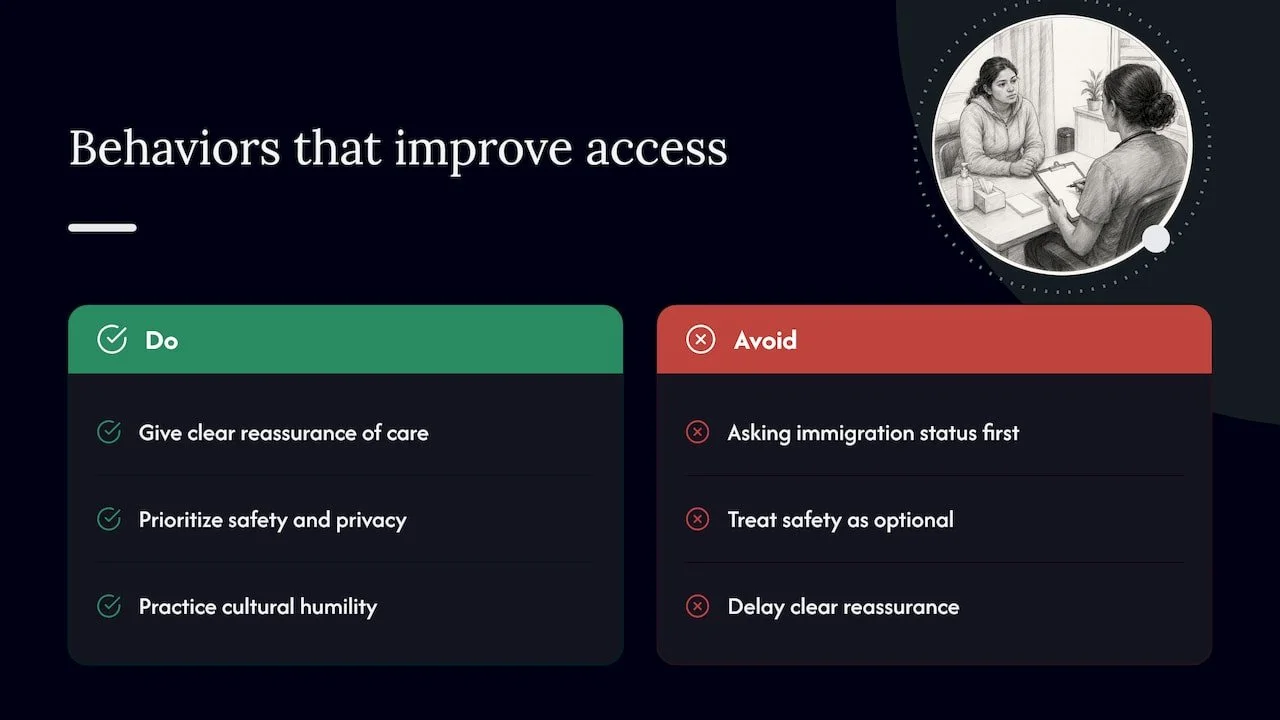
Fear keeps people out of therapy rooms long before any form or fee ever does. We have seen how much a single clear answer, "yes, we see you regardless of status," changes whether someone walks back in for a second session.
Safety, privacy, and cultural humility are not add-ons to good trauma care. They are the foundation it stands on. For deeper reading on how immigration-related trauma shows up in daily life, our blog on healing the emotional impact of immigration is a good next stop.
— Juiced
Bilingual, trauma-informed care at Alvarado Therapy
We built our practice around the belief that trauma care should never require a client to prove their worth before receiving it. We offer EMDR therapy and EMDR intensives for clients who want focused, short-term processing, individual counseling, couples therapy, immigration psychological evaluations, and support for victims of crime through VOCA services.
Our clinicians provide care in English and Spanish, with identity-affirming approaches for Latinx, BIPOC, and LGBTQ+ clients.
Online booking is available for clients across California, with in-person options in select locations.
We also offer downloadable worksheets and a PTSD recovery journal to support the work between sessions.
If you are weighing an immigration psychological evaluation, our guide to what the process involves walks through preparation steps. A first consultation is a conversation, not a commitment. You can book a consultation or review our individual counseling and EMDR therapy services to see what fits your situation.
This article is general information, not a substitute for advice from a qualified doctor. Consult a qualified healthcare professional about your own circumstances before acting on anything here.
FAQ
What free mental health services are available for undocumented immigrants in NYC?
Community health centers and Federally Qualified Health Centers in New York City often provide sliding scale or free mental health services regardless of immigration status; search HRSA's Find a Health Center tool by zip code to locate one nearby. Some city-funded clinics and immigrant-serving nonprofits also run free counseling and peer support groups, so calling ahead to confirm current eligibility and language access is worthwhile.
Can undocumented immigrants get health care in the US?
Undocumented immigrants are generally not eligible for Marketplace coverage, but many can still access care through community health centers, sliding scale clinics, and in some states, Emergency Medicaid for urgent situations, according to Healthcare.gov. Coverage details vary significantly by state, so checking local rules is an important step.
Is the self-deportation stipend $3,000?
We did not find a government source confirming this figure, and claims about specific stipend amounts for self-deportation should be verified directly with official federal immigration sources rather than secondhand reports. If you are weighing decisions tied to immigration status, speaking with a qualified immigration attorney is the safest next step.
What are effective therapeutic interventions for immigrants dealing with trauma?
Clinical guidance points to trauma-informed practices, EMDR, and culturally adapted therapy as effective approaches for immigrant and migrant populations, often paired with consistent interpreter access, according to recent guidance published in PsychiatryOnline. Group and peer support can also help by reducing isolation, with individual therapy suited for processing specific traumatic events.
Sources
Health Resources & Services Administration (HRSA) — Bureau of Primary Health Care
PsychiatryOnline — Mental health care for refugees, immigrants, and migrants in the U.S. (2026)
