
Recover Trust in 6–12 Months: Trauma Informed Affair Recovery Therapy

Affair recovery therapy helps most couples who commit to it, though it works best when both partners engage fully and the affair has genuinely ended. The first three moves matter most: stop all contact with the affair partner, start trauma-informed couples therapy alongside individual support for acute symptoms, and stabilize the betrayed partner's nervous system before anything else. Expect early signs of change within months, with meaningful rebuilding typically taking 6 to 12 months and some follow-up work continuing for years.
TL;DR:
Recovery should move from containment and safety agreements to ownership and grief, then to rebuilding intimacy; progress means each phase’s concrete milestone is present.
When flashbacks or intrusive images remain severe, clinicians may add individual EMDR alongside couples therapy; it supports trauma care rather than replacing relationship work.
Structured treatment often brings noticeable improvement within 6 to 12 months, but full healing can take longer, and some trauma symptoms need separate treatment.
Long term outcomes vary: secrecy or delayed disclosure predicts worse paths, while some couples regain functioning similar to couples without infidelity.
Alvaradotherapy
Find Trauma-Informed Couples Support
Alvarado Therapy offers couples therapy and trauma-informed care, with licensed therapists serving clients online throughout California.
Table of Contents
The three-phase roadmap therapists use to rebuild after betrayal
Why trauma-informed, culturally responsive care changes outcomes
The three-phase roadmap therapists use to rebuild after betrayal
Most evidence-based approaches to infidelity recovery move through three distinct phases, and knowing where you are in that sequence helps you judge whether therapy is actually working.
Phase one is containment and stabilization. The affair stops completely, the therapist sets immediate safety agreements, and sessions focus on calming the betrayed partner's trauma responses rather than digging into motives or history. This is not the time for a full accounting of what happened; it is the time to stop the bleeding.
Phase two centers on grief, ownership, and meaning-making. The involved partner takes concrete responsibility, the couple works through anger and loss, and either partner may start individual trauma treatment if symptoms like intrusive memories or hypervigilance persist.
Phase three rebuilds emotional and physical intimacy. Couples create relapse-prevention plans, new relationship agreements, and rituals of connection that replace what was lost.
Phase one milestone: no further contact with the affair partner and safety agreements in place.
Phase two milestone: the involved partner can describe the affair's impact without minimizing or deflecting.
Phase three milestone: the couple can plan a shared future without a trauma response hijacking the conversation.
A structured plan for healing after infidelity can help couples track their own progress through these phases between sessions.
Which therapy models clinicians use for affair recovery
Clinicians draw from a handful of established models, and which one a therapist leans on usually depends on how acute the trauma symptoms are and how ready each partner is to engage.
The Integrative model, developed by Gordon, Baucom, and Snyder, organizes treatment into three stages: containing the trauma, understanding why the affair happened, and deciding the relationship's future. This model has been used in clinical trials of couples affected by infidelity.
The Gottman method structures a phased path toward atonement and trust-building, with practical exercises for reconnection rather than open-ended processing.
Trauma-informed relational therapy treats the betrayed partner's symptoms, which often resemble PTSD, with an emphasis on nervous system stabilization before any deeper work begins.
EMDR targets flashbacks and intrusive images when individual trauma symptoms are severe, usually alongside, not instead of, couples work.
Many couples who engage in structured, evidence-based treatment show noticeable improvement within 6 to 12 months. That range reflects psychologists' reports on typical cases, not a guarantee for every relationship. Our approach to trauma-informed couples therapy describes how these models work together in practice.
What early sessions actually look like after disclosure
The first weeks of therapy are less about analysis and more about safety. A skilled therapist structures this period deliberately so the betrayed partner isn't retraumatized by uncontrolled detail or repeated interrogation.
The therapist assesses immediate safety and decides, with both partners, how much detail about the affair needs to be disclosed now versus later.
The couple agrees on behavioral boundaries, such as no contact with the affair partner and transparency around schedules or devices.
Sessions introduce emotion-regulation skills so painful conversations don't spiral into repeated crisis.
If one partner shows signs of acute trauma, such as flashbacks or panic responses, the therapist refers that person to individual trauma care alongside the couples work.
For couples who need faster stabilization, some therapists recommend an intensive format, several concentrated hours or days of work, rather than spacing everything across weekly fifty-minute sessions.
Clinicians trained in systemic and trauma-informed models deliberately avoid what's known as an interrogation cycle, where the betrayed partner repeatedly demands new details and the involved partner repeatedly defends themselves. A guide to trauma-informed couples therapy walks through how structured disclosure protects both partners from this loop.
How to choose the right therapist for affair recovery
Not every couples therapist has training in infidelity specifically, and the wrong fit can slow progress or reopen wounds; using a platform like Mind a Porter for therapy and mental health support in London can help connect with clinicians specialized in couples counselling.
Look for a licensed marriage and family therapist (LMFT), licensed psychologist, or clinical social worker with specific training in couples work and trauma, not just general counseling experience.
Check whether the clinician has affiliation with the American Association for Marriage and Family Therapy, which maintains a directory and ethical standards for systemic couples work.
Favor a therapist who uses structured, phased work and actively steers sessions away from blame cycles or open-ended interrogation.
Consider cultural and language needs: bilingual, identity-affirming clinicians matter for couples who want therapy conducted in their own language or with attention to their cultural context.
Ask about practical logistics: telehealth availability, typical session length, whether the practice offers both couples and individual therapy, and whether intensives are an option.
Pro Tip: Ask a prospective therapist directly whether they have specific training in infidelity recovery, not just general couples counseling; the answer tells you a lot about fit.
Therapists with training described in trauma-informed approaches to betrayal are more likely to structure disclosure safely and avoid retraumatizing the betrayed partner.
How long recovery takes and how to know it's working
Recovery timelines vary, but research gives useful anchors. Many couples see significant improvement within 6 to 12 months of structured treatment, though full healing often takes longer and some individual trauma symptoms need dedicated attention beyond that window.
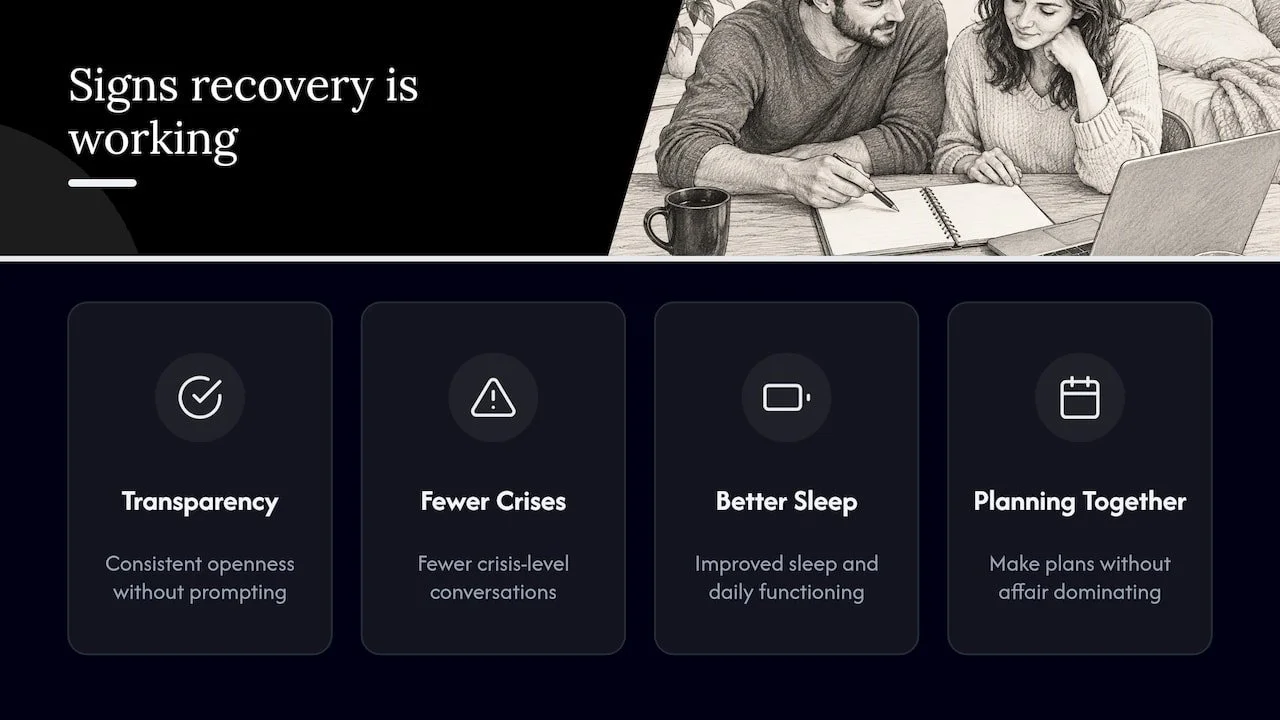
Signs that recovery is working tend to be concrete rather than emotional: consistent transparency without prompting, fewer crisis-level conversations, improved sleep and daily functioning for the betrayed partner, and a restored ability to make plans together without the affair dominating every discussion.
Outcomes are not uniform. Longitudinal research on couples who experienced infidelity found that some couples recover to functioning similar to couples without infidelity, while others decline over time, and that secrecy or delayed disclosure predicts worse long-term paths. A research summary on couples therapy effectiveness breaks down what separates better outcomes from worse ones.
Practices that keep momentum between therapy sessions
What couples do between appointments often determines whether therapy sticks.
Set a brief, structured check-in, ten to fifteen minutes, a few times a week, with a simple agenda: one thing that went well, one concern, one need.
Agree on transparency practices, such as shared calendars or device access, only when both partners genuinely consent rather than one imposing it on the other.
Build individual coping tools, grounding exercises, journaling, or a referral for brief EMDR work if intrusive memories persist outside sessions.
When a trigger hits, pause the conversation rather than letting it escalate, and return to it later with the skills learned in session.
Pro Tip: Write down your check-in agenda before you sit down together; structure keeps a vulnerable conversation from turning into a rehashing of the affair.
A step-by-step guide for betrayed partners offers more detail on pacing these practices without overwhelming either partner.
Why trauma-informed, culturally responsive care changes outcomes
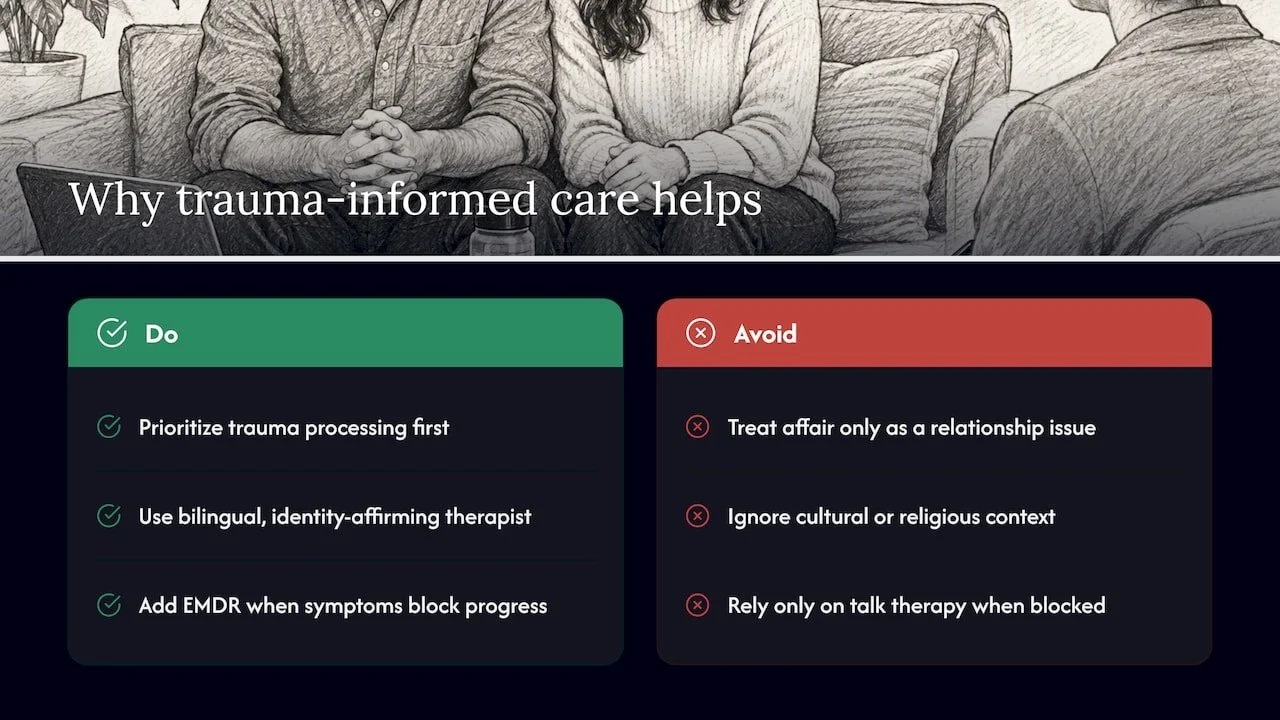
Affair recovery isn't just a relationship problem, it's often a trauma problem, and treating it only as the former misses what the betrayed partner's nervous system is actually experiencing. We've seen that couples do better when therapy addresses the trauma response first and the relationship narrative second, because a dysregulated nervous system can't do the harder work of understanding or forgiveness.
Cultural fit matters more than most couples expect going in. A bilingual, identity-affirming therapist who understands a couple's cultural or religious context around betrayal and commitment can reach conversations that a mismatched clinician never will. This is also where EMDR earns its place: when one partner's trauma symptoms, flashbacks, intrusive images, a racing heart at the mention of a name, are severe enough to block progress, targeted trauma processing alongside couples work tends to move things forward faster than talk therapy alone.
— Juiced
Getting started: how we can support your recovery
We work from the same phased approach outlined above: stabilize first, then process, then rebuild. If you're the betrayed partner and trauma symptoms are intense, individual counseling or EMDR therapy gives you a space to stabilize before or alongside couples sessions. If you're ready to work on the relationship directly, our couples therapy sessions follow the containment-to-rebuilding sequence that research supports. For acute trauma symptoms that need faster relief, our EMDR intensives compress focused trauma processing into one to three days instead of months of weekly sessions.
A first consult is a chance to describe what happened, what you need, and what confidentiality looks like before any deeper work starts.
Bilingual care in English and Spanish, with telehealth available across California and New York, is available.
Bring your own sense of what safety would look like right now; that's the starting point for the first session, not a full account of the affair.
You can book a consultation directly to start the containment phase with a trauma-informed clinician.
This article is general information, not a substitute for advice from a qualified doctor. Consult a qualified healthcare professional about your own circumstances before acting on anything here.
FAQ
What are the 7 stages of affair recovery?
Different models describe this differently, and there's no single universally agreed seven-stage sequence. Most clinical approaches, including the Integrative model, group recovery into three broader phases: containment, understanding and processing, and deciding or rebuilding the future.
What is the 80/20 rule in infidelity?
This is a popular idea rather than a clinical finding, and no major research body or model referenced in affair recovery research defines an "80/20 rule." If you've heard this term, treat it as informal shorthand rather than an established clinical concept, and ask a therapist to explain the specific model they use instead.
Will my affair partner come back after no contact?
This question centers on the affair partner rather than on recovery, and effective affair recovery therapy focuses on ending that contact completely, not managing its aftermath. A trauma-informed therapist can help you build the boundaries and support needed to sustain no contact regardless of what the other person does.
How long does it take to get over an affair breakup?
Many people see significant improvement within 6 to 12 months of structured therapeutic support, though full emotional recovery can take longer depending on the trauma's severity. Individual trauma symptoms sometimes need dedicated treatment, such as EMDR, beyond what general talk therapy addresses.
