
How to Heal From a Cheating Husband: Real Steps

The first thing to do right now is stabilize, not decide. Healing from a cheating husband begins with one priority: get yourself safe, slow your nervous system down, and resist the pull to make permanent choices while you're still in shock. That's not weakness. That's exactly what trauma-informed therapists recommend, and it's the foundation everything else builds on.
Here's what to do in the next few hours:
Ensure your physical safety. If there is any threat of violence or coercion, contact the National Domestic Violence Hotline at 1-800-799-7233 before anything else.
Pause major decisions. Don't file for divorce, move out, or make any irreversible financial moves today. Mayo Clinic advises taking time to heal and understand what happened before choosing to continue or end the marriage.
Stop contact between your husband and the affair partner. This is non-negotiable for any path forward, whether you stay or leave.
Tell one trusted person. You need a real human witness to what you're going through, not just a phone screen.
Book a therapy or crisis appointment. Even one session in the next 48 hours can change how you navigate the days ahead. A step-by-step plan for individual recovery can help you see what comes next.
Pro Tip: If your hands are shaking or you can't catch your breath, try the physiological sigh: two short inhales through the nose, then one long exhale through the mouth. It activates the parasympathetic nervous system faster than most other breathing techniques and takes about 30 seconds.
Key Takeaways
Healing from a cheating husband requires stabilizing your nervous system first, then making decisions, then doing the sustained work of either rebuilding or moving on with professional support.
| Point | Details |
|---|---|
| Stabilize before deciding | Avoid permanent decisions immediately; crisis impairs judgment and recovery takes 12–24 months. |
| End the affair completely | Contact with the affair partner must stop before any repair work is possible. |
| Use evidence-based therapy | EFT, EMDR, and trauma-informed couples therapy are the most effective tools for infidelity recovery. |
| Red flags mean safety first | Ongoing deception, violence, or refusal of accountability shifts the priority to separation planning. |
| Alvarado therapy offers specialized support | Individual EMDR, couples therapy, and EMDR Intensives are available online in California and New York. |
Table of Contents
What self-care actually helps when you're coping with a cheating spouse?
Which types of therapy actually work for infidelity recovery?
What emotional stages should you expect after infidelity?
Betrayal doesn't feel like ordinary heartbreak. It feels like the ground disappeared. What you're experiencing has a clinical name: betrayal trauma, a specific type of psychological injury that occurs when someone you depended on for safety violates that trust. Understanding the pattern of what's coming helps you recognize that your reactions are not signs of weakness or instability.
The stages most people move through after infidelity include:
Shock and disbelief. The mind protects itself by not fully processing what happened. You may feel numb, detached, or strangely calm.
Denial. "Maybe I misread it." "Maybe there's an explanation." This is the brain buying time.
Grief. You're mourning the relationship you thought you had. Psychology Today frames infidelity recovery as grief work, noting that healing requires grieving the old relationship before you can intentionally build anything new.
Anger. Often the most intense phase, and one of the most necessary. Anger is information.
Bargaining. "If he just explains it, I can fix this." "If I had been different, this wouldn't have happened." Neither is true.
Anxiety and hypervigilance. Your nervous system is now on threat-detection mode. Checking his phone, scanning for signs, replaying details — this is your brain trying to prevent another ambush.
Depression. The weight of what happened settles in. Energy drops. Motivation disappears.
Gradual acceptance. Not approval. Acceptance that this happened and that you can still build a life.
Meaning-making. The long game: understanding what this experience taught you about yourself, your needs, and what you want next.
Recovery is not linear. You may cycle back through anger after weeks of feeling better. That's normal. Therapist Figs O'Sullivan at Empathi notes that acute symptom reduction typically takes 12–24 months, and that the path is often non-linear. Progress looks like the bad days getting shorter and the good ones getting longer, not a clean upward slope.
Signs you're moving forward even when it doesn't feel like it: you go a full hour without thinking about the affair, you make a decision about your own life without referencing him, you sleep through the night, you laugh at something and don't immediately feel guilty about it.
What should you do in the first 72 hours?
The first three days after discovery are about survival and documentation, not resolution. Your prefrontal cortex, the part of the brain responsible for clear decision-making, is genuinely impaired by acute emotional shock. Empathi's therapist guidance is direct: prioritize stabilization before any irreversible choices. Here's the practical checklist.
Safety and support:
Confirm you are physically safe. If you're not, call 1-800-799-7233 (National Domestic Violence Hotline) or 911.
Identify two or three people you can contact at any hour: a close friend, a family member, a therapist.
If you have children, arrange for someone to help with childcare so you have time to process without performing stability.
Documentation:
Screenshot or photograph relevant communications before they can be deleted. Store them in a cloud folder (Google Drive, iCloud) that only you can access, not on a shared family device.
Note dates, times, and any relevant financial transactions you've observed.
If you think you may need legal counsel, consult a family law attorney before taking any financial action. Many offer free 30-minute consultations.
Basic grounding and self-care:
Drink water. Eat something, even if it's small. Trauma suppresses appetite but your body still needs fuel.
Sleep matters more than almost anything else right now. If you can't sleep, talk to your doctor. Short-term sleep support is a legitimate medical need in acute crisis.
Try a simple grounding exercise: name five things you can see, four you can touch, three you can hear. It interrupts the rumination loop and brings you back to the present moment.
Talking to children:
Keep it brief and age-appropriate. "Mom and Dad are going through something hard right now, and we're getting help" is enough for most ages. Children need reassurance of their own safety and routine, not adult details. Avoid placing them in the middle or asking them to keep secrets.
Pro Tip: Store any documentation in a personal email account or cloud folder your husband doesn't have access to. If you later decide to involve an attorney, having a timestamped record matters. If you decide to reconcile, you can delete it. You can't recreate it if it's gone.
How do you decide whether to stay or leave?
This is the question that will consume you for weeks, possibly months. The most important thing to know first: Mayo Clinic explicitly recommends not making this decision immediately. The shock and grief of discovery impair judgment. A choice made in the first week is rarely the choice you'd make with a clearer head.
That said, you need a framework, not just permission to wait. Here's a practical decision flow:
Step 1: Safety first. Is there any violence, coercion, or ongoing threat? If yes, separation planning takes priority over reconciliation questions.
Step 2: Is the affair over? If your husband is still in contact with the affair partner, there is nothing to rebuild yet. Contact must end completely before any repair work is possible.
Step 3: Is there genuine accountability? Does he take full responsibility without minimizing, blaming you, or making excuses? Accountability is not a one-time apology. It's a sustained posture.
Step 4: Is he willing to be transparent? Transparency means open access to phone, email, and calendar for a defined period, not because you're controlling him, but because your nervous system needs verifiable safety to begin healing.
Step 5: Is he willing to do the work? Therapy, hard conversations, sitting with your pain without shutting down. If he refuses professional help, that tells you something important.
Questions to ask yourself:
Do I want this relationship, or do I want to escape the pain of losing it?
Can I imagine forgiving him, even if it takes years?
Was this marriage meeting my core needs before the affair?
Is there a pattern of deception, or was this a single catastrophic breach?
Temporary separation can be a legitimate tool, not a final answer. It creates space to think without the daily friction of living with someone you're furious at. If you separate temporarily, agree on a defined period (30–90 days is common), establish financial arrangements in writing, and agree on a co-parenting schedule if children are involved.
What concrete steps rebuild trust if you decide to stay?
Choosing to stay is not the same as choosing to forgive immediately. It's choosing to find out whether repair is possible. That distinction matters because it takes the pressure off both of you to perform a recovery you haven't actually done yet.
What your husband must do first:
End the affair completely. No "we're just friends now," no lingering contact. TherapyDen's therapist guide is clear: contact with the affair partner must end if the couple decides to stay together. If the affair partner is a coworker, a formal plan for limiting contact (different schedules, no private communication) is the minimum.
Commit to radical transparency. Share location, phone access, and calendar for a defined period. This isn't permanent surveillance. It's a temporary scaffold while trust is being rebuilt.
Offer a sincere, full apology. Not "I'm sorry you're hurt." A real apology names what he did, acknowledges the impact, and makes no excuses.
Stop defending himself when you ask questions. Your need to understand what happened is legitimate. His discomfort with the questions is not your problem to manage.
The therapy roadmap:
Trauma-informed couples therapy is the most effective structured path for repair. Emotionally Focused Therapy (EFT) specifically targets attachment wounds, which is exactly what infidelity creates. Cleveland Clinic confirms that rebuilding trust requires observable behavioral changes and new healthy boundaries, and that therapy supports both. EMDR (Eye Movement Desensitization and Reprocessing) is particularly useful for the betrayed partner when intrusive memories, flashbacks, or hypervigilance are severe.

The sequencing matters: individual therapy for you first, to stabilize your own nervous system and clarify your needs, then couples therapy once you have enough ground under you to engage without being overwhelmed. Couples therapy for healing explains how this sequencing works in practice.
Rebuilding trust milestones:
| Timeframe | What progress looks like | Example behaviors |
|---|---|---|
| Weeks 1–4 | Affair ended, crisis stabilized | No contact confirmed, individual therapy started, basic safety restored |
| Months 1–3 | Transparency established, couples therapy begun | Consistent check-ins, open phone access, first therapy sessions completed |
| Months 3–12 | Emotional presence increasing, triggers decreasing | Fewer intrusive thoughts, husband responds to questions without defensiveness |
| Years 1–3 | New relationship foundation forming | Renewed intimacy, shared meaning-making, trust rebuilt through repeated experience |
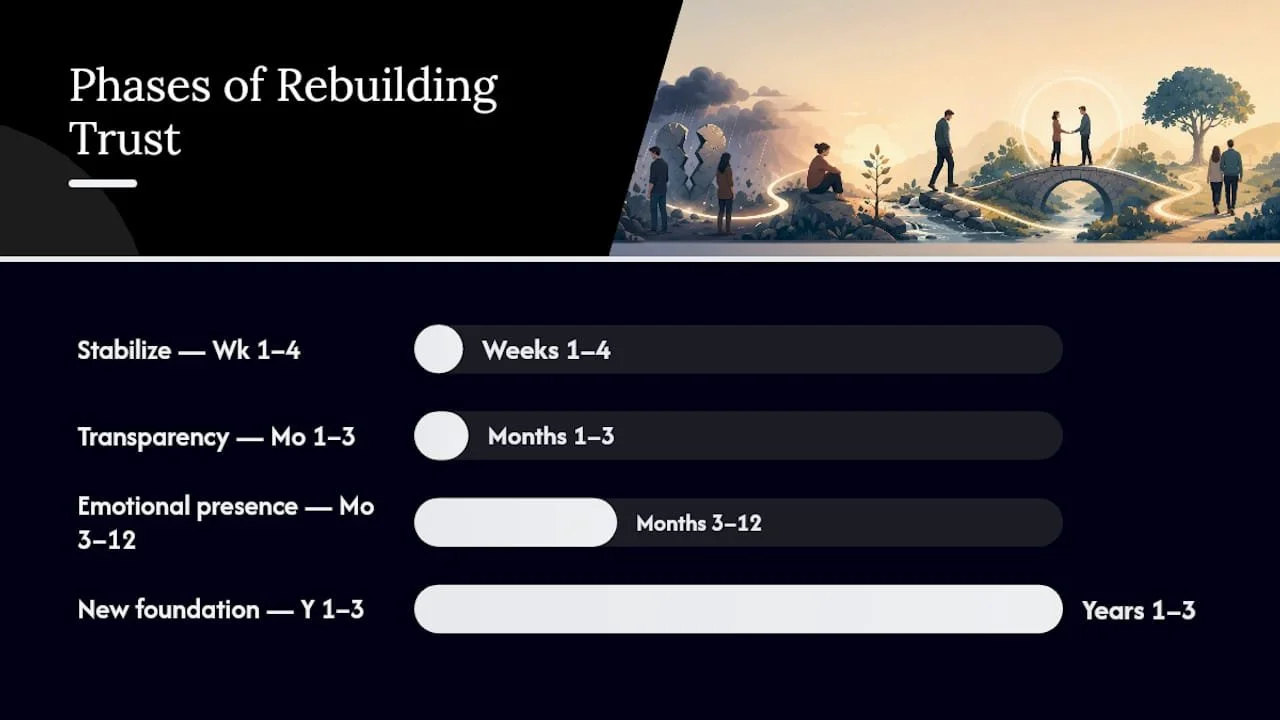
PositivePsychology's trust research makes a point worth holding onto: trust is rebuilt through repeated small dependable actions, not grand gestures. One dramatic apology weekend means far less than six months of consistent, boring, reliable behavior.
On communication protocols:
You will ask the same questions many times. That's not pathology; it's how trauma processes. Your husband needs to understand that answering the same question for the fifteenth time is part of his accountability, not an optional exercise. At the same time, there are details that re-traumatize rather than heal. A therapist can help you identify which questions serve your healing and which ones feed the wound.
Pro Tip: Ask your husband to commit to one small, predictable daily action, a text when he arrives somewhere, a consistent check-in time, whatever fits your situation. Predictability is what retrains a traumatized nervous system. Grand gestures are memorable; small reliable ones are what actually rebuild safety.
What self-care actually helps when you're coping with a cheating spouse?
Self-care after betrayal isn't bubble baths and scented candles. It's the unglamorous work of keeping your body and mind functional enough to make good decisions and eventually heal.
Daily basics that matter more than they sound:
Sleep 7–9 hours. If you can't, address it medically. Sleep deprivation compounds every emotional symptom.
Eat regular meals. Grief suppresses appetite, but blood sugar crashes make emotional regulation nearly impossible.
Move your body daily, even a 20-minute walk. Physical movement processes stress hormones that otherwise stay trapped in the body.
Check your medications. If you're on any prescription, confirm you're taking it consistently. Stress disrupts routines.
Emotion-regulation tools:
Grounding: The 5-4-3-2-1 technique (five things you see, four you can touch, three you hear, two you smell, one you taste) interrupts dissociation and rumination.
Paced breathing: Inhale for four counts, hold for four, exhale for six. The extended exhale activates the vagus nerve and reduces heart rate.
Journaling: Write without editing. Prompts that help: "What I need right now is..." and "What I'm most afraid of is..." Getting fear onto paper reduces its power.
Graded exposure to triggers: Avoiding all reminders keeps anxiety high long-term. Gradually, with support, facing triggers in small doses reduces their intensity over time.
Social support:
Choose one trusted confidant carefully. Someone who will listen without immediately telling you what to do, who won't gossip, and who can hold complexity. Support groups for betrayed partners (in-person or online) can also reduce the isolation that makes recovery harder. Limit social media checking, especially anything that involves his accounts or the affair partner's.
Rebuilding your identity:
Infidelity often damages your sense of self alongside the relationship. Reclaiming your identity means making choices that are entirely yours: a class you've wanted to take, a friendship you've neglected, a project that has nothing to do with him. Small autonomy-building actions accumulate into a rebuilt sense of self over months.
Pro Tip: Hypervigilance, the compulsive checking of his phone, location, or social media, is your nervous system trying to prevent another ambush. It makes sense, but it also keeps you in a constant state of threat. Work with a therapist to set specific "checking windows" rather than checking constantly. This reduces the behavior gradually without forcing cold-turkey avoidance.
Which types of therapy actually work for infidelity recovery?
Not all therapy is equally useful for betrayal trauma. Generic talk therapy can help, but the evidence points to specific modalities that address what infidelity actually does to the brain and the relationship.
Individual therapy options:
Trauma-focused individual therapy addresses the betrayal trauma directly: intrusive thoughts, hypervigilance, emotional dysregulation, and the identity disruption that follows.
EMDR (Eye Movement Desensitization and Reprocessing) is particularly effective when the betrayed partner is experiencing symptoms that resemble PTSD: flashbacks, nightmares, emotional flooding when triggered. EMDR processes traumatic memories so they lose their charge without requiring you to talk through every detail repeatedly.
Trauma-informed individual counseling provides a safe space to process grief, clarify your own needs, and make decisions from a more regulated state.
Couples therapy options:
Emotionally Focused Therapy (EFT) targets the attachment system directly. It helps both partners understand the emotional cycles that drive disconnection and builds new patterns of reaching and responding. EFT has a strong evidence base for couples recovering from infidelity.
Trauma-informed couples therapy specifically accounts for the betrayed partner's trauma symptoms and paces the work accordingly, rather than treating both partners as equally resourced.
Infidelity-specialized couples therapy follows a structured disclosure and accountability process that generic couples counseling often skips. Mayo Clinic recommends seeing a marriage counselor with specific experience in infidelity, not just general relationship work.
When to choose what:
Start with individual therapy if you are in acute crisis, if your husband is not yet committed to repair, or if you need to clarify your own decision before engaging as a couple.
Add couples therapy once the affair has ended, both partners are willing, and you have enough individual stability to engage without being overwhelmed.
Consider EMDR when intrusive memories or trauma symptoms are interfering with daily functioning or making couples work impossible.
Consult a psychiatrist if depression or anxiety is severe enough to impair basic functioning. Medication can create enough stability to engage in therapy effectively.
What to look for in a therapist:
Licensed (LMFT, LCSW, LPC, or psychologist)
Specific experience with infidelity and betrayal trauma
Trauma-informed training
EMDR certification if offering EMDR (look for EMDRIA-certified)
Willingness to discuss their approach to infidelity before you commit
Red flags in a therapist:
Blames the betrayed partner for the affair
Pushes reconciliation before safety is established
Has no specific infidelity experience
Offers EMDR without certification
Preparing for your first appointment:
Bring a brief written summary of what happened and when, your primary goals (stabilize, decide, rebuild), any safety concerns, and a list of your most distressing symptoms. How to prepare for marriage counseling walks through this preparation in detail.
What warning signs suggest repair is unlikely or unsafe?
Some situations call for healing from the marriage, not within it. These red flags don't mean you failed. They mean the conditions for repair don't exist.
Ongoing secret contact with the affair partner. If he is still communicating with her and hiding it, the affair hasn't ended. There is nothing to rebuild on.
Continued denial or minimization. "It wasn't that serious." "You're overreacting." "It only happened a few times." Minimization is a form of ongoing deception.
Repeated betrayals. A pattern of infidelity across the relationship is different from a single breach. Patterns require a different level of accountability and a harder look at whether change is realistic.
Violence, threats, or coercion. Any physical intimidation or threats connected to the affair or your response to it is a safety emergency. Contact the National Domestic Violence Hotline at 1-800-799-7233.
Refusal of accountability. He won't apologize sincerely, won't enter therapy, and won't make any behavioral changes. Repair requires two people. One person cannot do it alone.
Substance abuse or criminal behavior that continues. If the affair is connected to ongoing addiction or illegal activity that he won't address, the underlying problem remains active.
Gaslighting. If he consistently makes you question your own perception of events, that's a form of psychological abuse that makes healing inside the relationship nearly impossible.
If any of these apply, the priority shifts from reconciliation planning to safety planning. That means consulting a family law attorney, identifying a safe place to stay if needed, and working with an individual therapist on an exit plan. The National Domestic Violence Hotline also offers safety planning support, not only for physical violence but for coercive control situations.
How long does healing take, and what does therapy cost?
Healing from infidelity takes longer than most people expect and shorter than it feels like it will in the first weeks. Empathi's therapist guidance puts acute symptom reduction at 12–24 months for most people. Cleveland Clinic notes that full trust rebuilding can take an extended period depending on the severity of the breach and the consistency of repair behaviors.
Factors that speed recovery: both partners committed to the process, early professional support, no repeat betrayals, strong individual support networks, and the offending partner's sustained accountability. Factors that slow it: ongoing deception, trauma history that predates the affair, lack of professional support, and financial or parenting stress that keeps both partners in survival mode.
Typical U.S. therapy costs:
Practical budgeting tips:
Insurance: Many plans cover individual therapy under mental health benefits. Couples therapy is less consistently covered. Call your insurer and ask specifically about "marriage and family therapy" coverage.
Sliding scale: Many therapists offer reduced fees based on income. Ask directly. Most won't advertise it prominently, but most will offer it if asked.
Telehealth: Online therapy is often less expensive than in-person and removes the barrier of geography. Alvaradotherapy offers online therapy across California and New York.
EMDR Intensives: If you're in acute crisis and weekly sessions feel too slow, an EMDR Intensive compresses multiple sessions into a concentrated format. The upfront cost is higher, but the accelerated progress can reduce total treatment time.
Prioritize individual therapy first if budget is limited. Your own stabilization is the foundation for everything else.
How Alvarado Therapy approaches infidelity recovery
Alvaradotherapy is a trauma-informed mental health practice serving clients in California and New York, with licensed therapists available online throughout both states and in-person in Pasadena and Ventura. The practice specializes in exactly the combination of services that infidelity recovery requires.
Services relevant to betrayal trauma:
Individual EMDR therapy for the betrayed partner experiencing trauma symptoms: intrusive memories, hypervigilance, emotional flooding, and sleep disruption. EMDR processes these without requiring you to narrate every detail of the affair repeatedly.
EMDR Intensives for those who need accelerated progress, particularly useful when acute symptoms are severe or when weekly sessions feel insufficient.
Trauma-informed couples therapy that accounts for the betrayed partner's trauma state and paces the work accordingly, rather than treating both partners as equally resourced from the start.
Bilingual English-Spanish care for clients who process emotional material more naturally in Spanish.
Individual counseling for grief, anxiety, depression, and identity work that runs alongside or independent of couples work.
Alvaradotherapy's clinicians are trained in trauma-specialized modalities and bring specific experience with relationship trauma and betrayal. The practice's approach to couples therapy in trauma recovery reflects the sequencing and pacing that evidence-based infidelity recovery requires.
Pro Tip: If you're unsure whether to start with individual or couples therapy, book a consultation first. A 30-minute conversation with a clinician can clarify which entry point fits your situation and what to expect from the process.
A therapist's perspective on healing after infidelity
What I see most often in the early days after discovery is someone trying to think their way out of a feeling. You want an explanation that makes sense of it, a decision that ends the uncertainty, a plan that gives you control back. All of that is understandable. None of it works yet, because your nervous system is still in crisis mode and your brain is not yet capable of the kind of clear, regulated thinking those tasks require.
The most important reframe I offer clients is this: healing is not about getting back to who you were before. That relationship is gone. What's possible, if both people do the work, is something different. Psychology Today describes this as building a "relationship 2.0", a new relationship that is chosen deliberately rather than inherited from the past. That framing takes the pressure off restoring something that can't be restored and puts the energy into building something that might actually be better.
If you're reading this alone, without your husband's participation, that's also a valid place to be. Your healing doesn't depend on his choices. Individual therapy, EMDR for trauma symptoms, and the slow work of rebuilding your own identity are all available to you regardless of what he decides to do. You don't need his cooperation to start.
Alvarado Therapy is ready to support your recovery
Healing after a husband's infidelity is one of the most disorienting experiences a person can go through. The path forward is clearer with professional support, and Alvarado Therapy offers the specific combination of services that betrayal trauma requires: individual EMDR therapy, trauma-informed couples counseling, EMDR Intensives for accelerated progress, and bilingual care in English and Spanish.
Alvaradotherapy serves clients online throughout California and New York, with in-person sessions available in Pasadena and Ventura. Telehealth makes it possible to start quickly, without waiting for an in-person opening. Sliding-scale fees are available, and the team can help you understand your insurance options during a consultation.
The next step is a single conversation. Book a consultation to talk with a clinician about where you are and what kind of support fits your situation. If you're ready to start with EMDR or couples therapy directly, you can learn what to expect at Alvaradotherapy's therapy overview page or go straight to online couples therapy to explore that path.
Sources
These resources offer research-backed guidance for anyone navigating infidelity recovery. They're worth bookmarking, but if you're in acute distress, prioritize getting human support before reading further.
Infidelity: Mending your marriage after an affair - Mayo Clinic
Healing After Infidelity: A Therapist's Guide to Rebuilding Trust - TherapyDen
This article provides general information and is not a substitute for professional mental health or legal advice. If you are in crisis or need personalized guidance, please consult a licensed therapist or contact a crisis line.
