

First-session anxiety is normal, and it usually comes from not knowing what will happen. Healthline's guide to the first session says it is completely natural to feel nervous before starting therapy, and that the nerves often come from uncertainty about the process. The fastest way to take the edge off is to learn what the hour looks like, decide what you do and do not want to share, and tell your therapist you are nervous. This guide walks through all three.
Alvaradotherapy
Start Therapy At Your Own Pace
Alvarado Therapy offers trauma-informed counseling across California, with licensed therapists supporting clients in English and Spanish.
TL;DR
Nerves before a first appointment are common. They often come from not knowing what to expect, not from anything being wrong with you.
The first session is usually an intake: your therapist asks about your history and current struggles, explains confidentiality and fees, and starts building a working relationship.
You do not have to tell your whole story or talk about trauma right away. You set the pace.
Bring a short list of questions, concerns and medications, and say out loud that you feel anxious.
If you feel shaky after a session, or the fit feels off, say so. Both are things a good therapist wants to hear.
Table of Contents
Why your stomach drops before the first appointment
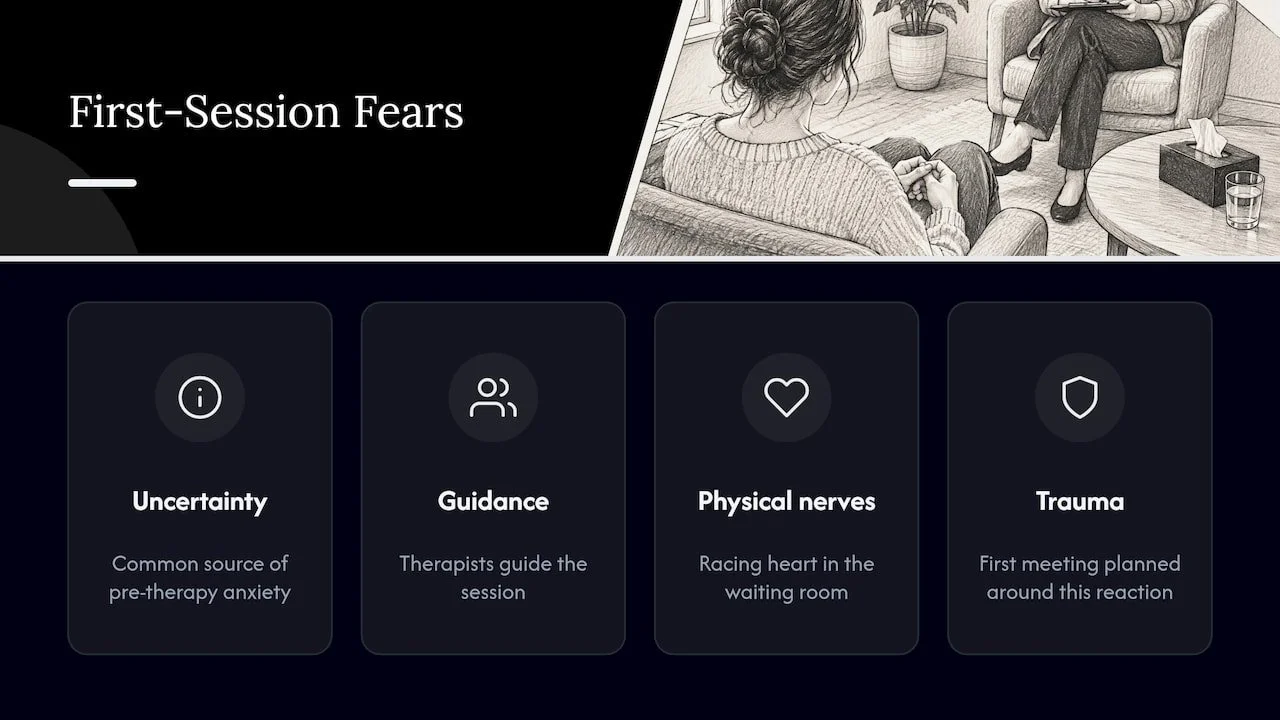
Most people who book a first therapy session have a few quiet fears running in the background. Will I cry in front of a stranger? Will I say the wrong thing? Will they judge me, or decide my problems are too small, or too big? Will I be asked about the one thing I never talk about?
None of these fears is unusual. Healthline lists uncertainty about what therapy involves as a common source of pre-therapy anxiety, and the same article notes that therapists are trained to set the tone, guide the session and help clients feel more comfortable and less overwhelmed. In other words, the person across from you has done this many times and knows the first meeting is awkward for almost everyone.
There is also a particular irony for people who seek help for anxiety: the act of getting help can set off the very symptoms you want to treat. A racing heart in the waiting room does not mean therapy is a bad idea. It means you are about to do something that matters to you, and your body knows it.
For trauma survivors the nerves can run deeper. Walking into a room with someone you do not know yet, and expecting to be asked about painful things, can feel unsafe. That reaction makes sense, and a trauma-informed therapist plans the first meeting around it. We cover that below.
What actually happens in a first therapy session
The American Psychological Association describes the early sessions as a time when the therapist may ask many questions, learn your history, and then work with you to shape a treatment plan. In practice, most first sessions cover some mix of these:
Logistics and consent. Your therapist explains confidentiality and its limits, fees, scheduling and how to reach them between sessions.
Your reasons for coming. What is going on now, how long it has been happening, and how it affects sleep, work, relationships and mood.
Background. Family, relationships, past treatment, health and medications. You choose how much detail to give.
What you hope will change. Goals do not have to be polished. "I want to stop dreading every Sunday night" is a real goal.
How the work might go. Your therapist may outline an approach and invite your questions about it.
Most therapy sessions run about 50 minutes, according to UC Davis Health. Some practices schedule intakes a little differently, so check your confirmation message or ask when you book.
Two things the first session is not. It is not a test you can fail, and it is not a commitment to continue. Think of it as a two-way interview: you are learning whether this person and this way of working feel right to you.
What the therapist is doing while you talk
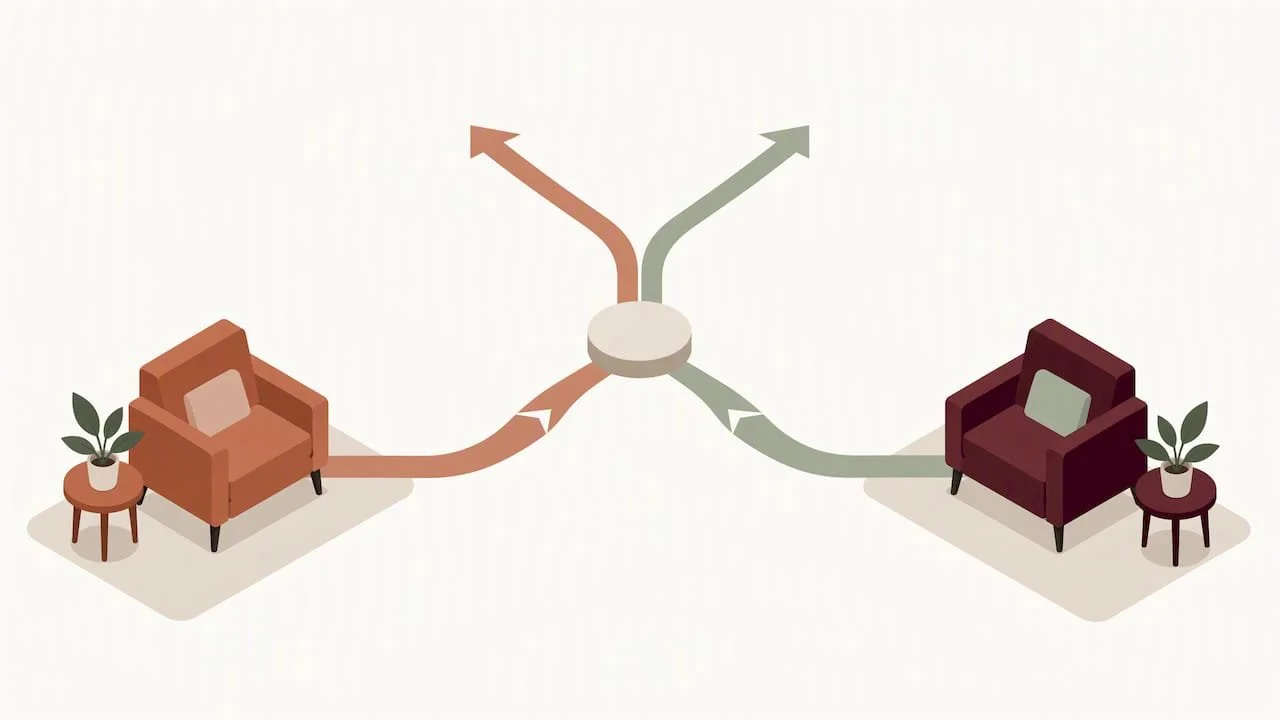
Your therapist is listening for patterns, but also paying attention to how you are doing in the room. Simply Psychology describes the first session as mostly about assessment and relationship-building, and points out that the therapist-client relationship is a consistent predictor of outcomes. That is a good reason to treat the first meeting as a chance to notice how you feel with this person, not just to hand over information.
Do you have to talk about trauma in the first session?
No. This is the question that keeps many survivors from booking at all, so it is worth being plain about it. The APA says clients are not expected to share every difficult or traumatic experience right away. You can share at your own pace as trust builds.
That means you can say things like:
"I have been through some things I am not ready to talk about yet. Can we start with how I am doing now?"
"I would like to know how you work before I go into my history."
"If I go quiet, it does not mean I want to leave. Can we slow down?"
A therapist who works with trauma will take these statements as useful information, not as resistance. If you are heading toward trauma-focused work such as EMDR, the early sessions are usually about history-taking, building stability and making sure you have ways to steady yourself before any deeper processing. Our guide on how to prepare for EMDR therapy explains that sequence, and our piece on preparing for counseling as a trauma survivor goes deeper on pacing and safety.
How to prepare so there are fewer unknowns
Preparation will not remove the nerves, but it gives them less to feed on. Here is a short routine.
Write down your questions and concerns
The National Institute of Mental Health suggests going to a provider visit with a list of questions, concerns and medications, including over-the-counter drugs, herbal remedies, vitamins and supplements. That advice is written for health care visits in general, and it works well for an intake too. Your list might include:
What you want help with, in a sentence or two
Symptoms you have noticed, such as trouble sleeping, panic, irritability or avoiding certain places
Medications and supplements you take, and any previous therapy
Practical questions: fees, cancellation policy, whether you can switch from online to in person, whether insurance or a sliding scale applies
Questions about the therapist: how they work, how they handle trauma, whether they offer sessions in Spanish if that is your preferred language
Decide your boundaries ahead of time
Before you arrive, pick one or two topics you are willing to talk about and one or two you want to save for later. Knowing you have a plan for "not today" makes it easier to show up.
Handle the logistics early
Online sessions: test your camera, sound and internet connection the day before, and choose a room where you will not be overheard. Our step-by-step guide to preparing for an online therapy session covers the setup. In person: look up parking or transit, and give yourself a few extra minutes so you are not rushing in with your pulse already up.
If paperwork comes first, read our walkthrough of the therapy intake process so the forms feel familiar.
Plan something gentle for afterward
Schedule the hour after your session with as little demand as you can. A walk, a quiet lunch or a short break from email gives your mind time to settle. Some people bring a notebook to jot down what stood out.
Calming down on the day itself
No single trick works for everyone, so pick what suits you.
Arrive a little early. Or log in a few minutes early for online sessions, so you are settled before the clock starts.
Say it first. Open with "I am pretty nervous today." It costs nothing, it lowers the pressure to hide it, and it gives your therapist a way to help you right away.
Bring your list. Reading from notes is completely acceptable. Therapists see it often.
Ask for what you need. A glass of water, a pause, a window open, a slower pace. If you are online, you can turn your camera angle or sit somewhere that feels safe.
Remember you can stop. You can say "I need a minute" at any point.
The National Institute of Mental Health notes that therapists use approaches such as cognitive behavioral therapy to help people manage stress, challenge inaccurate thinking and build coping strategies. If you are coming in specifically for anxiety, your therapist may talk about those tools early on. Our step-by-step guide to therapy for anxiety relief shows how the process often unfolds after the first meeting.
What if you feel worse after the first session?
Some people leave the first session relieved. Others feel drained, tearful, restless or raw. Mind, a mental health charity in the United Kingdom, says it can be common to feel upset or overwhelmed after a session stirs up difficult memories or feelings, and suggests telling your therapist how you felt at your next session.
In practice, that means:
Name it at the start of the next session. "After last time I felt shaky for two days" is exactly the kind of feedback that lets your therapist adjust the pace.
Ask about between-session support. Find out how to reach your therapist about scheduling, and what to do if you need urgent help.
Do not wait it out alone if it becomes severe. If you feel unsafe or are thinking about harming yourself, call or text 988, the Suicide & Crisis Lifeline, or call 911 for an emergency.
A hard day after a session does not mean therapy is failing. It does mean the pace is worth talking about.
What if it does not feel like the right fit?
The APA identifies the therapeutic alliance, the working bond between you and your therapist, as an important part of what makes psychotherapy work. So fit matters, and it is reasonable to pay attention to it.
At the same time, one awkward hour is not a verdict. Lifeline in Australia advises that you do not give up after one session if you feel you are not clicking, since therapy takes time. A fair approach is to give it a few sessions while you notice:
Do I feel listened to, even when the conversation is uncomfortable?
Does my therapist explain what we are doing and why?
Can I disagree or say "that did not land" without it going badly?
Does my background, language or identity feel respected and understood?
The last question matters more than people expect. If you want a therapist who speaks Spanish, understands immigrant or bicultural family dynamics, or works with LGBTQ+ clients, ask about that before you book. Our overview of identity-affirming counseling explains what to look for, and our article on cultural humility in therapy shows how that shapes trust.
If the fit is wrong, you are allowed to say so and look elsewhere. Most therapists would rather you speak up than quietly disappear.
First sessions for couples
If you are walking into couples therapy, the nerves can double: yours and your partner's. Expect the first meeting to focus on each person's view of what is happening, what you hope will change, and how the work will be structured. Neither of you is on trial. Our practical guide on what to expect in couples therapy walks through it, and if the issue is broken trust after betrayal, trust-based therapy for couples describes how that repair work is approached. If the topic is anxiety inside the relationship, these coping tips for anxiety in relationships can help you before the first appointment.
Our perspective on first-session anxiety
At Alvarado Therapy, we think the first session should lower fear, not test courage. Many of the people who come to us have carried something for years: childhood trauma, grief, anxiety that never fully switches off. For them, the hardest part of therapy is often walking in the door.
So we start where you are. We are a trauma-informed practice, which means we do not ask you to relive painful events to prove you belong in treatment. We explain what we are doing, we let you set the pace, and we treat nervousness as useful information about what you need to feel safe.
We also know that safety is not only about technique. It is about being understood. We offer care in English and Spanish, and our work is built around identity-affirming, culturally responsive support for Latinx, BIPOC and LGBTQ+ clients. Not having to translate your life or explain your culture to your therapist removes one more reason to feel on edge.
For people who want focused trauma work, we offer EMDR therapy, including intensives. We believe careful preparation is part of good EMDR, and the first sessions are where that foundation begins.
Juiced
Ready to take the first step?
If you are looking for trauma-informed support in California, we offer individual counseling and EMDR therapy in Pasadena, Ventura and online across the state, in English or Spanish. You can read about individual counseling and EMDR therapy and book online. Tell us in your first message that you are anxious. It helps us plan a calmer start.
If you would rather work in concentrated blocks, our EMDR intensives are listed at $1,500 for a 4-hour one-day format, $2,250 for a 6-hour one-day format, and $5,750 for the 3-day format. Intensives involve preparation first, and we explain how that works before you commit.
FAQ
Is it normal to be nervous before your first therapy session?
Yes. Healthline's guidance says feeling anxious before starting therapy is completely natural, and uncertainty about what will happen is a common cause. Naming the nerves to your therapist at the start is a good way to begin.
What should I say in my first therapy session?
Start with why you decided to come now and what you would like to change. You do not need a script or your full history. Bring a list of questions, concerns and medications, and share the rest at a pace that feels manageable.
Do I have to talk about my trauma right away?
No. According to the APA, clients are not expected to disclose everything immediately and can share as trust develops. If you want to wait, tell your therapist what you are ready to cover today and what you would like to save.
Can therapy make my anxiety worse at first?
It can feel unsettling for a while if sessions bring up hard memories or feelings, and Mind notes this is common. Tell your therapist how you felt so they can adjust the pace. If you feel unsafe, call or text 988 or call 911.
Sources
Tips to Manage Anxiety Before Your First Therapy Session, Healthline
Understanding psychotherapy and how it works, American Psychological Association
Therapy for anxiety: What to know about types of therapy and how to get started, UC Davis Health
Tips for Talking With a Health Care Provider, National Institute of Mental Health
What to expect in your first therapy session, Lifeline Australia
Your First Therapy Session: What to Expect, Simply Psychology
