

When an avoidant partner shuts down, they go quiet, turn away or leave the room because the conversation has become too much for their nervous system, not because they have stopped caring. The pattern is usually a learned protection, and it responds best to calm, low-pressure contact, an agreed break with a set time to return, and your own steadiness. It does not respond to chasing, arguing harder or demanding an explanation.
This guide explains what shutdown looks like, why it happens in conflict, how long it tends to last, what to say, and when it is time to bring in a therapist.
Alvaradotherapy
Find Support for Relationship Patterns
Alvarado Therapy offers couples therapy and trauma-informed counseling for Californians navigating relationship difficulties and trauma.
TL;DR
Shutdown is a protective response to feeling overwhelmed or threatened, often learned in childhood. It is rarely a deliberate punishment.
Pushing for answers in the moment usually deepens it. Calm yourself first, then offer a specific, low-pressure way back.
No research gives an average length. Agreeing on a break and a return time matters more than guessing how long it will take.
Deliberate stonewalling used to control or hurt you is a different thing and can be emotional abuse.
If the cycle repeats, couples therapy or trauma-focused work can help both of you change it.
Table of Contents
What an avoidant partner's shutdown looks like
Shutdown is easy to recognize once you know the pieces. Outwardly, it can look like silence, avoiding eye contact, turning away, pulling back from physical affection, or abruptly leaving the conversation or the room. Some partners stay physically present but seem distracted, or they minimize the issue and your concern about it. These are the behaviors described by attachment-focused clinicians writing about avoidant partners, and they match what many people report in their own relationships.
Over days or weeks, the signs can widen. Replies get shorter. Contact drops. Affection thins out. Talk of independence grows louder, future plans get vague, and criticism of you may creep up. If you only notice these in hindsight, you are not alone: the slow version often looks like a partner who is simply busy.
A few examples make it concrete:
You raise a worry about money. Your partner says "it's fine," picks up their phone and stops answering.
After a disagreement, they say they need to go for a drive and are gone for hours, then act as if nothing happened.
You ask "Do you still want this?" and get a flat shrug or a joke.
None of these proves what your partner feels. They show what happens in the moment when closeness feels like too much.
What is happening inside
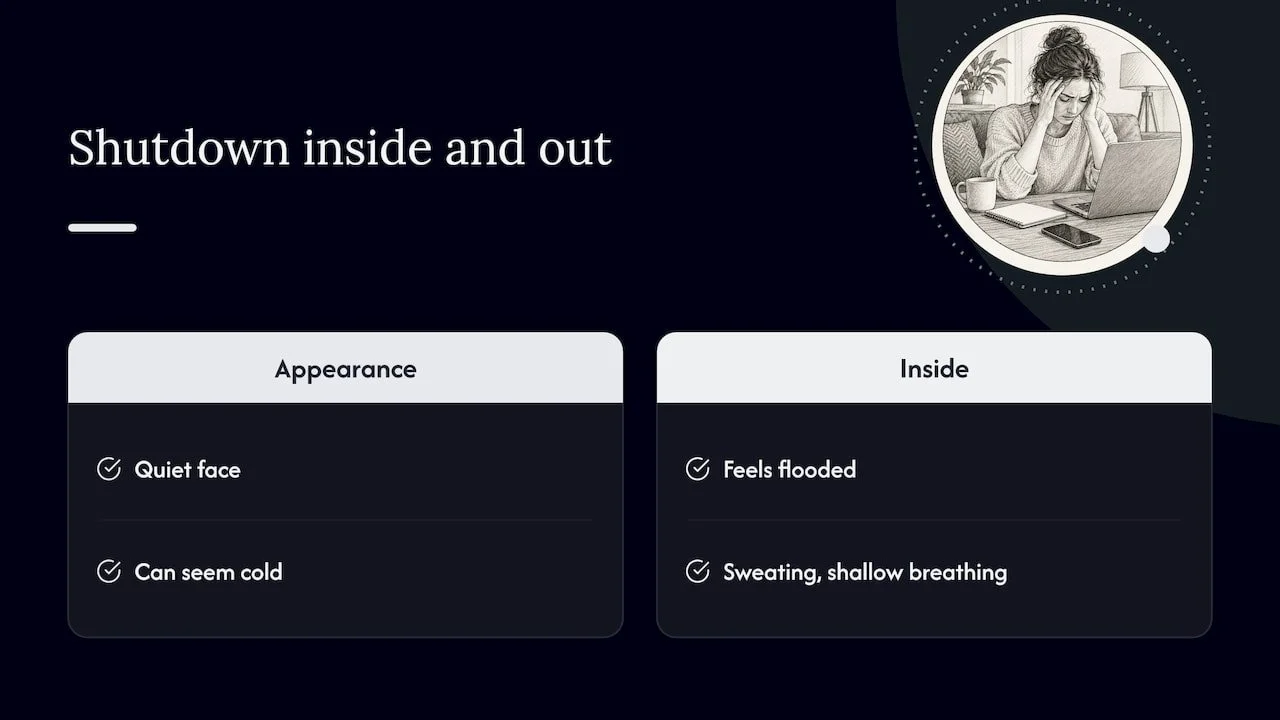
From the inside, shutdown is often not calm at all. Some therapists describe the experience as a body that is bracing for an emergency: sweating, shallow breathing, muscle tension and an urgent need to get away, while the thinking mind blanks out, intellectualizes or shrinks the problem to cope with overwhelming shame or insecurity. That is one clinician's description, not a measured standard, but many people recognize it.
This helps explain why a shut-down partner can seem cold while feeling flooded. The quiet face and the racing body can coexist. If you want a grounding in how early relationships shape these responses, our piece on attachment theory and how it connects to trauma and relationships covers the basics.
Why avoidant attachment shuts down in conflict
Avoidant attachment tends to form when closeness, needs or big feelings were not safely met early in life, so relying on yourself became the safest strategy. Later, conflict can trigger that old strategy. The response is often not a conscious choice. It is a deeply ingrained coping mechanism that may have developed in childhood, as Attachment Project's overview of communicating with avoidant partners puts it.
There is also a research angle. Studies of couples describe a "demand-withdraw" pattern, where one partner presses for discussion and the other disengages, avoids the topic, denies the problem or stonewalls. This pattern can lower relationship satisfaction, according to academic work on personality and relationship functioning. Notice that it takes two. The more one person pursues, the more the other withdraws, and the more the other withdraws, the harder the first pursues.
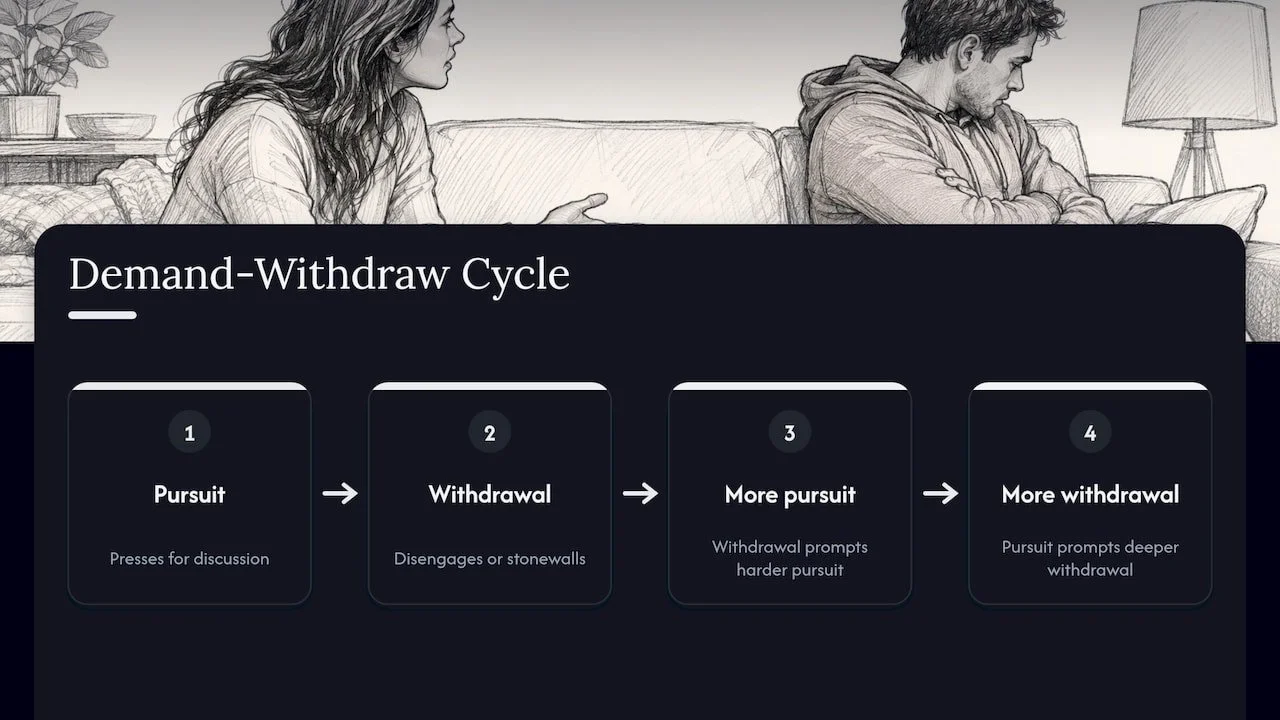
That loop is especially intense when an avoidant partner is paired with someone who has an anxious style: reassurance-seeking meets distance, and each person's coping sets off the other's fear. If you recognize yourself on the pursuing side, our practical guide to anxious attachment and dating may help you understand your half of the dance.
One more idea worth knowing: withdrawal can serve a purpose for the person doing it. It lowers the other person's ability to influence them, which can feel like a necessary defense when they sense a threat to their autonomy. Understanding that purpose does not excuse hurtful behavior, but it can turn "he doesn't care" into "he is protecting himself," which changes how you respond.
How long does an avoidant shutdown last?
There is no scientifically measured average. People describe stretches from a few hours to a few weeks, but those ranges come from lived experience, not research. What seems to shape the length is practical and fairly consistent across clinical advice:
How strong the trigger was. A small disagreement often passes faster than a conversation about commitment or a betrayal.
Pressure during the pause. Repeated texts, questions or visible distress tend to extend the withdrawal.
Whether a return time was agreed. An open-ended silence feels risky to both of you. A named time gives it edges.
Whether reconnecting feels safe. If the first moment back is a lecture, the next shutdown comes sooner.
For in-the-moment breaks, many couples therapists suggest at least 20 minutes so the body can settle, because calming down physically takes longer than people expect. Longer silences, such as days of withdrawal, are better handled by the steps below than by waiting and hoping.
What to do in the moment
The goal is not to end the shutdown by force. It is to keep both of you steady and make the way back easy.
Pause the conversation. Table it instead of pushing through. Say something short, such as "I can see this is a lot. Let's stop and come back to it."
Calm your own body first. A racing heart on your side will read as a threat on theirs. Slow breathing, a walk, cold water or any practice from our guide to self-soothing techniques that calm your body fast can help.
Write it down. Jotting your thoughts lets you set them aside without swallowing them, and gives you something clear to return with. This is among the strategies Psych Central describes for dealing with a partner who shuts down.
Do not retaliate. Going silent back, slamming doors or listing grievances feeds the loop. Staying calm, without accusing, is the whole task.
Respond with kindness, not pressure. Psychologist Mark Travers advises regulating yourself first, then offering gentle contact or a shared activity once your partner starts to re-engage, as reported in Forbes. His view is that your calm gives off safety cues that help your partner settle, while immediate analysis or confrontation on re-entry can set withdrawal off again.
Return with "I" statements. When you both feel steadier, name your experience without blame: "I felt alone when we stopped talking," rather than "You always shut me out."
How to invite your partner to talk without adding pressure
Timing and wording do most of the work. Pick a calm moment, not the middle of an argument or the first minute after a shutdown. Use a short, non-accusatory observation, then a specific request that is easy to say yes to.
A script that follows Travers's guidance: "I've noticed you're quiet. I'll give you space. Could we reconnect tomorrow evening?" Notice what it does. It names what you see without a verdict, it grants the space your partner needs, and it offers a clear time. It does not demand a full explanation.
A few more habits help:
Ask for one manageable change. "Could we sit together for ten minutes after dinner?" is easier to meet than "We need to talk about us."
Say that space is acceptable and ask for reassurance. Something like: "Take the time you need. I just want to know we're okay." Guidance from relationship platforms, such as Interpersonal's advice on what to say, points the same way: specific, low-pressure requests made during calm periods.
Agree on a signal in advance. Pick a word or gesture that means "I'm overwhelmed," a rough length for the break, and a way to reconnect afterward, such as a walk or a cup of tea together. Deciding this when things are calm means nobody has to improvise in a flood.
Keep the topic small. Tackle one issue at a time. Piling on three complaints is a reliable way to end a conversation.
If conflict in general is where things go wrong, six steps for relationship conflict resolution gives a structure you can use alongside these scripts.
What tends to backfire
Some responses feel natural and make things worse:
Chasing. Repeated calls and texts confirm the feeling that closeness equals pressure.
Punishing. Cold shoulders, sarcasm or threats to leave raise the stakes and make withdrawal feel necessary.
Diagnosing. Telling your partner "you're avoidant" in the middle of a fight turns a pattern into an accusation. Share what you've learned about attachment only when things are calm, and as something you are both curious about.
Erasing your own needs. Swallowing everything to keep the peace is not a strategy. Your needs are real, and a relationship in which only one person's comfort counts will wear you down.
Interrogating on return. The first few minutes back set the tone. Warmth and a light touch first, analysis later.
When shutdown signals something more serious
There is a line between an overwhelmed partner who withdraws and a partner who uses silence as a weapon. Deliberate stonewalling to exert control or cause harm is emotionally abusive, according to the Cleveland Clinic's guidance on stonewalling. The same source notes that counseling may help when stonewalling becomes someone's go-to way of handling difficult situations.
Questions to ask yourself:
Does the silence come with contempt, threats or humiliation?
Does it last long enough, or recur often enough, that you feel afraid to raise anything?
Do you find yourself changing what you say or do to avoid triggering it?
Has the pattern persisted even after you tried calm, low-pressure approaches?
If you answer yes to several, or you feel unsafe, talk with a licensed therapist on your own first. If you are in immediate danger, call 911. The National Domestic Violence Hotline is also available at 1-800-799-7233.
If the pattern is a stuck cycle rather than abuse, couples therapy is often the right next step. Our guides on when to seek couples therapy and how couples counseling helps conflict that keeps repeating explain what to expect, and preparing for marriage counseling walks through getting ready for the first session.
Our perspective
At Alvarado Therapy, we see shutdown as a nervous-system story before it is a character story. When someone has learned that closeness is unsafe or that their feelings cause trouble, the body steps in long before the words do. That is why insight alone, or one more "we need to talk," so often fails.
We work in a trauma-informed way, which means we ask what the shutdown is protecting before we ask how to stop it. For many people, the roots reach back to childhood or to earlier relationships. EMDR therapy is one approach we use to help the nervous system process those experiences, so that a hard conversation no longer feels like an emergency. Couples work then gives both partners a safer place to practice new patterns, with a therapist who can slow things down when the old loop starts.
We also know that culture and language shape how people show distress and ask for closeness. We offer care in English and Spanish, and we approach each person's background as part of the picture, not an obstacle to it. Whether you are the partner who withdraws or the partner who pursues, change is possible, and you do not have to wait until the relationship is in crisis to ask for support.
Juiced
Get support for the pattern, not just the argument
If you keep landing in the same silence, the most useful thing may be support that treats both the relationship and the history underneath it. At Alvarado Therapy, we offer couples therapy for partners who want to rebuild communication and trust. We also offer individual counseling and EMDR therapy for people whose shutdown or pursuit traces back to earlier trauma. Sessions are available online across California and New York, in English and Spanish.
Not sure where to start? You can book a consultation and talk through what you are experiencing. If trauma may be part of the picture, our page on PTSD and complex trauma explains how we work.
FAQ
What do avoidants do when they shut down?
They typically go quiet, turn away, avoid eye contact, leave the room or give short, closed answers. Some stay present but seem distracted or play down the issue. Inside, they may feel flooded, which is why the outside can look so flat.
How long does an avoidant shutdown last?
No research gives an average. People report anything from a few hours to a few weeks. Length tends to depend on how strong the trigger was, how much pressure the person feels during the pause, and whether you have agreed on a time to reconnect.
How do you get an avoidant partner to open up?
Lower the pressure and raise the safety. Choose a calm moment, make a short, specific request such as a particular evening together, and say that space is fine. Ask for one small change instead of a full explanation, and respond warmly when they do engage.
Is an avoidant partner shutting down the same as stonewalling?
Not always. Shutdown from overwhelm is usually a protective reflex, while stonewalling used on purpose to control or punish is considered emotionally abusive. If silence is used as a weapon or leaves you afraid to speak, speak with a licensed therapist.
Can an avoidant pattern change?
Many people shift their patterns with consistent, safe practice and, often, therapy. Because the response is usually learned rather than chosen, progress tends to come from building safety, slowly and repeatedly, rather than from willpower or ultimatums.
Sources
Personality Disorders: Theory, Research, and Treatment (2019)
How to Communicate with Someone Who Shuts Down (Psych Central)
The Best Way To Respond When Your Partner Withdraws (Forbes)
