
Relationship Conflict Resolution: 6 Steps to Fix Fights

Use these six steps to stop escalation and move toward a solution right now. Most couples don't lose fights because they're incompatible — they lose them because no one ever taught them the mechanics of arguing well. The research is clear, and the skills are learnable.
Stop escalation mid-conflict with this checklist:
Soften your startup. Begin with "I feel..." instead of "You always..." to lower your partner's defenses before the conversation gains momentum.
Name the emotion and make a specific request. "I feel dismissed when plans change last minute. I need 24 hours' notice when possible." One emotion, one ask.
Call a time-limited pause if you're flooded. Say "I need 20 minutes to calm down — I'll come back to this" rather than walking out without explanation.
Reconvene with one speaker at a time. When you return, only one person talks while the other listens. No interrupting, no counter-arguing mid-sentence.
Validate and clarify the underlying need. Repeat back what you heard and ask one question: "So you're feeling unheard — is that right?" before offering your own perspective.
Brainstorm one trade-off. Identify one area where each of you can give something small. You don't need a full solution today — one concrete step forward is enough.
Pro Tip: When asking for a break, always name a return time. "I need a break" sounds like abandonment. "I need 20 minutes and I'll be back at 8:00" sounds like repair.
Key Takeaways
Relationship conflict resolution is a learnable skill set — and the couples who repair fastest are the ones who practice these tools before they need them.
| Point | Details |
|---|---|
| Soft startup changes outcomes | Open with "I feel / I need" to lower defensiveness before the conversation escalates. |
| Pause when flooded | Take a 20–30 minute break with a named return time; self-soothe before reconvening. |
| Distinguish conflict types | Roughly 69% of couples' conflicts are perpetual — manage them, don't try to solve them. |
| Use the Bagel method | Map non-negotiables vs. flexible areas to find unexpected room for agreement on recurring issues. |
| Seek therapy for persistent patterns | Contempt, stonewalling, safety concerns, or trauma history are signals to get professional support — Alvaradotherapy offers trauma-informed couples therapy online in California and New York. |
Table of Contents
Why do couples fight? Solvable vs. perpetual problems explained
When the problem won't go away: managing perpetual conflicts
Alvaradotherapy supports couples with therapy that goes deeper
Why do couples fight? Solvable vs. perpetual problems explained
Not all arguments are created equal, and treating them the same way is one of the most common mistakes couples make. Gottman Institute research draws a sharp line between two categories of conflict: solvable problems and perpetual problems.
Solvable problems have a clear resolution. One partner wants the thermostat at 68°F, the other at 72°F. You can negotiate that. Chores, scheduling, a specific disagreement about a decision — these have workable answers.
Perpetual problems are rooted in fundamental personality differences, values, or lifestyle preferences. One partner is a spender; the other is a saver. One needs a lot of social time; the other recharges alone. The goal isn't resolution — it's management and mutual understanding.
Knowing which type of problem you're dealing with changes everything. Trying to "solve" a perpetual problem leads to gridlock. Treating a solvable problem as if it's a core values clash creates unnecessary drama.
How escalation happens in the first three minutes
Gottman findings reported by Greater Good at UC Berkeley show that the first three minutes of a conflict conversation strongly predict its entire trajectory. Start with a harsh tone or a blame-loaded opener, and the odds of a productive conversation drop sharply. Start gently, and the conversation has room to breathe.
The mechanism behind rapid escalation is flooding — a state of physiological overwhelm where your heart rate spikes, your thinking narrows, and you literally cannot process what your partner is saying. You're in fight-or-flight. At that point, no communication technique works, because the brain isn't in a state to use one.
Differing conflict styles compound the problem. Program on Negotiation research shows that egocentrism — each person's tendency to see their own position as obviously fair — distorts how couples interpret the same event. What feels like a reasonable complaint to one partner reads as an attack to the other.
Common fights mapped to conflict type:
"You never help around the house" → often a solvable problem (task division) wrapped in perpetual-problem language (feeling unvalued)
"You're too close to your family" → typically perpetual (values around family loyalty)
"We never have sex anymore" → can be either, depending on whether the cause is logistical or a deeper mismatch in desire
Core communication skills that actually work in conflict
The skills below aren't soft suggestions. They're the mechanics that determine whether a conversation produces understanding or more damage.
Soft startup: how you open the conversation
A soft startup means leading with your own experience rather than your partner's behavior. The Gottman approach, supported by evidence from the Gottman Institute's conflict guidance, is straightforward:
Template: "I feel [emotion] when [specific situation]. I need [specific request]."
Compare these two openers:
"You always make me feel like I don't matter." (harsh startup — triggers defensiveness immediately)
"I felt hurt when our plans changed without a heads-up. I need us to check in before making changes." (soft startup — describes an experience and makes a request)
The difference isn't just politeness. It's neurological. A harsh opener activates your partner's threat response. A soft opener keeps the conversation in a space where problem-solving is actually possible.
Active listening: the three-line script
Program on Negotiation research calls this "listening to learn" — the practice of asking your partner to explain their perspective, then repeating it back before you respond. Most people listen to reply. This is listening to understand.
The script:
Listen without interrupting. Let your partner finish the full thought.
Paraphrase what you heard. "So what I'm hearing is that you felt left out when I made that decision alone — is that right?"
Ask one clarifying question. "What would have felt better to you in that moment?"
That's it. You don't need to agree. You don't need to fix it yet. You just need to demonstrate that you actually heard them.
Validation without agreement
Validation is not the same as saying "you're right." It means acknowledging that your partner's feelings make sense given their experience. "I can see why that felt dismissive to you" is not a concession. It's a signal that you're present and engaged — and it directly reduces flooding in your partner.
Expressing needs with "I feel / I need" statements
The goal is to state a positive need — what you want, not what you don't want. "I need you to stop ignoring me" is a negative need. "I need 10 minutes of focused conversation when you get home" is a positive need. The second one gives your partner something to do rather than something to stop doing.
Pro Tip: Tone carries more weight than words. Research on nonverbal communication consistently shows that a calm, even voice and open body posture make partners more receptive — even when the words themselves are imperfect. If your voice is tight and your arms are crossed, a perfectly worded "I feel" statement still reads as an attack.
How to handle a conflict step by step, from start to repair
This is the full workflow. It's not complicated, but it requires both partners to agree on the rules before a fight starts — ideally during a calm moment, not mid-argument.
Step-by-step conflict process
Agree on rules of engagement in advance. Decide together: no name-calling, no bringing up unrelated past grievances, one topic per conversation, and a safe word that signals "I need a pause."
Use a soft startup. The person who raises the issue goes first with an "I feel / I need" statement.
Limit the conversation to one topic. Scope creep — piling on additional grievances — is one of the fastest ways to derail a productive conversation.
Pause if you're flooded. If your heart is racing and you can't think clearly, say the safe word or a pre-agreed phrase. Name a return time.
Self-soothe during the break. Gottman Institute guidance recommends 20–30 minutes as the minimum break, with up to 24 hours if needed, as long as a return time is agreed. Self-soothing means genuinely calming down — a walk, slow breathing, music — not rehearsing your argument.
Reconvene with one-speaker rules. NPR's Life Kit reporting on couples conflict describes this clearly: one person shares while the other listens and validates. Then switch. No interrupting.
Make a repair attempt. A repair attempt is any gesture that signals "I want us to be okay." It can be an apology, a touch, a moment of humor, or simply saying "I love you and I want to work this out."
What self-soothing actually looks like
Self-soothing is not scrolling your phone or venting to a friend. It's physiological regulation. Options that work: slow diaphragmatic breathing (4 counts in, 6 counts out), a 10-minute walk, progressive muscle relaxation, or listening to music that doesn't stoke the argument in your head. The point is to bring your nervous system down before you re-enter the conversation.
Pro Tip: Write down your main point before reconvening. Not a list of grievances — just the one thing you most need your partner to understand. It keeps you focused and prevents the conversation from spiraling again.
Common reconvening mistakes
Returning before you're actually calm (the break was physical, not emotional)
Immediately defending yourself before your partner finishes speaking
Bringing in new topics that weren't part of the original conversation
Treating the reconvening as round two instead of a fresh start
What's your conflict style, and is it working for you?
The Thomas-Kilmann Conflict Mode Instrument (TKI) identifies five distinct conflict-management styles, each defined by how much a person prioritizes their own concerns versus their partner's. None of them is universally wrong — but some are far more costly in long-term relationships than others.
Competing: High assertiveness, low cooperation. You push for your outcome. Useful in genuine emergencies or when a decision must be made quickly, but corrosive as a default in intimate relationships.
Avoiding: Low assertiveness, low cooperation. You sidestep the conflict entirely. Occasionally useful for trivial issues, but chronic avoidance creates resentment and leaves problems unaddressed.
Accommodating: Low assertiveness, high cooperation. You give in to keep the peace. Generous in small doses; self-erasing over time.
Compromising: Moderate on both axes. Each person gives something up. Efficient, but it often leaves both partners partially dissatisfied.
Collaborating: High assertiveness, high cooperation. You work together to find a solution that genuinely addresses both partners' underlying needs.
Program on Negotiation research finds that collaboration produces the most durable, relationship-strengthening agreements — specifically because it requires both partners to surface their underlying interests rather than defend their stated positions. That said, the same research notes an interesting wrinkle: complementary styles (one partner more assertive, one more inquisitive) can sometimes outperform matched styles by combining clarity with information-gathering.
Negotiation techniques that create real solutions
The Program on Negotiation at Harvard Law School identifies multi-issue bargaining as one of the most reliable tools for moving from adversarial to collaborative outcomes. In practice, this means bringing more than one issue to the table at once, which creates room for trade-offs neither partner would have found by arguing one point at a time.
Brainstorming prompts couples can use:
"What would a solution look like that works for both of us?"
"What's the part of this that matters most to you — and why?"
"What could I give you on this that would make it easier to give me what I need on that?"
Pro Tip: Reframe "positions" as "interests." Your position is what you're asking for. Your interest is why you want it. Most couples argue positions and never reach interests — which is why they keep having the same fight. Ask "what's driving that for you?" and the conversation changes.
When the problem won't go away: managing perpetual conflicts
Gottman research puts the number at roughly 69% of relationship conflicts being perpetual — rooted in personality differences that don't resolve. Gridlock is what happens when a perpetual problem becomes entrenched: both partners feel their core needs are being ignored, and every conversation about the topic ends in pain or shutdown.
The goal with perpetual problems is not resolution. It's moving from gridlock to dialogue — being able to discuss the difference without it becoming a crisis.
The Bagel method: mapping what's negotiable
The Bagel method, developed within the Gottman framework, helps couples identify which parts of a disagreement are absolute (the "hole" — non-negotiable) and which are flexible (the "bagel" — areas where movement is possible).
Each partner independently writes down their non-negotiables on the issue. These are the things they cannot compromise on without violating something core to who they are.
Each partner writes their flexible areas — things they'd prefer but could adjust.
Share and compare. Often, the non-negotiables don't actually overlap as much as each partner feared.
Identify any overlap in flexible areas and build a temporary agreement there.
Revisit the non-negotiables with curiosity, not pressure. Ask: "Help me understand why this matters so much to you." The goal is understanding, not conversion.
Example template:
| Area | Partner A | Partner B |
|---|---|---|
| Non-negotiable | Spending holidays with my family | Having at least one holiday just the two of us |
| Flexible | Which specific holidays | Where we spend them, how long we stay |
In this case, the non-negotiables don't actually conflict — they can both be honored with some scheduling creativity.
Practical approaches to living with differences
Establish a dialogue ritual. Set a monthly 20-minute check-in specifically for the perpetual issue. Keep it time-limited and low-stakes.
Honor your partner's dream. Gottman's research emphasizes that perpetual conflicts often carry a deeper personal meaning or life dream. Ask what the issue represents to your partner at a deeper level.
Small compensatory behaviors. If your partner needs more social time than you do, you don't have to match their pace — but you can make one social commitment a month that signals you value what they value.
Pro Tip: If a perpetual issue is escalating rather than stabilizing over time, that's a signal — not a failure. It often means there's an attachment wound or trauma history underneath the surface conflict. That's exactly the kind of work a trauma-informed couples therapist is trained to help with.
Red flag: Perpetual problems that involve contempt, repeated stonewalling, or safety concerns are beyond self-help territory. Those patterns need professional support.
Scripts and exercises you can actually use
These are ready to copy, practice, and keep somewhere accessible.
Short scripts
Soft startup: "I feel [emotion] when [specific situation]. I need [specific request]."
Reflective listening: "What I'm hearing is [paraphrase]. Did I get that right?"
Validation line: "That makes sense given what you've been through. I hear you."
Repair-apology script: "I'm sorry I [specific behavior]. That wasn't fair to you. What I'll do differently is [specific change]."
Safe word: Agree on a neutral word (e.g., "pause" or "yellow") that means "I'm flooded — I need a break, and I'm coming back."
Time-out token: "I'm calling a pause. I'll be back in [specific time]. I want to work this out."
Positive need statement: "I need [specific, positive request] — not because I'm angry, but because it matters to me."
Partner practice exercises
5-minute daily check-in. Each partner shares one feeling from the day and one appreciation. No problem-solving. Just connection.
Role reversal. Take turns arguing the other person's position on a low-stakes issue. It builds genuine empathy faster than most techniques.
Bagel exercise. Use the template above on a recurring conflict. Do it separately first, then share.
Conflict-readiness checklist
Use this outside of conflict to stay prepared:
We have agreed on a safe word
We have agreed on a return time after pauses
We both know the one-speaker rule
We have practiced the soft startup template
We have identified our top perpetual issue and named it without blame
We know when to call for outside support
HelpGuide's conflict resolution skills resource and Program on Negotiation's dispute-resolution skills both support practicing these skills outside of conflict — not just during it. Rehearsal is what makes them available when you're flooded.
When should couples seek therapy?
Self-help tools work well for couples who are fundamentally connected but stuck in unproductive patterns. They work less well when the conflict has deeper roots — and knowing the difference can save months of frustration.
Clinical thresholds for seeking professional support
Repeated stonewalling (one partner shuts down completely and cannot re-engage, even after breaks)
Contempt as a pattern (eye-rolling, mockery, dismissiveness — Gottman identifies this as the single strongest predictor of relationship breakdown)
Safety concerns of any kind — emotional, physical, or psychological
Persistent gridlock on core issues that isn't softening over time
Unresolved attachment injuries — betrayals, abandonment experiences, or trauma histories that keep surfacing in conflict
One or both partners has a trauma history that makes flooding more intense or more frequent
If any of these apply, knowing when to seek couples therapy is not a sign of failure. It's a sign of taking the relationship seriously.
What couples therapy actually focuses on
Good couples therapy doesn't just teach communication scripts — it addresses the underlying dynamics that make communication break down. A trauma-informed couples therapist will typically work on:
Communication patterns — identifying the pursue-withdraw or attack-defend cycles specific to your relationship
Attachment repair — addressing the moments of disconnection that have accumulated over time
Trauma stabilization — when one or both partners carries trauma that activates during conflict, EMDR or other trauma-focused approaches can reduce reactivity at the source
Conflict blueprints — building a shared framework for how the couple handles disagreement going forward
Realistic outcomes: most couples who engage consistently with therapy report improved communication and reduced escalation within 8–12 sessions. Deeper attachment work takes longer.
Questions to ask a therapist before starting
What modalities do you use with couples? (Look for: Gottman Method, EFT, EMDR, or trauma-informed approaches)
Do you have specific training in trauma and attachment?
What does a typical session look like — do you see us together, separately, or both?
What are your fees, and do you offer telehealth?
How do you handle it if one partner is more reluctant than the other?
Preparing for couples counseling before your first session makes the intake process faster and helps you get to the real work sooner. A good therapist will conduct an initial assessment, collaboratively set goals, and explain what the treatment plan looks like — you should never feel like you're just showing up and hoping for the best.
Pro Tip: If trauma is part of the picture — childhood experiences, past relationship abuse, or significant loss — look specifically for a therapist trained in EMDR or somatic approaches. Standard talk therapy can inadvertently reactivate trauma responses during conflict work if the therapist isn't equipped to manage them.
A therapist's honest take on conflict in relationships
Conflict in relationships isn't the problem. The absence of repair is. In clinical work, the couples who struggle most aren't the ones who fight the hardest — they're the ones who never learned how to come back from a fight. They accumulate disconnections, each one small, until the distance feels permanent.
What the research and the clinical work both confirm is that repair is a skill, not a personality trait. It can be practiced, strengthened, and made more reliable over time. The couples who do best aren't the ones who argue least — they're the ones who know how to find their way back to each other. That's the work, and it's entirely learnable.
At Alvaradotherapy, the trauma-informed lens matters here because many conflict patterns aren't really about the current argument. They're about older wounds that get activated by the present moment. Recognizing that distinction — between a triggered nervous system and a genuine relationship problem — is often the first thing that changes everything.
Alvaradotherapy supports couples with therapy that goes deeper
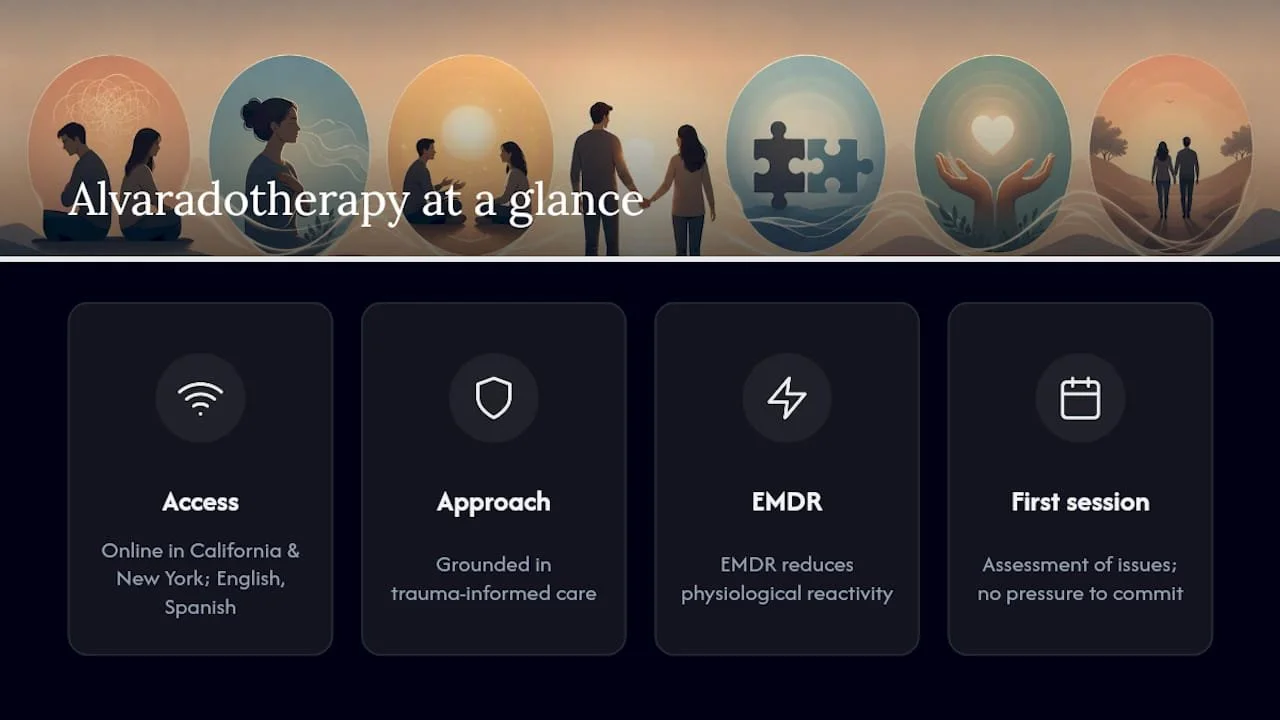
When self-help tools aren't enough, Alvaradotherapy offers online couples therapy in California and New York grounded in trauma-informed care. The practice works with couples navigating communication breakdowns, recurring conflict cycles, attachment injuries, and the kind of gridlock that doesn't respond to scripts alone.
For couples where trauma history is part of the picture, EMDR therapy can reduce the physiological reactivity that makes conflict so hard to navigate — addressing the root rather than just the surface pattern. Sessions are available online throughout California and New York, in both English and Spanish.
A first session at Alvaradotherapy starts with an assessment of what's happening in the relationship, what each partner needs, and what a realistic treatment plan looks like. There's no pressure to commit to a long-term program before you know if it's the right fit. To take the next step, schedule a consultation and find out what working with a trauma-informed couples therapist actually looks like for your specific situation.
Sources
The claims and techniques in this guide draw on the following primary research and applied resources:
Conflict resolution strategies — Program on Negotiation (daily)
Managing vs. Resolving Conflict in Relationships — The Gottman Institute
How to fight without hurting your relationship — Greater Good (Berkeley)
This article is general information, not a substitute for advice from a qualified doctor. Consult a qualified healthcare professional about your own circumstances before acting on anything here.
