

EMDR (Eye Movement Desensitization and Reprocessing) treats a phobia by working with the memories that taught your brain to fear something, rather than only practicing facing the fear. It fits best when a phobia traces back to a frightening event, such as a painful dental visit, a turbulent flight or a bad medical experience. At Alvarado Therapy, our licensed therapists offer individual EMDR therapy in California and online, in English and Spanish.
Alvaradotherapy
Explore EMDR Support for Phobias
Alvarado Therapy offers individual EMDR therapy in California and online, with licensed therapists providing care in English and Spanish.
TL;DR
EMDR for phobias is built on the idea that an intense, upsetting experience can set off a phobia, and that reprocessing those memories lowers the fear.
In a randomized trial of dental phobia, three 90-minute EMDR sessions cut anxiety and avoidance, and gains held at 12 months.
Exposure therapy is the standard first-line treatment for specific phobias. EMDR is a well-studied option when a distressing event sits behind the fear.
Treatment moves through history taking, preparation, reprocessing and future-focused work, not eye movements alone.
A therapist who knows your history can tell you whether a past event is driving the phobia and plan accordingly.
Table of Contents
What a phobia is, and where EMDR fits
What the research shows
EMDR and exposure therapy: how they differ
What EMDR for a phobia looks like, step by step
Is EMDR right for your phobia?
Weekly sessions or an intensive
Start with a conversation
FAQ
Sources
What a phobia is, and where EMDR fits
A specific phobia is a marked, lasting fear triggered by one object or situation: flying, needles, dogs, heights, dentists. The DSM-5 (the manual clinicians use to diagnose mental health conditions) describes it this way, and a review in the Journal of EMDR Practice and Research notes that recommended treatment typically uses cognitive behavioral techniques of exposure, either in real life or through virtual reality.
EMDR approaches the problem from another angle. The same review explains that EMDR for phobias rests on the hypothesis that intense emotional disruption in a particular situation can precipitate the phobia, and that processing those memories reduces symptom intensity. The review adds that EMDR can be usefully applied after careful clinical evaluation of the role stressful or traumatic events play in a person's history.
That is the key question for you: is there a moment, or a series of moments, that your fear seems to come from? If so, EMDR has a clear target. If the fear has always been there with no story behind it, a clinician can still help you choose the right approach after an assessment.
What the research shows
Dental phobia: large, lasting effects
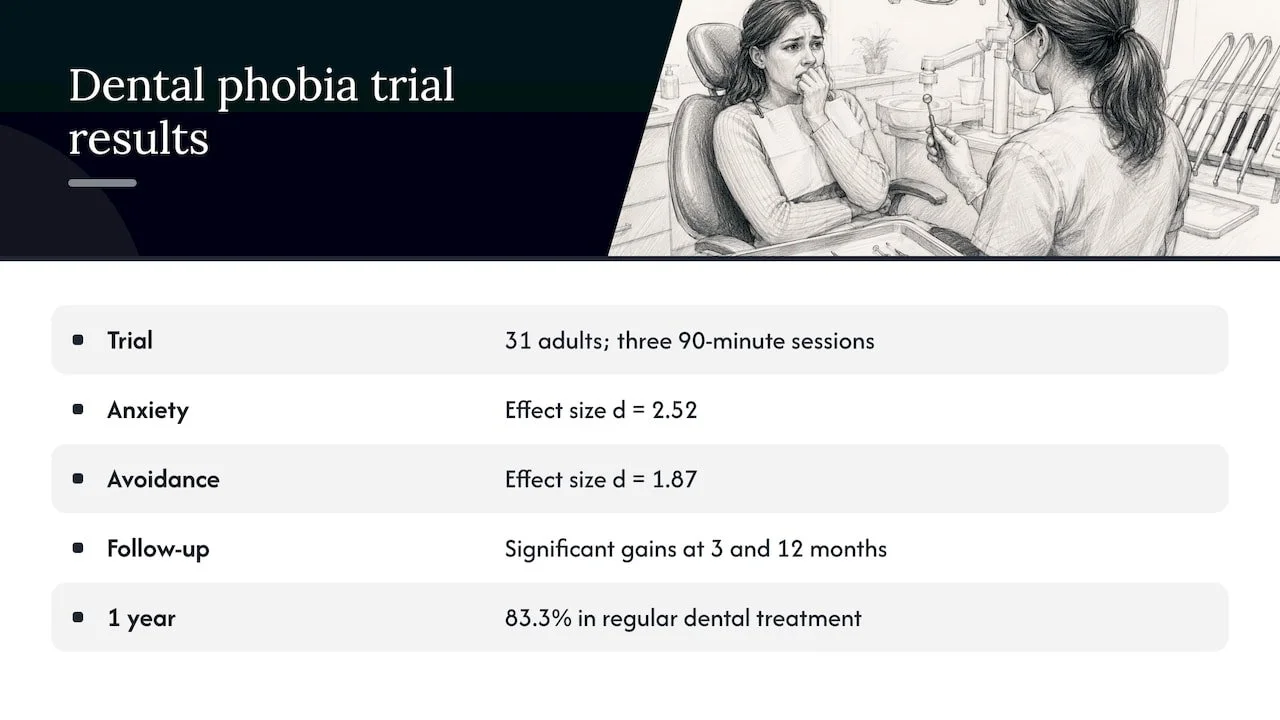
The strongest single result comes from a 2013 randomized trial by Doering and colleagues. Thirty-one medication-free adults with dental phobia received three 90-minute EMDR sessions focused on memories of negative dental events. Dental anxiety and avoidance dropped significantly, with effect sizes of d = 2.52 and d = 1.87 right after treatment (effect sizes above 0.8 are conventionally considered large). Gains were still significant at 3 and 12 months, and after one year 83.3% of the EMDR group were in regular dental treatment.
Flight phobia: as effective as the comparison treatments
In a 2015 trial of 65 people with a fear of flying, ten weekly 2-hour sessions of cognitive behavioral therapy combined with EMDR produced significant drops in flight anxiety that held at one year. According to the review of EMDR for anxiety disorders, results did not differ from CBT combined with virtual reality exposure or with systematic desensitization (a method of gradually pairing relaxation with feared images).
The overall picture
The same review counts six randomized trials between 1997 and 2017 on EMDR for adult anxiety disorders, two of them on specific phobias, with four showing positive effects on phobic symptoms. A 1999 review by De Jongh and colleagues concluded that EMDR can produce significant improvements for specific phobias in a limited number of sessions, and noted it can be useful when real-life exposure is hard to arrange. The authors also stressed that the evidence base was still small, which is why newer trials matter.
The EMDR International Association reports that peer-reviewed studies show promising outcomes for specific phobias, anxiety and panic disorders, and that guidelines from ISTSS, WHO, APA and VA/DoD recommend EMDR as a first-line treatment for PTSD. Those guidelines address trauma, which matters if your phobia grew out of a traumatic event. The APA's 2025 PTSD guideline includes conditional recommendations for EMDR in adults.
For more on anxiety broadly, see our overview of what the evidence shows for EMDR and anxiety.
EMDR and exposure therapy: how they differ
Exposure therapy is the best-documented approach to specific phobias. A 2008 meta-analysis of 33 randomized studies found exposure-based treatment produced large effects compared with no treatment, and that real-life contact worked better than other exposure formats. Multi-session treatment slightly outperformed single sessions.
EMDR research on spider phobia has been more mixed. In a controlled study of 26 spider-phobic children, real-life exposure improved every outcome measure, while EMDR improved self-reported fear only. Those were small groups and brief protocols, and they targeted a phobia that often has no single triggering event. That detail is relevant to who benefits most: EMDR's logic depends on there being memories to process.
| Exposure therapy | EMDR | |
|---|---|---|
| Core idea | Face the feared object repeatedly until fear fades | Reprocess the memories and triggers that fuel the fear |
| Best-fit phobias | Most specific phobias | Phobias linked to a distressing event or experience |
| What you do in session | Gradual, planned contact with the feared thing | Recall target memories while following bilateral stimulation, such as guided eye movements |
| Evidence | Large body of randomized trials | Trials in dental and flight phobia, plus broad trauma evidence |
The practical point: you do not have to treat these as rivals. The 2025 Oxford Handbook chapter on EMDR and phobias recommends integrating planned exposure tasks and checking for spontaneous behavior change between sessions. A good EMDR plan for a phobia often includes both.
What EMDR for a phobia looks like, step by step
The EMDR International Association's guide to standard protocols describes treatment in phases, including assessing readiness for reprocessing, preparation, assessment and desensitization. For a phobia, that tends to look like this.
History and mapping. Your therapist asks when the fear started, what the worst moments were, and what it costs you now. The goal is to find the memories feeding the phobia. Where it goes wrong: rushing past this step and targeting the wrong memory.
Preparation. You learn calming skills and what to expect, so reprocessing feels manageable. Our guide on how to prepare for EMDR walks through it.
Assessment. You pick a target, such as the memory of a dental chair, and name the image, the belief about yourself and the body sensations that come with it.
Reprocessing. You hold the target in mind while following bilateral stimulation in short sets, and report what comes up. The therapist guides, you do not have to narrate in detail.
Present triggers and the future. The Journal of EMDR Practice and Research review describes a three-pronged approach: past experiences, current triggers and the future, using flash-forwards and future templates to rehearse handling the feared situation. It reports that studies with poorer outcomes did not address traumatic memories or underlying issues.
Real-world check. Between sessions you notice how you respond to the feared situation, and the therapist plans exposure tasks if useful. Our step-by-step EMDR guide covers the phases in more depth.
At Alvarado Therapy, a licensed therapist leads this work, and you can have sessions in person or online across California.
Is EMDR right for your phobia?
EMDR is worth exploring if:
Your fear started after a specific frightening or painful event.
You have avoided something for years and your life has shrunk around it, such as medical care, travel or driving.
Your phobia comes with trauma symptoms like flashbacks, nightmares or a startle reaction.
You want a treatment that works with memories rather than only with practice exposure.
Safe use matters. EMDR brings up memories, so therapists screen for things like dissociation, current stability and support before reprocessing. Our articles on screening questions for dissociation and EMDR contraindications and how clinicians prepare explain what your clinician looks for. If you have a medical condition that the phobia affects, such as a fear of needles with diabetes, tell your physician as well as your therapist. If you are in crisis or having thoughts of harming yourself, call or text 988, the Suicide & Crisis Lifeline, or go to an emergency room.
After a session, feelings can stay stirred up for a day or two. Our first 72 hours aftercare checklist explains how to look after yourself.
Weekly sessions or an intensive
Many people begin with weekly individual sessions, which suit phobias that need gradual exposure tasks between visits. If travel, a medical procedure or work makes the phobia urgent, an intensive condenses the work into long blocks. Our published formats are:
1-Day EMDR Intensive, 4 hours in one day: $1,500
1-Day EMDR Intensive, 6 hours in one day: $2,250
3-Day EMDR Intensive: $5,750
Details are on our EMDR Intensives page.
Our perspective
We see a phobia as a learned alarm, and the alarm usually has a history. When someone tells us they cannot get through a dental visit or board a plane, we start by asking what the body remembers, because that is where EMDR does its work.
Our practice is trauma-informed, so we do not treat the fear as a flaw to be pushed through. We build safety first, then process the memories and the present triggers, then practice the future you want. We work in English and Spanish, and we care that you can describe your fear in the language you feel it in.
Whether you choose weekly sessions or an intensive, our aim is the same: a plan fitted to your history and your life.
Juiced
Start with a conversation
If a particular memory sits behind your fear, our therapists can help you decide how to treat it. You can read about individual counseling and EMDR therapy or book a consultation to talk through your goals and choose between weekly sessions and an intensive.

FAQ
Does EMDR work on phobias?
Research is encouraging, especially where a distressing event is behind the fear. A randomized trial of dental phobia found large reductions in anxiety that lasted a year, and a flight-phobia trial found EMDR combined with CBT worked as well as comparison treatments. Exposure therapy remains the most established first-line approach, and the two can be combined.
What type of therapy helps with phobias?
Cognitive behavioral therapy with exposure, either in real life or in virtual reality, is the standard recommendation. EMDR is another option when stressful or traumatic events are part of the story. A licensed therapist can assess which fits you.
What is the EMDR protocol for treating phobias?
It follows the standard phases: history taking, preparation, assessment of a target memory, reprocessing with bilateral stimulation, and work on present triggers and future situations. Flash-forwards, where you imagine handling the feared situation, are a common future-focused step.
Why is EMDR controversial?
A 2001 meta-analysis questioned whether the eye movements add anything beyond exposure to the memory. Today the discussion centers on how EMDR works rather than whether people improve, and major PTSD guidelines include it as a recommended treatment. Your therapist can explain how the approach is used in your plan.
Sources
Efficacy of EMDR Therapy for Anxiety Disorders, Journal of EMDR Practice and Research
De Jongh et al. (1999), Treatment of specific phobias with EMDR, PubMed
EMDR International Association, Recent Research on EMDR Therapy
Wolitzky-Taylor et al. (2008), Psychological approaches in the treatment of specific phobias, PubMed
A Guide to the Standard EMDR Therapy Protocols, EMDR International Association
